
You're under contract on a non-owner-occupied duplex, your lender needs a clean first position, and the seller says there's nothing owed against the property. A quick online search seems to confirm that. Then closing stalls because a charge the recorder never showed is still attached to the parcel.
That's the gap a proper check for lien on property has to close. For investors, the question isn't whether you looked. It's whether you looked in every place a claim can live, and whether you have proof you can fund against.
Where to Check for Liens and Where Self-Search Stops
Say you search the county recorder for that duplex, find only the seller's deed and one old mortgage with a release, and move ahead. Two weeks later, a city code lien and an abstract of judgment surface. Neither was in the index you searched, under the name you searched.
That outcome is common because public records are fragmented. The Lake County Recorder page reflects the wider pattern, county offices provide access to records but disclaim responsibility for guaranteeing a complete search, and Maricopa County warns its online search does not guarantee a property is free of liens and recommends a title company when a guarantee is required.
Lien Search Sources and Their Limits
| Search source | What it shows | Main limit |
|---|---|---|
| County recorder or register of deeds | Deeds, mortgages, releases and most recorded liens | Covers only documents recorded in that county |
| Court clerk judgment and bankruptcy index | Civil judgments and bankruptcy filings against owners | Often a separate index from the recorder |
| County tax collector | Delinquent property taxes and tax liens | Usually searched by parcel number, not owner name |
| California Secretary of State UCC search | Financing statements on equipment and business assets | Does not show real estate liens |
| Municipal or code enforcement office | Code violations, special assessments and unpaid city charges | Not held in county recorder records |
| Title company search | Full chain of title with recorded encumbrances | Paid service that ends in a written title commitment |
Before you trust any one result, confirm who holds title. Our guide on how to verify property ownership walks through matching the vesting deed to the person or entity selling or borrowing against the property.
What a Clean Result Actually Proves
A clean self-search proves only that you found nothing in the indexes you opened, under the names and parcel numbers you entered. It doesn't prove the title is clear. Judgment liens can sit in a court system, not the recorder. Recent recordings can take time to appear. A lien filed under a prior owner's name, a misspelled name, or an old LLC name won't show up in a current-owner search.
Practical rule: If money changes hands based on the result, a self-search is screening, not clearance.
I would stop self-searching and order professional work the moment you see an unreleased lien, a name you can't reconcile, or a gap between indexes. That stopping point matters most on fast investment closings, where speed tempts you to treat one clean screen as final evidence. It isn't.
How to Search the County Recorder Step by Step
The recorder is still the right place to start, as long as you search it like a title examiner rather than a casual browser. The checklist below shows the order that catches the most problems early.

A defensible search is a multi-index title examination, not a single lookup. The American Land Title Association title insurance overview describes professional searches examining the broader record set, while county offices warn self-searches can miss liens and may contain errors or omissions.
The Seven Steps in Order
- Pull the parcel number (APN) from the tax bill or county assessor, the legal description from the vesting deed, and the current owner's exact legal name. These three identifiers anchor every later search.
- List every prior owner who held title during the period your lender or title company requires. Liens are often filed under a seller's name, not the current owner's.
- Open the recorder index and search three ways, by APN first, then by owner name, then by property address. Each path catches documents the others miss.
- Filter for the documents that carry claims, deeds of trust, mortgages, releases and reconveyances, abstracts of judgment, notices of lien, mechanic's liens, federal tax liens, and assignments.
- Log every hit in a reconciliation sheet with recording number, recording date, amount, debtor name, property description, and whether a release is recorded against it. Unmatched items stay open until proven closed.
- Check every name variation before dismissing a hit, middle initials, misspellings, trust names, and LLC names. Indexing follows the name on the document, not the name you expected.
- Save the index results and recorded documents with their recording stamps. Screenshots without stamps don't help a title officer clear an exception.
The short video below shows how those index searches look in practice before you hand anything off.
The common slip is searching only the current owner's name. That misses liens filed under earlier owners, which can still attach to the property. Finish with a short list of open items and unresolved name variations to hand to a title officer. That handoff list, not a pile of printouts, is the useful output of a self-search.
Reading Lien Types and Who Gets Paid First
Finding a lien doesn't tell you if you have a problem. A seller's existing mortgage that's being paid off at closing is routine. A small tax lien with statutory priority can be the main blocker. The question that decides your money is who gets paid first, and whether the claim survives the transfer.
Common Lien Types and What Decides Their Priority
| Lien type | Typically filed by | Priority concern |
|---|---|---|
| Deed of trust or mortgage | Lender financing the property | Recording date sets its place in line |
| Federal tax lien | IRS after an unpaid federal assessment | Generally must be paid or subordinated before a sale or refinance |
| Property tax lien | County or city tax authority | Can be superior by statute and survive a transfer |
| Judgment lien | Creditor who won a court judgment | Attaches to property once recorded in that county |
| Mechanic's lien | Unpaid contractor or supplier | May relate back to when work began, ahead of later loans |
| HOA assessment lien | Homeowners association | Priority depends on state law and the governing documents |
| Code enforcement lien | City or county | Often must be paid before the property transfers |
Recording order is the starting rule. The IRS lien priority guidance describes the general federal rule as "first in time, first in right," while noting federal tax liens often don't gain priority over certain creditors until a Notice of Federal Tax Lien is filed, and it identifies exceptions called "superpriorities."
Statutes can override recording order entirely. North Carolina law on property tax lien priority states certain property tax liens are superior to other claims and are not defeated by a later transfer, death, receivership, or bankruptcy. Paying off the recorded mortgage doesn't touch a claim like that.
Say a fix and flip project starts in March, your loan records in May, and an unpaid contractor records a mechanic's lien in July. In many states that lien relates back to when work began, which can put the contractor ahead of your May loan. That's why mid-project funding needs lien waivers, not just a fresh recorder search.
When a senior claim needs to move behind a new loan instead of being paid off, that rearrangement has its own document. Our explainer on what a subordination agreement does covers when lenders accept that structure.
A payoff letter shows what someone will accept. A recorded release is what actually clears title.
California Properties Need UCC and Fixture Checks
Say the title on a small California retail building looks clean, but the walk-in coolers, HVAC units, and built-in shelving were financed separately. Those items can carry their own claims, and a recorder-only search focused on the land can leave them unresolved.
Fixture Filings in the County Records
A fixture security interest can be created through specific language in a deed of trust or mortgage, or through a separate fixture filing. The California Department of Real Estate reference book states both must be recorded in the county where the property is located, and a fixture filing generally remains effective for five years, extendable by a continuation statement filed before expiration for another five years.
Check any fixture filing you find for four elements. It should identify the goods that are or will become fixtures, include the property's legal description, state that the goods are fixtures, and confirm the filing will be recorded in that county. A filing missing the legal description is a question for your title officer, not something to wave through.
The Secretary of State UCC Search
Equipment and business assets that aren't fixtures sit in a different system. The California Secretary of State UCC program serves as the central filing office for certain Uniform Commercial Code financing statements, and its system supports debtor searches, filing inquiries, and certified copies.
- Search the exact entity name as it appears on the deed and the state filing, character for character.
- Search former names too, because a renamed LLC can leave active filings under the old name.
- Order certified copies of any active filing that touches collateral your deal depends on.
A UCC filing perfects a security interest in identified collateral and helps establish priority if the borrower defaults or enters bankruptcy. For a non-owner-occupied property with business assets attached, I'd run both searches every time. The recorder covers the property. The UCC search covers what's inside it.
When to Order a Professional Title Search
Order professional work when the cost of being wrong exceeds the fee, which on a funded investment loan is almost always. Four triggers make it nonnegotiable, liens with unclear releases, recent construction or renovation, owners who've used several names or entities, and any deal where your funding depends on a specific lien position.
The checklist below contrasts what each type of search can and can't deliver.
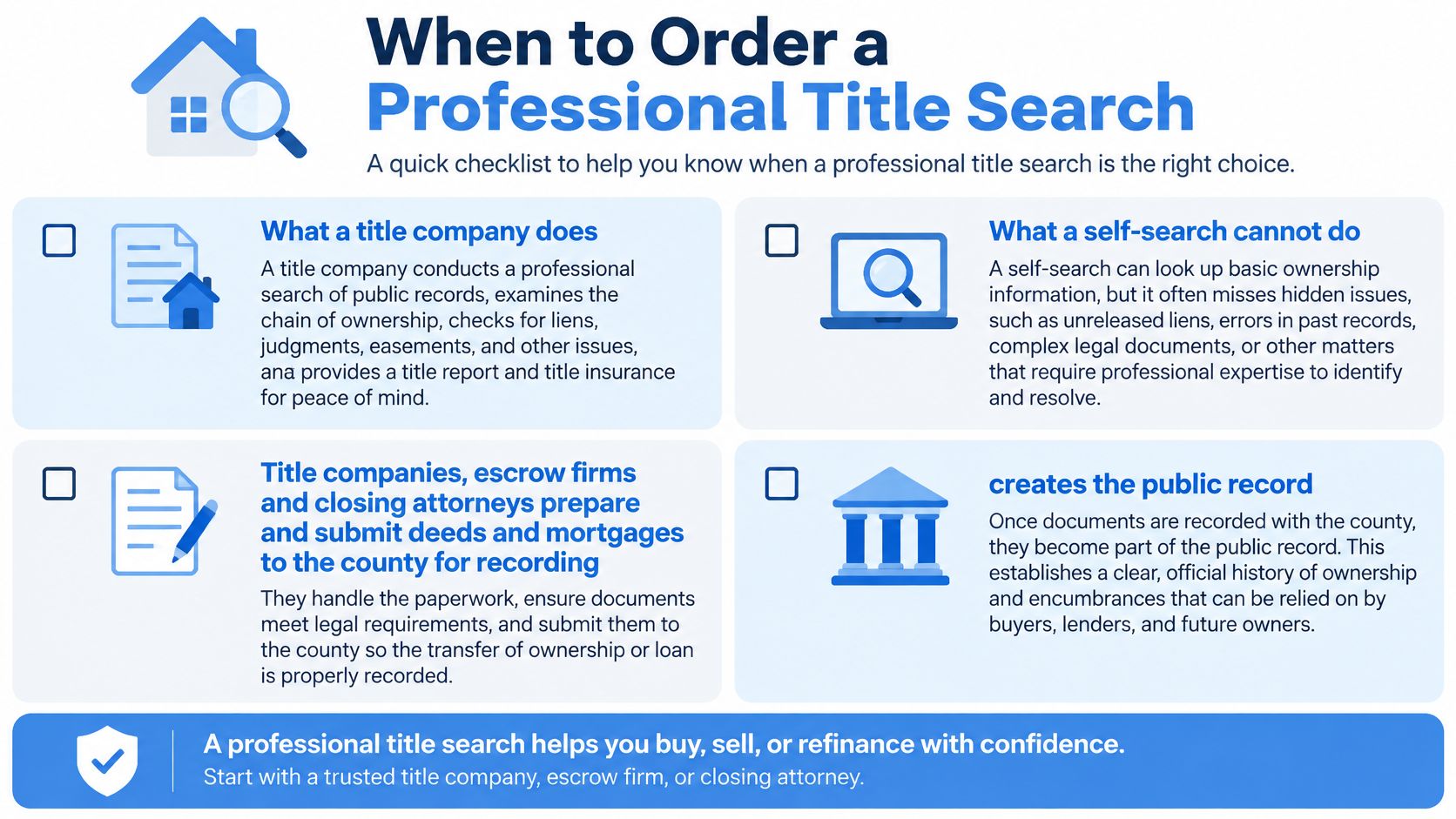
Title companies work from the same public record they help create. The Consumer Financial Protection Bureau closing guidance explains settlement providers submit deeds, mortgages, and transfer documents to the county registrar for recording, and that lender's title insurance is usually required for a mortgage loan, with title service fees commonly including the title search charge and the lender's title insurance premium.
A conventional title search examines the chain of title plus recorded mortgages, judgments, tax claims, and other encumbrances before insurance is issued. Unpaid judgments and taxes can affect ownership or a lender's security interest, which is why that examination comes first. When the commitment arrives with exceptions you don't understand, a legal review of property title reports from Tanner Law can help you sort routine exceptions from claims that need clearing before closing.
Before funds move, confirm this list in writing.
- Identity match: Borrower's legal name, property address, and parcel number agree across every document.
- Ownership chain: No unexplained gaps or transfers in the vesting history.
- Priority positions: Every existing lien is ranked, with payoff figures current.
- Recorded releases: Prior liens show recorded satisfactions, not just payoff letters.
- New loan position: Your documents will record in the intended priority spot.
Decide Your Next Step When a Lien Turns Up
A discovered lien isn't automatically a dead deal. It's a work item with a specific exit, and each type has a different one.
- Recorded mortgage with a current payoff. Plan for payoff from closing proceeds, then confirm the release or reconveyance records. Don't close the file on the payoff letter alone.
- Federal tax lien. The IRS guidance on federal tax liens and home sales states the lien generally must be satisfied before a sale or refinance, and with sufficient equity it's commonly paid from closing proceeds. If the sale price is below the lien amount, the taxpayer may request an IRS discharge to permit the sale, or request the lien become secondary to a refinancing lender's lien under approved conditions.
- Mechanic's lien. Get a recorded release or lien waiver from the contractor. On recently renovated property, ask the closing attorney to confirm appropriate steps were taken so subcontractors can't assert claims after you close.
- Property tax or code enforcement lien. Pay it, or build the full amount with penalties into the payoff figures before closing. These charges attach to the property, so they become yours if they survive the transfer.
Then apply one rule. If open items can't be cleared before your target closing date, hold the deal rather than fund over an unresolved position. A short delay costs days. A junior position you didn't price for costs real money.
If a traditional bank won't move at your timeline on a non-owner-occupied purchase or refinance, we can review the scenario with the title picture included. Our Loan Pre-Qualification tool matches a scenario to lenders in seconds, with no commitment required. We also text customers to request loan documents such as pay stubs, bank statements, tax returns, or identification, and send confirmations when documents are received, so title and loan paperwork move together instead of in separate threads.
Before your next closing date arrives, get the lien picture confirmed and your financing lined up in parallel. LendingXpress works with investors on non-owner-occupied bridge, fix and flip, and rental property financing when traditional banks can't move fast enough. Bring us the property, the payoff figures, and your target date, and we'll map a loan structure that fits the title you have.