
A property can pay every month on time and still fail to qualify for a new permanent loan when the old loan comes due. That gap is why commercial real estate bridge loans exist. The loan buys time, but time only helps when there's a real plan to raise income, sell, bring in equity, or refinance before the next maturity.
Why Investors Need a Short Commercial Loan Now
A commercial real estate bridge loan is short-term financing on a non-owner-occupied property that fills the gap between acquisition, renovation or lease-up and a permanent loan or sale. It isn't a loan for a home you live in. It's for investment and commercial property where the business plan, not today's income, explains why the deal should work.
The maturity map below shows why so many owners are facing that gap at once.

When the due date arrives before the property is ready
Say you own a small apartment building. Tenants are paying, the roof is new, and you're current on the loan. The loan still matures this year, and the lender can require full repayment on that date. Walker & Dunlop's summary of Mortgage Bankers Association data notes about $875 billion of the approximately $5.0 trillion in outstanding U.S. commercial mortgages was scheduled to mature in 2026, followed by another $652 billion in 2027.
That's the core problem. A maturity isn't a reward for good payment history. It's a deadline. If rates are higher, values are lower, construction isn't finished, or occupancy is still short of stabilized, a permanent lender may not lend enough to pay off the old balance.
Think of a bridge as a temporary span between two permanent roads. You're not moving onto the span. You're crossing it to get to lease-up, renovation, a sale, or a bank refinance on the other side.
Why permanent lenders don't always fill the gap
Different lenders are built for different lengths of road. Historical Federal Reserve research on loans originated from 2012 through 2017 found banks primarily originated loans with terms under 10 years and generally favored floating-rate structures, CMBS lenders most often issued 10-year loans, and life insurers disproportionately originated loans longer than 10 years, according to the same Walker & Dunlop summary.
- Loan size matters less than timing. A loan can be modest and still create trouble if it matures before income stabilizes.
- Floating-rate exposure matters. If the rate can move, your monthly carry can move too.
- Milestones matter. A lender wants to know what changes during the short term, such as new leases or finished repairs.
- The exit matters most. Refinance, sale, or extension has to be credible, not hoped for.
Practical rule: Don't ask whether a bridge loan is available. Ask what will be different on the day it comes due.
Use the next parts of your review in that order. Check the typical term, check loan structure, then run the exit test. That sequence prevents the most common mistake, borrowing short-term money for a property that has no clear way to repay it.
Typical Terms Next to a Permanent Loan
A bridge loan is short transitional debt, not a mortgage you hold for a decade. The Federal Reserve Bank of Richmond discussion of commercial real estate describes typical maturities of approximately six months to three years. Because amortization may run longer than the term, you may pay little principal during the loan and face a large balloon payment at maturity.
That structure changes how you should compare offers. You're not buying the lowest monthly payment for the next ten years. You're buying time, and you need to know the full price of that time.
Bridge loan terms versus permanent commercial debt
| Feature | Commercial bridge loan | Permanent bank or agency loan |
|---|---|---|
| Typical term | About 6 months to 3 years | Often 10 years or longer; qualifying standard no earlier than 10 years |
| Rate style | Usually floating and priced above permanent debt | Fixed or longer-term structures common at CMBS and life companies |
| Leverage reference | Bank supervisory limits up to 80% construction and 85% improved property; private lenders may differ | Qualifying threshold often 65% LTV and 70% combined LTV, or 60% and 65% |
| Repayment shape | Limited principal paydown and a large balloon | Fully amortizing over up to 25 years, or 30 years for qualifying multifamily |
| What gets tested | Exit by sale, refinance, or extension, plus collateral and reserves | Current income, long amortization, and occupancy that already supports the payment |
| Speed | Can be days when collateral and the exit are clear | Often weeks to months of full bank underwriting |
Walk the table in order. Term tells you how much time you have. Rate style tells you whether carry can rise. Equity requirement tells you how much equity you may need. Repayment shape tells you whether the balance shrinks or waits for you at the end.
The permanent side is stricter than many borrowers expect. The federal qualifying commercial real estate loan rule identifies thresholds of no more than 65% LTV and 70% combined LTV, or 60% LTV and 65% combined LTV in an alternative appraisal scenario. It also assumes fully amortizing payments over no more than 25 years, or 30 years for qualifying multifamily loans, with maturity no earlier than 10 years after origination.
A market reference helps too. CBRE's report on first-quarter 2024 U.S. non-agency commercial real estate loans reported average LTV of 62.3%, average underwritten capitalization rate of 6.0%, and average debt yield of 9.8%. Debt yield is net operating income divided by the original loan amount. It asks a simple question. How much income supports each dollar of debt, without relying on a hopeful value?
What to request on every quote
Don't compare one headline rate to another and call it diligence. Pricing is set deal by deal, so review your broader commercial real estate financing options and ask every lender for the same items in writing.
- Rate and index: Is the rate floating, what index does it follow, and is there a floor or cap?
- Origination fee: What do you pay to start the loan?
- Extension fee: What does extra time cost if lease-up runs late?
- Exit fee: What do you pay when you repay or refinance?
- Interest reserve size: How much carry is set aside, and is it inside or outside the loan?
- LTV basis: Is the amount measured against current value, completed value, or total project cost?
A cheap bridge loan with a thin interest reserve can cost more than a higher-priced loan that gives the business plan enough room to finish.
Now use the table for three quick estimates. First, estimate your equity in. Second, estimate the interest reserve you'll need if income is slow. Third, write down the balloon you'll owe at maturity. Then stress the exit with a higher exit cap rate and weaker income, not the best-case value.
If the refinance only works when everything goes right, it doesn't work yet. Lower the loan amount, add equity, shorten the business plan, or reconsider the purchase price before you sign.
Deals That Fit a Bridge and Deals That Do Not
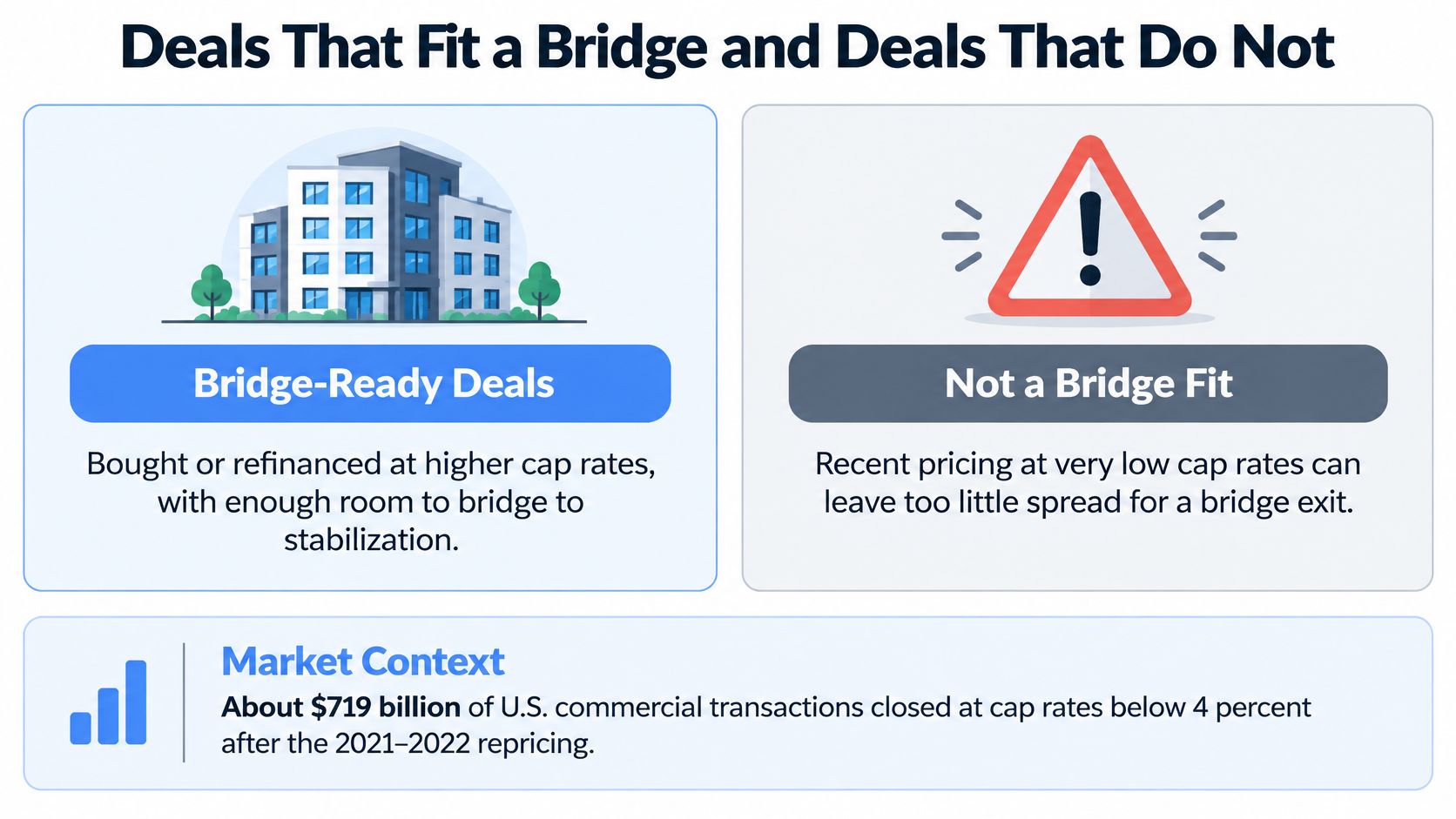
The recent need for bridge debt didn't appear by accident. CommercialSearch's analysis of the repricing after 2021 and 2022 reports approximately $719 billion in U.S. commercial real estate transactions closed at capitalization rates below 4% during those two years, nearly twice the combined volume of comparable transactions during the entire preceding decade. Multifamily and industrial assets accounted for about 93% of that total, and more than 76% of the 2021 to 2022 vintage transactions were financed with floating-rate debt.
That mix explains the squeeze. Low entry yields left little income cushion, floating coupons reset faster than many rents could rise, and values were marked down before the old loan reached maturity. The property could still be collecting rent and still fail the refinance test, because the next lender sizes proceeds from income, debt yield, and remaining term rather than from a clean payment history.
Good fits have a finish line
A bridge fits a time-sensitive purchase of a non-owner-occupied asset when the buyer cannot wait for full bank underwriting. It also fits value-add property where renovation or lease-up should lift income, and a maturity that arrives a little before stabilization. In each case, the repayment event has a name: a signed lease, finished units, higher collected rents, a sale contract, or a permanent loan sized from better income.
A weak fit sounds different. The plan is to wait for the market, hope rates fall, or refinance later at roughly the same income. Extra time only helps when it changes the inputs a permanent lender will measure. If debt yield stays thin and maturity gets closer, more months add carry without adding exit strength.
Bank access also is not uniform across property types. The Federal Reserve's Senior Loan Officer Opinion Survey reported banks modestly eased standards for multifamily loans, while standards for construction and land-development and nonfarm, nonresidential loans remained unchanged. A stabilized apartment deal and a land deal should not start with the same assumption about where the first quote comes from.
Which funding path fits the property
| Situation | Better first stop | Why |
|---|---|---|
| Stabilized multifamily with durable income | Bank or agency permanent loan | Recent Fed survey results showed multifamily standards modestly eased |
| Construction or land development | Bridge or more sponsor equity | Standards for construction and land were essentially unchanged |
| Transitional office, retail, or nonresidential | Bridge sized to the lease-up plan | Permanent lenders want income that already covers a long loan |
| Value-add rehab before rents stabilize | Bridge with controlled draws | The business plan is the collateral story, not today's NOI |
| Maturing loan with weak refinance proceeds | Bridge only if the exit is credible | Extra time does not repair value or debt yield by itself |
Speed does not remove the homework. A faster lender still needs reserves, interest carry, tenant rollover details, insurance, draw controls for renovation, and a written permanent-loan exit. Clean documents matter more when the clock is short, because there is less room to explain gaps after the file is already moving.
Before you proceed, name the milestone that must be true before the balloon. It might be a signed lease, a target occupancy, finished units, higher collected rents, or a sale contract. If you cannot state that milestone in one sentence, the deal is not ready for short-term debt.
When a Current Property Still Cannot Refinance
Here's the question borrowers ask most often. The property isn't delinquent, so why did the bank say no? The short answer is that paying this month and supporting a new loan large enough to repay the old one are two different tests.
The flow below shows how a property can pass the first test and fail the second.

Current doesn't always mean refinanceable
Trepp's analysis of 2026 private-label CMBS hard maturities reported $76.6 billion scheduled to reach hard maturity in 2026, with 39% concentrated in the fourth quarter and 36% with debt yields at or below 8%, a level associated with greater refinancing friction. Most striking, 97% of the $1.30 billion maturing with debt yields below 6% was still performing.
Read that slowly. Owners were paying, yet the income was thin compared with the loan balance. A permanent lender sizing a new loan doesn't just ask whether last month's payment cleared. It asks whether today's income can support enough new debt to take out the old debt, with cushion.
Two measures drive that decision. Debt yield divides net operating income by the loan amount, so it tests income against debt without depending on your preferred cap rate. DSCR, the debt service coverage ratio, is net operating income divided by annual debt service. It tests whether income covers the actual payment, including interest and required principal.
How proceeds shrink even when rent arrives
Follow the chain with a simple scenario. Say NOI slips because a tenant leaves or expenses rise. At the same time, buyers and lenders use a higher exit cap rate, which produces a lower value from the same income. Lower value supports a smaller loan. Weaker NOI also lowers debt yield and DSCR, which can shrink the loan again.
The result feels unfair if you've never missed a payment. Rent is coming in, but the new loan offer is smaller than the balance you need to repay. The gap has to come from somewhere: added sponsor equity, a partial paydown, a sale, supplemental capital, or higher income before maturity.
A current loan proves you can handle the old payment. It doesn't prove the property can borrow enough to replace the old loan.
That's why permanent lenders look for cushion in debt yield and cap rate assumptions. They want room if income dips or rates stay high. A bridge lender looks at the same math and asks whether your plan closes the gap before the short term ends.
When a bridge helps and when it postpones
A bridge helps when it funds a specific change. Lease-up after renovation can raise NOI. Finishing vacant units can improve DSCR. A prepared sale can repay the balance without needing permanent proceeds. Fresh equity can reduce debt to a level a bank accepts.
A bridge postpones when nothing material changes. If you borrow for another short stretch at the same thin debt yield, with no new leases, no paydown, and no sale process, the same refusal will be waiting at the next maturity, only with more interest paid.
Protect yourself with conservative sizing. Document stabilized NOI with leases and collections, not just a pro forma. Size the refinance at a higher cap rate and weaker coverage than your base case. If a gap remains under that stress test, plan the equity now instead of discovering it at maturity.
How Private Lenders Underwrite the Borrower
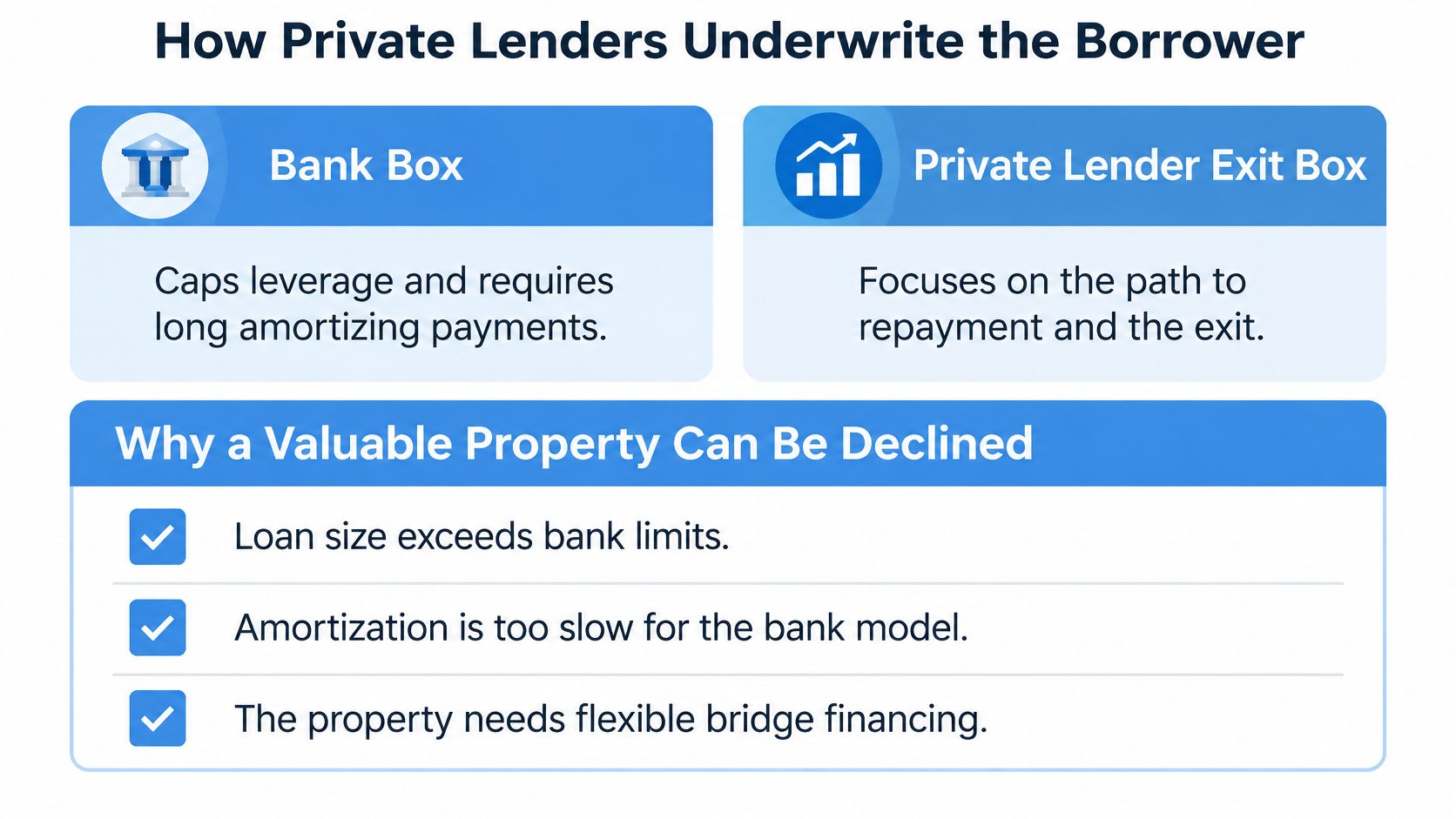
A bank decline doesn't always mean the property is bad. It often means the request doesn't fit the bank's permanent loan box. Loan-to-value caps, long amortizing payments, and established income requirements can reject a sound asset that needs time or repairs.
The comparison below shows the shift in focus from a bank box to a private lender's exit box.
Start with the value behind the LTV
Federal banking guidance gives you a useful reference point. The FDIC's real estate lending section lists supervisory loan-to-value limits of 80% for commercial, multifamily, and other nonresidential construction loans, and 85% for improved property. It gives the example that a property valued at $2 million under an 80% construction benchmark would support up to $1.6 million before other underwriting factors.
Private lenders may structure loans differently, but the question underneath is the same. Which value sets the LTV? Current value, completed value, and total project cost can produce three different loan amounts. That choice often matters more than a small difference in rate.
You can review the main points of commercial real estate underwriting before you submit a file, then ask the lender to state the sizing basis on the term sheet. Don't assume the highest value is the one being used.
What a private lender still needs to see
A private or hard money lender can often work around issues that stall a bank, such as a prior foreclosure, a thin credit file, or income that doesn't arrive as W-2 wages. That flexibility is for investors and developers of non-owner-occupied property, not owner-occupants. Flexibility doesn't mean the file can be vague.
- Purchase contract or payoff statement: Shows what the loan must accomplish and by when.
- Rent roll and leases: Shows current income, vacancies, and tenant rollover risk.
- Renovation budget: Shows scope, cost, schedule, and who controls draws.
- Insurance and reserves: Shows the property is protected and you can carry interest.
- One-page exit: Names refinance, sale, or extension, with dates and fallback steps.
- Lien and filing history: Helps confirm other claims on the borrower or business. It can help to trace a debtor's UCC filing history before closing so old filings don't surprise title or underwriting.
Common declines are plain. There's no repayment plan. Reserves are too thin to cover interest if rent is late. The loan amount is too high relative to today's value. The renovation budget has no draw control, so money could go out faster than work gets done.
Plain test: Could a stranger read your exit page and explain how the loan gets repaid, without calling you for the missing steps?
Faster closing increases the need for these documents. The lender has less time to guess, so your file has to answer the obvious questions up front. Bring a clear payoff plan, monthly carry you can support, and cash reserves that match the schedule.
Two Deals That Show the Real Loan Size
Headline loan amounts can mislead you. A approval for a large number doesn't mean that full amount is cash you can spend on day one. These two non-owner-occupied investment examples show why sizing basis, reserves, and draw limits matter.
Example one shows the equity left in the deal
Take a single property valued at $2 million. Under an 80% construction benchmark, the simple sizing check supports up to $1.6 million before reserves, interest, and other tests. The sponsor still brings equity, and the $1.6 million shouldn't be treated as $1.6 million available for repairs.
That's the first lesson. Loan proceeds may need to cover purchase price, closing costs, interest reserve, taxes, insurance, and controlled renovation draws. If you spend the whole mental budget on acquisition, the deal can run short before the business plan creates income.
Ask a blunt question on every term sheet. After the interest reserve and required holdbacks, how much cash is available for the property, and when?
Example two shows draws, maturities, and as-complete value
A larger development example makes the moving parts clearer. The FDIC banking example of acquisition, development, and construction financing pairs an acquisition-and-development loan of $4.8 million with a $2.4 million construction revolving line for a 48-lot project. Both loans had three-year maturities and an interest reserve, the acquisition facility represented 75% loan-to-value based on a $6.4 million as-complete value, and the revolver funded up to 12 units at a time, limited to the lesser of 80% LTV or 100% of costs.
Notice what's doing the work. The acquisition loan isn't sized only by today's dirt value. It's tied to as-complete value. The revolver isn't an open checking account either. It funds a limited number of units at a time, and each draw must pass both a value test and a cost test.
Worked loan sizing figures
| Facility | Sizing basis | Key limit |
|---|---|---|
| Example 1: single property | 80% construction benchmark | Up to $1.6 million on a $2 million value before other tests |
| Example 2: acquisition-and-development loan | 75% LTV on $6.4 million as-complete value | Three-year maturity with interest reserve |
| Example 2: construction revolver | Lesser of 80% LTV or 100% of costs | Up to 12 units funded at a time on a 48-lot project |
Use the same questions on your own deal. What value does the LTV use? How many units, phases, or draws can be outstanding at once? Is interest reserved inside the loan, and does that reserve reduce money available for work? What happens to proceeds if as-complete value slips?
There's also a risk note borrowers skip. If lease-up or lot sales miss the milestone, don't expect an automatic extension on the same terms. Expect a possible resize, added equity, faster sale effort, or tighter draw controls. The lender will protect the exit, because the exit is the loan.
Close this exercise with three lines on paper. Write current value, completed value, and cash left after the interest reserve. If those three numbers don't support the plan with room to spare, reduce the loan request before a lender does it for you.
Test the Exit Before You Request Terms
Borrow only if at least one exit still works after a harsher exit cap rate, higher interest, and slower lease-up. That rule sounds strict, but it's cheaper than learning the answer at maturity.
Run three exits, not one hope
- Permanent refinance: Use stabilized NOI you can document, apply a higher exit cap rate, and confirm the new proceeds pay off the bridge balance plus closing costs. If they don't, write down the equity gap now.
- Asset sale: Use a price a buyer could pay under current cap rates, subtract selling costs, and allow realistic time on market. A sale that must close in the final month isn't a plan.
- Extension: Price the extra interest and fees if the milestone slips, and ask what conditions the lender will require. Extra time should be a fallback, not the base case.
If none of the three works, add equity or wait. Don't use a bridge loan to outrun math that fails in every direction.
This check catches the main bridge risks early. Floating-rate carry can rise while income is still building. A balloon can arrive with no takeout loan. A renovation can run past the term and leave you paying for time instead of progress.
Mitigation is practical. Size reserves to the full term, not the optimistic schedule. Put the payoff plan in writing. Tie renovation draws to completed, inspected work. Keep the permanent lender or broker involved early enough that refinance standards shape your lease-up targets.
Our Bridge Loans provide flexible financing for quick acquisitions or refinancing, secured by residential or commercial properties, for non-owner-occupied investment deals that don't fit a bank timeline. We've originated over $558M in loans, and most loan approvals are handled in just 24 hours, but those process points don't replace your three exit tests.
If your exit, value, and reserves are already sketched, send the loan request with the rent roll, budget, and payoff or purchase documents attached. Treat any pricing estimate as information rather than a commitment, and remember the loan is for non-owner-occupied investment property, not a home you live in.
If your non-owner-occupied commercial deal needs short-term capital for a quick acquisition, refinance, renovation, or stabilization, and your exit still works under a stressed test, talk with LendingXpress about a bridge structure built around that exit. Send the property details, requested loan amount, reserves, and your refinance or sale plan so the first conversation can focus on whether the numbers support repayment.