
Hard money loans use standardized, asset-based underwriting and typically fund in 5 to 14 days, while private lenders rely on relationship-driven, negotiable terms that may offer more flexibility. The right choice depends less on the label and more on your project's timeline, draw schedule, and ability to repay before maturity.
You've found a non-owner-occupied property with potential, but the seller won't wait through a conventional bank process. Maybe the property needs work, your income documentation doesn't fit a bank's model, or the deal only works if you close quickly. In that situation, the question isn't just whether you need a hard money loan or a private lender.
The better question is: which underwriting structure gives this specific deal the best chance of closing and surviving the exit?
| Decision factor | Hard money loan | Private lender |
|---|---|---|
| Underwriting | Standardized and collateral-first | Relationship-driven and deal-specific |
| Funding speed | Typically 5 to 14 days | Flexible, but timing depends on the lender and process |
| Terms | Rate sheets and defined programs | Negotiable terms set case by case |
| Best fit | Fast acquisitions, fix-and-flips, bridge needs | Bespoke capital stacks and unusual situations |
| Main risk | Short maturity and higher carrying cost | Inconsistent process or unclear expectations |
Understanding the Core Difference Between Hard Money and Private Lenders
A buyer has a signed contract on a distressed rental property. The bank likes the borrower's credit profile, but it doesn't like the property's condition, the short closing deadline, or the borrower's plan to renovate before refinancing. A hard money lender may evaluate the collateral, projected value, budget, and exit instead of waiting for the full conventional approval process. A private lender may take a different route, asking more questions about the investor's experience, relationships, reserves, and broader plan before negotiating terms.
That distinction explains the practical difference in a hard money loan vs private lender decision. Hard money lending is a defined lending method, usually delivered by private capital. Private lending is a broader category that can include an individual, family office, or small investment group funding a deal directly. In other words, many hard money lenders are private lenders, but not every private lender operates with a hard money lender's standardized process.
Hard money loans are short-term, real-estate-secured loans funded by private investors, private investment groups, or specialized lenders rather than banks and credit unions. Approval focuses primarily on collateral value, especially for non-owner-occupied investment properties, while borrower income and credit may receive less weight than they would in conventional financing. This overview of hard money loans for real estate investors provides useful context on the collateral-first structure.
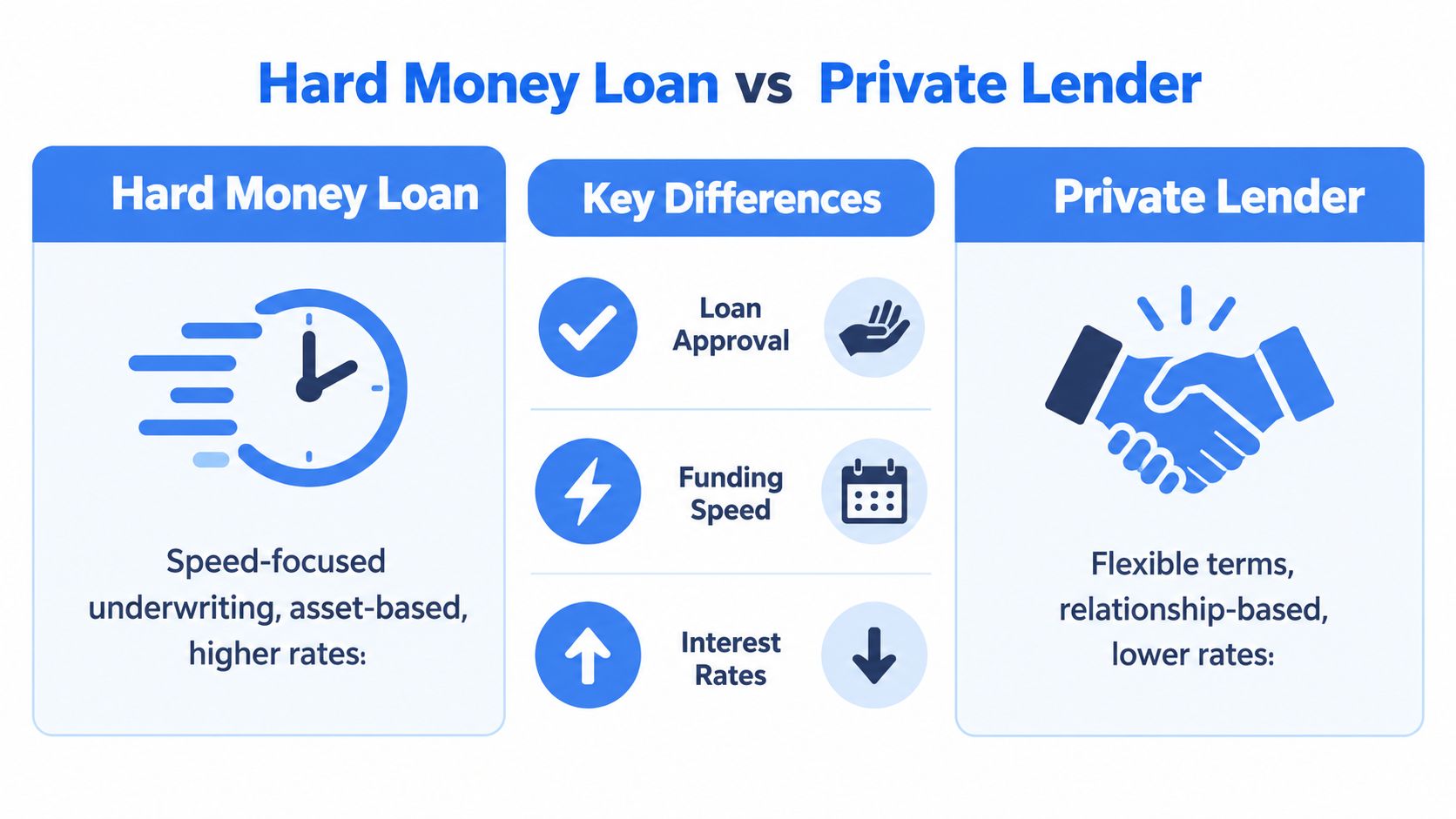
Why the structure changes the outcome
Hard money works well when the deal is easy to explain. The property has a defensible value, the renovation scope is clear, the loan amount fits the lender's limits, and the exit is realistic. A standardized process can reduce negotiation time and make the lender's decision more predictable.
Private money can work better when the deal needs customization. You might need a particular draw arrangement, a longer maturity, cross-collateralization, or a repayment structure that doesn't fit a standard program. That flexibility can help, but it can also create uncertainty if the lender has no clear underwriting checklist or closing process.
Historical industry accounts trace hard money's modern U.S. terminology to the Great Depression, when bank failures pushed borrowers toward real-estate-backed private capital. The market later moved from informal, collateral-only lending toward a more institutionalized private-lending segment that still considers asset value but may also evaluate experience and exit strategy. The history of private lending and its hard money origins explains that evolution.
For investors comparing options, the practical test is simple: choose standardized speed when the deal is time-sensitive and straightforward, and choose negotiable structure when the property or exit requires a custom solution. You can also review what a hard money loan involves before requesting terms.
Private transactions also require proper documentation. A written promissory note and deed of trust should clearly establish repayment obligations, collateral, default remedies, and other terms. Investors working through a California transaction may find drafting promissory notes in CA useful when coordinating the legal documents behind private real estate financing.
Comparing Rates, Terms, and Underwriting Criteria
The price of capital matters, but it shouldn't be the first number you compare. A lower rate paired with slow draws, a short maturity, or an expensive extension can cost more than a higher-rate loan that closes on time and supports the project properly.
For commercial real estate, reported hard money terms commonly cluster around 9% to 14% interest, 60% to 80% LTV, and 6 to 36 month maturities. Private money terms are more bespoke, with reported ranges of roughly 8% to 15% interest, 50% to 75% LTV, and 6 to 60 month terms. These ranges come from commercial real estate hard money lending benchmarks, and they should be treated as market reference points rather than a guaranteed quote.
What the lender measures
Hard money underwriting usually starts with the property. The lender reviews the as-is value, projected after-repair value, purchase price, construction budget, title, insurance, and exit strategy. The borrower still matters, but the property and the deal structure carry the central weight.
Industry guidance commonly sizes hard money loans at about 60% to 75% of as-is value, or around 65% to 70% of projected after-repair value for fix-and-flip transactions. Some lenders hold renovation funds back and release them through staged draws after work is completed and inspected. This explanation of hard money loan sizing and rehab draws outlines why lenders use value-based limits.
Private money underwriting can include the same property analysis, but the lender may negotiate around the numbers based on trust, experience, liquidity, and the overall relationship. One private lender may accept a lower LTV for a longer term, while another may prioritize a strong borrower history and offer a different draw arrangement. This comparison of hard money and private money lenders describes private money as more relationship-driven, with rates, LTV limits, and repayment schedules set deal by deal.
How to compare offers properly
Review the full term sheet, not just the interest rate. Check:
- Initial LTV basis: Is LTV based on as-is value, purchase price, cost, or projected value?
- Rehab funding: Are construction funds available at closing or released in stages?
- Draw timing: What inspection triggers a draw, and how quickly does the lender release it?
- Maturity: Does the term match a realistic sale or refinance timeline?
- Extension economics: What fees or rate changes apply if the exit takes longer?
- Payoff terms: Is there a prepayment penalty or minimum interest requirement?
A private lender may offer a lower rate, but that isn't automatically the better deal. A hard money lender may charge more while providing a defined process that lets you close, begin work, and manage the project without repeatedly renegotiating the loan.
For investors looking for a relationship-driven capital source, private money lending options for investment properties can be evaluated alongside standardized hard money programs. The useful comparison is always the complete cost and execution plan.
Key Decision Criteria for Real Estate Investors
Start with the closing deadline. If the seller expects a fast settlement and the property requires immediate action, a hard money lender's standardized process may be the safer operational choice. Private money can move quickly too, but the timeline depends heavily on the individual lender's availability, documentation, and decision-making process.
Next, test the loan size against the property rather than against your hopes. Ask the lender whether the limit is tied to as-is value, after-repair value, or total project cost. A loan that looks generous on the purchase price may leave you short on renovation funds, closing expenses, or carrying costs.

Four questions that expose the real terms
Ask how draws work. Find out whether rehab funds are held back, what completion evidence the lender requires, and how long a typical draw takes. A contractor can't maintain momentum if each funding request creates an avoidable delay.
Ask what happens after maturity. Don't accept “we can probably extend” as a financing plan. Get the extension process, fees, rate changes, notice requirements, and approval conditions in writing before closing.
Ask how the lender evaluates the exit. For a flip, that means reviewing the resale assumptions, comparable properties, marketing plan, and buffer in the budget. For a rental acquisition, it means showing how the property will stabilize and how you intend to refinance or hold it.
Ask about the payoff mechanics. Confirm whether the loan is interest-only, whether there's a minimum interest period, and whether early repayment triggers a penalty. These details can materially change the project's net result.
Practical rule: Choose the lender whose process you can execute, not the lender with the most attractive headline term.
A hard money loan often fits a clean, repeatable deal where speed and predictable underwriting matter most. A private lender may fit a complex transaction where the capital stack, collateral package, or maturity needs negotiation. Either way, the lender should understand that the property is strictly an investment asset, not an owner-occupied home.
Ideal Use Cases for Bridge, Fix and Flip, and Rental Properties
A fix-and-flip usually rewards speed and process discipline. The investor needs to acquire the property, fund the renovation, complete the work, and sell before interest and holding costs erode the spread. Hard money is often a practical fit because lenders commonly understand renovation underwriting and can structure staged draws around construction milestones.
The draw schedule deserves more attention than it receives. If the lender releases all rehab funds only after substantial work is complete, the investor may need enough liquidity to pay contractors before reimbursement. If inspections are slow or draw requirements are vague, even a profitable project can lose momentum.
Bridge financing presents a different challenge. A commercial or residential bridge loan may support an acquisition while the asset is repositioned, leased, repaired, entitled, or refinanced. Hard money can provide the necessary speed, particularly when a conventional lender won't finance the property in its current condition. Private money may be better when the bridge requires a custom maturity, multiple collateral assets, or a negotiated release structure.
Match the lender to the project
For a time-sensitive acquisition, focus on:
- Execution speed: Can the lender review the property and issue terms quickly enough for the contract?
- Collateral acceptance: Will the lender finance the asset's current condition and property type?
- Closing certainty: Does the lender have a defined process for title, valuation, insurance, and documentation?
For a renovation project, prioritize:
- Draw mechanics: Are the release stages aligned with your contractor's payment schedule?
- Budget review: Does the lender understand the scope, contingencies, and permits?
- Exit timing: Does the maturity leave room for final work, marketing, and closing?
For a rental acquisition, private lending can offer more flexibility when the property needs stabilization before long-term financing. A hard money loan may still be appropriate as a short bridge, but the investor must identify the refinance path before borrowing.
Private lenders financed 16.4% of investor single-family home purchases during the period from July 1, 2025 through June 30, 2026, according to recent private lending market coverage. That figure reflects the importance of private capital for investor purchases, but it doesn't mean every private lender is suitable for every property.
The strongest match comes from aligning the loan with the project's bottleneck. Use hard money when the bottleneck is speed and standardized execution. Consider private money when the bottleneck is structure and the deal needs a lender willing to negotiate beyond a standard program.
Mitigating Risks When Exit Strategies Fail
The most dangerous assumption in short-term real estate financing is that the sale or refinance will happen exactly when the original schedule says it will. A contractor may uncover hidden work, permits may take longer, buyers may negotiate harder, or appraisal values may not support the planned refinance. The loan still reaches maturity even when the project doesn't reach its exit.
Market conditions have made this risk more visible. National gross returns on fix-and-flip deals fell to roughly 25.1% in the second quarter of 2025, while another industry review reported average time to flip of about 164 days nationally. Coverage of hard money and private lender risks discusses why investors should examine extensions, fees, rate increases, and maturity consequences before signing.
Build the failure plan before closing
Start by asking what happens if the property hasn't sold at maturity. A lender may offer an extension, but the extension could require a fee, a higher interest rate, updated valuation, proof of progress, or a new underwriting decision. Private lenders may negotiate more readily, but flexibility isn't guaranteed unless the documents support it.
Then examine the renovation contingency. Staged draws can protect the lender and control the use of funds, but an underfunded budget can leave the borrower unable to finish the work. Confirm whether the lender will consider a revised budget, how change orders are handled, and whether unused funds can be redirected to a necessary repair.
Your exit plan should include more than one path:
- Primary exit: Sale after completion, supported by realistic pricing and marketing assumptions.
- Secondary exit: Refinance into rental or commercial debt if the property can support it.
- Extension plan: Written conditions for additional time, including all fees and rate changes.
- Capital reserve: Available funds for delays, interest, insurance, taxes, and cost overruns.
Ask this before you sign: “If the property isn't sold or refinanced at maturity, what exactly happens on the next day?”
Hard money lenders may apply a more formal default process because their loans follow standardized documents and underwriting rules. A relationship-based private lender may communicate more informally, but informal communication won't replace written rights and obligations. Treat every private loan as a professional transaction, with a properly documented note, security instrument, payment schedule, and default procedure.
Don't optimize for the lowest rate if the loan has no practical room for delay. The better structure may include a realistic maturity, transparent extension terms, disciplined draws, and an exit that doesn't depend on a perfect market. Those features protect both the property and your ability to continue investing after one project takes longer than expected.
Why LendingXpress Is a Reliable Partner for Your Next Deal
Investors often need a lender that can evaluate the property and the plan without forcing the deal into a conventional bank process. LendingXpress is a California-based private and hard money lender for real estate investors whose transactions don't fit traditional financing. The firm is headquartered in Orange County and structures bridge, fix and flip, and rental property loans secured by residential and commercial assets.

Typical loan sizes range from $100,000 to $18 million+, and closings can occur in as little as three days when the transaction, documentation, valuation, title, and borrower information are ready. The application process is efficient, and underwriting uses a common-sense review with conservative LTVs rather than treating every investor like a conventional owner-occupied mortgage applicant.
That structure is relevant when the main obstacle is timing. A non-owner-occupied bridge acquisition may require a quick response, while a fix-and-flip borrower may need renovation proceeds released through staged draws. LendingXpress can finance up to 100% of rehab costs, subject to the deal's underwriting, property, and repayment structure.
What to review with a lending partner
A useful lender conversation should address the complete project:
- Property type: Residential or commercial collateral and its current condition.
- Capital purpose: Acquisition, bridge financing, renovation, rental stabilization, refinance, or cash-out.
- LTV: Conservative LTV and the relationship between current value, projected value, and total cost.
- Draw process: Required inspections, release stages, documentation, and timing.
- Exit: Sale, refinance, or another clearly supported repayment strategy.
- Contingency planning: Extension terms and the response to budget or market changes.
The firm's experienced loan officers tailor terms to specific investment goals, which can be useful when a transaction needs more judgment than a standard rate sheet provides. That doesn't eliminate the borrower's responsibility to validate the numbers. You still need a defensible valuation, a realistic budget, adequate reserves, and an exit that works under less favorable conditions.
LendingXpress also works with investors pursuing bridge, fix and flip, rental, and commercial financing for non-owner-occupied properties. The right starting point is a complete deal package, including the property address, purchase terms, scope of work, budget, requested loan amount, timeline, and planned exit.
See how LendingXpress approaches the difference between these financing structures before you request terms.
If your transaction needs speed, compare the lender's actual closing process with the contract deadline. If it needs flexibility, compare the extension language, draw mechanics, and payoff terms rather than relying on the words “private” or “hard money.” That comparison will tell you whether the proposed financing supports the project or merely gets it to closing.
LendingXpress offers private and hard money financing for non-owner-occupied bridge, fix and flip, rental, and commercial properties, with typical loan sizes from $100,000 to $18 million+ and closings in as little as three days. Review your property, draw schedule, and exit strategy with a LendingXpress loan officer by visiting LendingXpress.