
You've found an off-market property with a purchase price that looks attractive, and the seller wants a quick close. Your contractor has a rough renovation estimate, but the lender asks for an actual plan. You send a thin spreadsheet, the assumptions don't explain the resale value, and the opportunity goes to another buyer with clearer funding.
That situation happens because a house flipping business plan isn't just a formality. For a non-owner-occupied project, it's the document that lets a lender judge whether you can acquire the property, complete the work, control the timeline, and repay the loan through a credible exit. Speed matters, but speed without disciplined underwriting creates problems for everyone involved.
The U.S. flipping market has always moved in cycles. ATTOM's historical data reaches back to January 2000. In 2005, flippers completed 338,207 single-family homes and condos, representing 8.2% of all home sales, while flips still represented 5.7% of sales in 2016. The market reached roughly 441,000 flipped homes around 2022, then declined to 297,045 in 2025, the lowest annual total since 2020, according to ATTOM's historical home-flipping data. Your plan must therefore account for liquidity, competition, and buyer demand, not only construction skill.
A lender-ready plan puts the deal in a straightforward order: market, acquisition, scope, budget, financing, schedule, and exit. The following framework is built for investors purchasing non-owner-occupied residential or commercial property, especially borrowers who need flexible capital when a conventional bank can't move fast enough.
Introduction Why Your House Flipping Business Plan Decides Funding
A promising flip can fail before construction starts if the financing package leaves basic questions unanswered. The lender needs to know why this property fits your strategy, how the purchase price was established, what the renovation includes, and how the completed property will be sold or refinanced.
The plan also has to separate gross profit from net profit. A resale spread can look healthy before interest, closing costs, taxes, insurance, utilities, selling expenses, and renovation overruns. If those costs aren't visible, the projected return is probably overstated.
Non-owner-occupied financing receives closer scrutiny because the property isn't your primary residence. Lenders commonly evaluate the borrower's credit, liquidity, experience, property condition, financing structure, contractor plan, and repayment strategy together. Many non-owner-occupied mortgage programs cite minimum credit scores around 620 to 680, down payments of 15% to 30%, and cash reserves of 6 to 12 months or more, depending on the lender and transaction, as summarized by non-owner-occupied mortgage guidance.
What a thin plan misses
A weak plan often contains an address, an estimated resale value, and a renovation number copied from a contractor's first visit. It doesn't explain which sold comparables support the ARV, whether the scope includes permits, how long the property will be held, or what happens if the listing sits longer than expected.
A stronger plan answers those questions before the lender has to ask them. It identifies the borrower's role, the project manager, the contractor, the acquisition criteria, the budget controls, and the fallback exit. The lender can then focus on the actual risk instead of reconstructing the deal from scattered documents.
Lender perspective: A fast closing only helps when the underwriting file is clear enough to support a fast decision.
What this plan needs to prove
Your document should show that you can:
- Buy with discipline: Establish a maximum purchase price from conservative resale evidence and complete project costs.
- Manage the work: Match the scope to a qualified contractor, realistic milestones, and documented draw requests.
- Protect liquidity: Maintain enough capital to handle delays, change orders, and additional carrying costs.
- Exit credibly: Explain whether the property will be listed for resale, refinanced into a rental loan, or supported by another repayment strategy.
That's the difference between a template and a funding document. The template records intentions. The funding document gives the lender a defensible basis for approval.
Building Your House Flipping Business Plan Foundation
A lender-ready plan has a clear hierarchy. Start with the business and market, then move to the property, financials, and risks. Don't bury the deal under pages of generic mission statements. A lender wants to understand what you buy, where you buy it, how you improve it, and how the capital comes back.
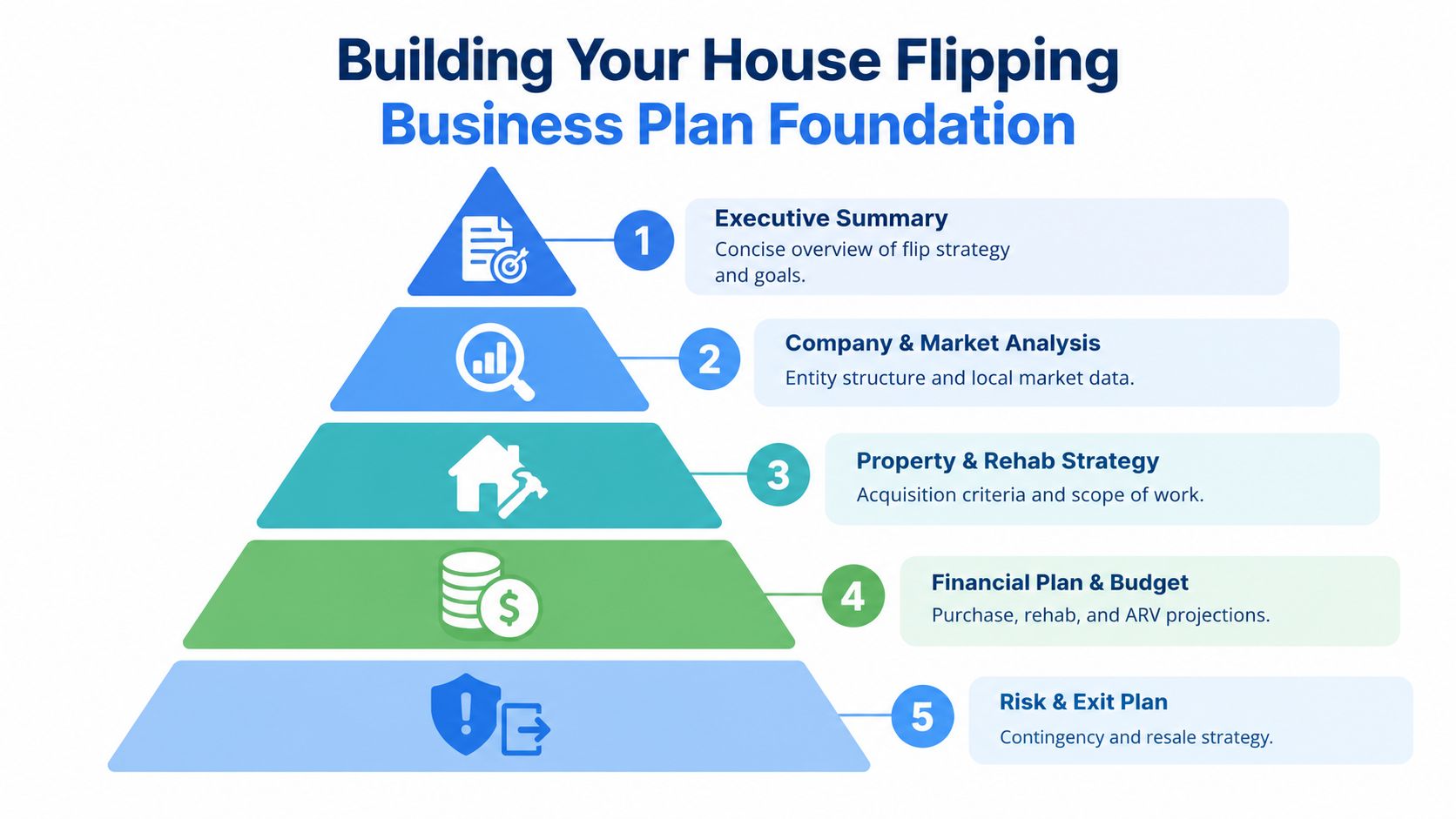
Start with the executive summary
Write this page after you've completed the rest of the plan. It should identify the entity, the principals, the target property, the requested financing, the renovation strategy, the expected exit, and the borrower's relevant experience.
Keep the language direct. “We acquire distressed single-family homes in selected Orange County neighborhoods, renovate them for owner-occupant resale, and use short-term non-owner-occupied financing” tells the lender more than a broad statement about creating value through real estate.
Include the facts that support confidence:
- Your acquisition area and property type.
- Your responsibility for acquisitions, construction, and sales.
- The contractor and real estate professionals assigned to the project.
- The requested loan amount and intended use of proceeds.
- The planned resale or refinance exit.
- The risk controls that protect the budget and schedule.
Define the company, market, and buy box
The company section should explain the entity structure, ownership, operating history, and decision-making responsibilities. If you're new to flipping, don't disguise that fact. Explain the experience your team brings, such as construction management, real estate sales, property management, or prior investment ownership.
Your market analysis should focus on the neighborhoods where you can make informed decisions. Review recent sold properties, active competition, buyer preferences, property condition, and the finishes that move homes in that submarket. Your buy box should then narrow the opportunities by location, property type, condition, acquisition price, renovation scope, and exit buyer.
Explain deal flow and operations
A lender should see how opportunities reach you and how you screen them. Describe your sources, initial property review, inspection process, comparable-sales analysis, contractor walk-through, title review, and maximum offer approval.
Your operations section names the people who perform the work. The acquisition lead finds and prices deals. The project manager controls the schedule. The contractor completes the scope. The agent handles the resale. The bookkeeper tracks actual costs against the pro forma.
For a more disciplined approach to projections, review this resource on financial forecasting that is not a lie. The useful lesson is simple: forecasts should expose assumptions instead of hiding them.
Practical rule: If a lender can't identify who owns each major decision, the plan isn't finished.
Budgeting and Pro Forma That Protects Your Profit
The pro forma is where an attractive property either becomes financeable or falls apart. Build it from the total project cost, not from the difference between your purchase price and optimistic ARV.
ATTOM reported that the typical flip in 2025 produced a $65,981 gross profit and a 25.5% gross ROI, down from $77,000 and 32.1% in 2024, as reported in the 2025 U.S. Home Flipping Report coverage. ATTOM also reported that the typical Q2 2025 flip produced $65,300 in gross profit and a 25.1% ROI, while Q3 2025 declined to $60,000 and 23.1%, according to ATTOM's year-end flipping report. Those are gross figures before financing, closing, taxes, and renovation overruns.
Build the cost stack
Start with the purchase price, then add every cost required to deliver and sell the finished property:
- Acquisition costs: Purchase price, inspections, title work, lender fees, and purchase closing charges.
- Rehab costs: Demolition, framing, roofing, plumbing, electrical, HVAC, windows, cabinets, flooring, paint, appliances, exterior work, permits, and final cleanup.
- Carrying costs: Interest, insurance, utilities, property taxes, security, lawn care, and other expenses during ownership.
- Selling costs: Agent compensation, staging, photography, seller closing charges, concessions, and repairs requested during escrow.
- Contingency: A separate reserve for hidden damage, material changes, permit issues, and schedule slippage.
The renovation budget needs useful detail. “Interior rehab” doesn't help a lender test the plan. Break the work into trades and phases, then compare contractor pricing with your own estimate. A specialized tool such as Exayard plumbing estimating software can help organize plumbing quantities and labor assumptions when that trade represents a meaningful part of the scope.
Example pro forma
ATTOM reported a median Q2 2025 flip purchase price of $259,700 and a resale price of $325,000, leaving a gross spread of $65,300 before project expenses, as documented in HousingWire's report on the 2025 flipping market. The example below uses those figures to show why a lender won't treat the spread as take-home profit. The rehab, holding period, financing, and sale expenses must fit inside it.
| Cost Category | Example Amount | Notes |
|---|---|---|
| Purchase price | $259,700 | Median Q2 2025 flip purchase price |
| Resale price | $325,000 | Median Q2 2025 resale price |
| Gross spread | $65,300 | Before rehab, financing, closing, and selling costs |
| Rehab budget | Project-specific | Use a trade-by-trade scope and contractor bids |
| Carrying costs | Project-specific | Model the full hold period, not only the target schedule |
| Financing costs | Project-specific | Include interest, points, lender fees, and draw-related costs |
| Closing and selling costs | Project-specific | Include resale charges, staging, concessions, and agent costs |
| Contingency | Project-specific | Reserve for overruns and schedule slippage |
| Net profit | Project-specific | Calculate only after every cost above |
The resale value should come from sold comparables, not active listings. Adjust for location, size, layout, condition, lot, parking, and finish quality. If your renovation produces a home that competes with higher-priced properties, explain precisely why. Don't assume a premium because the finishes are new.
Use the LendingXpress fix and flip loan calculator to test purchase, rehab funding, interest, and the effect of a longer hold. Then run a downside case with a lower resale price and additional months of carrying costs.
Budgeting takeaway: Build the contingency before the renovation starts. A reserve added after the budget breaks isn't a risk-control strategy.
Financing Options for Non Owner Occupied Flip Projects
The financing choice affects your purchase price, timeline, cash requirement, and exit flexibility. A conventional investment loan may work for a stable property with limited renovation, but it often struggles with distressed assets, incomplete scopes, and competitive offers that require rapid execution.
Conventional investment property financing is commonly limited to roughly 75% to 80% LTV for purchases, with rate-and-term refinances often near 75% LTV and cash-out refinances around 70% to 75% LTV, according to non-owner-occupied investment financing guidelines. These loans can offer attractive pricing, but the borrower generally faces stricter property and documentation requirements.
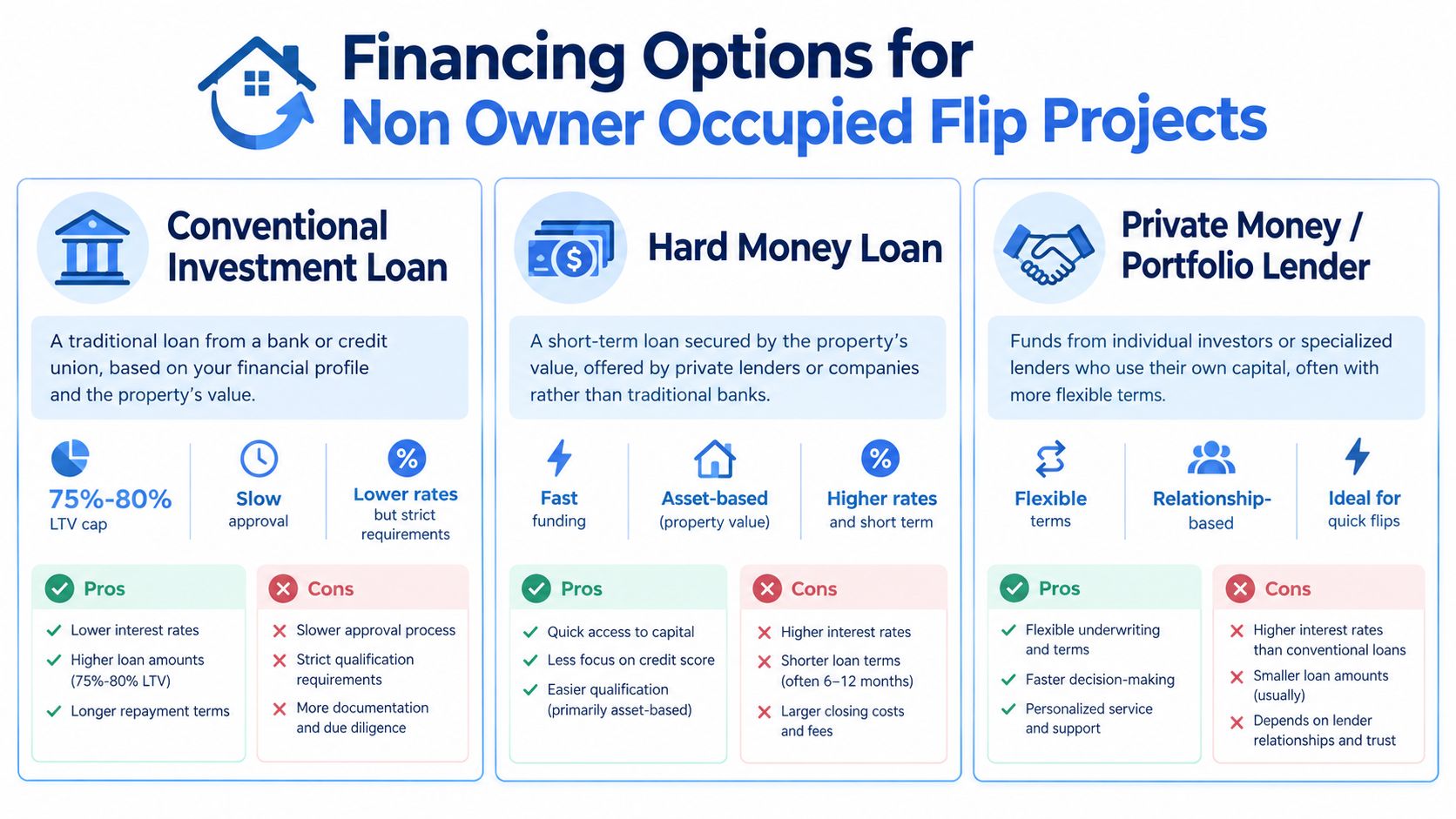
Compare the funding paths
| Financing path | Where it fits | Main trade-off |
|---|---|---|
| Conventional investment loan | A financeable property with a documented borrower profile and limited renovation risk | Approval can be slower and leverage is tighter |
| Hard money or bridge loan | A time-sensitive acquisition or substantial renovation supported by property value and a clear exit | Pricing is higher and the term is shorter |
| Private or portfolio lender | A transaction needing customized structure, relationship-based review, or unusual property considerations | Terms depend heavily on the lender and deal quality |
Hard money and fix-and-flip loans often use 80% to 85% purchase LTV, and some lenders can finance up to 100% of rehabilitation costs through loan-to-cost structures or staged draws. A 12-month term and interest-only payments are also common in this segment, according to hard money fix-and-flip financing guidance.
That structure can reduce the cash needed for construction, but it doesn't eliminate the need for reserves. You still need to cover costs the loan doesn't fund, absorb delays, and keep the project moving while draws are reviewed. The correct question isn't “Can the lender fund the rehab?” It's “Does the total structure remain safe if the work costs more or takes longer?”
A staged draw process usually requires photos, receipts, contractor invoices, and inspections before funds are released. One lender example describes draws of roughly 20% to 30% of the rehab budget per phase, with funds often released 24 to 72 hours after approval, as explained in this fix-and-flip draw financing guide.
For a broader framework on evaluating capital sources, this guide to business funding is useful when comparing debt structures and funding requirements.
LendingXpress structures bridge and fix-and-flip loans for non-owner-occupied residential and commercial assets, with loan sizes from $100,000 to $18 million or more, closings in as little as three days, and qualifying renovation financing of up to 100% of rehab costs through staged draws. If your bank can't match the acquisition timeline, a private lender can review the asset, scope, and exit using a more practical process. See how to finance investment property for the core considerations before submitting a request.
The video below provides another visual explanation of financing structures for investment projects.
Timeline Milestones Rehab Draws and Exit Strategies
A flip makes money only when the project moves through its milestones without losing control of time or cost. Your plan should show what happens after closing, who approves each stage, what documents support a draw, and when the property becomes ready for sale or refinance.
Industry compilations commonly describe cosmetic flips as taking about 3 to 4 months, moderate rehabs 4 to 6 months, and full renovations 6 to 12 months. These ranges are summarized in ATTOM's Q1 2025 flipping report coverage. Treat them as planning ranges, not promises. Permits, inspections, contractor availability, material delays, and buyer demand can extend the hold.
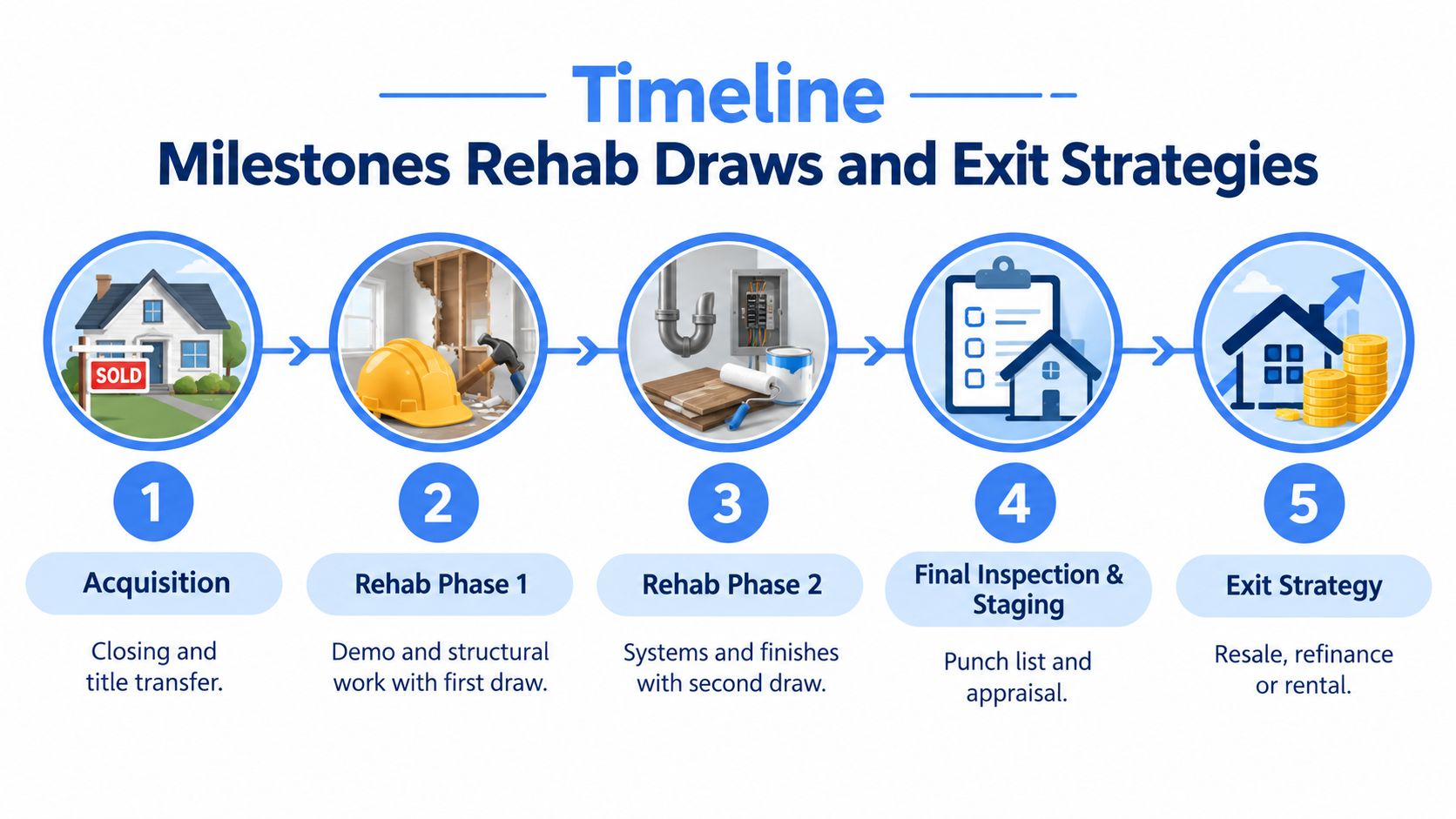
Organize the work by draw
The first draw should correspond to completed, verifiable work rather than a vague promise that construction has begun. Establish the scope, required inspections, documentation, and responsible person before closing.
A workable sequence looks like this:
- Acquisition: Confirm title transfer, insurance, permits, contractor access, and the final scope.
- Initial construction: Complete demolition, structural work, and any critical repairs before requesting the next release.
- Systems and finishes: Move through plumbing, electrical, HVAC, drywall, cabinets, flooring, paint, and fixtures with updated photos and invoices.
- Final completion: Resolve the punch list, complete inspections, clean the property, stage it, and prepare listing materials.
- Exit: List for resale, refinance into a rental loan, or use an approved extension or alternate repayment strategy.
Keep a draw file with dated photos, paid invoices, lien releases where required, inspection records, and an updated budget. The faster your team can verify completed work, the less likely funding administration becomes a source of delay.
Schedule control: A contractor's target completion date is an estimate. Your pro forma should test what happens when the estimate slips.
Choose the exit before the purchase
Resale is the usual exit for a flip, but it shouldn't be the only one in the plan. A refinance may make sense if the finished property produces acceptable rental income and the borrower wants to retain the asset. A bridge extension can provide additional time, but it can also increase interest and fees, so it should be discussed before the original term becomes urgent.
Labor and material challenges have placed more pressure on fix-and-flip execution, while investor demand remains active and some investors anticipate softer demand. HousingWire's 2025 fix-and-flip market coverage highlights why schedule slippage and resale uncertainty belong in the business plan, not in an emergency conversation after the budget is exhausted.
Risk Mitigation Tips and Your Lender Ready Pitch
A durable plan doesn't eliminate risk. It makes the risk visible, assigns responsibility, and preserves options when the original schedule or resale assumption changes.
Use a conservative ARV supported by sold comparables. Price the renovation from an itemized scope, verify the contractor's availability, and identify permit-sensitive work before you close. Model the full hold period, including the possibility that the property needs more time to sell or that a refinance takes longer than expected.
Protect the deal before closing
Your risk controls should be practical and easy to verify:
- ARV discipline: Use comparable properties that compete with the finished home instead of selecting only the highest sales.
- Contractor review: Confirm licenses, insurance, references, availability, scope interpretation, and payment expectations.
- Budget separation: Keep rehab, financing, carrying, selling, and contingency costs in separate categories.
- Draw preparation: Require photos, invoices, receipts, and inspection evidence before requesting each release.
- Exit flexibility: Document the resale plan and the conditions that would justify a rental refinance or extension.
- Liquidity planning: Maintain cash for expenses that fall outside the loan structure and for unexpected delays.
ATTOM's reporting shows the pressure clearly. Flipping ROI declined from 29.6% in 2024 to 25.1% in Q2 2025 and 23.1% in Q3 2025, demonstrating why a plan based on peak-market spreads is vulnerable, as reported in ATTOM's Q1 2025 market analysis. Gross profit is not the amount available to the borrower after all obligations.

Assemble the lender package
Keep the final submission concise and complete. Include a one-page deal summary, borrower and entity information, property details, sold comparables, contractor bids, scope of work, project schedule, sources and uses, pro forma, financing request, and exit strategy.
Your summary should make the lender's decision easier. State the purchase price, requested loan, renovation funding, projected resale, total cost, borrower contribution, and downside assumptions without forcing the reviewer to search through attachments.
A lender-ready pitch is not a sales presentation. It's a clear explanation of how the property, budget, loan, timeline, and exit fit together.
Before requesting terms, confirm that the numbers reconcile across every document. The purchase contract should match the pro forma. The scope should match the rehab budget. The draw schedule should match the work sequence. The exit value should match the comparable-sales packet.
LendingXpress offers non-owner-occupied bridge and fix-and-flip financing, including purchase and qualifying rehab funding through staged draws, with loan sizes from $100,000 to $18 million or more. Visit LendingXpress with your property details, scope of work, conservative ARV, and timeline so its lending team can review the deal and discuss terms built around your acquisition and exit plan.