
Hard money lenders commonly charge about 8% to 15% annual interest plus 1 to 4 origination points on non-owner-occupied investment property. Look at the cost table first, then turn that range into dollars for the months you'll hold the loan.
That's the part many investors miss. A rate by itself doesn't tell you what you'll pay. The useful number is total dollars over your real hold, and that number moves with financing structure, property type, and how certain your sale or refinance is. If you're asking how much do hard money lenders charge, start with interest and points, then add the smaller fees and the cost of running late.
Typical Hard Money Costs at a Glance
Budget with the broad range first. In the United States, an AD Mortgage summary of hard money pricing puts annual interest at about 8% to 15%, reflecting short terms, asset-based underwriting, and higher risk than conventional mortgages.
That same summary, citing Urban Institute data, puts residential transition-loan rates at approximately 9.5% to 11.5% in recent quarters. That tighter band is a practical benchmark for bridge and fix-and-flip deals, because those loans overlap with the renovation and investor-property work hard money usually funds.
Typical Hard Money Interest and Points
| Cost piece | Typical range | Dollars on $500,000 | Paid when |
|---|---|---|---|
| Annual interest | 8% to 15% | $40,000 to $75,000 per year | Monthly, often interest-only |
| Residential transition benchmark | About 9.5% to 11.5% | $47,500 to $57,500 per year | Monthly |
| Origination points | 1 to 4 points, often 2 to 3 | $5,000 to $20,000; 2 points is $10,000 and 3 points is $15,000 | At closing |
| Interest-only monthly example at 10% | 10% stated annual rate | About $4,167 per month | Each month the balance is outstanding |
Translate one cell before you call anyone. A 10% rate on a $500,000 balance equals roughly $50,000 of annual interest, or about $4,167 per month when interest-only. That's your carrying cost before insurance, taxes, utilities, or repairs, so it belongs in your monthly cash plan from day one.
Why Your Quote Won't Land in the Middle by Default
These ranges aren't a commitment. Your quote moves with loan-to-value ratio, property type, borrower experience, credit profile, market liquidity, and whether the loan is first- or second-position.
- Lower debt, easy exit: A stabilized, easily sold property with real equity usually prices better.
- Higher debt, harder exit: Construction, distressed, rural, or higher-debt transactions can fall near the upper end of the range.
- Short hold: Points matter more, because you spread that upfront charge over fewer months.
Practical rule: Use the table as a planning range, then budget with the high side until a lender puts a lower number in writing.
That discipline protects your spread. If a deal only works at the friendliest rate and the lowest points, it doesn't really work. A bank that won't fund a vacant or damaged property may be cheaper on paper, but hard money earns its place when speed, property condition, or your paperwork would otherwise kill the purchase. Pay for that speed only when the profit after financing still clears your minimum.
What Points and Interest Add Up To
Think of two meters. Interest runs only while the balance is outstanding. Points are collected at closing whether the loan lasts six months or a year. It's like a cover charge plus a per-month rent for the money. You can cut the rent by leaving early. You don't get the cover charge back.
The image below shows how those two meters feed one total.
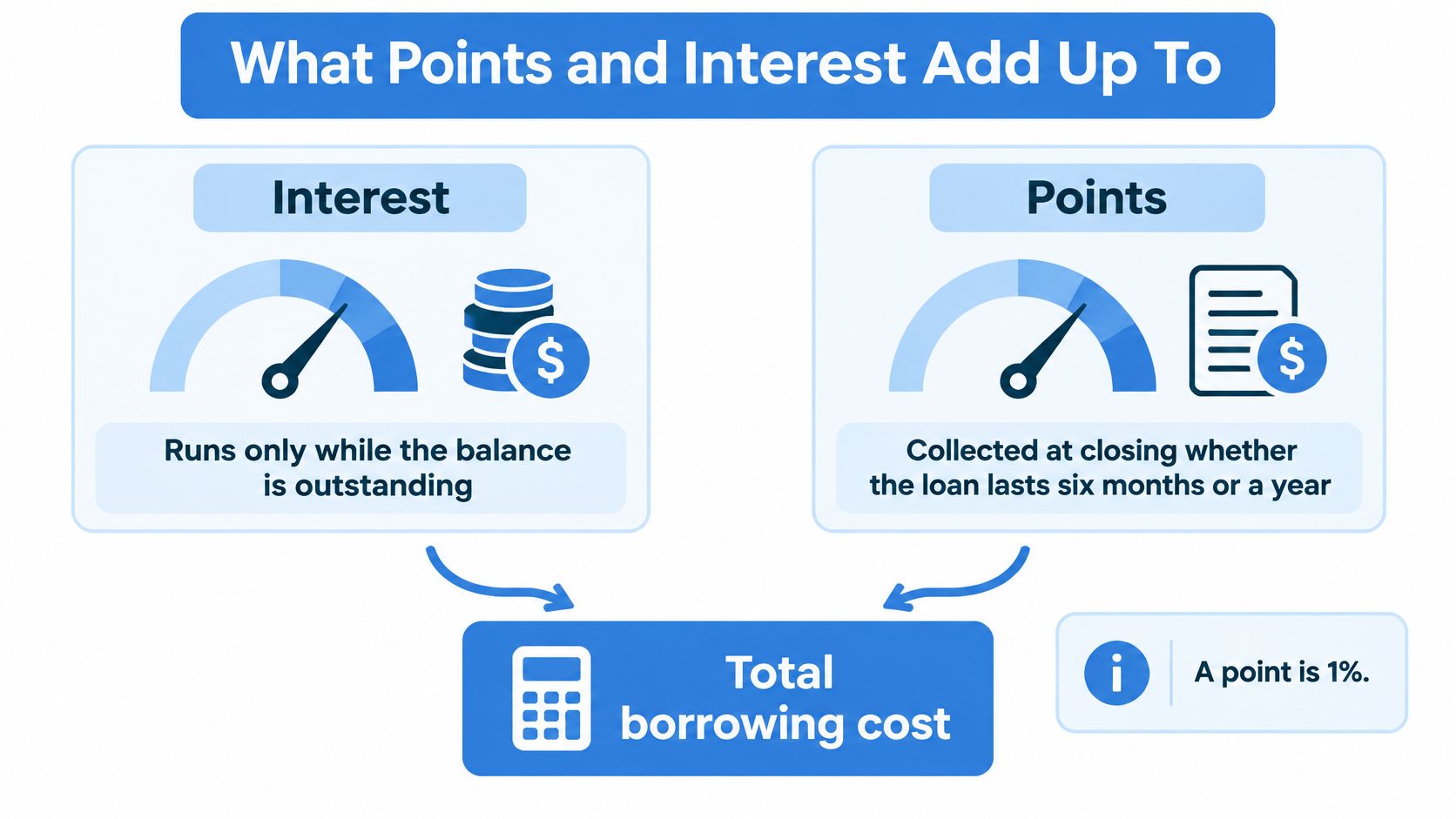
Borrowers commonly pay approximately 10% to 12% annual interest plus several origination points for six- to 12-month loans, according to a Scotsman Guide overview of hard money costs. A point equals 1% of the original principal, so a $500,000 loan at 11% interest and 3 points creates $15,000 of upfront origination cost, before appraisal, title, escrow, legal, inspection, or recording charges.
Why Three Points on a Short Loan Stings
Hold that loan for six months. Those 3 points alone represent an effective six-month financing cost of 6% of principal, equivalent to roughly 12% annualized before interest and other expenses. That's not a trick, it's simple time math. The shorter the hold, the harder the upfront charge hits on an annualized basis.
That doesn't make a fast flip bad. A quick sale can still be your most profitable path because you stop paying interest, taxes, insurance, and maintenance. It does mean you shouldn't celebrate a low coupon if you paid heavy points to get it. Compare lenders on total dollars for your expected hold, not on the headline rate alone.
Pay points once, pay interest by the month. Your exit date decides which one matters more.
Three Worked Deals
Say you borrow $500,000 at 11% and 3 points and sell in six months. Simple interest is about $27,500. Points are $15,000. Your core cost, counting interest and points only, is about $42,500.
Take the same size loan at 12% and 3 points and hold it twelve months. Interest is about $60,000, plus $15,000 in points, for a core cost of about $75,000. Doubling the hold didn't double the points, but it more than doubled your total compared with the six-month example because interest kept running.
Scale it up. A $1 million, 12-month loan at 12% with 2 points costs approximately $120,000 in scheduled interest plus $20,000 in origination fees, before third-party costs, as shown in a RentalRealEstate breakdown of hard money pricing. That source places published market ranges around 8% to 15% with origination charges of roughly 1 to 5 points.
Now pay that $1 million loan off after six months. Simple interest falls to about $60,000, but points remain $20,000 unless the agreement prorates them. Your core cost is still about $80,000. You saved interest. You didn't save points.
Sample All-In Interest and Points by Hold
| Deal | Hold | Interest | Points |
|---|---|---|---|
| $500,000 at 11% and 3 points | 6 months | About $27,500 | $15,000 |
| $500,000 at 12% and 3 points | 12 months | About $60,000 | $15,000 |
| $1,000,000 at 12% and 2 points | 12 months | About $120,000 | $20,000 |
| Same $1,000,000 loan paid off early | 6 months | About $60,000 | $20,000 unless prorated |
Read the last two rows together. Cutting the hold in half cut interest in half, but total core cost fell from about $140,000 to about $80,000, not to $70,000. That gap is the points staying put.
Some lenders let you finance fees and closing costs into the loan amount. That keeps cash in your pocket at closing, which can help if reserves are tight. It also increases principal, interest expense, and potentially your loan-to-value ratio. Don't roll fees in by reflex. Run both versions and see whether the cash you save today costs you more in interest and leaves you too close to the lender's maximum limit.
Watch one more trap. A lender can win on rate and lose on structure. Ask whether there's a minimum-interest period, a prepayment charge, or a rule that keeps you paying even after a fast sale. If you plan to exit in month four but owe six months of interest no matter what, your real cost is the six-month number. Put that number in your budget, not the optimistic one.
Fees Beyond Interest and Origination
Rate shopping misses the stack on your settlement statement. A LegalClarity guide to hard money loan costs cites underwriting or processing charges of roughly $1,000, appraisal costs of about $250 to $600, document-preparation fees of $150 to $1,500, and renovation draw inspections of approximately $50 to $150 per visit.
Those line items look small next to interest. They still matter when your margin is thin, and draw friction matters even more. If an inspector can't confirm work quickly, your contractor waits, your schedule slips, and you pay another month of interest while you wait for the next advance.
Hard Money Fees Beyond the Interest Rate
| Fee | Typical amount | Example on $500,000 | When it hits |
|---|---|---|---|
| Underwriting or processing | About $1,000 | About $1,000 | At closing |
| Appraisal | About $250 to $600 | $250 to $600 | Before or at closing |
| Document preparation | About $150 to $1,500 | $150 to $1,500 | At closing |
| Draw inspection | About $50 to $150 per visit | A few hundred dollars across several draws | Each rehab advance |
| Extension | About 0.5% to 2% per extension period, or 1 to 2 points | About $2,500 to $10,000 | If the loan passes maturity |
| Exit fee where charged | Up to about 1% | Up to about $5,000 | At payoff |
If points are new to you, read how an origination fee works on an investment loan before you compare quotes. You'll spot faster when a lender lowers one charge and raises another.
The Expensive Surprise Is Time
A four-draw rehab might cost only a few hundred dollars in inspection fees. A long project with repeat visits costs more, but the bigger hit is delay. Extension charges may add another 1 to 2 points when a borrower exceeds the original maturity. On a large balance, that's real money due at the exact moment your sale or refinance has already slipped.
An exit fee, where the note has one, is paid at payoff. Not every lender charges every line in the table. That's why you need the list in writing, with lender fees separated from third-party costs for title, escrow, legal, and recording.
Ask three direct questions. What's the extension price and how long does it buy me? Is there an exit fee or minimum interest? How fast do you release a draw after inspection? A slightly higher coupon with clean draws and no exit fee can beat a cheaper coupon that slows your rehab and charges you to leave.
What Moves Your Rate Up or Down
Hard money isn't one universal coupon. The lender prices the collateral, how fast it can be sold or refinanced, and how certain that exit is. The visual below groups those pricing drivers so you can map your own deal accurately.

Speed and flexibility explain part of the premium. Commercial bridge data in a GlobeNewswire report on term-sheet data from 700 lenders indicate private lenders averaged 9.76% in Q2 2026, compared with 6.47% for banks, while overall commercial loan rates averaged 6.62%. Treat those as commercial context for the size of the private-credit premium, not as a quote for your rental or flip.
Asset type shifts pricing too. That report cites a 2025 bridge-market update with spreads of roughly SOFR plus 275 to 325 basis points for multifamily, 300 to 350 basis points for industrial, and 500 to 700 basis points for flagged hotels. In plain terms, a property that's harder to operate or sell costs more to finance.
Score Your Deal on Three Questions
- Collateral: Is it leased and stable, or vacant with heavy rehab and permit risk?
- Equity cushion: Do you have a real equity cushion, or are you asking the lender to carry almost all the risk?
- Exit certainty: Can you name the buyer profile or refinance path, or are you hoping the market bails you out?
Experience and credit still count. They rarely outweigh weak collateral, maximum borrowing, and a fuzzy exit. If you're also comparing seller-carried land deals, the way land interest rates at Dollar Land Store are explained is a useful contrast, because owner financing prices a different kind of risk and timeline than a short-term investor bridge loan.
Watch this short walkthrough before you negotiate structure, then check whether a lower rate comes with tighter draws, a guarantee, or minimum interest.
A lower rate isn't automatically cheaper. Read the structure as part of the price, because a lender may trade rate for more points, tighter draw controls, personal guarantees, or a minimum-interest period. If those terms slow you down or trap you past your exit, the bargain rate can cost more in real dollars.
How to Price Your Own Deal
Run this check before you call any lender. It takes ten minutes and stops you from arguing over a rate when the true problem is your hold time.
A Simple Pricing Worksheet
- Write the loan and the hold: Note the amount you need and your expected months to sale or refinance. Add a second, later exit date in case permits, contractors, or buyers run slow.
- Calculate scheduled interest: Multiply loan amount by annual rate, then by months divided by 12. For example, $500,000 at 11% for six months is about $27,500.
- Add points in dollars: Multiply the loan by the points. Three points on that same example loan is $15,000 at closing.
- Add closing charges: Include lender underwriting and document fees, plus appraisal, title, escrow, legal, and recording costs the lender lists.
- Add rehab friction: For renovation deals, budget each draw inspection and set aside money for a possible extension if your calendar has no slack.
- Add the exit cost: Include any exit fee or minimum interest the note requires, even if you expect to pay off early.
- Annualize for comparison: Divide total financing dollars by the loan amount, then divide by your hold in years. Now you can compare two quotes on the same basis.
A fix-and-flip loan calculator can speed up steps two and three, but don't let it do your thinking. Enter your late-exit case too, not just the clean version you hope happens.
Pass or fail test: If the deal still leaves your target profit in the late-exit case, the quote is viable. If it only works on the perfect calendar, renegotiate price, leverage, or term before you sign.
Check your cash, not just your profit. Points and closing fees are due up front, interest is due monthly, and rehab money often comes back in draws after work is done. You can have a profitable project on paper and still run short in month two if you don't have reserves for interest, insurance, taxes, and contractor deposits. List the month each dollar leaves your account. That timeline is where many flips break, even when the final sale price looks fine.
Ways to Pay Less and Get a Full Term Sheet
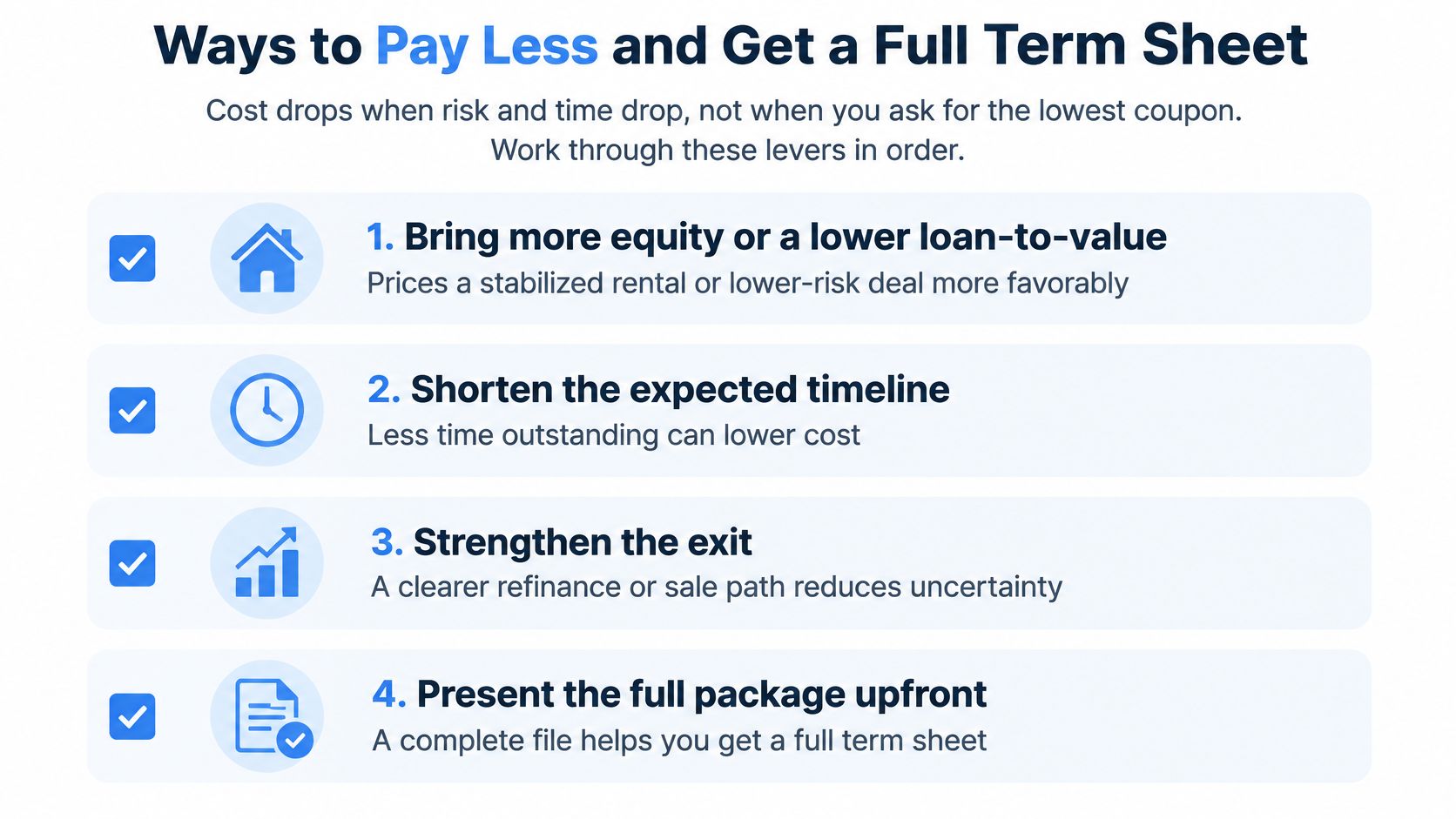
Cost drops when risk and time drop, not when you ask hardest for the lowest coupon. Work the levers that make a lender comfortable, then force every quote onto the same written sheet.
The checklist below puts those levers in the order to tackle them.
Levers That Actually Lower Your Cost
- Bring more equity: A lower loan-to-value gives the lender a cushion if value slips. A stabilized rental or light cosmetic flip with real equity usually prices better than a max-borrowing gut rehab.
- Put the exit in writing: Name the sale plan, the refinance loan you expect to use, or the other property you'll sell. Vague exits get priced as risky exits.
- Match term to a real calendar: A loan that needs an extension often costs more than a slightly longer first term. Build in permit and listing time now.
- Price the finished property to sell: An overpriced listing that sits for extra months burns interest fast. A realistic list price can save more than a small rate cut.
- Make draws clean: Have permits, bids, photos, and invoices ready before each inspection. Batch completed work so you aren't paying for repeat visits on small items.
- Don't finance points by default: Rolling points into the loan preserves cash, but a bigger balance means more interest. Pay in cash when reserves allow and the math still leaves a buffer.
Ask Every Lender for the Same Sheet
Get two or three full quotes and compare total dollars on your expected hold and your late hold. A usable term sheet states rate, points, lender fees, third-party costs, draw rules, minimum interest, extension price, exit fee, and how long the quote stays open.
Don't accept a verbal rate as a quote. If a fee isn't on the sheet, ask why. If an extension price isn't stated, assume you'll negotiate it later from a weak position. That's the worst time to bargain.
We can help you run that comparison on a non-owner-occupied deal when a bank timeline or property condition is the blocker. LendingXpress has originated over $558M in loans, and in step 2 of our process we review the application and provide a pre-approval and terms in as little as an hour. If you want to talk through a term sheet before you commit, call us at 866-993-6896 and bring your purchase price, rehab budget, expected value, and exit date.
That preparation is what gets you a serious answer fast. A lender can't price confidence from a vague story. Send the address, photos, scope of work, contractor bid, and your sale or refinance plan in one package. You'll get cleaner terms, fewer surprises at closing, and a better sense of whether hard money helps this deal or eats it.
If a bank can't move fast enough on your next non-owner-occupied rental, flip, or bridge purchase, bring us the property, your budget, and your exit plan and we'll price it in total dollars, not just a headline rate. Visit LendingXpress to request a full term sheet you can compare line by line before you sign.