
You've found a rental that looks solid on paper. The rent covers the payment, you've saved a down payment, and you're ready to make an offer. Then a bank runs its own math, cuts the rent, adds reserves you hadn't budgeted for, and tells you the loan is smaller than you expected.
That's normal for a first-time investor, and it's fixable before you apply. Learning how to qualify for investment property loan approval starts with using the lender's numbers, not the listing's numbers, so you can size the loan, the cash, and the property correctly the first time.
Lender Benchmarks You Must Meet by Loan Type
Two offers on the same rental can produce different loan limits. The lender's rules determine which rent counts, what reserves you must hold, and how much documentation the file needs. Use the table to compare the paths, then confirm the applicable terms with the lender.
| Loan type | Max LTV | Income test | Reserves | Typical close |
|---|---|---|---|---|
| Conventional, one-unit purchase | Up to 85% (Fannie Mae eligibility matrix) | Lender applies its rental-income and expense rules | Set by eligibility and lender requirements | Depends on lender and file |
| Conventional, two- to four-unit purchase | Up to 75% (Fannie Mae eligibility matrix) | Lender applies its rental-income and expense rules | Set by eligibility and lender requirements | Depends on lender and file |
| Conventional cash-out refinance, one unit | Up to 75% (Fannie Mae eligibility matrix) | Lender applies its rental-income and expense rules | Set by eligibility and lender requirements | Depends on lender and file |
| Conventional cash-out refinance, two to four units | Up to 70% (Fannie Mae eligibility matrix) | Lender applies its rental-income and expense rules | Set by eligibility and lender requirements | Depends on lender and file |
| Portfolio lender | Set by the lender | Lender-specific; may consider experience and assets | Set by lender policy | Ask the lender |
| Private or hard money lender | Set by the deal and lender | Property value and exit plan | Set by the deal terms | Ask the lender |
How to Read Your Row
Conventional loan limits vary by occupancy count and transaction type. The figures in the table are maximum LTVs, not guaranteed approvals. A lender still reviews the property, borrower, and file against its eligibility requirements.
Portfolio lenders set terms based on their own lending criteria. Private and hard money lenders may focus more heavily on property value and the exit plan, which can help when conventional documentation does not fit the deal. The trade-off is that terms depend on the specific property and lender.
Plan around the lender's calculation, not the rent in the listing. A lender may apply a rent haircut and reserve rules, reducing the income available to support the loan. Ask how it treats rent, expenses, and cash reserves before relying on a projected loan amount.
Down Payment and Loan-to-Value Math
Lenders don't finance the price you agreed to pay. They finance the lower number. The Fannie Mae conventional eligibility matrix permits up to 85% LTV for a one-unit investment-property purchase and 75% LTV for two- to four-unit investment properties, with purchase loans generally using the lower of the contract price or appraised value.

A Worked Purchase Example
Say you sign a contract at $250,000 and the appraisal comes in at $245,000. The lender uses $245,000. At 85% LTV for a one-unit property, your maximum loan is $208,250 and your down payment is $36,750 before closing costs. For a two- to four-unit property at 75%, the loan drops to $183,750 and the down payment rises to $61,250.
That appraisal gap is where deals stall. If you planned your cash around the contract price, a lower appraisal means you either bring more cash, renegotiate the price, or walk away. Run the math on a slightly lower value before you offer, and you'll know how much room you have.
Investment loans can also carry loan-level pricing adjustments, which raise the rate or fees compared with an owner-occupied loan. Don't just ask about LTV. Ask for the final rate and fees at that LTV, because a higher loan amount can cost more than it saves you in cash.
Set Your Cash Target
The minimum down payment isn't what most approved investors pay. In the third quarter of 2025, Realtor.com reported that investment-property buyers made an average down payment of 26.7%, with a typical down payment of $84,200.
Work in this order. First, calculate the maximum loan from the LTV cap. Second, confirm the appraisal supports the price. Third, check that cash remains after closing. If a 15% down payment leaves you with nothing left for reserves and repairs, it isn't a workable loan, even if the LTV fits on paper.
Rental Income a Lender Will Actually Count
The rent in the listing isn't the rent in your loan file. That's the assumption that trips up most first-time investors when they work out how to qualify for investment property loan approval.

The 75 Percent Haircut
Fannie Mae's subject-property rental-income calculation generally uses 75% of gross monthly rent rather than 100%, then subtracts the property's PITIA to calculate adjusted net rental income. PITIA means principal, interest, taxes, insurance, and association dues.
Say a property rents for $3,000 a month. The lender counts $2,250. If PITIA is $2,000, you're left with $250 of adjusted net rental income. That $250, not the full rent, is what helps your qualifying income. The haircut covers vacancy and expenses, and you can't argue it away with a strong lease.
If you have less than 12 months of property-management experience, the rules get tighter. Positive rental income generally can't be used freely as qualifying income and may instead be limited to offsetting the subject property's PITIA. Your personal income then has to carry more of the file.
This short walkthrough shows how rent and expenses feed into a lender's worksheet. Watch it before you rely on projected rent in an offer.
When a Lease Helps and When It Doesn't
A lease can support income when it transfers with the property, when you bought after your latest tax return, or when renovation interrupted rent. Timing matters too. If you bought a property recently and apply for another subject-property loan in quick succession, a lender may not accept lease agreements and may instead require an appraisal rent schedule or comparable rentals.
Bring proof, not projections. Gather executed leases, deposit records, comparable rental listings, and any prior landlord statements you have. Clean records make the income easier to defend, which is why rental property bookkeeping essentials are worth setting up before you apply, not after an underwriter asks questions.
Strong market rent with no tax-return history usually means bringing more cash, a co-borrower, or a lender that underwrites the property itself.
Credit Score and Debt-to-Income Limits
Your property can work and your file can still fail on personal debt. Underwriters check both.

Run Your DTI Before a Lender Does
Debt-to-income ratio, or DTI, is your total monthly debt divided by your verified gross monthly income. Under the Consumer Financial Protection Bureau Qualified Mortgage framework, a 43% DTI threshold was established for many qualified mortgages. On $10,000 of verified monthly income, that's about $4,300 in total monthly debt.
Use the same income to test other limits. At 36%, you can carry $3,600 a month. At 45%, where a manually underwritten loan may go if credit-score and reserve conditions are met, you can carry $4,500. Count the new mortgage payment plus car loans, student loans, minimum credit card payments, and any support payments. If the new PITIA pushes you over, a lower loan amount or a cheaper property is the fix, not a different spreadsheet.
Fixes That Help Before You Apply
- Pull all three reports: Dispute errors now, because corrections take time and a mid-process surprise can stall closing.
- Pay down revolving balances: Lower card balances help both your score and your monthly debt total.
- Avoid new credit and new debt: A fresh car payment or card inquiry right before applying gives an underwriter a reason to pause.
- Explain blemishes in writing: A short letter covering each late payment or collection is better than leaving the underwriter to guess.
If you're unsure where your score needs to be for a private or hard money scenario, check the plain-language breakdown of what credit score is needed before you assume you're out. I wouldn't let a weaker score end the search on its own. A borrower with strong reserves and real equity may still fit with a portfolio or private lender, even when a bank says no.
Bottom line: Your score opens the door, but DTI decides how much payment you can carry through it.
Debt Service Coverage When Personal Income Fails
If your personal income falls short of a bank's DTI test, a lender may qualify the loan based on the property's cash flow instead. The key measure is debt-service coverage ratio, or DSCR: the property's net operating income divided by its annual loan payments.
Build the Ratio From Stabilized Income
Start with net operating income, not gross rent. Account for vacancy, collection loss, operating expenses, management, repairs, taxes, insurance, and normal capital costs. The remaining income is stabilized NOI. Divide it by the loan's annual debt service to calculate DSCR.
Lenders set their own minimum DSCR and loan-to-value limits by property type and loan program. Ask each lender for its exact thresholds before assuming a deal qualifies. A property that meets one lender's requirements may fall short with another, especially if the lender uses a larger vacancy allowance or a more conservative rent estimate.
A Contrast That Catches Buyers Out
A property can appear to cover its mortgage using the rent shown in the listing, then fail the lender's cash-flow test. Lenders often underwrite only 75% of stated rent and apply their own reserve rules, so the rent figure an investor quotes may be higher than the amount counted. Once the lender also accounts for expenses and loan payments, qualifying income can shrink further.
Check the seller's NOI against actual operating costs. Include recurring expenses and avoid relying on short-term projected rents as though they were established income. Cap rate compares NOI with property value; DSCR compares NOI with the loan payment. The lender is assessing whether the property's income can support that payment.
If coverage is thin, consider a lower purchase price, a smaller loan, more equity, or a different loan term. Calculate DSCR using the lender's rent and expense assumptions, then ask lenders what DSCR and LTV thresholds apply to your property type.
Cash Reserves Lenders Expect After Closing
Reserves are the cash still in your accounts the day after closing. They aren't a fee, and you don't hand them to the lender. You prove you have them so a vacancy or a roof repair doesn't turn into a missed payment.
The Six-Month Benchmark
Fannie Mae's minimum reserve requirements generally require six months of reserves for an investment-property transaction, measured against the property's monthly PITIA. On a property with $2,000 of monthly PITIA, that's $12,000 in liquid reserves, on top of your down payment and closing costs.
If you own other financed properties, expect additional reserves. Each property adds payment risk, and lenders want to see that one vacancy doesn't drain the account that covers every mortgage you have.
Bank accounts and eligible securities usually count clearly. Retirement accounts may count only at a discount, because you can't always pull that money out quickly or without a cost. Ask the lender how they'll value each account before you count it in your plan.
Build a Simple Reserve Schedule
- Post-closing cash: What's left in checking and savings after the down payment and closing costs are paid.
- Eligible securities: Investments the lender will accept, at the value they'll accept.
- Closing costs and repair budget: Money already committed, so it shouldn't double as reserves.
- Months of vacancy covered: Your remaining liquid funds divided by monthly PITIA.
Add the down payment, closing costs, repairs, and reserves together. That's your real cash need. I would keep extra beyond six months for an older, vacant, seasonal, or renovation-heavy property, because vacancy and repairs drain cash fastest in the first year.
If paying the down payment drops you below six months of PITIA, change the deal size or the property. Don't apply and hope.
How to Qualify Step by Step, From Documents to Approval
A rental deal can look affordable at the asking rent and still fail a lender's cash-flow test. Many lenders count only 75% of gross rent and apply their own reserve rules, so qualify the property using the lender's numbers, not the rent figure in the listing.
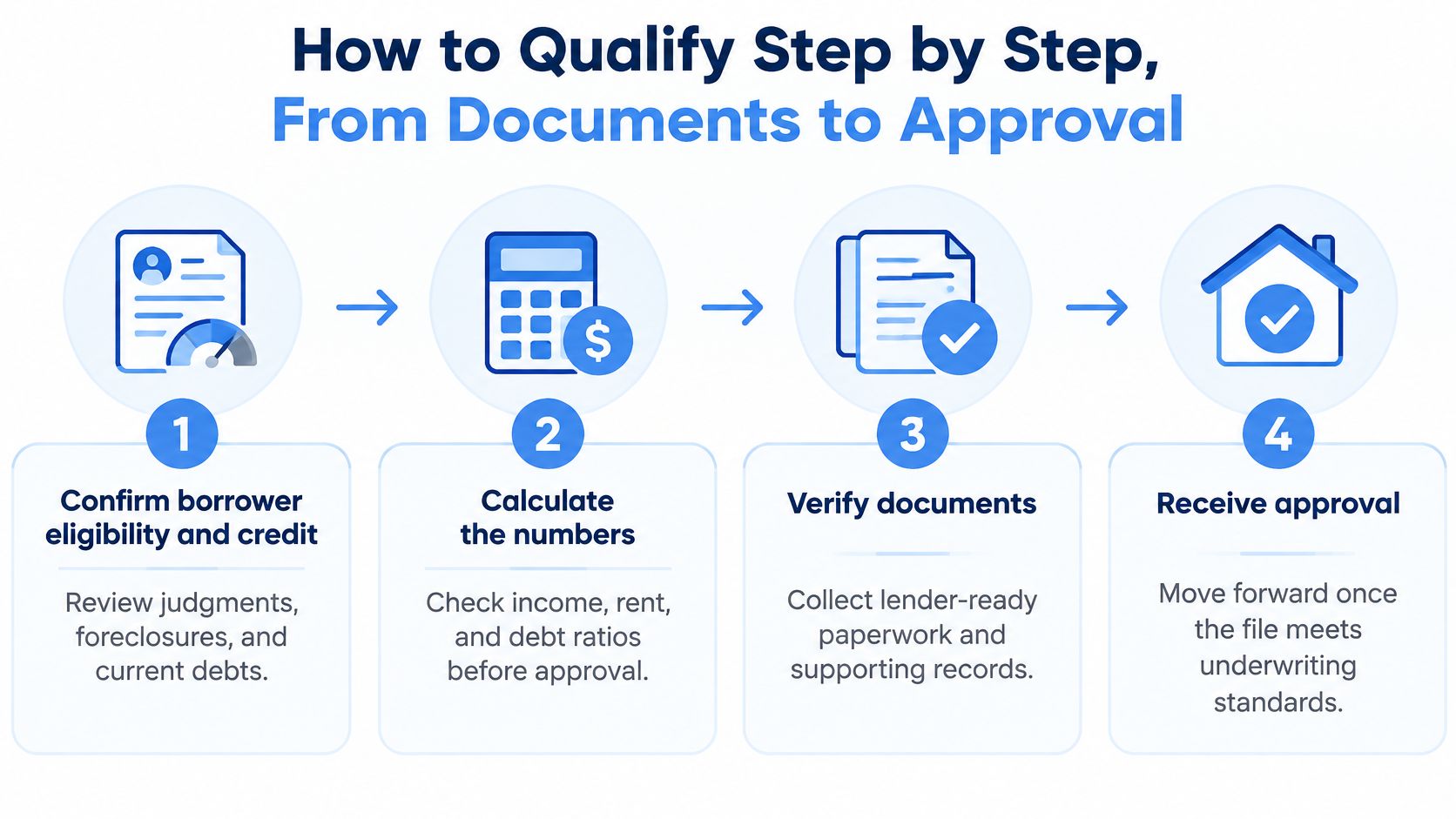
The Four Checks in Order
- Confirm borrower eligibility and credit. Review your credit reports, current debts, judgments, and foreclosures. Resolve discrepancies early, since an eligibility issue can stop underwriting before the property is assessed.
- Calculate qualifying rent against PITIA. Apply the lender's rent calculation, then compare the qualifying income with principal, interest, taxes, insurance, and association dues. The lender may use a different method or haircut, so confirm its calculation before relying on projected rent.
- Document assets and funds. Gather evidence of the money available for the transaction and the assets the lender will consider. Keep each balance traceable to a current statement.
- Check underwriting rules and lender overlays. Agency guidelines set a baseline for some loans, while lenders may add stricter requirements. Ask which rules apply to your loan type before you commit to a contract.
Fannie Mae's rental-income guidance explains how rental income is analyzed. For a Fannie Mae investment-property transaction, the minimum reserve requirements identify six months of reserves. Lender requirements can vary, so confirm the applicable rule for your loan.
Documents to Gather First
Prepare executed leases or market-rent support, tax returns, bank and asset statements, and proof of deposits. Property tax records, insurance quotes, a rent schedule or operating statement, and government ID can also help complete the file. Use this guide to organize your loan documentation before requesting terms.
Projected rent needs support. Depending on the loan and property, a lender may ask for leases, market-rent evidence, tax returns, operating statements, or a rent schedule, then adjust income for vacancy or expenses. Make sure your cash-flow estimate uses the same rent figure and documents the lender will review.
A complete file lets the underwriter trace each figure to its supporting document. If a lease, deposit, or asset balance needs an explanation, include it with the relevant paperwork rather than leaving a gap for the lender to resolve.
Choose a Lender and Take the Next Step
Match the lender to the way your file qualifies. If your credit, DTI, and reserves fit, a conventional loan gives you the structure in the benchmark table. If personal DTI fails but the property's stabilized income covers debt service, choose a lender that underwrites property cash flow instead of forcing your file through a bank matrix.
If speed and the exit plan matter most, a private or hard money route may fit better. You'll usually borrow less against value, but you can close fast and solve problems a bank won't touch, such as a vacant property, thin tax history, or a tight purchase deadline.
Bring the finished folder with you. Include leases or market-rent support, two years of tax returns, asset statements, your reserve schedule, and your maximum loan based on the lower of contract price or appraisal. Ask two direct questions. Which reserves count, and will rent be taken at 75% of gross?
Our Loan Pre-Qualification tool matches a scenario to lenders in seconds, with no commitment required. We review the application and provide a pre-approval and terms in as little as an hour, and our loan officers use text messages to answer questions about products, eligibility, terms, and the application process.
Run that pre-qualification with your cash, DTI or DSCR, and LTV already calculated. Make an offer only if six months of PITIA still remains after closing.
If a bank's DTI test, rent haircut, or reserve rule is blocking a non-owner-occupied purchase that works on property cash flow and equity, LendingXpress can help you match the scenario to a faster, more flexible loan. Bring your numbers and your document folder, run a no-commitment pre-qualification, and get a clear answer on terms before you commit to the deal.