
You found a property. The numbers looked workable. Your agent moved fast, the seller wanted a clean close, and then the bank asked for more paperwork, more time, and one more committee review. A week later, the deal was gone.
That happens all the time with non-owner-occupied property in California. It's usually not because the investor picked the wrong neighborhood or missed some secret strategy. It's because investing real estate is as much a financing business as it is a property business.
If you're buying rentals, flipping houses, or refinancing a commercial asset, you need more than a good eye. You need a simple way to judge the deal, a realistic plan for the loan, and enough speed to close before the window shuts. That's especially true in a market where pricing, debt costs, and buyer activity can change quickly.
The broader market shows exactly why discipline matters. Global commercial real estate investment volume fell 47% year over year in 2023 to US$647 billion, then global real estate deal value rebounded to US$873 billion in 2025, about 12% higher year over year, while the professionally managed global real estate market was estimated at USD 13.5 trillion in 2025 according to McKinsey's real estate private markets report. Big market, big swings.
California investors feel those swings in a very practical way. Rates move. Appraisals tighten. Sellers choose certainty. Lenders matter.
Why Investing Real Estate Still Works in California
A buyer in San Diego finds a duplex with below-market rents, solid bones, and a seller who wants a 14-day close. On paper, the opportunity looks good. In practice, the investor who wins is usually the one who already knows the loan structure, reserve requirement, and exit before the offer goes out.
That is why investing real estate still works in California. This market rewards preparation more than prediction.
A lot of newer investors assume success comes from spotting the next hot zip code. After funding hundreds of non-owner-occupied deals, I can tell you the repeat winners usually do something simpler. They match the property to the right financing early, underwrite conservatively, and leave themselves more than one way to finish the deal.
Real estate also has staying power as an investment category. Organized real estate investing has been part of the public market for decades, with FTSE Nareit tracking U.S. REIT equity market capitalization back to 1972 in its REIT market data history. Housing investor activity remains meaningful as well, but in California, the more important question is not whether investors are active. It is whether your offer can close on the seller's timeline.
California rewards prepared buyers
California is competitive in a very specific way. Sellers often choose certainty over a slightly higher price. A financed offer can beat another financed offer, and sometimes even a cash-style offer, if the buyer can explain the property and the loan plan clearly.
That starts with a few practical questions:
- What is the exit? Hold as a rental, sell after rehab, or refinance into long-term debt?
- What income supports the deal? In-place rent, stabilized rent, or resale value?
- What loan matches the business plan? DSCR rental loan, bridge financing, rehab loan, or commercial debt?
- How much cash is really needed? Down payment, closing costs, rehab budget, interest carry, and reserves.
Those questions sound basic. They are. They also decide whether a deal survives underwriting.
A fourplex in Orange County and a small warehouse in the Inland Empire can have very different numbers, but the same rule applies. Good investors do not just buy property. They build a structure around the property so the deal can close, operate, and exit without surprises.
In California, buyers lose deals when financing is vague or slow. They win deals when the lender, the borrower, and the exit all make sense on day one.
Why this still works
Real estate still works because execution can improve the result. An investor can raise under-market rents, fix deferred maintenance, reduce vacancy, clean up expenses, add usable space, or refinance expensive short-term debt into cheaper long-term debt. Few asset classes give you that many ways to create value after closing.
That does not mean every property is a good buy. It means the business is learnable, especially when you view it through the financing lens.
A strong deal in California is not just a property with upside. It is a property with upside, a loan that fits the plan, and enough speed to get to the closing table before the opportunity disappears.
How Real Estate Investing Creates Wealth
A new investor buys a rental in Sacramento. The rent covers the payment, so the deal looks fine on paper. Two years later, that investor is surprised to learn the gain did not come from one place. It came from several places working together.
That is where confusion starts. Real estate wealth is rarely a single paycheck. It works more like a four-cylinder engine. One cylinder can stall and the car may still move, but when all four are firing, the property starts building real net worth.

The four engines
Cash flow is the money left after rent comes in and the property pays its own bills. That includes taxes, insurance, repairs, management, and debt service. If there is money left over each month, that property can help fund reserves or the next acquisition.
Appreciation is growth in value. Part of it may come from the local market. Part of it can come from better execution, such as improving units, reducing vacancy, or making upgrades that support stronger rents. If you want practical examples, 7 expert renovations to boost home worth shows the kind of work that can improve value in a very direct way.
Loan paydown builds equity. Each monthly payment can reduce principal over time. In plain terms, your tenant may be helping retire a debt tied to an asset you control.
Tax benefits can improve what you keep after expenses and income taxes. Depreciation and deductions matter here. A CPA should handle the details, but investors who skip this part often underestimate the return.
A useful way to read these four engines is this: cash flow helps now, appreciation may help later, principal reduction builds equity in the background, and tax treatment changes the true net result.
Core idea: Wealth comes from the property's full financial picture. Income, debt, expenses, and exit options all have to work together.
Non-owner-occupied properties create wealth differently
For a primary residence, many borrowers focus on rate and monthly payment. For a non-owner-occupied deal, the better question is whether the property can perform like a business.
That difference matters in California. A rental in Riverside, a flip in San Jose, and a mixed-use building in Los Angeles may all create wealth, but they do not rely on the same engine at the same time. A flip may depend more on forced value and a clean resale. A rental may depend more on stable income and a refinance into long-term debt. The financing structure shapes which wealth engine matters first.
I see this in lending every week. An investor with a clear plan to renovate, lease, and refinance often creates more value than an investor who hopes the market rises. The property improves, the rent story gets stronger, and the next loan becomes easier to place because the numbers make more sense.
How borrowing helps and hurts
Borrowed capital can accelerate growth because you can control a larger asset with less cash upfront. If the deal performs, returns on your invested cash can improve.
The flip side is simple. Debt narrows your margin for error.
If rehab takes longer, rents come in lower, or the sale drags, the loan clock keeps running. That is why experienced investors in California do not size debt based on the maximum a lender will offer. They size debt based on what the deal can survive.
A good rule is to treat financing like the frame of a house. If the frame is right, the project can handle stress. If the frame is weak, even a property with upside can become a problem.
Choosing Your Investing Real Estate Strategy
Some investors start with the wrong question. They ask which strategy makes the most money. The better question is which strategy matches your capital, timeline, skill set, and financing options.
This side-by-side view makes that easier.

Four common paths
Buy-and-hold rentals fit investors who want ongoing income and a longer runway. You buy, stabilize, rent, and hold. The appeal is durability. The challenge is making sure the rent supports the debt and ongoing upkeep.
Fix-and-flip is operational. You need to buy right, renovate on time, and sell into a workable market. Timing matters more here because carrying costs and rehab surprises can eat the profit.
BRRRR means buy, rehab, rent, refinance, repeat. It's attractive when a property needs work but can become a stable rental after improvements. The whole model depends on whether the refinance will take out the short-term debt on acceptable terms.
Small commercial can include mixed-use, small retail, office condos, or light industrial. These deals often require more due diligence, but they can offer stronger income stories when bought well.
For a quick visual breakdown, this short video gives a useful overview of how investors think through property strategy:
Strategy selection is getting more specific
A few years ago, many investors treated real estate like one big category. That's less useful today. Sector selection matters more.
Recent industry coverage points to capital rotating toward operationally intensive and infrastructure-adjacent sectors such as digital infrastructure, logistics, senior housing, renewables, and residential-oriented housing. In that same outlook, U.S. real estate deal activity in 2026 was reported up 23% year over year in H1, and $10 million+ transactions outside the four major property types rose by over $16 billion, or 82%, from May to July 2026 versus the same period in 2025. Data centers were also identified as the top opportunity for 2026 in a global industry survey in PwC's real estate deals outlook.
For California investors, that means broad advice like “just buy real estate” isn't enough. A small warehouse, a residential rental, and a suburban office suite don't respond the same way to vacancies, demand shifts, or financing changes.
A practical way to choose
Use a simple filter before you chase a deal:
- Time horizon: If you need quick liquidity, don't force a long stabilization plan.
- Cash available: Some strategies can absorb surprises better than others.
- Operational skill: Flips and BRRRR projects need contractor management and timeline control.
- Financing fit: A strong strategy can still fail if the loan term doesn't match the business plan.
The right strategy is the one you can finance cleanly, operate competently, and exit without hoping the market bails you out.
How to Evaluate Deals With Simple Math
You don't need a giant model to screen a deal. You need a few basic numbers and honest assumptions.
The biggest mistake I see is investors falling in love with gross rent. Gross rent is just the top line. The property lives or dies on what remains after real expenses and realistic downtime.
Start with NOI
Net operating income, or NOI, is the income left after property operating expenses but before mortgage payments. If a property brings in rent and other income, then you subtract taxes, insurance, maintenance, management, utilities you pay, and ordinary operating costs.
That number tells you whether the asset itself works.
Here's a simple reference:
| Metric | What It Tells You | Simple Example |
|---|---|---|
| NOI | Income from the property before debt | Rent comes in, operating expenses go out, what's left is NOI |
| Cap rate | Return on the property price before financing | If NOI is strong relative to price, cap rate is higher |
| Cash-on-cash return | Return on the actual cash you invested | If you put in less cash but income holds, this can improve |
| ROI | Overall profit relative to total investment | Includes the full business outcome, not just monthly income |
Cap rate is useful, but incomplete
Cap rate helps compare pricing across deals. But don't stop there. A property with a higher advertised yield can still underperform if tenant turnover is constant, units sit empty, or leasing takes longer than expected.
A long-horizon dataset covering about 20,000 assets found vacancy rates are negatively related to cap rates, which reinforces a simple point. Occupancy stability matters to value in this discussion of vacancy and cap rate behavior.
A property with a 7% headline yield can lose to a 5% property if the first one burns cash through downtime, tenant churn, and leasing friction.
Run a vacancy stress test
Before you pay for appraisal, inspection, or third-party reports, test the deal with one ugly but realistic scenario.
Ask yourself:
- What happens if one month goes vacant?
- What if lease-up takes longer than expected?
- What if repairs cost more than your first estimate?
- Can the property still cover debt comfortably?
Newer investors get surprised. They underwrite the best month, not the average month.
Leverage changes the downside
Using borrowed capital isn't just about increasing returns. It changes your risk buffer.
A large academic study found that a 10-percentage-point increase in current LTV raised the probability of default by 4.7 percentage points in research published by The Review of Financial Studies. In plain language, less equity cushion means less room to absorb price drops, rent softness, or delays.
That's why an 80% loan structure and a 70% loan structure are not just slightly different versions of the same deal. They are different risk profiles.
A quick screen before due diligence
Use this short checklist before you spend more money:
- Check real income: Use in-place rent, not hoped-for rent, unless you have a credible renovation or lease-up plan.
- Write down all expenses: Taxes, insurance, repairs, management, utilities, HOA, and turnover costs.
- Stress vacancy: Assume some downtime. Don't underwrite perfect occupancy.
- Look at debt impact: Estimate whether payments still work if rent slips or the exit takes longer.
- Confirm your exit: Sale, refinance, or hold. If you can't explain the payoff clearly, pause.
Financing Non Owner Occupied Properties Without Bank Delays
A California investor gets a property under contract on Monday. By Wednesday, the seller wants proof the buyer can close fast. The building has deferred maintenance, two units are vacant, and the rent roll is mid-turnover. The deal may still be good, but a bank timeline often does not fit that kind of file.
For non-owner-occupied deals, financing is part of the investment strategy. In a competitive market, the borrower who closes on time usually wins over the borrower with the prettiest spreadsheet.
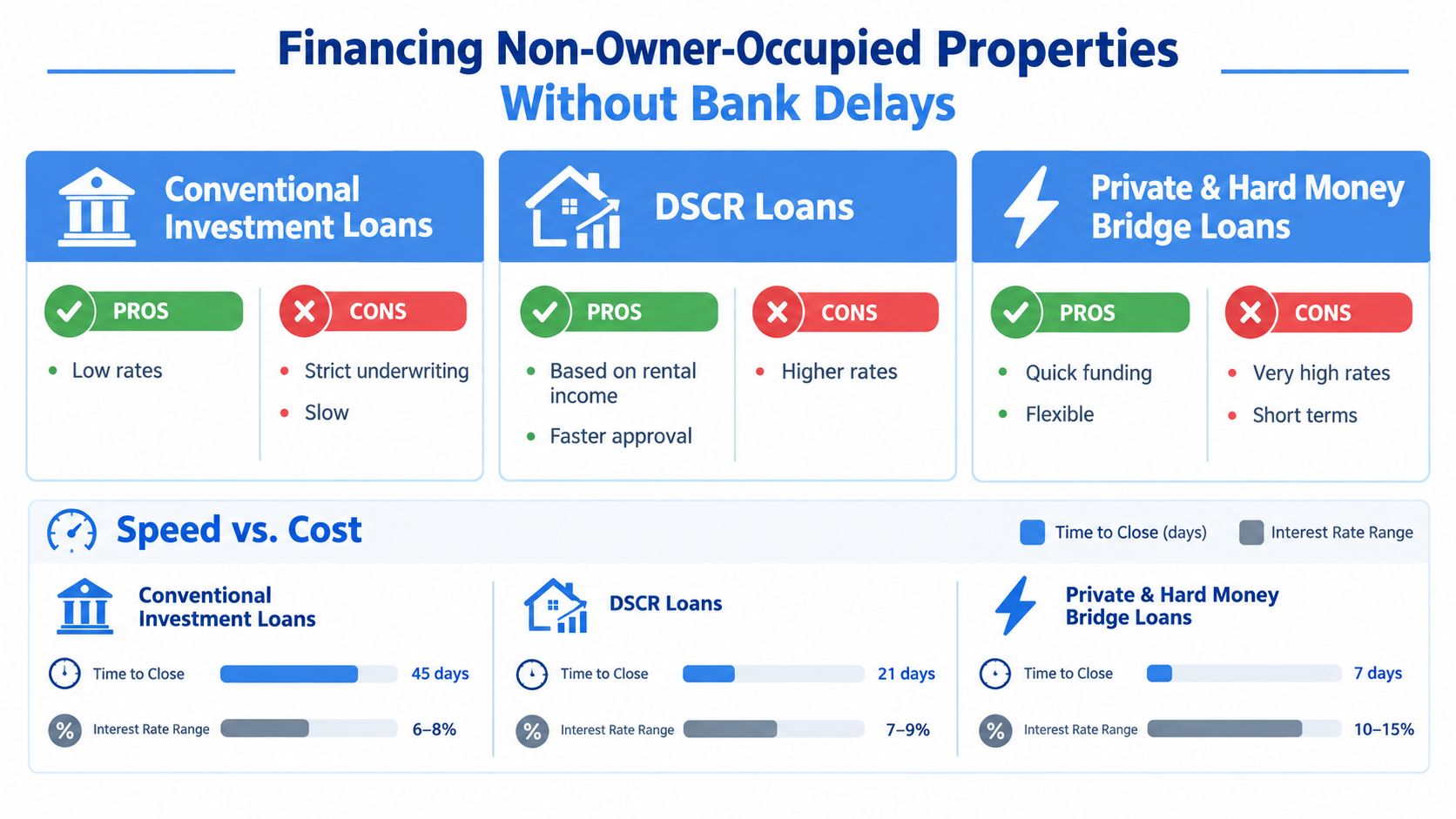
Conventional loans, DSCR, and bridge money
Each loan type solves a different problem.
Conventional investment loans usually fit stabilized properties, clean borrower profiles, and transactions that can wait for a full bank process. They get harder when the property needs repairs, rents are below market because of turnover, paperwork is incomplete, or the seller will not wait.
DSCR loans are built more around property income. They often make sense for rental investors who have multiple properties, uneven personal tax returns, or a plan based on long-term cash flow. If you want a practical primer, this guide on financing investment property with DSCR and related options explains how those structures are commonly used.
Private and hard money bridge loans are usually about speed and flexibility. They are common for short escrows, rehab deals, auction purchases, properties with vacancy, and assets that need work before permanent financing becomes available.
A simple way to look at it is this: conventional debt fits the finished house. Bridge debt fits the house while it is still being built, cleaned up, or repositioned.
Loan size matters as much as loan type
Newer investors often focus on rate first. On non-owner-occupied deals, proceeds and structure usually matter more.
A lender might like the property and still size the loan lower than the borrower expected. That happens all the time on bridge and DSCR files. The lender may cap proceeds based on current value, as-is rent, debt service coverage, repair scope, or exit timing. If an investor expects 80 percent of cost and the lender will only go to 70 percent of purchase plus part of the rehab, the cash needed at closing changes fast.
That is not just a pricing issue. It changes whether the deal can survive surprises. A lower loan amount can mean more cash in the deal up front, but it can also leave more room if rents slip, repairs grow, or the refinance comes in lower than planned. A higher loan amount can preserve liquidity, but only if the project timeline and exit are realistic.
Down payment expectations are different
A lot of first-time investors expect investment financing to resemble a primary residence mortgage. It usually does not.
One neutral industry source notes that investment-property down payments commonly run 15% to 25% of the purchase price, and cites Fannie Mae guidance of a 15% minimum for a one-unit investment property and 25% for 2-to-4 unit properties in this DSCR loan guide.
That gap is one reason short-term private capital is often used first. An investor can buy the property, complete repairs, stabilize rent, then refinance into longer-term debt once the file looks cleaner.
Rehab draws need to match the work
Rehab money also confuses newer borrowers. The lender usually does not send the full renovation budget on day one.
Funds are commonly released in draws after verified progress. It works like a construction checkpoint system. Finish demolition and rough work, request a draw. Complete the next stage, request the next draw. That keeps the budget tied to actual progress and helps prevent cost overruns from getting out of hand early.
An example industry breakdown shows draw schedules commonly split rehab funds into milestone-based installments such as 10% to 25% for the first draw, 20% to 30% for later draws, and a 5% to 15% final holdback until completion and final inspection in this rehab draw overview.
Where private lending fits
Private lending often fills the gap between a good deal and a slow lending process. In California, that gap shows up constantly. A borrower needs to close before a 1031 exchange deadline. A fourplex has vacancy and unfinished repairs. A small commercial asset has income, but the file is too messy for a bank this month.
One California option in that lane is LendingXpress, which structures bridge, fix-and-flip, and rental property loans on non-owner-occupied assets, with loan sizes from $100,000 to $18 million+, closings in as little as three days, and up to 100% of rehab costs financed, based on its published company information.
Practical rule: Match the loan term to the business plan. Use short-term bridge financing when speed, repairs, or a transition period are part of the deal. Use long-term rental debt when the property is stable and the hold plan is clear.
Underwriting Exit Strategies and Risk Management That Protects Returns
A lender can like the property and still decline the deal. That surprises newer investors. They assume hard money means no underwriting. In reality, smart private lenders still want a clean path to repayment.
The best deals are easy to explain. What are you buying, what are you fixing, who's managing the work, how long will it take, and how does the loan get paid off?
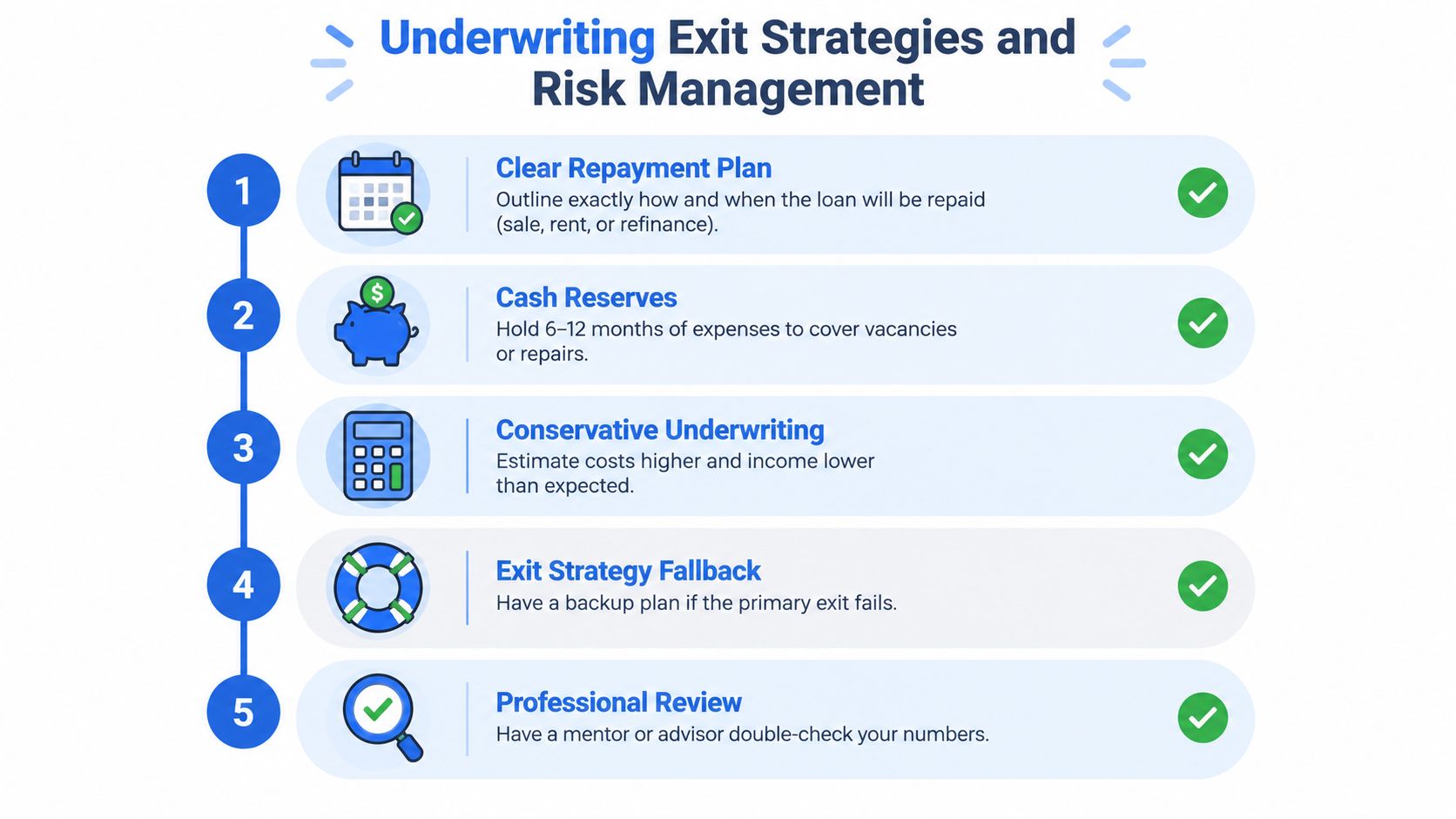
The underwriting sequence
A sound deal usually holds up under this sequence:
- Primary exit first. Write down whether repayment comes from sale, refinance, or operating cash.
- Budget second. Use a rehab scope that a contractor can defend, not a hopeful round number.
- Timeline third. Include time for permits, inspections, tenant turnover, and marketing.
- Reserves last. Keep cash available for surprises, because nearly every project has them.
Three exits to evaluate
Some investors only underwrite the preferred outcome. That's not enough.
Sale exit. Can you still sell if pricing softens or the listing takes longer than expected?
Refinance exit. Will the property qualify for long-term debt after repairs or stabilization? If rents come in lower than expected, does the refinance still retire the short-term loan?
Cash-out or portfolio exit. If you're pulling equity or repositioning multiple assets, can you do it without stressing the rest of the portfolio?
A lot of this comes down to clarity. If you need help thinking through fallback plans, this walkthrough on real estate exit strategy planning covers the decision points investors should pin down before closing.
Strong underwriting doesn't kill deals. It exposes weak assumptions while there's still time to fix them.
Conservative sizing protects you
The safest borrowers I've seen aren't always the richest ones. They're the ones who leave margin in the deal. They don't max their position, they don't understate rehab, and they don't assume the fastest possible exit.
That approach matters most on bridge and rehab transactions. If the contractor falls behind, permits drag, or the refinance market changes, your original plan may need more time. Conservative sizing gives you room to adapt instead of forcing a distressed decision.
Your Next Steps to Start Investing Real Estate in California
The cleanest way to start is to narrow your focus. Pick one strategy, one property type, and one target area. Don't chase flips, rentals, and small commercial all at once unless you already have the team to support that.
Then build around the numbers. Talk with an agent who understands investor property, line up a contractor if renovations are involved, and get pre-qualified with a lender who works on non-owner-occupied deals every day. Tax items like depreciation and 1031 exchanges can matter a lot, but that's where your CPA should guide the specifics.
A workable first month looks like this:
- Choose one lane: Rental, flip, BRRRR, or small commercial.
- Get your financing lined up: Know what loan types match your timeline and exit.
- Pick one market: Stay local enough to judge rents, repairs, and resale demand.
- Underwrite a few deals: Not to buy all of them, but to sharpen your judgment.
LendingXpress is based in Orange County and reports $558 million+ in originations, along with trust deed investment options and transparent private lending terms in its published company information. For California investors, brokers, and agents who need responsive capital on non-owner-occupied property, that kind of relationship-driven lending can make the difference between a missed opportunity and a closed deal.
If you're buying, refinancing, or renovating non-owner-occupied property in California, LendingXpress offers bridge, fix-and-flip, and rental property loans built for investor timelines, including common-sense underwriting and fast closings when bank financing falls short. If you want to talk through deal structure, rehab funding, or exit planning, visit LendingXpress and connect with a loan officer who works with California investment property every day.