
You've found a dated duplex for $300,000, penciled in $100,000 of renovations, and the seller wants to close in ten days. In this hypothetical deal, the problem isn't finding the lowest advertised rate. It's getting enough money to close while keeping enough cash available to pay contractors before the next draw arrives.
That's the practical starting point for a rehab loan vs conventional comparison. For a non-owner-occupied property, the better loan is the one you can qualify for, execute on time, and carry through a renovation that doesn't go exactly to plan.
Rehab Loan vs Conventional at a Glance
A private rehab loan is short-term financing secured by an investment property, with the lender evaluating the project, its after-repair value, and your repayment plan. A conventional renovation loan is a long-term mortgage underwritten around your financial qualifications and the property's completed-value appraisal.
A rehab loan usually wins when speed, staged funding, and cash preserved after closing matter most. A conventional renovation loan usually wins on rate and term for a well-scoped project you'll hold long term.
Core financing differences
The ranges below are screening benchmarks, not binding quotes. Ask lenders to confirm their acquisition advance, total project financing, fees, and closing conditions in writing.
Rehab loan vs conventional renovation loan on core factors
| Factor | Rehab loan (private or hard money) | Conventional renovation loan |
|---|---|---|
| Typical lender | Private or hard money lender | Bank, credit union or mortgage lender |
| Maximum loan-to-value | Typically 65–75% of purchase price, with eligible rehab costs sometimes funded up to 100%; confirm the separate completed-value ceiling | Typically 75–85% of purchase price for an investment property; renovation eligibility also has a completed-value test |
| Interest rate | Roughly 9–13%, plus 1–3 points as an initial comparison range | Lower, set by market conditions and borrower profile |
| Typical term | Short-term, with a maturity date tied to the exit plan | 15–30 years, fully amortizing |
| Time to close | As little as 3–14 days with a complete, eligible file | Commonly 30–45 days or longer |
| Credit and income focus | Property value, project plan and exit strategy; potentially flexible on credit history | Full credit, income and documentation review |
| Reserves after closing | Lender-set liquidity and contingency requirements | Investment-property reserve requirements based on qualifying payments |
| Rehab funding | Staged draws released after inspections | Eligible upfront expenses where permitted, with remaining funds controlled during construction |
Both rates and available borrowing capacity move with the market, borrower profile, property, and project risk. Don't treat the top end of a financing range as an approval.
What actually decides the choice
Loan-to-value, or LTV, means the loan amount divided by the value the lender uses. After-repair value, or ARV, means the property's estimated market value after the specified renovation is complete. Neither term tells you how much cash the lender will advance at closing.
If those terms are unfamiliar, Pie Assets' guide to investment jargon for small-budget property investors is a useful reference when reviewing term sheets.
Start with your deadline, your accessible cash, and the certainty of your construction scope. Also confirm property eligibility before comparing prices. A conventional renovation product that accepts an investment house doesn't automatically accept an investment duplex.
Practical rule: Compare the acquisition advance and renovation holdback separately. A large total commitment can still leave you short of closing cash.
How Underwriting Decides Who Qualifies
A duplex with damaged flooring may be straightforward to finance. Add unsafe wiring, an unpermitted addition, or a repair scope without dependable estimates, and the lender has a harder time assessing the property and the money needed to complete it. The borrower may be the same; the project risk is not.
Conventional underwriting reviews credit, income, existing obligations, tax returns, and rental documentation, along with the property and appraisal. Strong personal finances do not make a property eligible if its condition falls outside the chosen program.
The borrower lens and the project lens
A private rehab lender weighs the acquisition, proposed work, and repayment plan. Expect questions about contractor capacity, comparable renovated sales, your experience, and whether the schedule allows for inspections and delays. Credit and available cash still matter: you need to cover payments, costs outside the approved scope, and overruns.
Conventional renovation loans also consider the property's completed value. The distinction is that the mortgage must meet both borrower requirements and a defined renovation program. A private lender can assess the project under its own lending standards.
For portfolio loans, banks also set policies around collateral and construction risk. The interagency real-estate lending guidelines describe supervisory loan-to-value ceilings of 85% for improved property and 75% for land development, alongside institution-specific written policies. These are bank-level categories, not Fannie Mae renovation-loan limits. A bank may set a lower advance when the work or collateral is uncertain.
Build an approval-ready file
Give the lender enough detail to assess both your repayment capacity and the renovation budget:
- Scope of work: Break the project into trades, quantities, materials, and completion milestones.
- Contractor bids: Show pricing, exclusions, payment terms, and contractor credentials.
- Current valuation: Include an available appraisal or broker price opinion, with relevant property photographs.
- Rent roll: Document leases, collections, vacancies, and tenants affected by construction.
- Liquidity and exit plan: Show accessible funds and explain whether repayment depends on a sale or refinance.
Use this rehab loan requirements checklist to organize your submission before requesting terms.
A vague bid and unsupported after-repair value make it harder to assess whether the project can be completed within budget. A clear scope and credible costs give the lender a firmer basis to evaluate the borrower, the collateral, and the proposed financing.
What Each Loan Really Costs at Closing
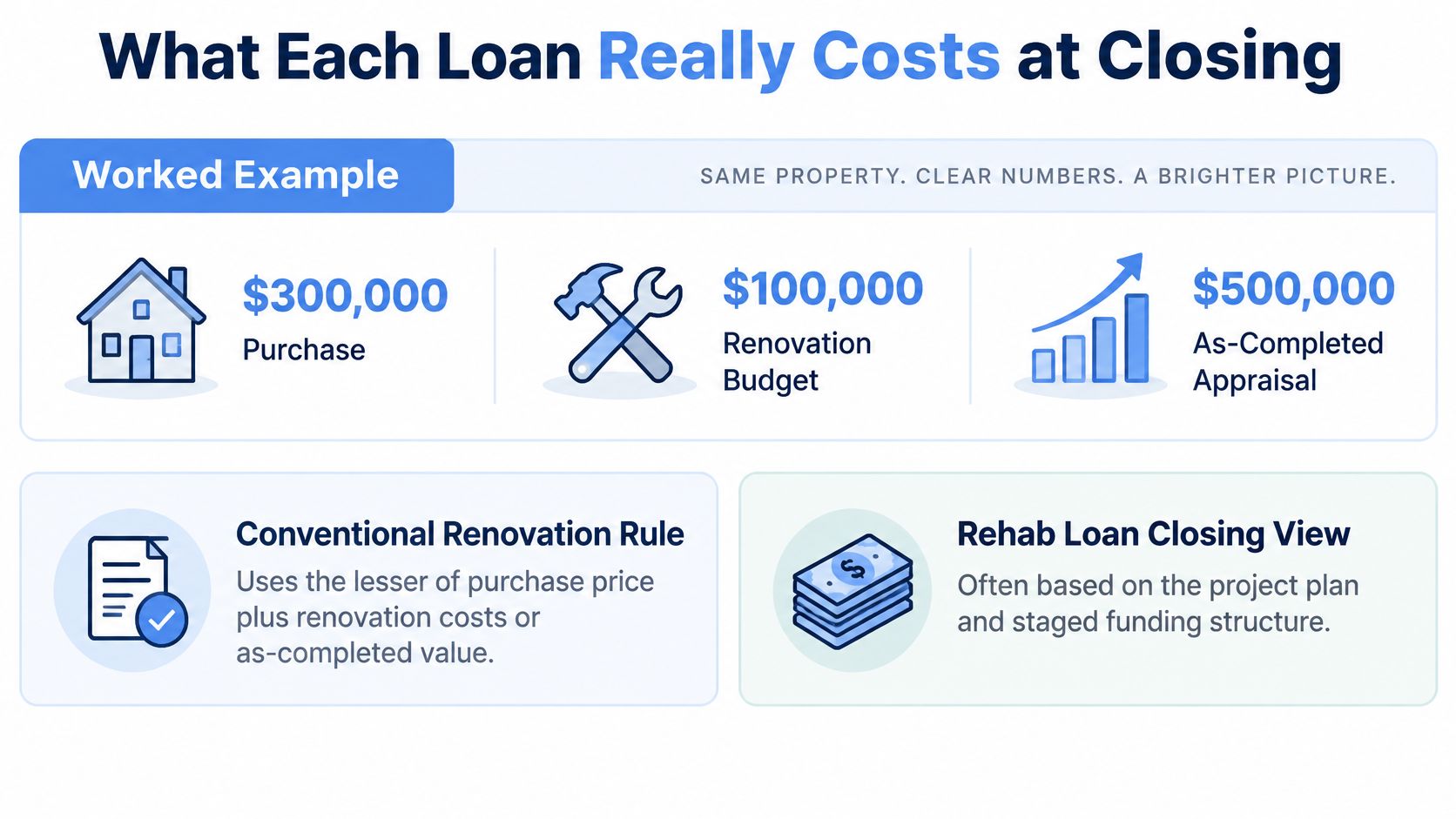
Cash left after closing often decides the loan choice before the interest rate does. Consider an investment house priced at $300,000, with a $100,000 renovation budget and a projected completed appraisal of $500,000.
For a conventional renovation loan, a typical limit ties eligible renovation costs to a percentage of the lesser of the purchase price plus renovation costs or the as-completed value. In this example, applying a 75% cap to the lower figure gives a $300,000 renovation-cost limit.
Worked example of renovation loan limits on a $300,000 purchase
| Item | Amount | How it is calculated |
|---|---|---|
| Purchase price | $300,000 | Hypothetical contract price |
| Renovation budget | $100,000 | Hypothetical estimated work from bids |
| As-completed appraisal | $500,000 | Hypothetical appraiser's completed value |
| Lesser of cost plus price or completed value | $400,000 | Lower of $400,000 and $500,000 |
| Renovation cap at 75% | $300,000 | 75% of $400,000 |
The cap tests renovation-cost eligibility; it is not the approved mortgage amount. The lender still calculates the permitted loan and checks borrower, property, and transaction requirements.
Points and interest change the cash requirement
In a hypothetical private-loan quote, 3 points on $300,000 equals $9,000. If the acquisition advance is 75% of the purchase price, the loan amount is $225,000, and 3 points on that advance equals $6,750.
At 11% simple annual interest, six months on a $225,000 balance costs about $12,375. This scenario excludes renovation advances, inspection charges, extension fees, taxes, insurance, utilities, and selling costs. Actual rates and fees depend on the loan terms; review the rehab loan rates and terms guide when comparing quotes.
Ask whether interest accrues on the amount drawn or the full commitment. Check minimum-interest provisions, too, and confirm whether points apply to the acquisition advance or the total approved loan.
Separate money spent from money reserved
Origination fees are spent. Required reserves remain yours, but the lender may require proof that the funds are available, and the same cash cannot cover both reserves and immediate construction needs.
A loan requiring a smaller reserve cushion may leave more usable cash, even if its interest rate is higher. Build a cash worksheet that subtracts loan proceeds from purchase costs, renovation costs, carrying expenses, and fees. Then compare the remainder with required reserves and the cash needed before renovation funds are released. Do not count withheld renovation proceeds as cash available at closing.
A lower-rate approval can still leave too little cash to pay the contractor.
How Rehab Draws and Timing Change Your Return
Private rehab financing usually separates the acquisition advance from the construction holdback. The lender funds the purchase at closing, then releases renovation money against approved progress. You may have to pay for some work before reimbursement arrives.
A conventional renovation mortgage also controls construction funds. Combining the mortgage and renovation budget doesn't mean the lender deposits an unrestricted repair allowance into your account.
Follow the funding sequence
Map the actual process before accepting a contractor's payment schedule:
- Application and appraisal: Submit the scope, bids, financial documents, and valuation information.
- Closing: Confirm the acquisition advance and the amount retained for construction.
- Initial project funding: Identify which deposits or expenses qualify for upfront funding and which you must cover.
- Work, inspections, and draws: Submit invoices and completion evidence according to the lender's requirements.
- Final inspection: Resolve remaining work, documentation, and release conditions.
- Repayment: Complete the sale or refinance before the short-term loan matures, or continue the approved long-term mortgage.
The following graphic illustrates the private rehab draw sequence. Conventional renovation mortgages can also use controlled releases, even though an ordinary conventional purchase mortgage doesn't include a renovation draw facility.

Fannie Mae's 2025 HomeStyle Refresh changes permit eligible borrowers to receive up to 50% of renovation costs at closing for specified expenses, while financing renovation costs up to 15% of as-completed value under that product. Those are product-specific provisions, not blanket terms for every conventional renovation mortgage.
Upfront funding can help with materials, permits, design services, or deposits. It doesn't eliminate unexpected code work, utility problems, or a contractor's demand for payment before the next inspection.
The lowest rate can still produce the worse result
A higher-rate bridge loan can be the better economic choice when timely funding preserves a profitable acquisition or lets you finish and lease the property sooner. Compare that benefit with the extra financing expense rather than assuming speed always justifies the premium.
Conversely, paying private-loan pricing for a straightforward project with a cooperative seller and ample liquidity may buy flexibility you don't need.
Ask every lender these questions:
- Overruns: Who pays when actual costs exceed the approved budget?
- Inspection timing: How are inspections booked, and what triggers release after approval?
- Lower appraisal: Must you contribute more equity, reduce the project, or accept a smaller loan?
- Undrawn proceeds: Does interest accrue before construction funds are released?
Get operational answers, not just an assurance that draws are fast.
Which Borrower Fits Each Loan
Consider an investor with dependable income and an attractive rental purchase who still receives a conventional decline. Most of the investor's capital is tied up in other properties, and the remaining cash won't satisfy the lender after the down payment and closing expenses.
That isn't necessarily a bad property or an unqualified operator. It's a mismatch between accessible cash and the selected loan's requirements.

Freddie Mac's investment-property mortgage guidance identifies a six-month reserve requirement for investment-property financing. Evaluate qualifying payments, including principal, interest, taxes, insurance, and applicable assessments, with the lender rather than budgeting only for the mortgage's principal and interest.
Match the loan to the operating plan
These are starting points for non-owner-occupied properties only, not approval promises.
Which loan fits each borrower situation
| Your situation | Usually the better fit | Why |
|---|---|---|
| Flip planned for under 12 months with a fast deadline | Rehab loan | Quick closing and staged draws can match the short holding period |
| Stabilized rental needing light, code-compliant work | Conventional renovation or investment loan | Lower pricing and 15–30-year amortization suit a long hold |
| Most cash tied up in other properties | Rehab loan, if its liquidity requirements are achievable | Project-focused underwriting may offer a workable alternative |
| Auction or offer with a closing window of about two weeks | Rehab loan | A prepared private-lending file may fit the deadline |
| Renovation scope still uncertain or likely to change | Rehab loan with an approved contingency and change process | Greater structuring flexibility may help, but changes still need funding |
| Strong credit, liquidity, and a fixed renovation budget | Conventional renovation loan | Lower cost of capital can suit a documented, eligible project |
An uncertain scope isn't a reason to skip due diligence. A private lender won't automatically increase its commitment because demolition reveals additional work. Investigate structural, permit, and environmental concerns before treating flexibility as a solution.
A temporary loan needs a credible replacement
The answer can change with your holding period. A short-term rehab loan becomes expensive when you keep extending it on a rental you intended to hold indefinitely. A conventional application can be equally unsuitable when its approval process can't meet the seller's deadline.
A hybrid approach can work: acquire and renovate with private financing, lease the finished property, then refinance into an eligible long-term loan. Validate the refinance before using it as your exit.
Ask the proposed refinance lender about property condition, rental documentation, borrower qualifications, valuation, and any ownership-history requirements. A projected rent and an optimistic appraisal aren't a refinance commitment.
Confirm Your Financing Before You Make an Offer
Build a line-item budget with written bids. Separate demolition, structural work, mechanical systems, finishes, permits, and cleanup. As a planning assumption, start with a 10% contingency, then increase it where inspections leave meaningful uncertainty. For interior repairs, the CS1 Real Interiors drywall cost guide can help identify estimating questions, but local contractor bids should determine your actual allowance.
Support the after-repair value with comparable sales. Start your review with sales from the last six months, treating that as a screening window rather than a universal appraisal rule. Match location, property type, size, and finished condition. Don't support a rental duplex with renovated single-family sales just because their asking prices look attractive.
Schedule every cash requirement. List closing funds, contractor deposits, anticipated reimbursement gaps, carrying costs, reserves, and your contingency. Compare those dates with liquid funds, not equity you hope to extract from another property. Keep business operating cash separate so a construction delay doesn't disrupt the rest of your portfolio.
Request complete written terms. Ask who funds overruns, how inspections are scheduled, what happens after a low appraisal, and whether undrawn funds accrue interest. Obtain the rate, points, maturity date, draw schedule, inspection fees, extension provisions, and payoff conditions. Ask which approval conditions remain unresolved before relying on a proposed closing date.
Confirm the exit and compare actual options. For a sale, model selling expenses and a slower marketing period; for a refinance, speak with the prospective takeout lender before committing. Include LendingXpress, which offers private rehab, bridge, and fix-and-flip financing, alongside a bank option. Give both lenders the same scope, property details, liquidity information, and intended exit so their proposals are meaningfully comparable.
Test the deal before committing
A loan officer who understands investment-property transactions can help model the advance, construction holdback, and repayment path before you sign an offer. Ask for a project-specific review rather than relying on a generic prequalification.
Before signing: Know which dollars arrive at closing, which arrive after inspections, and which must come from you.
Run a delayed-completion scenario, a cost-overrun scenario, and a lower-appraisal scenario. If any leaves you unable to finish or repay, change the purchase price, scope, equity, or financing structure before proceeding.
The right financing plan isn't just the cheapest quote. It's one that remains workable after a delay, an unexpected repair, or a valuation below your estimate.
LendingXpress offers private rehab, bridge, and fix-and-flip financing for non-owner-occupied investment properties. Visit LendingXpress with your purchase details, contractor budget, available cash, and exit plan to discuss a financing structure you can compare with a conventional lender's proposal.