
The most common advice about a rehab purchase loan is to focus on getting approved quickly and comparing rates. That's not where many investment deals run into trouble. A loan can close on time and still leave an investor short of the capital needed to complete the work if the as-completed appraisal comes in low or the draw process doesn't match the contractor's cash-flow needs.
For a non-owner-occupied property, treat financing as a project-wide plan, not just a closing event. The purchase price, renovation scope, valuation, draw conditions, contingency reserves, and exit strategy all have to fit together. A strong application helps, but the operational details determine whether you can carry the project through to sale or rental stabilization.
The Real Bottleneck in Rehab Financing
Getting a term sheet may feel like the hard part. In practice, investors and brokers should scrutinize two other constraints just as closely: how the lender values the completed property and how the lender releases renovation funds. An appraisal tied to the scope of work can limit proceeds, while unclear draw conditions can slow contractors and create cash-flow pressure. Fannie Mae's renovation guidance describes the role of the as-completed value and the lender's review of renovation documentation, making valuation and administration central to the financing decision (Fannie Mae renovation guidance).
A project may pencil out on the investor's spreadsheet and still fall short at underwriting. The contractor's bid might include costs that the lender doesn't consider eligible, comparable sales might not support the projected finished value, or the scope may be too vague for an appraiser to evaluate. Those gaps can reduce borrowing capacity or delay a decision, even when the purchase price looks attractive.
Map every cost before you apply
Separate hard costs, such as labor and building materials, from soft costs, such as plans, permits, and other project-related expenses. Don't assume every line item will be financed or disbursed under the same conditions. Ask the lender how each category is treated, which items require documentation, and what proof is needed before funds can be released.
Also build time for inspections and draw reviews into the construction schedule. A contractor may be ready to move to the next phase while a completed phase is still awaiting inspection or lender approval. If the borrower can't cover labor or materials during that gap, work can stall.
Practical rule: Compare lenders on the capital available through completion, not just the amount available at closing.
Before signing, get the draw requirements in writing. Clarify whether inspections are required at each milestone, what documents accompany a draw request, and how the lender handles disputed completion percentages. The fastest closing isn't necessarily the fastest route to a finished property if the funding process is unclear.
Calculating Leverage and As-Completed Value
A lender shouldn't size a rehab purchase loan using only the acquisition price. The project's as-completed value matters because it reflects the property after the planned work, but that value must be supported by an appraisal and a defined scope. Freddie Mac's CHOICERenovation framework limits financed renovation costs on a purchase to 75% of the lesser of the purchase price plus eligible renovation costs or the appraised value after improvements (Freddie Mac CHOICERenovation fact sheet).

The framework's math shows why a renovation budget doesn't automatically translate into an equal amount of borrowing. Consider the verified example: a property purchased for $300,000, with a $100,000 renovation budget and a $450,000 as-completed appraisal. The purchase price plus eligible renovation costs totals $400,000, which is lower than the appraisal. Applying the 75% test to that lower amount produces a $300,000 maximum under the calculation, not automatic financing for the full renovation budget.
Test both sides of the borrowing base
Private lenders may structure financing differently from a conventional renovation program, but investors should still calculate loan-to-cost and loan-to-after-repair-value separately. Then size the deal to the more conservative result. A high projected value won't fix a budget that is incomplete, and a detailed budget won't establish value if comparable sales don't support the finished condition.
Tie the appraisal request to a specific scope of work. Provide contractor pricing, describe the planned improvements, and make sure the projected finished condition can be compared with relevant renovated properties. If the scope changes after valuation, ask how that affects the appraisal, proceeds, and approval before assuming the original numbers still apply.
For a working explanation of the after-repair-value concept, use this ARV guide for real estate investors. The practical question isn't whether the project will be worth more when finished. It's whether the documented work and comparable sales support enough value to carry the combined acquisition and renovation financing.
Conventional Constraints Versus Private Flexibility
A conventional renovation loan can be a fit for some investment properties, but approval doesn't mean every project structure will work. Fannie Mae's HomeStyle Renovation program allows investment properties, yet renovations generally must be completed within 15 months, and DIY work can't exceed 10% of the as-completed value (Fannie Mae HomeStyle eligibility rules). Work items costing more than $5,000 require inspections, and licensed contractors are generally required unless local law doesn't require licensing.
Those requirements can fit a defined scope with contractor capacity and a manageable schedule. They may be less suitable when the property needs substantial structural work, the scope can't be finalized before closing, or the investor plans to perform much of the work. In those situations, the advertised note rate is only one part of the comparison. Delays, contractor limitations, and documentation requirements can affect the total cost of execution.
| Feature | Conventional Renovation | Private Rehab Loan |
|---|---|---|
| Property use | Some programs allow investment properties, subject to program rules | Can be structured for non-owner-occupied investment properties |
| Project schedule | HomeStyle renovations generally must be completed within 15 months | Terms and project schedule depend on lender underwriting |
| DIY work | HomeStyle limits DIY work to 10% of as-completed value | Policies vary by lender and project |
| Contractor and inspection process | Contractor requirements and inspections apply under program rules | Draw and contractor requirements depend on the lender's structure |
| Underwriting emphasis | Conventional eligibility and renovation-program requirements | Property, scope, valuation, borrower capacity, and exit strategy |
Match the financing to the job
FHA's 203(k) program can combine acquisition and renovation financing, but it is generally for owner-occupants, not investors buying non-owner-occupied properties. HUD describes the Standard 203(k) as requiring at least $5,000 in repairs and an approved consultant, while the Limited 203(k) is for nonstructural work with rehabilitation costs capped at $75,000 (HUD overview of the 203(k) program). These are useful examples of how a renovation product can have clear boundaries, but they don't provide an investor with a direct financing route for a rental or flip.
Before choosing a conventional or private option, compare occupancy, asset type, scope certainty, contractor availability, and how soon the seller expects to close. A lower rate may not compensate for a structure that doesn't suit the project. Brokers weighing bank financing against private capital can also review this comparison of private lenders and banks.
Managing Draw Schedules and Inspections
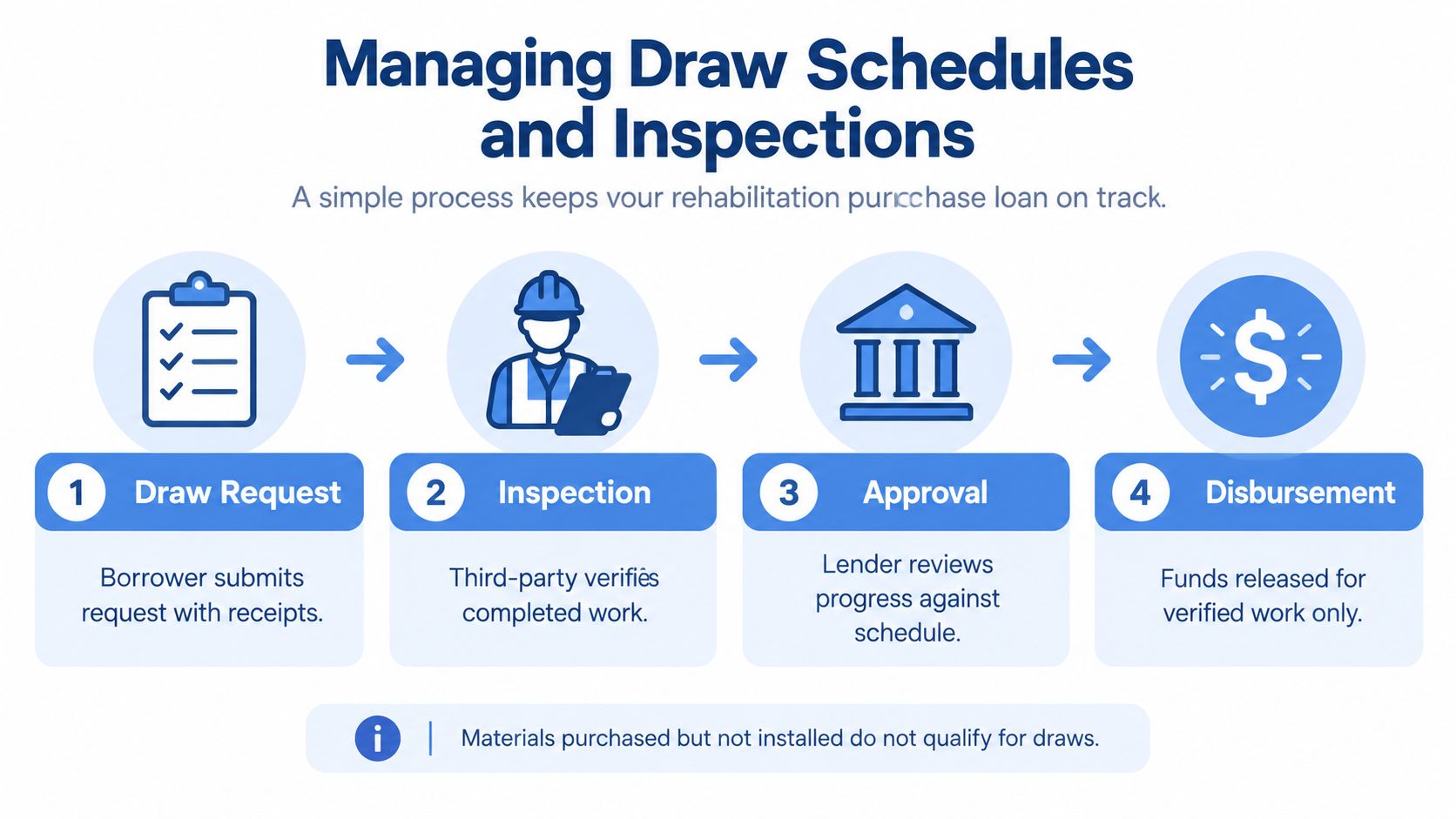
Renovation funds should be released against verified progress, not because materials have been purchased. HUD's FHA 203(k) draw procedure requires inspection-based draw requests and says construction items can't be paid until the work is acceptably installed. Materials located at the property alone don't qualify for a draw (HUD 203(k) inspection and draw procedure). Private lenders set their own procedures, so confirm the requirements before work begins.
Set up the draw process before closing
Start with a line-item budget that maps each major task to a construction phase. Ask the lender what it needs to review a draw, how inspections are scheduled, and which documents must accompany the request. Contractors should understand that purchased materials and completed installation may be treated differently.
A practical process includes:
- Document the budget: Match contractor bids to the approved scope and identify which costs are expected in each phase.
- Keep contingency funds available: Don't commit all available cash to the initial budget. A change in scope or unexpected condition can create a funding gap.
- Gather draw documents: Prepare updated invoices and lien waivers where required, and retain records of work completed.
- Request inspections at milestones: Give the inspector access and enough notice to verify progress before the next phase depends on released funds.
- Track remaining proceeds: Reconcile each draw against the approved budget so the project doesn't run short near completion.
Contractors may need cash to mobilize before a meaningful amount of work is installed. Discuss a documented initial mobilization draw with the lender rather than relying on reimbursement for materials that haven't been put in place. That can support the contractor's start while preserving completion-based oversight.
The draw calendar should also match the construction schedule. If a project relies on a contractor being paid promptly after a milestone, account for the time needed to submit the request, complete an inspection, resolve any adjustments, and receive approval. Clarify these steps early so the investor and contractor aren't working from different assumptions.
The following video provides additional context on rehab financing:
Structuring Deals with Private Lending Partners
Private financing can be useful when a non-owner-occupied property needs a fast acquisition, a project-specific review, or a structure that doesn't fit conventional renovation rules. The trade-off is that flexible underwriting doesn't remove execution risk. The lender still needs a credible scope, supportable as-completed value, workable draw plan, and realistic exit.
A private lender may look beyond traditional debt-to-income qualification and focus more closely on the property and project. That can help borrowers who don't fit a bank's standard profile, but it doesn't mean financial capacity is irrelevant. The borrower still needs a plan for closing costs, carrying expenses, delays, and any costs that aren't included in the approved renovation budget.
Evaluate the full financing relationship
Ask prospective lenders to explain how they evaluate a deal, what information they need before issuing terms, and how proceeds are divided between acquisition and rehab. If a lender offers financing for up to 100% of eligible rehabilitation costs, confirm what counts as eligible, what borrowing limits apply to the combined loan, and which conditions must be met before funds are released. A stated rehab funding percentage on its own doesn't tell you how much of the project can be financed.
Compare the full process, not just the loan outline:
- Application and underwriting: Find out which property, contractor, and borrower documents are needed for a decision.
- Closing expectations: Ask what could hold up closing, including appraisal review, incomplete scope details, or title requirements.
- Draw administration: Confirm inspection procedures, documentation, approval steps, and how the lender handles work that needs correction.
- Exit planning: Make sure the proposed sale or refinance remains plausible if the work takes longer than planned or the finished value is lower than expected.
LendingXpress offers bridge, fix-and-flip, and rental property loans for non-owner-occupied residential and commercial properties, with staged rehab draws and underwriting that considers the investment project. Its process may be worth discussing when a borrower needs a private alternative to traditional bank financing, but the final structure should still be judged against the scope, valuation, draw requirements, and exit plan.
For brokers, clear communication matters as much as a quick initial response. Share the purchase contract, scope, bids, and timing needs early, then ask the lending partner to identify unresolved conditions before the buyer commits to a closing schedule. That conversation can expose a funding mismatch while there's still time to address it.
Preparing Your Application and Project Scope
A well-prepared application gives underwriting a coherent story: what the property costs, what work will be done, how the finished value is supported, and how the loan will be repaid. Investors should assemble the scope and contractor information before they need an urgent answer. A rushed package with missing bids or vague descriptions can create avoidable questions at the point when timing matters most.

Prepare a package that can be checked
Bring together the purchase contract, property details, contractor bids, and a line-item scope of work. Explain the work in specific terms so the appraiser and lender can connect the proposed improvements to the projected completed condition. Mark which costs are hard costs and which are soft costs, and ask the lender how each category will be reviewed.
Then document the execution plan:
- Contractor capacity: Provide bids and clarify who will perform the work. If the project depends on self-performed labor, disclose that early and confirm the lender's policy.
- Valuation support: Organize comparable sales that reflect the expected finished condition. Don't rely on the renovation budget as a substitute for evidence of value.
- Draw timing: Link expected requests to construction milestones and allow for inspection and review time.
- Liquidity: Show how you'll handle closing expenses, project costs not covered by the loan, and overruns without exhausting operating cash.
- Exit strategy: Explain whether the plan is a sale or rental hold, and what conditions must be met before that exit is viable.
Investors buying a property should also review acquisition and due-diligence materials alongside the financing package. The Blue Sage Tax & Accounting checklist can help organize acquisition questions so financing review doesn't become the only lens on the deal.
A lender can move more efficiently when the borrower and broker submit a complete, internally consistent package. Make sure the purchase price, scope, contractor estimates, appraisal assumptions, draw milestones, and exit plan all describe the same project. If one changes, update the others before relying on the original financing calculation.
If you're evaluating a non-owner-occupied purchase that needs renovation capital, LendingXpress offers private bridge, fix-and-flip, and rental financing with staged rehab draws. Share the purchase details, scope, and expected exit so its lending team can assess whether the structure fits your project.