
You've got a signed purchase agreement, a renovation budget, and a seller who expects to close quickly. Then the title company sends revised figures, the lender requests another document, and the appraiser flags a condition that nobody addressed during due diligence. The closing date on the contract may look firm, but the real estate closing process is a chain of dependencies, and one unresolved exception can stop the entire transaction.
From a private lending perspective, fast closings don't happen because someone works faster. They happen because the borrower, broker, title officer, appraiser, and lender identify the bottlenecks early and keep them from reaching the final signing table. That matters most for non-owner-occupied investment properties, including fix-and-flips, bridge acquisitions, rental properties, and commercial assets where traditional bank underwriting may not fit the deal.
What the Closing Day Actually Looks Like
A fix-and-flip borrower arrives at a California title company with identification, executed purchase documents, lender paperwork, and wire instructions saved from several separate emails. The private lender has set a 24-hour funding deadline, so the borrower wants every signature completed before the escrow officer's cutoff. The room feels calm, but the transaction has already passed through contract review, title work, valuation, underwriting, insurance coordination, and disclosure requirements.
The title officer confirms the parties, reviews the settlement statement, and checks that the borrower understands the documents being signed. The lender's package may include a deed of trust, promissory note, personal guaranty, entity resolutions, insurance requirements, and instructions for future rehab draws. A notary verifies identity and witnesses the signatures. The borrower's final walkthrough confirmation also matters, particularly when the contract requires the property to be delivered in a specified condition.

The wire is not the closing
Signing documents doesn't automatically mean the deal is funded. Escrow must confirm receipt of the borrower's cash-to-close and the lender's wire, then verify that the deed and security instruments are ready for recording. Depending on the transaction and local practice, keys or access may be released after recording or after the title company confirms funding conditions.
That's why closing day is the culmination of a 30-to-45-day process, not the beginning of one. The federal disclosure framework requires a Loan Estimate and a Closing Disclosure, while title, appraisal, inspection, insurance, and underwriting teams work on separate schedules. A useful video walkthrough for real estate can also help agents and investors document property condition before the final walkthrough, particularly when the buyer is coordinating remotely.
The practical lesson is simple. Treat closing as a regulated sequence of checkpoints. The signing appointment is only the visible endpoint of work that should have been completed well before the funding deadline.
The Closing Timeline From Contract to Keys
The process starts when the seller accepts and the purchase agreement becomes binding. The investor should send the executed contract to the lender, title company, insurance contact, and relevant broker immediately. Early distribution gives each party time to identify inconsistent names, entity details, vesting instructions, purchase terms, or contingency dates.
The sequence that controls the deal
The lender then reviews the application and property. A bank may request extensive personal income and asset documentation. A private lender may focus more heavily on the asset, the borrower's experience, the purchase contract, the exit strategy, and the proposed loan structure. The appraisal, inspection, insurance review, and title search should move in parallel rather than one after another.
The title company searches ownership records and identifies liens, judgments, unpaid taxes, vesting problems, or other exceptions. The appraiser evaluates collateral value, while the inspector identifies physical conditions that may affect the renovation budget or the lender's risk. Underwriting reconciles these findings with the borrower's requested proceeds and the property's projected use.
Federal disclosure rules create a timeline that neither a conventional lender nor a private lender can ignore. The lender must deliver the Loan Estimate within 7 business days of application, and the borrower must receive the Closing Disclosure at least 3 business days before consummation, according to CFPB closing-cost guidance. Those requirements create roughly 6–8 calendar days of minimum timeline friction, even when the rest of the file is ready.

Where investors can gain time
Investors can't remove the disclosure waiting period, but they can prevent avoidable delays before it starts. Send complete documents at application, order title work promptly, schedule the appraisal as soon as the property is accessible, and resolve valuation or title questions before the final disclosure package is issued.
A private bridge lender may also reduce the front end of the process by issuing a term sheet within 48 hours and underwriting primarily against the property rather than requiring a complete conventional income profile. That doesn't eliminate diligence. It changes which facts receive the most attention and allows a lender to make a decision that matches an investment property's risk profile. Investors pursuing a compressed schedule can review bridge-loan options for a 3–5 day closing while confirming that title, valuation, insurance, and disclosure timing can support the target date.
What Closing Costs Are Made Of
A borrower can misread the Closing Disclosure by treating it as one large unexplained total. The document separates charges into loan costs, other costs, and prepaid items, so an investor can compare the final settlement figures with the financing assumptions used to underwrite the deal.
The CFPB reported a $6,000 median closing-cost figure in 2022. Its regulatory analysis also found that median total loan costs on home-purchase loans increased by more than 36% from 2021 to 2023, while the 2022 median was 21.8% higher than in 2021. The CFPB closing-cost review provides the underlying analysis.
Three buckets to reconcile
Loan costs cover lender charges such as origination, underwriting, processing, and discount points. Private and hard money loans may also include points, processing fees, extension fees, or exit fees under terms that differ from conventional mortgage pricing. Confirm which charges are due at closing, deducted from loan proceeds, or triggered only if the loan extends or exits under a specific structure.
Other costs generally include title insurance, escrow or settlement charges, recording fees, government taxes, and related transaction services. These amounts may sit outside the lender's control, but the borrower should confirm who selected each provider and whether the figures match the contract and preliminary settlement statement.
Prepaid items include property taxes, homeowners insurance, and per-diem interest due before the first payment. The Consumer Financial Protection Bureau explains how these charges are handled. They are not lender profit, yet they still increase the cash required to close.
| Category | Examples | Typical Range |
|---|---|---|
| Loan costs | Origination, underwriting, processing, points, possible exit fees | Varies by lender and loan structure |
| Other costs | Title insurance, escrow, recording, transfer taxes | Varies by property, county, and transaction |
| Prepaid items | Property taxes, insurance, per-diem interest | Varies by closing date and coverage |
Calculate cash to close by adding the required down payment or borrower equity, loan charges, third-party costs, and prepaid items, then subtracting deposits and documented credits. Before wiring funds, compare that calculation with the final settlement statement and have the title officer explain every material change.
A flexible private-lender fee structure still requires clear documentation. A closing date that is near does not justify accepting an unexplained figure.
What Private and Hard Money Lenders Require at Closing
Private lending can move quickly because the lender evaluates the transaction through an investment-risk lens rather than applying every conventional employment and income filter. That doesn't mean the file is informal. A lender still needs reliable evidence that the borrower controls the contract, the collateral supports the loan, title can be insured, and the repayment plan is credible.
For an investment property, the appraisal remains central. Under standard conforming guidelines, a one-unit non-owner-occupied property generally requires a 15% minimum down payment, or a maximum 85% LTV, while a 2-to-4 unit investment property generally requires a 25% minimum down payment. Cash-out refinances are generally capped at 75% LTV for one-unit properties and 70% LTV for 2-to-4 unit properties, according to investment-property financing guidance.
Asset value drives the conversation
Fannie Mae defines an investment property as one owned but not occupied by the borrower and requires applicable loans to be underwritten in Desktop Underwriter with an Approve/Eligible recommendation, as outlined in its occupancy-type guidance. Private lenders may use a different underwriting model, with more attention to purchase price, current value, after-repair value, scope of work, liquidity, experience, and exit strategy.
Fix-and-flip loans commonly use short-term debt with a 6–18 month term and may fund at 65–80% LTV, with some programs referencing up to 75% of after-repair value, according to fix-and-flip loan mechanics. Lower debt financing can protect the lender from valuation changes, cost overruns, and an extended sale period, but it also means the borrower must bring more equity.

Rehab money arrives in stages
A rehab budget isn't automatically available as unrestricted cash at closing. Under a rehab draw schedule, the lender releases renovation funds after a work phase is completed and verified through an inspection. The borrower submits a draw request, the lender or third-party inspector reviews the work, and reimbursement follows when the milestone clears, as described in this rehab draw schedule explanation.
Milestones may include initial closing, demolition, rough-in, finishes, and final completion. Borrowers should provide a clear scope of work, contractor information, budget, permits where applicable, and a realistic sequence. A low-rate loan that funds too slowly can create more pressure than a flexible structure with transparent draws and responsive inspections.
Where Closings Actually Stall
The riskiest part of a closing usually isn't the final signing. It's the unresolved dependency that reaches the final week without an owner, deadline, or documented solution. A borrower may be ready, but the deal still cannot fund if title has an unreleased lien, the appraisal needs clarification, or the lender is waiting for a missing entity document.
One NAR survey found that nearly 80% of contracts closed on time, while 17% were delayed and 5% were terminated. Among delayed closings, financing represented 30%, home inspection or environmental issues 19%, appraisal 18%, and title or deed issues 11%, according to the closing-delay survey summary.
Rank the exceptions before they rank you
Financing problems deserve early attention because the lender may need additional proof of liquidity, experience, insurance, or repayment capacity. Pre-qualification should be based on the actual property and proposed structure, not just a casual discussion of the borrower's credit profile.
Inspection issues require a written decision. If the report identifies roof, structural, electrical, plumbing, environmental, or access concerns, the borrower and agent should decide whether to renegotiate, obtain a specialist report, revise the budget, or proceed under the contract terms.
Appraisal gaps need their own response plan. Ask whether the lender can use additional comparable sales, reconsider the value, reduce proceeds, or require more equity. Title exceptions should be ordered and reviewed immediately after acceptance, not treated as a final-week administrative task.
Operational rule: Every exception needs an owner, a due date, and a written resolution. “Someone is handling it” isn't a closing plan.
The benchmark points to a broader truth. Closings fail less often because people can't sign documents and more often because earlier workflow dependencies weren't resolved before the legal clock began.
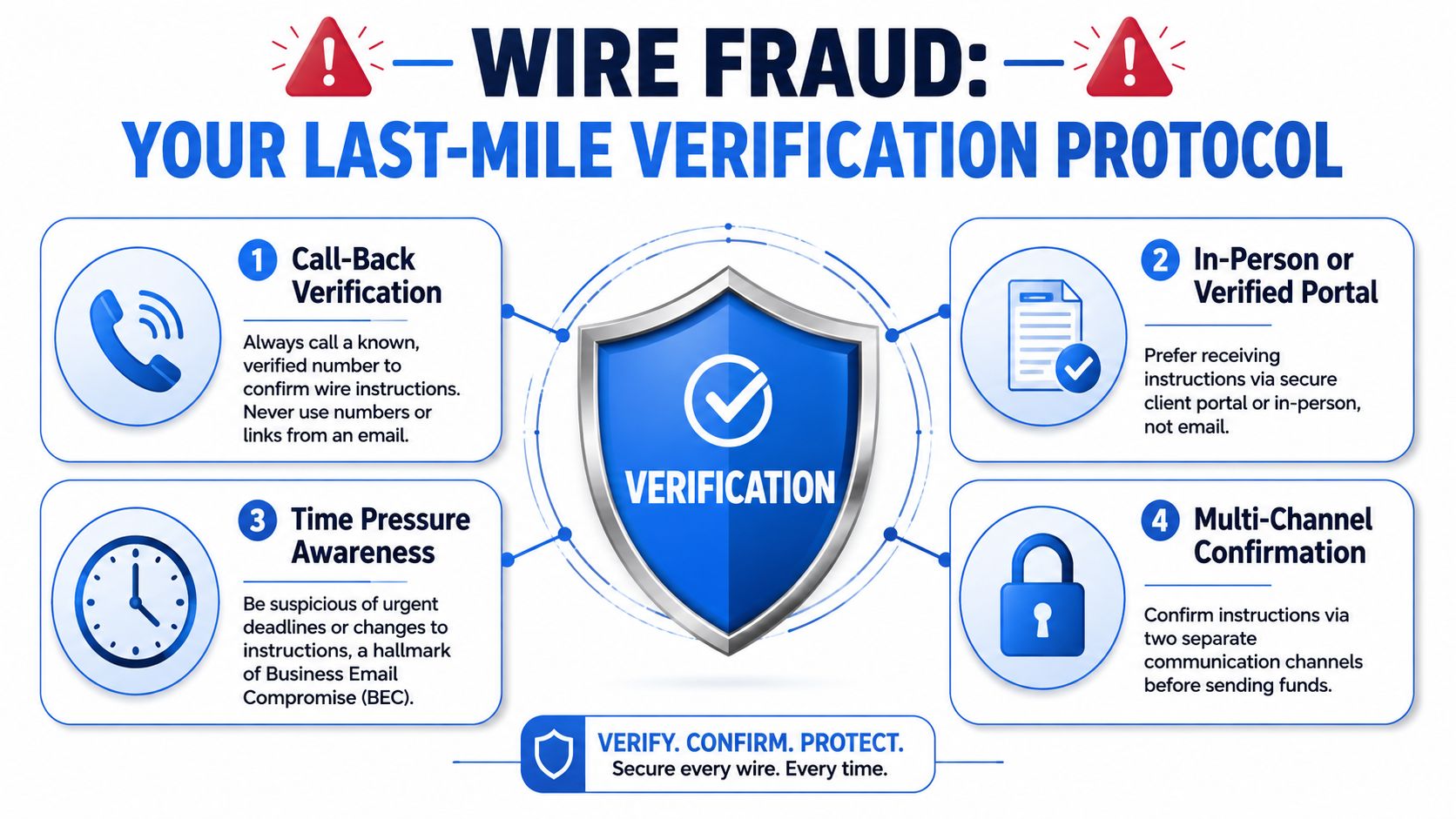
Wire Fraud and the Last-Mile Verification Protocol
Wire fraud must be managed as part of the closing plan, especially during the final 48 hours. Attackers may impersonate a title company, escrow officer, broker, or lender through convincing addresses and urgent instructions. A borrower trying to meet a funding deadline can mistake pressure for proof that a message is legitimate. In private lending, the faster timeline leaves less room to correct a misdirected wire, so verification belongs with the funding controls, not just the buyer's checklist.
Use independent confirmation. Do not click a phone number in an email or reply to the message that supplied the wiring instructions. Retrieve a known number from the title company's established records, call the receiving institution directly, and confirm the account details verbally before releasing funds.
Use more than one channel
A borrower, broker, or agent should use the same repeatable protocol on every closing:
- Retrieve instructions independently: Request wiring instructions through a secure client portal or in person whenever possible.
- Call a known number: Use a verified telephone number for the title company or escrow provider, not contact information in a suspicious message.
- Confirm revised figures: If the settlement statement, cash-to-close amount, or wiring instructions change, stop and reconfirm the change with the title officer and lender.
- Use separate channels: Confirm important instructions through two independent communication methods before releasing funds.
- Protect sensitive details: Do not email wire information casually or forward unverified instructions to other participants.
Borrowers can review the CFPB's closing-document and cash-to-close guidance before funding. For impersonation tactics involving suspicious document and signature emails, consult these Digital Footprint Check phishing tips.
Closing-day control: Verify the recipient independently before verifying the deadline. A fast closing with misdirected funds is not a successful closing.
Practical Checklists for Borrowers, Brokers, and Agents
The right checklist depends on the person responsible for the next decision. Borrowers control document quality and cash readiness. Brokers control lender fit and coordination. Agents control communication, property access, and expectations.
Borrower checklist
Start before submitting the application. Gather the executed purchase agreement, entity documents, identification, property information, photos, renovation scope, contractor details, insurance information, and a clear exit plan. If the lender requests financial statements or proof of liquidity, send complete and legible files in one organized package.
At disclosure, compare the Loan Estimate with the Closing Disclosure. Check the loan amount, rate, points, lender charges, title and escrow costs, prepaid items, credits, and total cash-to-close. Ask questions before the mandatory review period begins, not while you're sitting at the signing table.
Before sending money, independently call the title company using a known number. Confirm the account details, recipient name, amount, and timing. If anyone changes the instructions by email, pause the transfer and require direct confirmation.
Mortgage broker checklist
A fast private-lending relationship starts with accurate positioning. Send the contract, purchase price, requested proceeds, property type, current condition, estimated value, ARV support, borrower experience, liquidity, and exit strategy together. Don't present a speculative renovation budget as a finished underwriting package.
Pre-clear the issues that commonly create rework:
- Title and vesting: Confirm the borrower's entity, vesting preference, lien position, and title commitment status.
- Collateral review: Provide photos, comparable sales, access details, and a coherent valuation explanation.
- Rehab execution: Separate acquisition funds from renovation proceeds and define inspection milestones.
- Closing coordination: Identify who owns the settlement statement, insurance binder, payoff demands, and signing schedule.
Use LendingXpress's loan documentation requirements as a practical reference when organizing the submission. The goal isn't to bury the lender in paperwork. It's to give underwriting the facts needed for a fast, defensible decision.
Real estate agent checklist
Set seller expectations around the difference between a target date and a funded closing. Explain that title, appraisal, inspection, disclosure, and lender conditions can affect the date even when the buyer is motivated. Give the seller prompt updates when a dependency changes, and avoid promising a recording time that the closing parties haven't confirmed.
During inspections and appraisal, make access easy. Keep the property available, preserve agreed repair documentation, and share relevant permits, leases, plans, or disclosures with the appropriate professionals. At the final walkthrough, confirm that the property matches the contract and that agreed items remain in place.
Protect the final transfer. Remind clients that legitimate parties won't ask them to bypass independent verification because a deadline is approaching. A closing process that runs smoothly is built through clear ownership, parallel coordination, and early exception management. It's a system you can operate, not an event you just endure.
LendingXpress structures private and hard money financing for non-owner-occupied bridge, fix-and-flip, rental, and commercial properties, with asset-focused underwriting, staged rehab draws, and closings in as little as three days. Visit LendingXpress to discuss the property, timeline, and capital structure before an avoidable bottleneck puts your closing at risk.