
You found a Texas deal that works on paper, works on price, and fits your plan. The problem is timing. The seller wants a fast close, the property needs work, and your bank is still asking for updated statements, leases, explanations, and another round of conditions.
That’s where bridge loans texas become practical, not theoretical. For non-owner-occupied properties, a bridge loan can give an investor or broker a way to close while the long-term plan is still being built out. Used correctly, it solves a real problem. Used poorly, it becomes expensive drift.
Most articles stop at the basic definition. That doesn’t help much when you’re trying to win a deal in Dallas, stabilize a rental in Houston, or carry a multifamily reposition in Austin long enough to refinance. What matters is how the loan is structured, how a private lender will look at the deal, and how you get out cleanly.
The Texas Investor's Dilemma Speed Versus Opportunity
A common Texas scenario looks like this. An investor gets a call on an off-market duplex, a dated small apartment building, or a single-family flip with clear upside. The price is right because the seller wants certainty, not a buyer who needs a month of back-and-forth with a bank.

If you work with investors long enough, you see the same tension over and over. The best deals rarely wait for conventional financing. The buyer who can move fast usually controls the conversation. The buyer who needs committee approvals usually loses it.
That pressure is one reason Texas has become such an active bridge market. Statewide bridge loan volume increased by 51% year over year between January 2024 and January 2025, and Texas ranked among the top three states for bridge-loan originations, according to AAPL’s bridge and DSCR activity report.
What the investor is really buying
A bridge loan isn’t just money. It’s the ability to say yes to a property before the window closes.
For a broker, that changes the conversation with a client. Instead of saying, “Let’s see whether the bank can get there,” you can ask better questions:
- Can this property support a short-term loan? The asset has to make sense as collateral.
- Is there enough margin? Equity and price discipline matter more than enthusiasm.
- What’s the exit? Refinance, sale, or stabilization has to be realistic.
Practical rule: If the only reason the deal works is because everything goes perfectly, it probably doesn’t belong in a bridge loan.
Why traditional banks often miss these deals
Banks are built for stability. Investors often need flexibility.
A Texas investor buying a property with vacancy, deferred maintenance, title clean-up, lease-up risk, or quick seller deadlines usually doesn’t fit a bank’s ideal file. A private bridge lender can still say yes if the property, deal structure, and exit make sense. That’s the key difference.
When investors understand that distinction early, they stop treating bridge debt like a last resort. They start using it as a tool for timing, repositioning, and control.
What Exactly Is a Texas Bridge Loan
A Texas bridge loan is short-term, asset-based financing used to acquire, refinance, or carry a non-owner-occupied property until the borrower reaches the next step. That next step is usually a sale, a refinance into longer-term debt, or the completion of improvements that make the asset financeable on better terms.
Think of it as a private road built between two points. Point A is the deal you need to close now. Point B is the permanent solution. The bridge is what gets you across when the regular road is too slow, blocked, or not available for this type of property.
What makes it different from a conventional loan
A conventional mortgage starts with the borrower file. A bridge lender usually starts with the asset.
That doesn’t mean the borrower doesn’t matter. It means the property, equity position, and payoff plan carry more weight than a perfect tax return package or a clean W-2 profile. For investors, that’s often the difference between getting funded and getting declined.
Here’s the practical contrast:
| Loan type | Main focus | Typical use |
|---|---|---|
| Conventional bank loan | Full income documentation, long-term stability, lower-risk property profile | Stabilized properties that fit standard guidelines |
| Private bridge loan | Asset value, equity, condition, time sensitivity, clear exit | Fast purchases, transitional assets, rehab, lease-up, delayed refinance |
What bridge loans texas are best for
Bridge loans fit situations where the property is good, but the timing or condition isn’t bankable yet.
Examples include:
- Acquisition of a distressed property where the seller wants a quick close
- Cash-out or rate-and-term refinance on an investment asset that needs seasoning, repairs, or lease-up
- Fix and flip financing when speed matters more than cheapest rate
- Transitional rental property financing before moving into DSCR or bank debt
- Short-hold financing while an investor prepares the property for sale
A bridge loan should solve a timing problem or a property problem. If it doesn’t solve one of those, it may be the wrong loan.
What it is not
It’s not a long-term mortgage. It’s not cheap capital. And it’s not for owner-occupied consumer housing in the context of this guide.
This article is about non-owner-occupied investment properties only. That includes residential investment property, small multifamily, mixed-use in some cases, and other asset-backed investor scenarios where private money can move faster than a bank.
A lot of new investors hear “hard money” and assume it means desperate borrowing. That’s not how experienced operators use it. They use it when they need speed, when the property needs work, or when conventional underwriting can’t catch up to the deal timeline.
The better way to think about it is simple. A bridge loan buys time. Your job is to make sure that time creates value.
How Smart Investors Use Bridge Loans in Texas
A seller gives you 10 days to close on an aging apartment deal outside Dallas. Occupancy is soft, interiors are dated, and a bank wants trailing financials the property cannot support yet. That is the kind of deal bridge debt is built for, but only if the investor already knows how the loan gets paid off.

Smart Texas investors usually use bridge loans in three ways. They reposition an asset, win a time-sensitive acquisition, or cover a real transaction gap. The common thread is not speed by itself. It is a short-term plan that creates a clear refinance or sale option at the end.
Value-add multifamily in a growth corridor
Texas continues to attract population and job growth, and some market participants projected roughly 563,000 new residents between July 2023 and July 2024, according to Insula Capital Group’s review of Texas multifamily bridge markets. That demand keeps older multifamily assets in play, especially properties that are operationally weak but well located.
A bridge loan gives the buyer time to fix the actual problem. On a dated apartment property, that may mean unit turns, exterior work, better management, and a lease-up plan that raises effective income without assuming unrealistic rent growth.
The structure matters as much as the rate. If the renovation scope needs nine months and the property needs another six months to show stable collections, a short maturity with no extension option can create pressure at the worst point in the project. Good borrowers match term, reserves, and draw schedules to the work required, then underwrite the refinance using realistic post-renovation numbers.
Auction and quick-close acquisitions
Texas is competitive enough that clean execution often beats a slightly lower price.
For auction purchases, estate sales, distressed inventory, or off-market deals, private bridge financing can give the buyer proof of funds, fewer financing contingencies, and a closing timeline the seller will accept. In practice, that changes who gets the contract.
The trade-off is straightforward. Fast money costs more, and it should. The investor is paying for certainty, asset-based underwriting, and the ability to move before a conventional lender can finish committee review. That only works if the basis is right on day one.
If you are newer to investment lending, this guide on how to finance investment property shows where bridge debt fits alongside rental loans and other common financing options.
Timing gaps in a 1031 exchange
Exchange buyers run into a different problem. The replacement property is ready now, but sale proceeds, lender timing, or documentation are lagging behind the deal.
A bridge loan can hold the transaction together while the investor completes the exchange or places the next loan. Used correctly, it protects the acquisition and preserves flexibility. Used carelessly, it adds cost to a deal that already has a hard deadline.
The borrowers who handle this well do the prep early. Entity documents, insurance, title work, reserve liquidity, and an identified payoff source need to be lined up before the clock gets tight.
Speed helps only when the file is clean and the exit is credible.
This short explainer is worth watching if you want a quick visual on how short-term real estate financing is commonly used in practice.
What doesn’t work
Bridge debt breaks down when the borrower is using time to avoid a weak plan instead of improve a property.
Common failure points include:
- No real rehab plan. There is no written scope, no budget, and no contractor path.
- No refinance path. The borrower assumes permanent debt will be available later without checking debt service coverage, seasoning, or occupancy requirements.
- No pricing discipline. They overpay and expect short-term financing to cover a bad basis.
- No reserve cushion. Lease-ups take longer, repairs cost more, and insurance or taxes move against the budget.
Experienced investors ask a better question than “Can I get a bridge loan?” They ask whether the bridge period will create enough value, with enough margin, to support the exit they are counting on.
How Private Lenders Evaluate a Texas Bridge Loan Deal
Private lenders underwrite bridge loans with one question in mind: can this property support the loan long enough for the borrower to execute the plan and pay us off?
That is a different standard from bank underwriting. A bank often starts with tax returns, global cash flow, and a long list of policy screens. A bridge lender starts with the deal itself. We still review the borrower, but we spend more time on collateral quality, equity position, and whether the exit makes sense in the existing Texas market the property sits in.
Three factors drive most decisions: the asset, the equity, and the exit.
The asset
Start with the property.
A lender wants to know what the borrower is buying or refinancing, what shape it is in today, and what has to happen during the loan term to improve its value or financeability. That means looking at condition, occupancy, location, access, deferred maintenance, title issues, and whether the property type fits the lender's risk appetite.
A clean single-family rental with light turns is one type of file. A half-vacant retail strip in a tertiary market is another. Both can be financeable, but they will not be sized, priced, or structured the same way.
Execution risk matters here. If the business plan depends on permits, heavy rehab, tenant rollover, or a fast lease-up, the lender will test those assumptions. A good file shows a clear scope, a realistic budget, and a timeline that leaves room for delays. Texas deals often fail because the borrower underestimates how long inspections, repairs, insurance changes, or local approvals will take.
The equity
Equity protects both sides of the transaction.
Bridge lenders care about loan-to-value, but basis often matters just as much. If the borrower is in the deal at a sensible number, the lender has room to work with if the rehab runs over budget or the refinance takes longer than planned. If the borrower is paying top-of-market pricing for a problem asset, the loan gets harder quickly.
In the current Texas market, bridge lenders commonly stay in a moderate LTV range, with sizing moving up or down based on property quality, sponsor strength, and exit clarity, according to market analysis cited earlier. Lower debt usually gives the borrower better terms and more options if the project slips.
I tell brokers to focus less on maximum proceeds and more on durability. A loan that closes fast but leaves no reserve cushion can create problems the first time the contractor misses a deadline or the insurance quote comes in higher than expected.
Why basis matters more than a hopeful pro forma
Private lenders can fund a messy property. We have a much harder time funding a messy capital stack.
If the deal only works with perfect rehab execution, rent growth that has not happened yet, and a refinance the day the property stabilizes, the loan request is too tight. Strong sponsors can still get aggressive structures approved, but they usually bring cash, experience, or other support to offset the risk.
Underwriting lens: A bridge lender can live with property issues. Bad basis and a thin exit are harder to fix.
The exit
In this situation, newer investors lose deals.
A bridge loan should be structured around the payoff before closing, not figured out halfway through the term. The lender wants to know how the borrower plans to take us out, what milestones have to be hit, and what happens if that first plan gets delayed.
Common exits include:
- Sale of the property after cleanup, repairs, lease-up, or better marketing.
- Refinance into DSCR debt once rent roll, condition, or occupancy supports it.
- Bank refinance after seasoning and stabilization.
- Payoff from another capital source or portfolio recapitalization already identified by the borrower.
The strongest submissions show the primary exit and the backup exit. For example, if the plan is a DSCR refinance in six months, the file should also address what happens if rents are in place but seasoning is not, or if debt service coverage comes in lighter than expected. That is the overlooked part of bridge lending. The deal is not just about getting to closing fast. It is about choosing a structure that gives enough time and flexibility to reach a realistic payoff.
In Texas, lender competition can help or hurt you here. One lender may offer a larger loan amount but a tighter term. Another may quote a higher rate but allow extension options, rehab holdback flexibility, or interest reserves that make the exit more achievable. Smart borrowers compare structure, not just price.
What private lenders care about less
Private lenders usually spend less time trying to fit an investor into a consumer mortgage model.
That helps when the borrower is self-employed, has multiple entities, uneven income, recent write-offs, or a property a bank will not finance in its current condition. Credit, liquidity, and experience still matter. They just do not carry the whole decision on their own.
For brokers and investors, the practical takeaway is simple. Present the property clearly, show real equity, and build the loan around a believable exit. That is how bridge deals get approved, and that is how they get paid off without drama.
Decoding Texas Bridge Loan Costs and Timelines
A Texas bridge loan can save a deal that dies in a bank queue. It can also erase profit if the structure does not match the business plan. Cost and timeline have to be judged together, because the cheapest quote often fails where bridge debt is supposed to help most, which is speed, flexibility, and execution on a property that is not ready for conventional financing.
What the market is showing on pricing
Texas bridge pricing in early 2026 remained high, but lender competition kept a meaningful spread between clean files and tougher deals. As noted earlier, market data on Texas bridge originations showed average rates a little above 10 percent, points a little above 2 percent, and lower advertised rates on select low-risk scenarios.
That spread matters.
A stabilized rental refinance with strong in-place rents, moderate debt, and a clear DSCR takeout will not price like a heavy rehab purchase with title issues and a 10-day close. Both are bridge loans. They do not carry the same risk, and they should not cost the same.
What actually drives the cost
Rate is only one line item. The full cost usually moves up or down based on five practical factors:
- Loan-to-value ratio. More borrower equity usually gets better pricing and more lender confidence.
- Property condition. Deferred maintenance, vacancy, and unfinished rehab increase risk fast.
- Exit strength. A lender will price more aggressively when the refinance or sale plan is specific and believable.
- Borrower experience. Operators who have completed similar projects usually get more flexibility.
- Closing speed. Rush files often cost more because fewer lenders can process them without adding execution risk.
I see borrowers make the same mistake over and over. They compare note rate only, then ignore extension fees, minimum interest, draw fees, legal review, or the cost of a lender who cannot close on schedule. On a competitive Texas deal, a late close can cost more than a one-point difference in pricing.
A simple cost comparison
| Scenario | Usually lower cost | Usually higher cost |
|---|---|---|
| Clean rental refinance | Lower leverage, light documentation issues, clear DSCR exit | Higher leverage, unstable rents, weak backup plan |
| Fix and flip purchase | Cosmetic rehab, experienced borrower, strong basis | Heavy construction scope, rushed closing, thin margin |
| Multifamily reposition | Clear renovation budget and lease-up plan | Vacancy, management issues, unclear timeline |
Timelines matter as much as pricing
In Texas, speed has value on its own. It can win a purchase, protect earnest money, shorten vacancy, or get renovation started before taxes, insurance, and interest eat into margin.
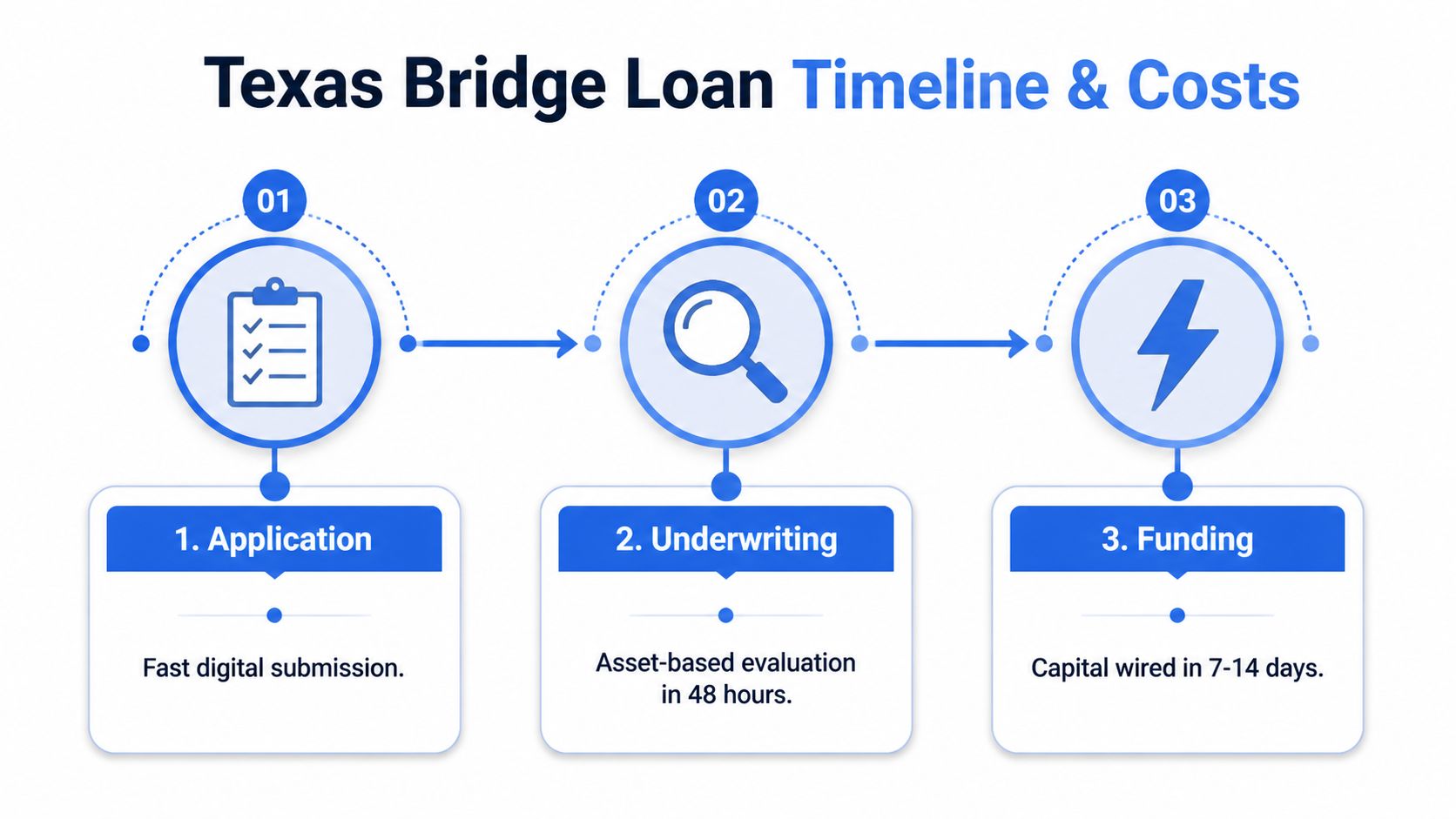
Private bridge loans usually move through three stages:
- Application and document review
- Asset-based underwriting
- Funding after title, insurance, and closing conditions are cleared
On a straightforward file, some lenders can move in days. If the deal needs an appraisal, entity clean-up, rehab budget review, survey updates, or title curative work, expect a longer path. The point is simple. Bridge loans are fast when the file is organized and the lender is built for this product.
Cheap money that misses the closing date is not cheap.
How to judge points, fees, and structure
Points can make sense on a short hold with a defined payoff. They become harder to defend when the borrower has not worked through how long the loan may stay outstanding.
Review the whole structure:
- Rate
- Points
- Extension options and extension cost
- Prepayment terms
- Draw process if rehab is part of the plan
- Reserves or holdbacks
- Actual funding speed
Some lenders want highly standardized files and tighter boxes. Others will fund more nuanced situations if the collateral, basis, and exit make sense. As one example among private lending options, LendingXpress private money programs are built around bridge, fix-and-flip, and rental scenarios where speed and asset-focused underwriting matter.
The right loan in Texas is not always the lowest-priced loan. It is the one that gives enough runway to complete the business plan and enough certainty to reach the exit without expensive surprises at month six or month nine.
Structuring Your Loan for a Successful Exit Strategy
A Dallas duplex goes under contract at a good basis, but the borrower takes a 9-month bridge with a hard prepayment minimum, no extension, and a refinance exit based on projected rents that have not been proven. Rehab runs six weeks long. Lease-up misses the original timeline. By month eight, the deal is still salvageable, but the loan structure has turned a workable project into a maturity problem.
That is how bridge loans go bad in Texas. The issue usually is not the property. It is the mismatch between the loan term and the actual path to payoff.

Start with the exit event
Bridge debt should be built around the payoff event, not just the acquisition. In practice, that means deciding early whether the loan will be taken out by a sale or by permanent financing, then shaping the note around that plan.
The two exits require different loan structures.
| Exit path | Structuring focus |
|---|---|
| Refinance | Enough term to complete rehab, stabilize rents or occupancy, satisfy seasoning if needed, and qualify for the takeout lender |
| Sale | Prepayment terms that do not punish an early payoff, enough time to finish the work, and room in the budget for price cuts if the market softens |
A refinance exit sounds safer on paper, but it fails all the time because the borrower only underwrote the purchase loan. The takeout loan needs its own underwriting before closing the bridge. Rent assumptions, post-rehab DSCR, occupancy requirements, entity documents, insurance costs, and seasoning rules all matter.
Match the note to the business plan
A good bridge structure gives the property enough runway to reach the exit with margin for delay. It also avoids paying for flexibility you do not need.
Focus on the terms that change the outcome:
Term length
Shorter is not automatically better. A 6-month or 9-month note can create pressure on a project that realistically needs 12 months to rehab, lease, season, and refinance.Extension options
A documented extension right is far different from a verbal promise to "work with you later." Review the trigger, fee, notice requirement, and whether new underwriting is required.Prepayment structure
For a sale exit, a declining prepayment schedule or no penalty at all may matter more than a slightly lower rate. For a refinance exit, a minimum interest period can be acceptable if the timeline supports it.Draw administration
Rehab-heavy deals need a draw process that matches contractor reality. Slow inspections or unclear release rules can cost more than an extra point in rate.Reserves and holdbacks
Tax, insurance, interest, and capex reserves can protect the deal if lease-up slips. They also reduce flexibility, so the reserve amount should reflect actual risk, not boilerplate.
A Texas example. Poorly structured versus well structured
Take a Dallas duplex that needs moderate interior work before it can be leased at market rents.
Poor structure:
- 9-month term
- No extension option
- 6 months minimum interest
- Refinance exit based on projected market rents only
- Rehab draws released slowly and only after large completion thresholds
- No interest reserve
That structure leaves very little room for contractor delays, permit issues, insurance changes, or a slower tenanting period. If the units are not fully leased and documented in time, the borrower may miss the refinance window and face default pressure even if the asset is improving.
Better structure:
- 12-month term
- One 3-month extension priced upfront
- Light or no prepay after month 3 if sale is a backup exit
- Refinance underwritten using realistic in-place and post-rehab rent assumptions
- Draw schedule tied to logical rehab milestones
- Interest reserve sized to cover the expected stabilization period
The second loan may carry a higher nominal cost. It often produces a lower total cost because it reduces the chance of forced extension fees, rushed leasing, or a discounted sale.
That is the trade-off many new borrowers miss. The cheapest note at closing is often the most expensive note at month ten.
Underwrite the refinance before you close the bridge
If the expected exit is a refinance, build that file first. Do not wait until the property is finished.
Check these items before closing:
- Who is the likely takeout lender. DSCR lender, local bank, agency, credit union, or another private lender.
- What that lender will need. Occupancy, seasoning, rent documentation, trailing income, appraisal support, and entity requirements.
- What the property must look like at payoff. Fully rehabbed, fully leased, stabilized for a period, or financeable as-is.
- What happens if rates or rents move against the borrower. Margin should exist in the DSCR and loan amount.
- Whether a sale still works as a backup exit. If it does not, the amount borrowed may be too high or the basis may be too thin.
Borrowers looking at Texas private money lending options for bridge and rental scenarios should compare lenders on this point. The term sheet matters, but so does whether the lender understands the likely takeout path for that property type.
Where exits usually break
The failure points are usually ordinary. Rehab takes longer. Insurance costs come in higher. Taxes reset. Rents come in below pro forma. A duplex that looked refinanceable on a spreadsheet is still one vacant unit away from missing the DSCR target.
Good structure accounts for that. Bad structure assumes everything has to go right.
Three mistakes show up often in Texas bridge files:
- Using a sale timeline for a refinance exit
- Taking on a high level of debt without enough cash to carry delays
- Ignoring extension and prepayment language until maturity gets close
A bridge loan should give the borrower options, not remove them. The strongest structures are built with a primary exit, a backup exit, and enough time to reach either one without negotiating from a weak position.
Choosing the Right Texas Private Lending Partner
A term sheet can look fine and still lead to a bad borrowing experience. In bridge lending, execution matters just as much as pricing. Brokers and investors should spend less time chasing marketing claims and more time testing how the lender handles files.
Questions worth asking early
Start with direct questions. If the lender answers vaguely, that tells you something.
Ask about:
- Texas deal experience. Do they regularly lend on the property type and scenario you’re bringing?
- Actual underwriting process. Who reviews the file, and what can slow it down?
- Fee clarity. Are the points, lender fees, third-party costs, and extension terms clearly laid out?
- Draw administration. If rehab money is involved, how are draws requested and released?
- Maturity handling. If the exit gets delayed, what happens next?
A good lender doesn’t need to promise perfection. They need to explain the process clearly and answer the hard questions before documents go out.
Red flags that show up fast
Some warning signs are easy to miss when you’re trying to save a deal.
Watch for these:
- Vague term sheets that leave major fees or conditions open-ended
- High-pressure lock-ins before the lender has reviewed the actual file
- Shifting negotiation advantage after initial discussions
- Poor responsiveness before closing, which usually gets worse after closing
- No clear draw or extension process
If communication is messy before funding, expect more friction when the loan is active.
What a useful lending relationship looks like
The right partner helps a broker look good to the client. The right partner helps an investor make clean decisions under time pressure.
That usually means:
- Transparent expectations
- Reasonable document requests
- Honest feedback on whether the exit makes sense
- Consistent communication from quote to closing
If you’re comparing private lending options, this overview of private money lenders for real estate investors can help frame what to look for in a lender relationship beyond headline rate.
A bridge lender should make the path clearer, not more confusing.
Frequently Asked Questions About Texas Bridge Loans
Can I get a bridge loan for raw land in Texas
Sometimes, but it depends heavily on the lender and the exit. Raw land is harder than improved property because there’s usually less immediate income support and fewer clear takeout options. Many lenders prefer improved residential or commercial investment assets with a more obvious path to refinance or sale.
If the land has a strong business purpose, clear collateral value, and a believable payoff plan, some private lenders may consider it. Expect tighter terms and more scrutiny.
What happens if my property doesn’t sell or refinance before the term ends
Bridge loans become serious when the maturity date arrives and the loan hasn’t been paid off; the borrower usually needs an extension, a refinance with another lender, a sale, or additional capital to reduce risk and satisfy the current lender.
That’s why exit strategy work upfront matters so much. Don’t assume an extension will be automatic. Ask about extension rights, fees, and conditions before you close.
Do I need a certain credit score to qualify
Private bridge lenders usually look at the full file rather than using one number as the whole decision. Credit still matters because it says something about payment history and risk habits, but in investor bridge lending, the asset, loan-to-value ratio, and exit often carry more weight than they would at a bank.
A weaker credit profile can sometimes be offset by a strong property, less debt, more reserves, or a borrower with a credible track record.
Can a bridge loan cover 100 percent of my purchase price
Usually, no. Most bridge lenders want the borrower to bring real equity into the deal. That keeps the borrower invested and gives the lender a protective cushion.
In some cases, a lender may finance a high percentage of the purchase if the asset was bought well below value or if another part of the structure supports the risk. Rehab costs are a separate question and may be financed differently from the acquisition balance.
Are bridge loans only for fix and flip deals
No. Fix and flip is common, but it’s not the only use. Investors also use bridge financing for rental acquisitions, lease-up situations, multifamily repositioning, cash-out refinances on transitional properties, and timing gaps where conventional financing can’t move fast enough.
The unifying idea is simple. The property or timing isn’t ready for permanent debt yet, but there’s a clear path to get there.
If you’re working on a non-owner-occupied property in Texas and need a lender who understands bridge financing from the asset, financing structure, and exit side, LendingXpress can review the scenario and help you determine whether short-term private capital fits the deal.