
You’ve got a rental deal in Ohio that makes sense on paper. The rent is there. The neighborhood is familiar. The exit is clear. Then the bank asks for tax returns, pay stubs, debt-to-income calculations, entity documents, explanations for write-offs, and a timeline that drags long enough to put the deal at risk.
That’s where many investors get stuck. The property works, but the financing lane doesn’t. Traditional mortgage underwriting is built for owner-occupants with clean W-2 income, not investors buying non-owner-occupied rentals through LLCs, stacking multiple properties, or writing off aggressively on their taxes.
DSCR loans solve that mismatch. For Ohio investors, they’re often the most practical way to buy or refinance rental property based on what matters most: whether the asset can carry the debt. If you’re searching for dscr loans ohio, the primary question usually isn’t what DSCR stands for. It’s whether this loan structure can help you close faster, qualify more easily, and keep scaling without your personal income becoming the bottleneck.
Tired of Traditional Banks Rejecting Your Ohio Rental Deals?
A familiar version of this happens every week. An investor finds a rental in Columbus, Cincinnati, Cleveland, or a smaller Ohio market where the price point still leaves room for cash flow. The numbers look workable. The borrower has experience. But the bank underwriter doesn’t like the tax returns, the borrower already owns several financed properties, or personal debt-to-income comes in too tight.
The deal stalls even though the property itself is solid.
That’s the core frustration with conventional financing for investment property. The bank often spends more time analyzing the borrower’s personal file than the rental itself. If your income is irregular, you’re self-employed, you write off expenses the way investors should, or you hold multiple properties, that file can look weaker than your actual business performance.
Traditional banks often reject the borrower’s profile, not the rental’s economics.
DSCR financing was built for that gap. Instead of centering the approval around W-2 income and personal DTI, the lender looks at whether the property’s rental income supports the payment. For investors buying non-owner-occupied property, that changes the conversation completely.
What investors usually run into with bank loans
- Personal income scrutiny: Tax returns can hurt more than help when you’ve optimized for write-offs.
- Property count limits: Some borrowers hit resistance once they own several financed rentals.
- Slow decisions: Delays create real risk when sellers want certainty.
- Underwriters who don’t think like investors: A solid rental strategy can get treated like an exception instead of a business plan.
A DSCR loan doesn’t make every deal financeable. Weak properties are still weak properties. But it does align underwriting with how rental investors operate. If the property can support the debt and the rest of the file is workable, you have a financing path that fits the business.
That’s why DSCR has become such a useful tool in Ohio. It gives investors another option when the bank says no for reasons that have little to do with the asset.
How DSCR Loan Underwriting Unlocks Investment Properties
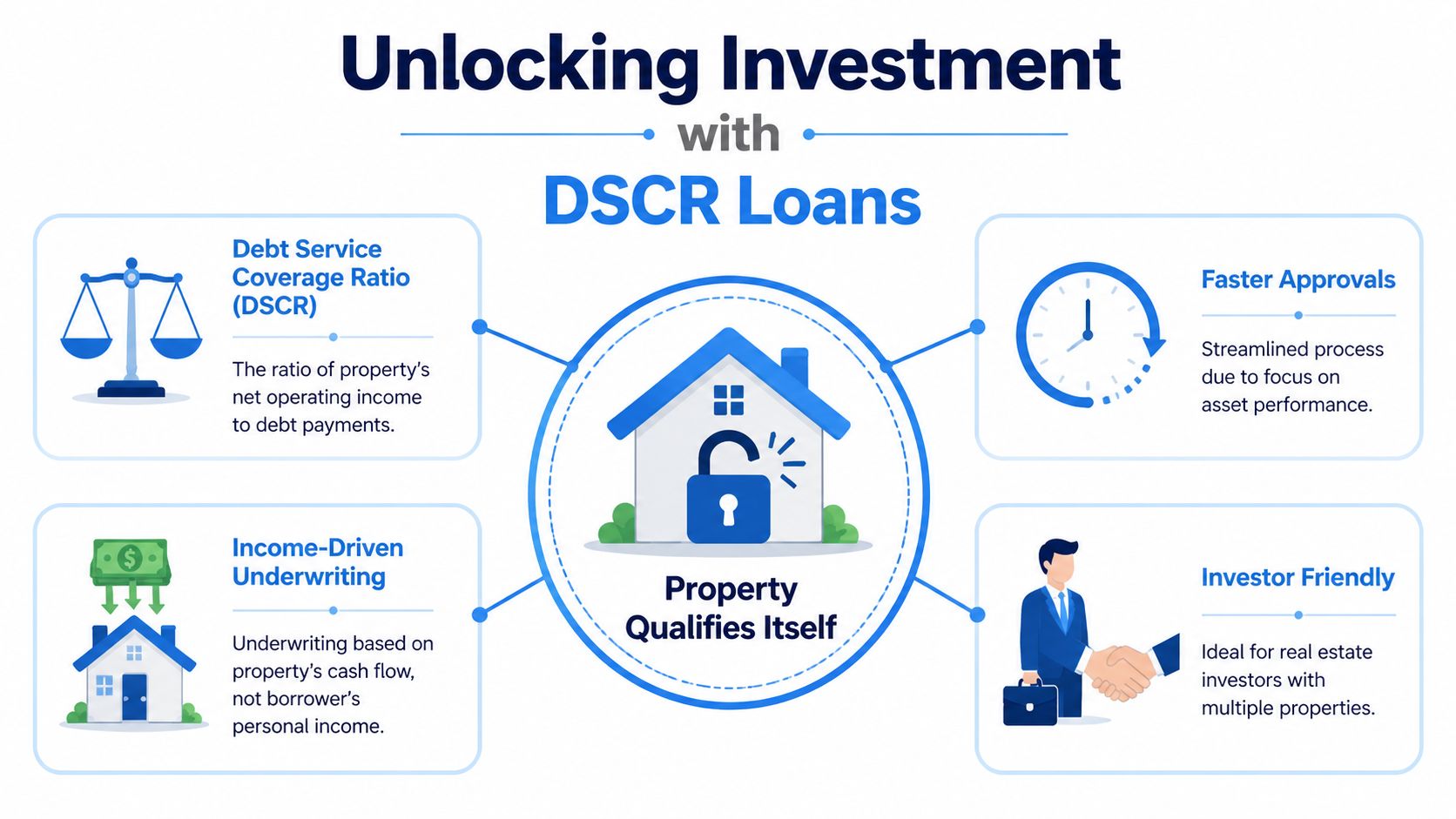
The simplest way to think about a DSCR loan is this: the property qualifies itself.
That’s what makes it different. Instead of asking whether your personal income can support the mortgage, the lender asks whether the rental income from the property can cover the monthly housing expense tied to that property.
What DSCR means in plain English
DSCR stands for debt service coverage ratio. In practical terms, it measures how well the property’s rent covers its debt obligation.
If the monthly rent is higher than the monthly debt service, that ratio improves. If rent barely covers the payment, the ratio gets tighter. If rent falls short, the ratio drops below break-even.
The important shift is underwriting logic. Ohio DSCR underwriting removes personal debt-to-income calculations entirely, and some lenders can approve borrowers with DSCR ratios as low as 0.80 when compensating factors such as 660+ credit scores or lower LTVs are present. That structure can let investors access capital 30 to 40 percent faster than conventional loans, with closings in as little as 21 days, according to Launch Financial Group’s Ohio DSCR lending guide.
What lenders focus on instead of your personal DTI
A DSCR file is still underwriting. It’s just different underwriting.
Lenders usually spend their attention on a smaller set of variables tied to the property and the overall risk profile:
- Property cash flow: Can the rent support the payment?
- Credit profile: Better credit usually opens better pricing and improved financing opportunities.
- Down payment or equity: More equity can offset a tighter DSCR.
- Reserves and experience: These matter more when the deal is thin or transitional.
A practical way to read the ratio
If a property rents cleanly and the projected payment leaves room, the file tends to move smoothly. If the deal only works when every assumption is optimistic, expect friction.
That’s why experienced investors don’t treat DSCR as a checkbox. They treat it like a screening tool. Before they make an offer, they ask a simple question: does the property support itself at realistic rent and realistic financing terms?
Practical rule: If the property only qualifies when you stretch rent assumptions, trim expenses, and expect best-case pricing, the file is weaker than it looks.
Why this helps investors scale
Traditional underwriting often penalizes success. The more properties you own, the more debt shows up. The more advanced your tax planning, the lower your personal income may appear on paper. DSCR loans bypass that bottleneck because the lender isn’t building the approval around your personal DTI in the first place.
That’s the key value of dscr loans ohio investors care about. It’s not just convenience. It’s the ability to keep buying without every new property forcing a full re-litigation of your personal finances.
For an investor trying to move quickly on a rental acquisition, refinance a stabilized asset, or hold property in an entity, that can be the difference between growing a portfolio and getting trapped in underwriting delay.
DSCR Loans vs Traditional Mortgages A Side-by-Side Comparison
For an investor, the choice isn’t abstract. You’re choosing between two underwriting systems that reward different borrower profiles. If you want the lowest-cost conventional money and your personal file is clean, a traditional mortgage can still be useful. If speed, flexibility, and portfolio growth matter more, DSCR often fits better.
Here’s the side-by-side view.
DSCR Loan vs. Traditional Mortgage for Ohio Investors
| Feature | DSCR Loan | Traditional Mortgage |
|---|---|---|
| Income verification | Primarily based on property cash flow | Primarily based on borrower personal income |
| Debt-to-income ratio | Generally not the core approval standard for the loan structure | Strictly reviewed and often decisive |
| Best fit | Real estate investors buying non-owner-occupied rentals | Borrowers with straightforward personal income and fewer complexities |
| Property count flexibility | More investor-friendly for borrowers building portfolios | Can become restrictive as financed property count grows |
| Speed | Often faster and more streamlined for investment property | Often slower due to broader personal documentation review |
| Tax return sensitivity | Less dependent on personal write-offs and business deductions | Tax returns can reduce qualifying income |
| Entity borrowing practicality | Common for investor ownership structures | Often less flexible depending on lender program |
| Underwriting mindset | Asset-focused | Borrower-focused |
Where DSCR clearly wins
The biggest advantage is alignment. DSCR lending matches the way many investors operate. It doesn’t punish you for being self-employed, writing off expenses, or owning multiple rentals.
It also cuts down a lot of friction. Instead of proving your whole financial life again for each deal, you’re proving that a specific asset is a workable rental.
If you’re weighing financing paths for your next non-owner-occupied property, this guide on how to finance investment property is a useful next read.
Where conventional loans can still make sense
A traditional mortgage can still be the better fit when:
- Your personal income is easy to document
- You’re not trying to scale quickly
- You’re optimizing for rate over flexibility
- The lender is comfortable with your full borrower profile
But that’s not most active investors. Most experienced operators care about certainty of close, cleaner underwriting, and the ability to repeat the process across multiple deals.
That’s where DSCR becomes a business tool, not just a loan product.
How to Qualify for a DSCR Loan in the Ohio Market
Qualifying for a DSCR loan in Ohio is usually straightforward if you know what lenders are looking for before you apply. Most problems happen when borrowers assume the property alone will carry the file. It won’t. The property leads the underwriting, but the rest of the borrower profile still affects terms, borrowing capacity, and deal structure.

Start with the three numbers that drive most outcomes
In Ohio, most DSCR lenders require a minimum credit score of 620, borrowers with scores over 720 usually get the best terms, a 20 to 25 percent down payment is standard though some lenders accept 15 percent, and a DSCR of 1.15 or higher typically gets the best pricing and highest financing amount. Loan decisions can often be made in 24 to 48 hours, according to New American Funding’s Ohio DSCR loan page.
Those are the three numbers investors should pressure test first:
- Credit score
- Equity or down payment
- Property DSCR
If one of those is weak, the other two usually need to be stronger.
What stronger and weaker files look like
A borrower with strong credit, a healthy down payment, and a property that comfortably covers debt service usually gets the cleanest execution. A borrower with a borderline score and a thin DSCR might still get approved, but the pricing and LTV usually won’t look as attractive.
That’s the trade-off many investors miss. Approval and favorable terms are not the same thing.
A file can be financeable and still be expensive. Strong investors separate “can close” from “worth closing.”
A practical qualification checklist
Use this before you apply for dscr loans ohio programs.
- Credit readiness: Pull your score first. If you’re near the minimum, expect tighter financing terms and more scrutiny.
- Down payment plan: Know whether you’re bringing standard equity or trying to push lower down.
- Rent support: Make sure the property’s market rent can support the planned payment.
- Entity setup: If you’re closing in an LLC or similar structure, have those documents ready early.
- Liquidity and reserves: Even when not the headline item, liquidity helps weaker files.
- Clean property story: Lenders like properties that are clearly rentable and easy to understand.
How appraised rent affects the file
In many DSCR transactions, the appraiser doesn’t only estimate value. The appraiser also supports the market rent analysis used in underwriting. That matters because investors sometimes underwrite to pro forma rent that’s ahead of current condition or market evidence.
If your number is aggressive and the appraisal comes in lower on rent, the DSCR can compress quickly. That can change terms or force a larger down payment.
What borrowers should prepare before submitting
A smoother DSCR file usually includes the basic transaction documents plus enough support to keep underwriting from chasing missing items.
Have these organized:
- Purchase contract or payoff information: Depends on whether it’s a purchase or refinance.
- Entity documents: If title will vest in a business entity.
- Property insurance details: Carriers and quotes often come into the review.
- Lease or rent support: If the property is occupied, current lease terms matter.
- Bank statements or reserve evidence: Especially useful if the property isn’t a slam dunk.
If you want a product-level overview before comparing programs, review the core DSCR loan options here.
What usually does not work
Investors run into trouble when they do one of three things. They overestimate rent, underestimate payment pressure, or wait too long to discuss a marginal file with a lender who understands investor deals.
Another common mistake is treating a DSCR loan like a bailout for any weak acquisition. It isn’t. If the property’s income story is poor and the borrower has no compensating strengths, this structure won’t fix the fundamentals.
The best DSCR approvals are boring. The property rents well, the borrower is organized, and the file tells a simple story.
Ohio DSCR Loan Rates Terms and a Sample Scenario
A deal can look good at the purchase price and still fail once debt service hits the spreadsheet. That is why Ohio investors should price the whole loan structure, not just the note rate. Rate, points, amortization, prepay terms, reserves, and any interest-only period all affect whether a property helps your portfolio grow or slows it down.

For historical context, in the first quarter of 2026, Private Lender Link’s Ohio residential long-term rental market snapshot reported an average DSCR loan interest rate of 7.10% on 1,017 funded loans, with an average loan amount of $191,972. That same snapshot showed median 2-bedroom home prices around $167,205 and median rents of $1,149 per month in Ohio’s long-term rental segment, according to Private Lender Link’s Ohio residential long-term rental market snapshot. Those numbers are useful as a baseline, not a live quote sheet.
Actual pricing moves with the file. Stronger DSCR, better credit, higher equity, more reserves, and a cleaner property story usually get better terms. A marginal file gets priced for risk, and that can show up as a higher rate, more points, a lower max LTV, or all three.
What terms usually look like
Most Ohio DSCR loans still center on 30-year fixed amortization. Some lenders also offer interest-only periods or longer amortization structures to reduce the monthly payment. That can help cash flow on the front end, especially for a property that is stabilizing, but it often comes with a pricing trade-off or a stricter review of reserves and exit strength.
The practical question is simple. Does the payment fit the business plan?
For a stabilized single-family rental, plain 30-year fixed debt is often the cleanest option. For a property coming out of rehab or turning over tenants, a temporary interest-only structure can protect cash flow during the first few months. For an experienced investor working a thin or sub-1.0 DSCR file, structure matters even more because the right payment can keep the deal financeable long enough to reach stronger rents and refinance later.
A simple Ohio-style scenario
Assume an investor is buying a rental near the price range reflected in that Q1 2026 Ohio snapshot and expects rent near the statewide median for a similar unit type. That is not enough to approve a loan, but it is enough to screen the deal before spending money on appraisal, inspection, and lender fees.
Start with gross rent, then back into the full monthly obligation. Use principal and interest, property taxes, insurance, and any HOA dues. If the ratio is comfortably above the lender’s target, the file is probably worth pursuing. If it lands near break-even, the investor needs to look harder at loan structure, down payment, and whether the property has a credible path to stronger income.
That is where experienced investors separate good acquisitions from busy ones. A lower rate helps, but a larger down payment or an interest-only period can sometimes do more for monthly coverage than chasing rate alone.
How investors should underwrite the deal
A practical review usually looks like this:
- Confirm market rent with real comps. Use signed leases, property manager opinions, and nearby closed rental data when possible.
- Model the actual payment. Include taxes, insurance, and association dues, not just principal and interest.
- Stress the numbers. Check the deal at a higher rate or a slightly lower appraised rent so you know how thin the file really is.
- Match the term to the plan. Long-term hold, lease-up, and post-rehab refinance each call for a different structure.
- Decide whether the property still works if underwriting comes in tighter than expected.
If the answer is yes, the property is a real DSCR candidate. If the answer depends on perfect rent, perfect timing, and perfect execution, it is probably too thin for standard terms.
Here’s a quick explainer that helps visualize how investors evaluate these structures:
What works and what does not
The best Ohio DSCR deals usually share the same traits. The basis is reasonable, the rent support is real, the payment leaves room for error, and the investor chooses terms that fit the hold period.
Weak deals usually break in predictable places. Rent was overstated. Taxes were underestimated. The borrower picked the cheapest headline quote instead of the structure that matched the property.
Ohio still gives investors a real advantage because entry prices are often more manageable than in higher-cost states. That creates more room to make DSCR work. It also creates opportunity for investors who know how to present a sub-1.0 file properly, with stronger reserves, more equity, and a clear plan to improve rents after closing.
Advanced DSCR Strategies for Scaling Your Ohio Portfolio
Most DSCR content stops at the standard playbook. Buy a stabilized rental, show rent coverage above break-even, close the loan, repeat. That works, but experienced investors often need something more flexible.
The underused edge is understanding when a property with a sub-1.0 DSCR can still be financeable.
According to The Credit People’s Ohio DSCR loan overview, while many lenders focus on a minimum 1.0 DSCR, some lenders offer loans on properties with DSCRs as low as 0.75. That can be a practical option for value-add properties where current rents don’t yet cover debt service but there’s credible upside after renovation, repositioning, or stronger management.
When sub-1.0 DSCR can make sense
A below-break-even DSCR doesn’t mean the deal is bad. It means the deal needs a stronger story.
That story usually needs to include some combination of:
- Investor experience: The borrower has executed similar projects before.
- Liquidity or reserves: The investor can carry the property through transition.
- A clear exit strategy: Stabilize and refinance, improve and hold, or increase rents through known levers.
- Stronger equity: More cash in the deal lowers lender risk.
Lenders separate operators from speculators. If the property is temporarily weak but the business plan is credible, there may be a path. If the file depends on vague upside and thin reserves, it usually stalls.
Cash-out refinance as a scaling tool
Another advanced use of DSCR financing is the refinance cycle. Investors buy or improve a rental, stabilize it, then refinance based on the stronger asset profile. That can free up equity for the next acquisition without forcing a personal-income underwriting event every time.
Used well, this creates a repeatable portfolio rhythm:
- Acquire below full stabilized value
- Improve operations or condition
- Increase rent strength and DSCR
- Refinance into long-term debt
- Recycle capital into the next property
Portfolio growth without personal-income bottlenecks
The major advantage here isn’t just speed. It’s repeatability. Investors can keep adding rentals without every new loan turning into a fresh analysis of tax returns, business write-offs, and personal DTI strain.
That matters even more in Ohio markets where value-add inventory can still appear at price points that support a realistic stabilization plan. If you know how to manage the transition, sub-1.0 DSCR deals can become a niche worth pursuing, not avoiding.
The key is discipline. These loans are tools for experienced operators, not shortcuts around bad fundamentals.
Choosing the Right Ohio DSCR Lender and Taking the Next Step
The lender matters almost as much as the loan. Two lenders can look similar on a term sheet and perform very differently once the file is in motion.

What to look for in a DSCR lending partner
You want a lender that does four things well.
- Gives clear feedback early: If the file is weak, they should say why.
- Understands investor business plans: Especially if the property is in transition.
- Moves with urgency: Speed matters when the seller has backup offers.
- Explains trade-offs clearly: Rate, loan structure, reserves, and DSCR all interact.
A weak lending partner creates friction by asking the wrong questions late. A strong one identifies pressure points upfront and structures around them when possible.
Good questions to ask before you commit
Before you move forward, ask practical questions:
- How do they handle tight DSCR files?
- Are they comfortable with entity borrowers?
- What tends to delay their closings?
- How do they treat value-add rentals that are not fully stabilized?
- What documentation do they want on day one?
Fast closings don’t come from marketing claims. They come from clear conditions, responsive processing, and a lender that knows what kind of deal it’s looking at.
If you’re comparing dscr loans ohio options, don’t just shop rate. Shop execution. The cheapest quote can become the most expensive loan if missed timelines cost you the deal.
Frequently Asked Questions About Ohio DSCR Loans
The questions that matter late in the process are rarely basic. They usually come up when a deal is close, the DSCR is tight, the property is in transition, or the borrower wants to know whether a lender will stretch on structure instead of declining the file.
That is where experienced investors separate a dead deal from a financeable one.
Ohio DSCR Loan FAQs
| Question | Answer |
|---|---|
| Can I get a DSCR loan if the property’s cash flow is thin? | Yes, sometimes. A thin DSCR does not automatically kill the deal. Lenders usually adjust for risk through rate, down payment, reserves, prepayment terms, and interest-only structure. If the property is close to breakeven and the business plan is credible, there may still be a path. This is one of the least understood parts of Ohio DSCR lending, especially on deals with sub-1.0 in-place DSCR that can improve quickly after rent increases or cleanup. |
| Do interest-only options help DSCR qualification? | They can. Lower initial debt service can improve the ratio during the interest-only period, which gives value-add investors time to raise rents, reduce vacancy, or stabilize operations before full amortizing payments begin. The trade-off is simple. Better near-term cash flow usually comes with a higher rate or different pricing. |
| Can a first-time investor qualify? | Yes, if the rest of the file is strong. Credit, liquidity, reserves, property quality, and down payment matter more than a long track record on many DSCR programs. New investors should expect tighter scrutiny if the property has a messy rent story or needs repositioning. |
| What if the property is vacant when I buy it? | Vacancy is workable if the unit is rent-ready and the lender is comfortable using market rent from the appraisal. If the property still needs rehab, a bridge or rehab loan is often the cleaner first step. Then you refinance into DSCR debt after the asset is stabilized. |
| Are DSCR loans only for single-family rentals? | No. Many lenders will finance non-owner-occupied 1 to 4 unit properties, and some allow small multifamily or mixed rental strategies depending on the program. The real question is whether the income can be documented and underwritten in a way that fits the lender’s guidelines. |
| Can I use a DSCR loan for a short-term rental? | Sometimes. Short-term rental programs exist, but they are not underwritten the same way as long-term rentals. Ask early how the lender treats seasonal income, occupancy history, appraisal support, and local market restrictions. |
| What usually kills a DSCR file? | Rent that does not hold up in the appraisal, missing documents, weak reserves, deferred maintenance, title issues, and a borrower who assumes a lender will finance a property before it is actually rent-ready. Tight files can still close. Sloppy files usually do not. |
| Is a DSCR loan always better than a conventional loan? | No. It is often better for active investors because it focuses on property income, closes faster, and avoids the bottleneck of personal debt-to-income calculations. But if you qualify easily for conventional financing and the terms are better, conventional debt can still be the right move on that specific asset. |
Good lenders do more than issue a yes or no. They explain what is making the file tight, whether the problem is solvable, and which adjustments are worth making before you spend money on appraisal, legal work, and lost time.
If you need a lender that understands investor deals, tight timelines, and non-owner-occupied property financing, talk with LendingXpress. Their team works with real estate investors who need practical answers, fast feedback, and reliable execution when traditional financing falls short.