
You’re looking at a property that needs work. The seller wants a fast close. The contractor says the rehab is manageable. The listing photos are ugly enough to scare off most retail buyers, which usually means there’s room for an investor to create value.
Then the question hits. Do the numbers still work?
That’s the right question. Fix and flip houses can still produce solid profits, but the easy-margin deals are harder to find. In this market, a flip succeeds because the investor buys right, scopes the rehab correctly, keeps the timeline tight, and uses financing that matches the deal. If any one of those pieces is off, profit disappears fast.
A lender sees that clearly. The deals that close smoothly usually have the same traits: realistic ARV, a tight scope of work, enough cash to handle surprises, and an exit plan that exists before closing day. The ones that struggle usually start with optimism and end with change orders, price cuts, and expensive hold time.
Is Now a Good Time to Fix and Flip Houses
A lot of investors are asking the same thing right now. They’ve found a distressed house, run a rough comp sheet, and they’re trying to decide whether this is still a real business or whether the margin has gotten too thin.
The honest answer is yes, fix and flip houses can still work. But they don’t work on loose underwriting or hopeful resale assumptions. They work when you treat the deal like a short-term business project with hard costs, deadlines, and backup plans.
The market itself tells that story. By Q3 2025, U.S. home flipping activity had cooled, with a typical gross profit of $60,000 per flip and a 23.1% ROI, according to ATTOM’s Q3 2025 home flipping report. That’s still meaningful profit. It also tells you margins have tightened, so mistakes hurt more than they did when rising prices covered bad decisions.
What the current market is really saying
A cooling market doesn’t kill flipping. It filters out sloppy deals.
When margins compress, speed matters more. Cost control matters more. Financing matters more. If a lender can’t close fast enough, you lose the deal. If your rehab funds are too tight, the project stalls. If you buy based on a resale number that only works in a perfect scenario, you’re building risk into the project before demo even starts.
Practical rule: In a tighter market, the investor who says no to a bad deal usually makes more money than the investor who forces one to work.
That’s why a disciplined investor can still do well while less prepared buyers get stuck. Distressed properties still exist. Sellers still need certainty. Homes still need repair. Buyers still pay for clean, functional, move-in-ready inventory. The opportunity is there, but the margin has to be protected from day one.
Who still has an edge
Investors with an edge usually have three things:
- Fast decision-making: They can review comps, rehab scope, and financing terms quickly.
- Reliable capital: They’re not waiting on a bank to approve a property in rough condition.
- A defined exit: They know whether the plan is resale first, rental fallback, or quick liquidation if the market softens.
That’s the lens to use for the rest of the deal. Not “Is flipping dead?” but “Can this specific project survive real-world costs and still leave room for profit?”
The Anatomy of a Profitable Flip
A profitable flip is simple on paper. ARV minus total costs equals profit. In practice, that equation only works if every input is grounded in reality.
Treat the deal like a build sheet, not a dream. If one number is wrong, the whole structure leans.
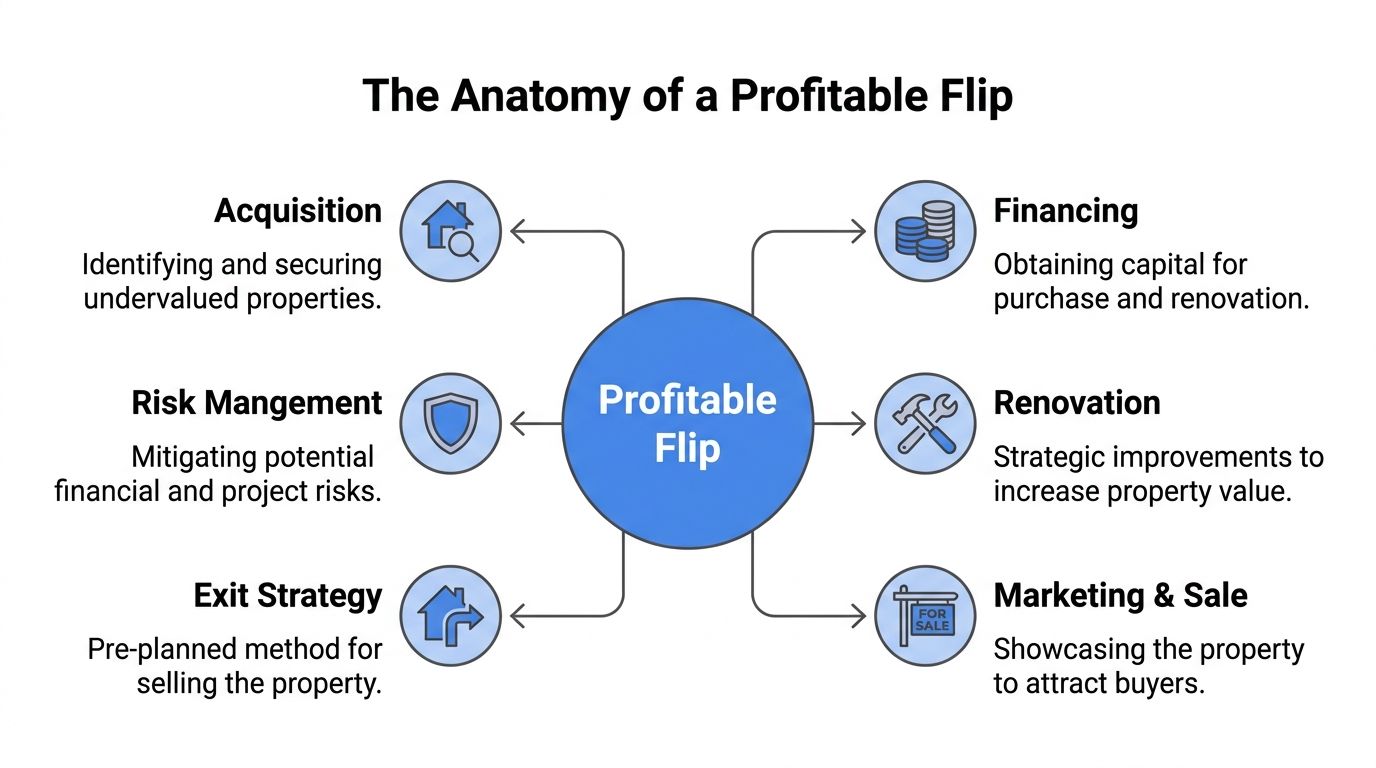
Start with the end value
ARV means after-repair value. It’s the price the property should command after the work is complete. This is not the number you want. It’s the number the market supports based on nearby renovated comparables, buyer expectations, and the actual finish level you can deliver.
If the ARV is inflated, every downstream decision gets distorted. You’ll overpay, overspend, and justify holding costs that shouldn’t exist.
Then account for every cost bucket
Most newer investors focus on purchase and rehab. That’s not enough. A real flip budget usually includes six moving parts.
| Cost component | What it covers |
|---|---|
| Purchase price | What you pay to acquire the property |
| Financing costs | Interest, points, lender fees, and draw-related timing issues |
| Renovation costs | Labor, materials, permits, and change orders |
| Holding costs | Taxes, insurance, utilities, maintenance, and carrying time |
| Selling costs | Listing-side expenses and transaction costs at resale |
| Reserve cushion | Cash left for surprises and delays |
A deal can look great before carrying costs and sale expenses are included. It can look average after. And it can become a loss if the timeline slips.
Buy based on the property’s current condition and your real cost to improve it. Don’t buy based on what you hope a future buyer feels.
The three pillars that hold the deal up
Acquisition discipline
Profit starts at purchase. If you buy too high, there’s no clever financing structure that can fully fix that mistake. Good flips are often won before closing because the investor negotiated hard, moved fast, and stayed inside a strict max offer.
Renovation discipline
The rehab has one job. Increase saleability and support the ARV. That means the work should solve buyer objections, not satisfy the investor’s taste. Functional repairs, clean finishes, and a scope tied to neighborhood standards usually outperform over-improvement.
Exit discipline
The sale is not an afterthought. You need a clear picture of buyer demand, likely days on market, and what happens if the property doesn’t sell on the first listing cycle. A strong exit plan shapes how much risk the entire project can carry.
What works and what doesn’t
A few patterns come up again and again.
- What works: Buying below your ceiling, keeping the rehab aligned with comps, and preserving margin for delays.
- What doesn’t: Stretching on ARV, using a contractor with a vague bid, or assuming the market will bail you out.
- What works: Financing that fits an investor property and a short timeline.
- What doesn’t: Trying to force a conventional process onto a distressed, non-owner-occupied deal.
That’s the anatomy of it. Every profitable flip is just a disciplined version of the same equation.
Mastering Your Acquisition Metrics
The most important number in a flip is the number that tells you when to walk away. That’s why serious investors lean on the 70% Rule.
It’s simple. Maximum purchase price = (ARV × 0.70) – repair costs. The rule exists to leave room for financing, holding costs, selling expenses, and profit. According to Park Place Finance’s fix-and-flip guide, analyses show deals that exceed this threshold result in negative cash flow 65% to 75% of the time.

Why this rule matters
Investors don’t lose money on flips because they missed one thing. They lose money because several small misses stack on top of each other.
The ARV comes in a little low. The contractor adds work that wasn’t in the first bid. The property sits longer than planned. Interest keeps running. Utilities keep running. The price cut comes later, and deeper, than expected.
The 70% Rule creates space for those hits. It’s not magic. It’s a buffer.
A clean example
Park Place Finance gives a straightforward example. If a property has an ARV of $400,000 and needs $50,000 in repairs, the maximum purchase price under the 70% Rule is:
($400,000 × 0.70) – $50,000 = $230,000
That formula matters because it removes emotion. If the seller wants more than that and the deal can’t be restructured, you pass.
Where investors go wrong
They start with the seller’s asking price
That’s backward. The seller’s number has nothing to do with whether the deal works for you.
Start with the exit value. Then subtract repairs. Then protect margin. If the final purchase number doesn’t match the asking price, that’s not your problem. It just means the deal isn’t there yet.
They guess on repairs
Bad rehab estimates ruin more flips than bad interest rates. If your repair budget is soft, your max offer is fiction.
Use multiple contractor bids when possible. Walk the property with someone who can identify major issues early. Be especially careful when the home shows signs of deferred maintenance, water intrusion, old systems, or unpermitted work.
Underwriting habit: If the repair number feels rushed, the offer is rushed.
They treat the rule like a suggestion
In a hot market, some investors stretch. In a tighter market, stretching gets expensive. A disciplined buy box protects you from your own optimism.
A practical acquisition checklist
Before you make an offer on fix and flip houses, confirm these points:
- ARV support: Recent renovated comps support the exit price.
- Repair scope: The scope is detailed enough to defend the budget.
- Margin cushion: The max offer still leaves room after financing and carrying costs.
- Exit clarity: You know who the likely buyer is at resale.
- Walk-away line: You’ve decided your ceiling before negotiations begin.
The investor who wins long term isn’t the one who buys the most houses. It’s the one who avoids paying retail for a problem property.
Financing Your Flip with Speed and Flexibility
Most flips don’t die because the investor lacks ambition. They die because the financing doesn’t fit the deal.
A distressed property, a short hold period, and a non-owner-occupied exit plan usually don’t line up well with conventional bank lending. Banks want stability, clean properties, standard documentation, and timelines that move at their pace. A flip usually needs the opposite. It needs quick certainty, flexible structure, and underwriting that looks at the asset and the exit.
Why traditional financing often breaks down
Conventional lenders are built for long-term homeowners and stabilized assets. That’s not a criticism. It’s just a mismatch.
If the property has condition issues, a renovation need, title cleanup, or a seller who wants a fast close, the bank process can become the problem. Appraisal conditions, property standards, committee review, and slower closings can make a workable deal impossible to execute.
For investors, speed isn’t just convenience. It affects whether you get the contract at all.
What private lending is built to do
Private and hard money loans are designed around the reality of investor deals. The underwriting is more practical. The term is shorter. The collateral matters. The resale or refinance plan matters. The lender expects a project, not a move-in-ready owner-occupied home.
For a fix and flip, the useful features usually include:
- Fast closings: Important when the seller values certainty over top dollar.
- Rehab funding: So you don’t have to fund the entire construction budget out of pocket.
- Asset-based review: Helpful when the property or borrower profile doesn’t fit conventional rules.
- Short-term structure: Better matched to a buy-renovate-sell timeline.
Financing options side by side
| Feature | Traditional Bank Loan | Private / Hard Money Loan (e.g., LendingXpress) |
|---|---|---|
| Approval focus | Borrower income and property condition | Asset value, rehab plan, and exit strategy |
| Speed | Slower and more document-heavy | Faster and built for time-sensitive deals |
| Distressed properties | Often difficult to finance | Common use case |
| Rehab funds | Often limited or cumbersome | Commonly structured through draws |
| Flexibility | Lower | Higher |
| Best fit | Stabilized long-term property | Non-owner-occupied value-add project |
How a fix-and-flip loan typically works
A fix-and-flip loan is usually a short-term loan that covers acquisition and, in many cases, rehab. Instead of receiving all rehab funds upfront, the lender may release them through a draw schedule tied to completed work. That structure helps control risk for both sides.
The investor benefits because less cash is trapped in the project upfront. The lender benefits because funds are released as milestones are verified. On larger or more complex rehabs, that discipline can keep a project from drifting.
Some lenders also structure bridge financing for investors who need to close first and stabilize or improve the property before selling or refinancing.
Where speed actually matters
Speed matters in three places.
First, on the purchase contract. Distressed sellers, wholesalers, and estate sales often favor the buyer who can close quickly and predictably.
Second, at the rehab stage. Delayed funding can slow contractor schedules, which then extends hold time.
Third, at the portfolio level. Investors who can close, renovate, and exit efficiently can move capital into the next project sooner.
That’s why many investors use lenders built for repeat transactional work rather than trying to fit each project into a retail mortgage process.
What lenders want from you
Private lending is flexible, but it isn’t careless. A lender still wants to see that the project is coherent.
Bring a file that answers these questions clearly:
- What are you buying? Property type, condition, and acquisition price.
- What’s the plan? Scope of work, timeline, and budget.
- What is the exit? Resale, refinance, or alternate fallback.
- Can you execute? Relevant experience, liquidity, and contractor readiness.
The cleaner your package, the faster the review tends to go.
A practical way to use financing as leverage
Use financing to improve execution, not to excuse a weak deal. Effective financing helps you move quickly, preserve liquidity, and manage rehab cash flow. Ineffective financing lets you overpay.
That distinction matters.
If you’re comparing options, review how fix and flip loan programs handle purchase funding, rehab draws, property condition, and closing timelines. Those details affect the deal more than a headline rate by itself.
The best financing structure is the one that helps the project finish on time with enough margin left to justify the risk.
A lender should understand that your property is an investment project, not a consumer mortgage file. If they don’t, you’ll feel the mismatch at closing, during draws, or when the timeline tightens.
Executing the Renovation and Managing Timelines
The rehab phase is where a promising flip turns into either a clean resale or a budget leak. Most investors don’t lose control because they chose the wrong paint color. They lose control because the scope was vague, the contractor wasn’t managed, or the project spent too much money on cosmetics before handling the items buyers care about.

Fix functional first
The highest-return rehab plans usually start with the parts of the house that can kill a sale. According to Home Depot’s house flipping guide, functional fixes such as roof or HVAC work can yield 1.2x to 1.5x ROI per dollar spent, while cosmetic upgrades often return 0.8x to 1.1x.
That’s why the rehab order matters.
If the roof leaks, buyers worry about everything else. If the HVAC is failing, fresh flooring won’t save the deal. If electrical or plumbing work is questionable, inspection issues can delay or kill the sale. Cosmetic improvements help once the house feels sound.
Build a scope that people can follow
A workable renovation scope should be specific enough that your lender, contractor, and project manager all understand the same job.
Include:
- Major systems: Roofing, HVAC, plumbing, electrical, foundation, windows
- Interior finishes: Cabinets, counters, flooring, paint, fixtures, appliances
- Exterior items: Landscaping, drainage, siding, driveway, entry curb appeal
- Permit-triggering work: Anything structural or code-sensitive that may affect timing
The more detailed the scope, the easier it is to compare bids and control changes later.
Contractor selection affects profit
A cheap bid can be expensive if it causes missed deadlines, rework, or failed inspections. Investors who flip repeatedly usually care less about the lowest number and more about whether the contractor communicates, stays organized, and understands investor timelines.
If you need a starting point for evaluating bids and screening vendors, this guide on finding the best contractor for house flipping covers the practical side of choosing who should run the job.
A contractor doesn’t need to be flashy. They need to finish what they bid, document progress, and keep the project moving.
Keep the timeline visible
A rehab schedule shouldn’t live in your head. It needs a sequence.
One useful approach is to break the job into milestone stages:
- Trash-out and demo
- Rough repairs and systems
- Inspections and permits
- Interior finishes
- Punch list and cleaning
- Listing prep
That staging helps you monitor whether the job is progressing or just staying busy.
This walkthrough is worth watching if you want a visual sense of how investors think about renovation flow and execution:
How draw schedules help
A draw-based rehab loan can be useful beyond funding. It also adds discipline.
When funds are tied to completed work, the contractor has to hit milestones. The borrower has to keep paperwork and progress organized. The project gets reviewed in chunks instead of becoming a blur of invoices and partial work. That structure doesn’t eliminate problems, but it can expose them earlier.
For fix and flip houses, early visibility matters. A delay found in week two is manageable. A delay discovered near the end of the loan term is expensive.
Mitigating Risk When a Flip Goes Wrong
A lot of fix-and-flip advice assumes the property sells on time, at the expected price, after a clean rehab. Real projects don’t always cooperate.
Buyers hesitate. Contractors fall behind. Permits take longer than expected. A price that looked safe when you bought the house turns into a problem when the market softens or competing inventory hits at the same time.
That’s why risk planning belongs at the front of the deal, not after the listing goes stale. As noted by PropertyRadar’s discussion of flipping homes in an uncertain market, profit margins had dropped to 27.5%, the lowest level since 2007 in that context, which makes contingency planning more important for investors working tighter spreads.
The first risk is pretending there is no risk
A surprising number of weak flips start with one assumption: “If it doesn’t sell, I’ll figure it out.” That’s not an exit strategy. That’s delay.
Before you close, decide what you’ll do if the primary plan fails. For most investors, the backup options fall into a few buckets:
- Lower the scope and sell quickly: If the spread isn’t there for a full rehab, reduce spend and exit faster.
- List aggressively and price realistically: Don’t let ego extend hold time.
- Pivot to a rental: If the property can carry as a non-owner-occupied rental, that may buy time.
- Sell to another investor: Sometimes the best move is to preserve capital, not maximize headline profit.
Know what is draining cash
When a flip stalls, holding costs don’t pause. Interest keeps accruing. Insurance remains due. Taxes, utilities, maintenance, and security keep eating into the spread.
That’s why experienced investors monitor their carry in plain language. Not abstractly. They know what an extra month costs them, and they know how much room remains before the project stops making sense.
Reality check: The longer you wait to make a pricing or exit decision, the fewer options you usually have.
What tends to go wrong
The ARV was too optimistic
This is common. The investor used the highest comp instead of the most relevant one, or assumed a finish level the budget didn’t support.
The fix is painful but simple. Adjust early. Price to the market you have, not the market you underwrote months ago.
The rehab expanded midstream
Scope creep often starts with “while we’re here.” That phrase gets expensive fast.
Changes should either protect the sale or support the exit. If they don’t, they’re usually discretionary and should be questioned.
The timeline slipped
A delayed project often creates a chain reaction. Contractor schedules shift. Listing date moves. Carry costs grow. Seasonal selling windows change. The final buyer pool may be weaker than the one you expected.
Evaluate the rental pivot before you need it
Not every flip makes a good rental, but some do. The key is to test that possibility before closing.
Ask practical questions:
- Would the property rent in its submarket without unusual vacancy risk?
- Could the asset support debt service and operating costs?
- Would a lighter rehab still make the property rentable if resale weakened?
- Would you want to hold this asset, or are you forcing a backup plan?
A rental pivot works best when it’s a real option, not a story you tell yourself to justify a thin deal.
Use reserves the right way
Cash reserves are not there to help you feel better. They exist so a delay, inspection issue, or buyer fallout doesn’t force a bad decision.
Good reserves let you choose. Weak reserves corner you into price cuts, rushed work, or expensive extensions.
That’s one reason many lenders prefer staged rehab funding and conservative borrowing. Those structures can reduce the chance that a project runs out of control before someone notices.
A lender’s perspective on failed flips
When a flip goes sideways, the strongest borrowers communicate early. They don’t hide the problem until maturity. They bring updated numbers, a revised timeline, and a realistic exit path.
The weakest borrowers do the opposite. They avoid the conversation, hope the market saves them, and lose time they can’t afford.
If you want to stay in this business, build every deal assuming you may need to adapt. The goal isn’t to avoid all risk. The goal is to survive mistakes and keep your capital intact for the next project.
Your Next Steps to a Successful Flip
Profitable flipping isn’t about chasing every distressed house that hits your inbox. It’s about running the same disciplined process every time.
Start with the buy box. If the ARV is shaky or the rehab budget is guesswork, pass. If the purchase price doesn’t leave enough room, pass. Good investors protect their downside first.
Then line up the execution pieces before closing. That means contractor conversations, a written scope, realistic timing, and financing that matches a non-owner-occupied rehab project instead of fighting it. Speed matters, but only when the deal itself is solid.
A few practical next steps can keep you out of trouble:
- Review one live deal carefully: Underwrite it with a hard max offer, not a flexible target.
- Pressure-test the rehab plan: Separate functional work from cosmetic work.
- Map the exit before purchase: Retail resale is the primary plan. Decide your backup too.
- Talk to capital sources early: Don’t wait until you’re under contract to learn what a lender needs.
- Stay selective: In a tighter-margin market, one bad acquisition can wipe out the profit from a good one.
The investors who last aren’t the ones who force deals through. They’re the ones who know when the spread is real, when the risk is acceptable, and when the financing supports the business plan.
Fix and flip houses can still be profitable. But the margin has to be engineered. You do that through disciplined acquisition, controlled rehab spending, realistic exits, and financing that gives you room to execute.
If you’re evaluating a deal right now, the smart next move is simple. Put the numbers in front of someone who understands investor properties, short timelines, rehab funding, and what can go wrong before it does.
If you’re buying, renovating, or refinancing an investment property, LendingXpress offers private lending for non-owner-occupied real estate with common-sense underwriting, staged rehab draws, and closings in as little as three days. A quick conversation with an experienced loan officer can help you pressure-test your deal, structure the funding correctly, and move faster when the numbers make sense.