
You found a rental or flip that makes sense. The numbers work, the location is solid, and the seller wants a fast close. Then the bank comes back to the same issue that keeps killing investor deals. Your credit score.
That's usually where people ask, what credit score is needed for an investment property loan? The short answer is that it depends on who's lending and what kind of deal you're trying to do. For non-owner-occupied properties, a bank and a private lender often look at the same file in completely different ways.
If you're buying an investment property, your score matters. It just doesn't always matter in the way people think. In private lending, the property, the equity, the plan, and your exit often carry more weight than a bank-style pass/fail score cutoff.
Beyond the Bank's Rigid Scorecard
A lot of investors run into the same wall. They have a property under contract, maybe one that needs light rehab or needs to close before a conventional lender can move, and the deal stalls because the bank underwriter doesn't like the score, the income documentation, or both.
That frustration is real because banks underwrite investment property loans with a rigid filter. They want a stronger borrower profile from the start, and they often treat credit as the first gatekeeper instead of one part of the overall risk.

Why investors get tripped up
Investment deals don't behave like owner-occupied purchases. Sellers want certainty. Renovation projects need speed. Bridge situations don't wait for a long approval cycle. A borrower can have a workable deal and still get blocked because a bank sees a score issue before it sees the asset.
Private lending flips that order. The first questions are usually practical:
- What is the property worth
- How much equity is in the deal
- What is the business plan
- How does the loan get paid off
That doesn't mean credit disappears. It means credit is evaluated in context.
Banks often ask whether you fit the loan box. Private lenders ask whether the deal itself makes sense.
There's also a broader shift in lending toward looking beyond one score alone. If you want a useful primer on that bigger trend, this piece on alternative data in credit scoring gives good context on why old-school score-only screening is getting challenged.
The practical takeaway
If you're asking what credit score is needed for a non-owner-occupied property, don't assume a bank's answer is the only answer. For investors, the rules are different. A lower score can still work when the collateral is strong, the numbers are clean, and the exit is believable.
That opens up options most borrowers miss.
The Hard Money Perspective on Credit Scores
Private and hard money lenders look at credit through a more deal-driven lens. The score still matters, but it usually isn't the centerpiece. The asset, the equity position, and the repayment plan carry more weight.
According to BE Lending's hard money credit score overview, hard money lenders typically accept credit scores between 550 and 650, and many asset-based lenders have no minimum credit score requirement at all. The same source notes that 600 is often enough for smaller or simpler projects, while a score above 650 can reduce interest rates by 1 to 2 percentage points versus a 580 score on the same deal. It also notes that loan-to-value is often capped between 60% and 75%, which is a major reason the score isn't always the deciding factor.

Where the score ranges usually land
Here's the simplest way to think about it.
| Credit range | What it usually means in private lending |
|---|---|
| 700+ | Stronger pricing and easier leverage conversations |
| 650 to 699 | Often workable for many investment scenarios |
| 600 to 649 | Still financeable, but terms may tighten |
| Below 600 | More deal-dependent and more reliant on collateral |
That framework matches what many investors see in the field. The deal can still get done below bank standards, but the trade-off is usually more equity, a lower debt ratio, or more scrutiny on reserves and exit.
For a deeper look at this loan category, compare current hard money lender loan options against your timeline and property type.
Later in the process, it helps to hear how these loans are discussed in plain English:
What private lenders care about more than score
Capital Funding's approval criteria for hard money lending makes the trade-offs clear. It says minimum score requirements commonly range from 550 to 680, short-term private lenders often accept 600, and many private lenders use 650 as a common minimum. It also says borrowers with lower scores often need 25% to 40% equity or a similar down payment to offset the risk.
Practical rule: A lower score doesn't automatically kill a deal. It usually means the lender wants more protection somewhere else.
That protection usually comes from four places:
- More equity in the property. A smaller amount of borrowed capital reduces lender risk.
- Stronger cash reserves. Liquidity shows you can handle surprises.
- A cleaner project plan. Rehab scope, timeline, and resale or refinance path need to make sense.
- A believable exit strategy. Sale, refinance, or stabilization has to be realistic.
What doesn't work
Weak files usually fail for reasons borrowers don't expect. A vague renovation budget, no reserves, unrealistic after-repair value assumptions, or no clear payoff plan can create more trouble than a middling score.
If you're trying to answer what credit score is needed, the better question is often this: How strong is the deal without the score? In private lending, that's the question that moves a file forward.
What Banks Require for Investment Properties
Conventional financing for non-owner-occupied properties is a different game. The official rules may look reasonable on paper, but practical approval standards are often much tighter.
According to Opendoor's overview of investment property mortgage requirements, the official minimum for non-owner-occupied conventional loans is typically 620, but lender overlays often push the effective minimum closer to 680 to 700, and the best pricing tiers start at 740. That's a major gap between the posted floor and the score many investors need to compete for terms.
The bank checklist is longer than most investors expect
Credit isn't the only hurdle. Conventional lenders also want more cash into the deal and more cash left over after closing.
Rocket Mortgage's guide to non-owner-occupied mortgage rates says investment property borrowers generally need a 20% to 30% down payment for conventional conforming loans, while jumbo investment loans can require 20% to 50% depending on loan size. The same source notes that lower scores can push the down payment requirement higher.
BE Lending's non-owner-occupied mortgage reserve guide adds another challenge. Investment property borrowers typically need six to twelve months of PITI reserves, compared with much lower reserve expectations on many owner-occupied loans.
Side-by-side reality
| Issue | Bank financing for investment property | Private money approach |
|---|---|---|
| Credit score | Often stricter in practice | More flexible when the asset is strong |
| Down payment | Usually larger | Often structured around equity and LTV |
| Reserves | Heavier reserve expectations | Important, but reviewed in context |
| Speed | Slower process | Often better suited to fast closings |
If you want a practical baseline before applying, review common rental property loan requirements and compare them to your current file.
A borrower can qualify for a bank loan in theory and still lose the deal in practice because the process is too slow or too rigid.
For many investors, that's the core issue. The bank loan may look cheaper on paper, but if the property needs a quick close, light rehab, title cleanup, seasoning, or a cash-out bridge, the bank's structure often stops being useful.
How Your Score Interacts with Other Key Factors
A credit score isn't a standalone decision tool in private lending. It's one piece of a larger underwriting picture. The easiest way to think about it is like a four-part puzzle. If one piece is weaker, the other pieces need to be stronger.
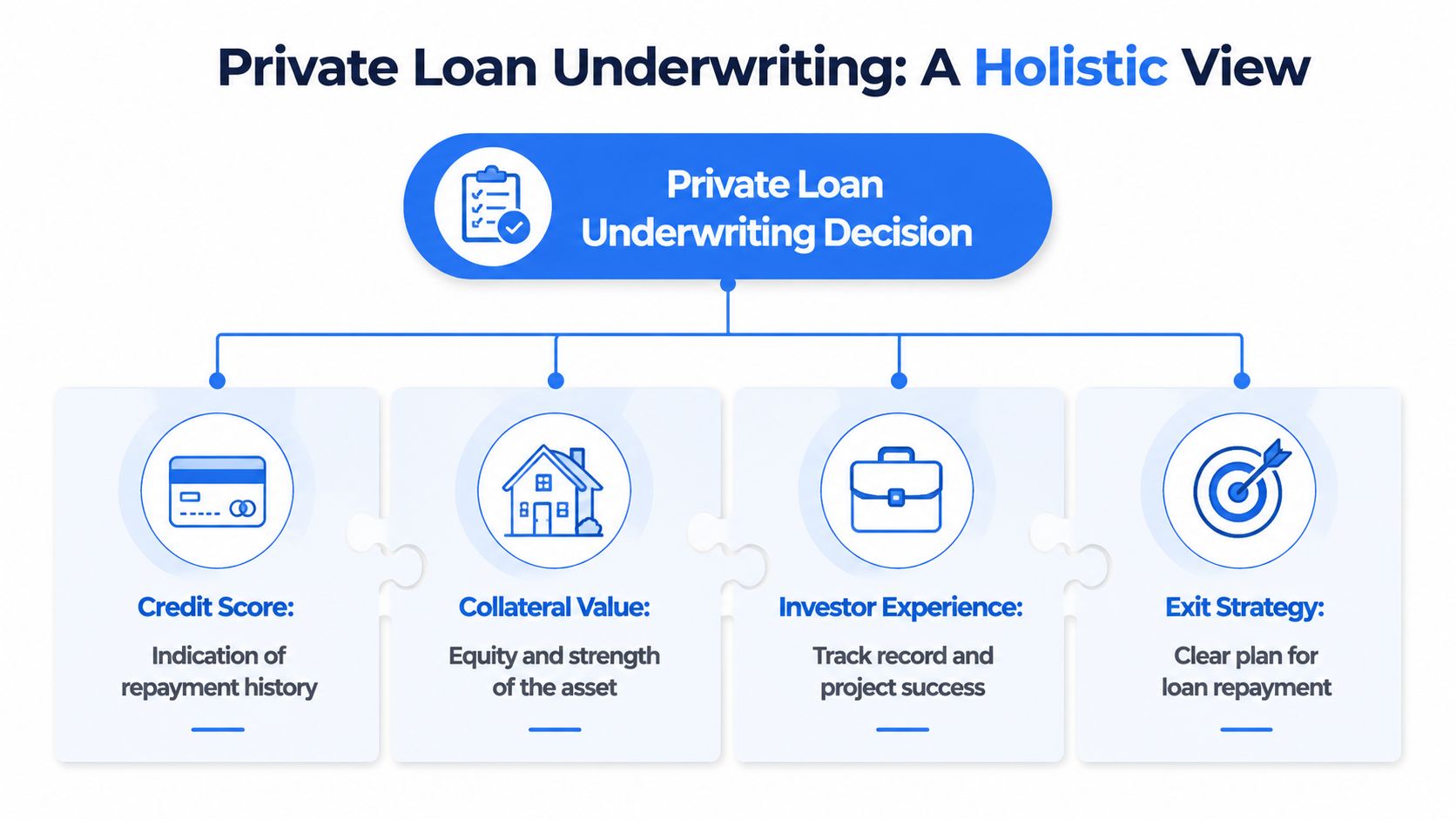
The four pieces lenders look at
Credit history
The score gives a snapshot of payment behavior, but lenders also look at what sits behind it.Collateral strength
Equity and property value can offset credit weakness faster than most borrowers realize.Experience
A borrower with a clean project history usually presents less execution risk.Exit strategy
A clear plan to sell, refinance, or stabilize the property matters a lot.
Biz2Credit's hard money loan requirements guide captures an important shift in modern underwriting. Lenders now put more weight on cash reserves, loan-to-value ratios, and project feasibility, while still reviewing credit for signs of character and financial discipline. That same source notes a key distinction many borrowers miss. A score around 580 may still be acceptable, but recent bankruptcies or active collections can still trigger a denial.
How trade-offs actually work
Investors gain an advantage by understanding the file from the lender's side.
A borrower with average credit but strong liquidity and a modest borrowing request can still look solid. A borrower with a better score but no reserves and a shaky rehab plan can look weak. The score doesn't disappear, but it gets balanced against the rest of the file.
If the property is good, the leverage is conservative, and the payoff path is clear, a lender has room to work.
For rental scenarios, another path comes into play. According to AAA Capital Funding's DSCR loan overview, DSCR loans for non-owner-occupied properties often require a minimum credit score of 660 to 700, and many programs target a DSCR of at least 1.10 to 1.25 for standard pricing. The same source explains that DSCR loans qualify based on the property's income rather than W-2s, tax returns, or personal DTI.
A simple way to assess your own file
Ask these questions before you apply:
Is my financing request realistic
If you're asking for aggressive financing with weak credit, the file gets harder quickly.Can I show liquid reserves
Lenders want to know you can handle carrying costs, delays, and repairs.Is my project plan specific
A clean rehab scope and timeline can help more than a few FICO points.Does my exit make sense today
Sale, refinance, or long-term rental needs to be defensible based on the property.
One practical option in this lane is LendingXpress, which offers private real estate financing for non-owner-occupied properties with a common-sense underwriting approach centered on the asset, debt structure, and business plan rather than a rigid minimum FICO screen.
Improving Your Terms with a Lower Credit Score
A lower score doesn't mean you should accept weak terms without trying to improve the file. In private lending, better preparation often matters more than chasing a small score increase before the deal closes.

What helps right away
Start with the parts of the loan package you can control now.
- Bring a real rehab budget. If it's a fix-and-flip, line-item costs and a workable timeline show the project is grounded in reality.
- Show liquidity clearly. Bank statements and reserve documentation matter because they reduce concern about carry risk.
- Define the exit in one sentence. Sell after renovation, refinance into a rental loan, or stabilize and hold. If you can't explain it clearly, the lender will keep asking.
- Use experience where you have it. If you've done prior projects, present them clearly. If you haven't, partnering with someone experienced can strengthen the file.
What lenders still watch closely
Credit flexibility doesn't mean credit blindness. A lender may work around a lower score, but unresolved issues can still cause trouble.
Watch for these red flags:
- Active collections that suggest current financial instability
- Recent bankruptcy history that hasn't seasoned enough for the lender's comfort
- Incomplete paperwork that makes the file look disorganized
- Overstated property values or unsupported rent assumptions
Clean explanations matter. If there's a past issue on the credit report, address it directly and document what changed.
Focus on lender confidence
The goal isn't to look perfect. The goal is to look financeable.
Borrowers improve their terms when they make the lender's decision easier. A complete package, realistic numbers, visible reserves, and a credible exit can do more for a hard money file than generic credit advice. If you're asking what credit score is needed, remember that private lenders often care just as much about whether you look prepared to execute the deal.
Partnering with LendingXpress for Your Next Deal
For investment properties, the right credit score depends on the loan type, the amount of financing, and the quality of the deal. Banks usually want a stronger score profile, more cash down, and more reserves. Private lending gives investors another route when speed, asset strength, and execution matter more than fitting a rigid underwriting box.
That matters for brokers trying to place a difficult file and for investors trying to close before the opportunity disappears. A score issue may affect loan terms, pricing, or structure, but it doesn't always end the conversation.
LendingXpress works in the part of the market where borrowers need practical solutions for non-owner-occupied properties. That includes bridge scenarios, fix-and-flip projects, and rental property financing where the asset and the plan deserve more attention than a single credit threshold.
If you've been stuck wondering what credit score is needed, the better move is to review the deal as a whole. Property type, equity, reserves, and exit strategy will tell you more than a generic score target ever will.
If you're sizing up a non-owner-occupied purchase, refinance, or bridge scenario, talk with LendingXpress. A quick review of the property, financing, and exit plan can tell you whether the deal is workable and what structure makes sense.