
You found a Florida investment property that fits your strategy. The seller wants a fast close. Your bank wants tax returns, explanations, committee review, and time you do not have.
That is where bridge loans florida become a practical tool, not a last resort.
For non-owner-occupied real estate, speed often decides who gets the deal. The investor who can show proof of funds, move through underwriting quickly, and close without drama usually gets the call back. The investor waiting on a conventional timeline usually gets a polite rejection from the seller or loses the asset to a cash buyer.
A bridge loan works best when the property, the timeline, and the exit all line up. Used well, it helps you acquire, rehab, refinance, or stabilize an asset before longer-term financing takes over. Used poorly, it creates pressure you did not need. The difference is usually planning, not luck.
Why Florida Investors Are Turning to Bridge Loans
Florida investors are dealing with one simple problem. Good opportunities do not wait.
In markets where listings move fast, a seller does not care that your conventional lender might need several more weeks. They care whether you can close on time, whether your financing looks dependable, and whether your process will blow up during underwriting.
That is a big reason bridge loan activity has surged in Florida, and the state has consistently ranked in the top three for volume according to AAPL's market trends report on bridge and DSCR activity. The same report notes a national $2 trillion commercial real estate maturity wall through 2026, which has pushed more borrowers toward flexible financing as banks pull back. It also highlights a $52 million bridge loan for an apartment complex in Orange City, which shows how important this product has become in Florida.
For smaller investors, the logic is the same as it is on larger commercial deals. You need capital that matches the pace of the opportunity.
Why the bank route often breaks down
A conventional lender usually wants a neat file. Clean property condition. Straightforward borrower profile. Plenty of time.
Many Florida investment deals do not look like that.
- The property needs work: Deferred maintenance, lease-up issues, storm damage, or vacancy can make a deal unattractive to a bank.
- The timeline is compressed: Sellers want a short inspection window and quick close.
- The borrower needs flexibility: Investors may need purchase money, rehab funds, a cash-out refinance, or time to stabilize before long-term debt is available.
Private bridge debt fills that gap. It gives investors a way to move now and solve the permanent financing question after the asset is in better shape.
Practical takeaway: If your deal only works with a slow lender, it may not be the right financing plan for a competitive Florida market.
What Exactly Is a Real Estate Bridge Loan
A real estate bridge loan is short-term financing that carries you from one point to the next. Consider it a physical bridge. You use it to cross a gap, not to live on it forever.
For investors, that gap is usually one of these:
- buying before permanent financing is available
- acquiring a property that is not bankable today
- funding a renovation before a sale or refinance
- solving a short-term cash need tied to real estate equity

What makes it different from a traditional mortgage
A bank mortgage is built for stability. A bridge loan is built for movement.
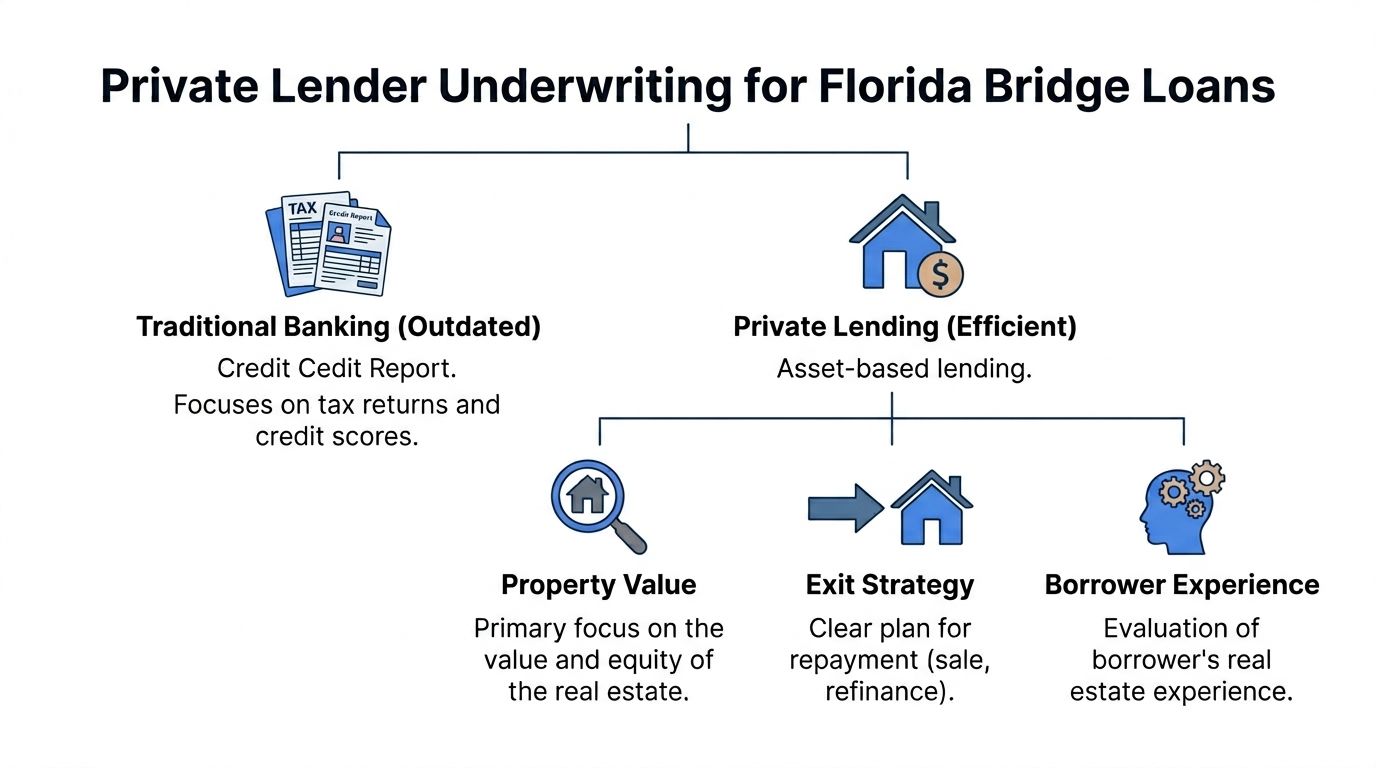
Traditional loans usually focus heavily on income documentation, debt ratios, long approval chains, and property condition standards. A bridge lender still reviews the borrower, but the primary focus is the asset, the equity position, and the payoff plan.
That is why investors use bridge loans on non-owner-occupied properties when a conventional mortgage is too slow or too rigid.
What problem it solves
The core benefit is not just money. It is timing.
If you are buying a distressed duplex, a small multifamily building, a mixed-use property, or a single-family flip in Florida, the deal can fall apart while a traditional lender is still reviewing the file. A bridge loan lets you secure the asset first, then execute the business plan.
Common examples include:
| Situation | Why a bridge loan fits |
|---|---|
| Property needs rehab | Conventional lenders may not like condition issues |
| Seller wants a quick close | Private lenders can move faster |
| Borrower plans to refinance later | Short-term loan buys time for stabilization |
| Investor needs purchase and rehab structure | Asset-based lending can be more flexible |
What bridge loans are not
They are not cheap long-term debt. They are not a substitute for having a real exit strategy. And they are not meant for owner-occupied consumer home purchases in this context.
Used correctly, they are strategic capital. Used carelessly, they become expensive stress.
Think of bridge debt as transaction fuel. You use it to secure control of the property and create the conditions for the next step, usually a refinance or sale.
Key Scenarios for Using a Bridge Loan in Florida
The best way to understand bridge loans florida is to look at the moments when they solve a real problem.

You need to beat slower buyers
A broker sends over a property on Monday. By Tuesday, there are multiple offers. The seller wants certainty more than a slightly higher number.
In that situation, a bridge loan can make your offer behave more like cash. You can shorten the financing contingency, tighten the close, and remove some of the uncertainty that makes sellers nervous.
This matters most on assets with friction. Maybe the property has vacancy. Maybe it needs roof work, interior updates, or cleanup. Those are exactly the deals where a bank's process tends to drag.
You are buying a value-add property
A lot of Florida investors make money by buying something that looks rough and turning it into something financeable.
That could be:
- A dated rental: New flooring, paint, appliances, and lease-up.
- A distressed single-family flip: Cosmetic improvements and resale.
- A tired small commercial building: Cleanup, tenant improvements, and stabilization.
A bridge lender can underwrite the deal based on the current value, the renovation plan, and the likely value after the work is complete. That gives investors room to act on assets that conventional lenders often reject at the front door.
You are between one stage and the next
Some deals are solid, but they are not ready for permanent debt today.
The building may need a few months of seasoning. Occupancy may need to improve. Insurance issues may need to be cleaned up. A title matter may need to be resolved. The sponsor may need time to finish the renovation and then refinance into longer-term debt.
That is the classic bridge use. It buys time for the asset to become financeable on better terms later.
A short explanation from a lending perspective can help here:
You are pulling equity out quickly
Some investors use bridge financing for a partnership buyout, urgent payoff, or cash-out tied to another acquisition. The key question is whether the property has enough equity and whether the exit is realistic.
That can work well when the borrower has a clear next move. It works poorly when the loan is being used to postpone a deeper business problem.
What tends to work and what usually does not
Works well
- clear purchase story
- realistic rehab budget
- short path to refinance or sale
- property with obvious upside after cleanup or repair
Usually does not
- no defined exit
- rehab scope that keeps changing
- borrower counting on perfect market timing
- property problems that are still unknown late in diligence
The strongest bridge deals are not complicated. They are just time-sensitive.
How Private Lenders Underwrite Florida Bridge Loans
Private lenders do not underwrite bridge loans the way banks underwrite conventional loans. The file still matters, but the conversation starts with the property and ends with the exit.
LTV and ARV drive the decision
Florida bridge lending is centered on Loan-to-Value (LTV) and After Repair Value (ARV). According to Price Capital Group's overview of Florida bridge loans for investors, lenders typically cap LTV at 70 to 80 percent to preserve an equity cushion. For renovation projects, financing can reach 70 percent of ARV, and the same source notes that Florida fix-and-flip data shows properties can gain 20 to 40 percent in value after improvement. It also states that this asset-focused model can allow closings in 5 to 10 business days.
In plain language, lenders ask two questions:
- What is the property worth today?
- What should it be worth after the work is done?
Those answers shape the loan-to-value ratio, draw structure, and risk.
The property matters more than paperwork volume
A private lender wants to know whether the collateral makes sense.
That means reviewing things like:
- location
- current condition
- scope of repairs
- comparable sales or rents
- title and insurance issues
- whether the asset is marketable after the plan is completed
A property that is messy but understandable can still get financed. A property with unclear value, unclear scope, and unclear marketability is much harder.
The exit strategy is not a formality
This is the piece many borrowers underestimate.
A bridge lender expects a believable repayment plan. Usually that means a sale, a refinance, or both as backup options. The plan does not need to be fancy. It needs to be credible.
A solid exit usually answers these questions:
| Exit question | What the lender wants to hear |
|---|---|
| How will the loan be repaid? | Sale proceeds or refinance proceeds |
| When should that happen? | A realistic timeline tied to the business plan |
| What must happen first? | Rehab completion, lease-up, seasoning, payoff of other liens |
| What if Plan A slips? | A backup path, not wishful thinking |
Tip: If you cannot explain your exit in a few plain sentences, the loan request is not ready yet.
Borrower experience still matters
Asset-based lending does not mean lenders ignore the sponsor.
Experience helps because it shows the borrower knows how to manage contractors, budget rehab work, handle holding costs, and execute a sale or refinance. First-time investors can still get bridge financing, but the deal usually needs to be simpler, the loan-to-value ratio more conservative, or the support team stronger.
Why common-sense underwriting wins in this space
Traditional banking often treats unusual deals as defects. Private bridge lending treats them as underwriting questions.
That is a major difference.
If the lender can see enough equity, a practical business plan, and a clean path out, the deal can move. If those pieces are weak, speed alone will not save it.
Understanding the Costs and Timelines
Bridge money costs more than conventional financing. That part should never be sugarcoated.
The better question is whether the cost of the loan is smaller than the value of winning the deal, controlling the asset, and executing the strategy before someone else does.
Why bridge loans cost more
Private lenders are taking short-term risk on deals that often have one or more complications. The property may need work. The title may need cleanup. The borrower may be moving fast. The exit may depend on renovation or refinance.
Because of that, pricing is typically higher than a bank loan. Fees can also include origination and standard closing costs. The right way to look at it is not “Is this cheap?” The right question is “Does this financing help me create enough value to justify the cost?”
That answer is often yes on a strong acquisition. It is often no on a marginal one.
What you are really paying for
Borrowers usually pay for three things:
- Speed: Fast review, fast decisions, fast closings.
- Flexibility: The lender can handle deals that do not fit a conventional box.
- Execution certainty: The seller sees a lender that understands short-deadline investment transactions.
A cheap loan that misses the close is often more expensive than a higher-rate loan that gets the property across the finish line.
Typical timeline in practice
Private bridge timelines depend on how clean the deal file is.
A borrower who sends a complete package, clear purchase contract, rehab scope, and title information will move much faster than a borrower who is still assembling the story after applying. In practice, experienced private lenders can close very quickly, and some programs can fund in as little as three days when the file, title, and borrower responsiveness all line up.
A normal sequence looks like this:
- Initial review: Loan request, property address, basic numbers, and exit.
- Indicative terms: The lender gives preliminary structure.
- Due diligence: Title, valuation, insurance, entity docs, and rehab review if needed.
- Docs and closing: Final loan documents, escrow coordination, and funding.
Practical advice: If your seller requires a quick close, submit a complete package on day one. Speed comes from preparation as much as from the lender.
When timelines slip
Most delays come from avoidable issues:
- missing organizational documents
- unclear ownership structure
- insurance not lined up
- contractor scope that does not match the budget
- title items discovered late
- borrower taking too long to answer simple follow-up questions
Bridge lending is fast, but it is not magic. Clean files close first.
Navigating Florida-Specific Market and Legal Factors
Florida is not just another state with warm weather and active real estate. It has its own risk profile, legal quirks, and opportunity set. Investors who understand that usually structure better bridge deals.

Hurricane-related distress creates a specific lending opportunity
One of the most overlooked uses of bridge loans in Florida is disaster recovery investing.
According to Biz2Credit's discussion of Florida bridge loan scenarios, after hurricanes, “unbankable” distressed properties can increase by 25 to 30 percent in coastal markets. The same source notes that private bridge loans can finance up to 100 percent of rehab costs for value-add projects, while state programs are much smaller and more limited.
That matters because storm-impacted properties often do not fit standard financing. Damage assessments drag on. Insurance disputes delay repairs. Material costs shift. A bank may decline the file until the property is stabilized.
Private bridge capital can work well here because it can be structured around staged rehab draws, conservative financing amounts, and a practical path to resale or refinance once the asset is repaired.
Homestead and collateral clarity matter
Florida borrowers also need to think carefully about whether the property is investment property collateral.
For non-owner-occupied lending, lenders want a clear record that the asset is not crossing into owner-occupied issues. Florida's homestead framework is important in the state, and investors should make sure title, vesting, and intended use are consistent with an investment loan request.
If there is confusion on occupancy, exemptions, or entity ownership, the closing can slow down fast.
Title and insurance are not side issues
In Florida, title review and insurance review often decide whether a “fast” closing remains fast.
Before pushing hard on timing, make sure the file has:
- Current title information: Liens, vesting, judgments, and entity authority should be clear early.
- Insurance strategy: This is especially important on coastal properties or buildings with known damage history.
- Renovation scope: If the deal includes rehab draws, the lender will want the scope and execution plan lined up.
Investors who operate in multiple states often benefit from working with lenders that already know how to handle these issues across markets. If you want a sense of how a private lender approaches short-term investment financing in another active market, this page on bridge loan financing in California gives a useful comparison point.
Key point: In Florida, speed comes from solving title, insurance, and property condition questions early. Not from promising a fast close and hoping the details cooperate.
How to Choose the Right Florida Private Lender
Choosing a lender for bridge loans florida is not just about the quoted rate. It is about whether that lender can get your deal funded without creating new problems.
A lender who looks inexpensive on paper can become very expensive if they retrade late, miss the closing, or stop communicating when title turns up an issue.
Start with execution, not marketing
Ask direct questions.
Have they funded deals like yours before? Do they understand non-owner-occupied residential and commercial assets? Are they comfortable with vacant property, rehab funding, cash-out, or time-sensitive closings?
You want a lender with a process, not just a pitch deck.
A useful screen is whether they can explain, clearly and quickly, how they look at collateral, loan-to-value ratios, and exit. If the answers are vague, expect trouble later.
Transparency matters more than a flashy term sheet
A good private lender should be able to walk you through:
- fees
- reserves if required
- draw process for rehab
- extension options
- required documents
- likely pain points before they become surprises
The wrong lender hides the hard parts until escrow is already moving. The right lender surfaces them early.
Tip: Ask what usually delays closings in their process. Honest lenders answer this directly. Inexperienced lenders pretend delays never happen.
Out-of-state lenders can be a strong option
Some borrowers assume a Florida lender must be better because they are local. That is not always true.
As noted by Insula Capital Group's page on Florida bridge loans, out-of-state firms can be highly effective in Florida, especially when they understand state-specific issues like usury caps and title insurance and offer more flexible, asset-based underwriting for borrowers who do not fit perfect bank credit boxes.
That is an important point for brokers and investors. A lender's address does not close your deal. Their process does.
What to watch for during the first call
The first conversation usually tells you a lot.
Good signs include:
- they ask about your exit early
- they want to understand the asset, not just your credit
- they give clear feedback on loan-to-value ratios and structure
- they tell you what documents they need right away
Bad signs include:
- they avoid specifics
- they promise terms before understanding the deal
- they cannot explain rehab funding mechanics
- they go quiet after issuing interest-level quotes
The best private lenders behave like transaction partners. They move quickly, but they do not rush past obvious problems.
Your Bridge Loan Application Checklist and Alternatives
A bridge loan is not always the right answer. Sometimes a conventional loan works. Sometimes a longer-term rental loan is the better fit. Sometimes an SBA-related option applies if the property and borrower meet that program's rules.
The key is matching the financing to the actual deal.
When a bridge loan is the better choice
Bridge financing usually makes sense when the property is time-sensitive, transitional, distressed, or not ready for permanent debt.
A bank loan may be better if the asset is stabilized, the timeline is relaxed, and the borrower fits standard underwriting. But if the asset needs work or the close needs to happen quickly, bridge debt often fits better than forcing a conventional product onto a nonconventional deal.
One niche alternative is the Florida 504 Bridge Loan Program described by Florida First Capital. It uses a $97.6 million federal allocation to provide interim financing for SBA 504-eligible projects, with loans from $250,000 to $5 million. That can be useful for specific owner-user SBA situations, but it is not the same thing as a flexible private bridge loan for general investment property acquisitions.
If you are comparing structures for an investment deal, this guide on how to finance investment property can help frame the broader options.
What to prepare before you apply
The fastest bridge files are usually the most organized ones.
Bring the lender a clear package:
- Purchase contract or payoff request: If it is an acquisition, provide the signed contract. If it is a refinance, provide the current payoff picture.
- Property summary: Address, asset type, occupancy, condition, and what makes this a good deal.
- Entity documents: Borrowing entity paperwork and ownership structure.
- Exit plan: Sale, refinance, or both. Keep it plain and realistic.
- Renovation scope if applicable: Budget, timeline, contractor information, and what the work is expected to accomplish.
- Photos and supporting materials: Interior, exterior, rent roll if relevant, trailing financials if relevant, and anything that helps the lender understand the asset quickly.
What makes an application stronger
The strongest applications do not try to overwhelm the lender with paper. They answer the important questions directly.
A good loan request usually does three things well:
| What the borrower shows | Why it helps |
|---|---|
| Clear business plan | The lender sees how the asset moves from today to payoff |
| Realistic numbers | Underwriting can rely on the request |
| Organized documentation | The file moves faster through diligence |
Common mistakes to avoid
- Submitting half the story: A lender cannot move fast on a deal they do not understand.
- Ignoring the exit: “I will figure it out later” is not an exit strategy.
- Overstating value: Aggressive assumptions slow the file because they create credibility problems.
- Underestimating rehab complexity: If the scope is substantial, act like it. Do not present it as light cosmetics.
If your deal is solid, bridge lending can be one of the simplest ways to move decisively in Florida. If your paperwork is scattered and the plan is fuzzy, even a flexible lender will have trouble getting to yes.
If you need fast, practical financing for a non-owner-occupied property, LendingXpress is built for deals that banks move too slowly to handle. The team offers common-sense underwriting, bridge and rehab financing, and closings in as little as three days for qualified files. Reach out to discuss your scenario, pressure-test the exit, and see whether the structure fits before the opportunity slips away.