
You find a property that fits the plan. The price is workable, the location makes sense, and the numbers leave room for profit. Then the deal slows down because the bank wants more time, more paper, and more borrower-focused review than the transaction can tolerate.
That's the moment when many investors stop thinking about financing as a commodity and start treating it as a strategy. In California, trust deed lending exists for exactly that gap. It's built for non-owner-occupied deals where speed, collateral, and execution matter more than fitting a bank's checklist.
For brokers, this matters just as much. The client who can't wait three or four rounds of underwriting still needs a real answer. The answer isn't always cheaper money. It's often money that closes in time, matches the business plan, and keeps the borrower in the deal.
When Your Investment Deal Can't Wait for a Bank
A common scenario looks like this. An investor ties up a small apartment building, mixed-use property, or value-add single-family rental. The property needs work, the seller wants certainty, and the buyer plans to refinance after cleanup or stabilization. The bank doesn't like the condition, doesn't like the timeline, or doesn't like the borrower's current income profile.
That doesn't mean the deal is bad. It usually means the deal is transitional.
Banks tend to work best on clean files. Fully documented income. Stabilized asset. Longer approval window. Conventional exit. Investment property deals often don't look like that, especially in California where sellers and listing agents care a lot about who can close.
Trust deed lending is often the better tool when the borrower needs to move first and optimize later. Typical trust deed loan terms run from 6 months to 5 years, with yields commonly described in the 7% to 13% range according to MOR Financial's trust deed investing overview. That short-duration structure is one reason these loans fit bridge situations so well.
The deals that usually need private speed
A few situations come up over and over:
- Fast purchase closings when the seller won't wait for traditional underwriting
- Properties with deferred maintenance that a bank won't finance in current condition
- Cash-out refinances used to finish rehab, resolve a maturity issue, or free up capital
- Non-owner-occupied transactions where the property story matters more than W-2 income
Practical rule: If the borrower's plan is “buy, improve, stabilize, refinance, or sell,” a short-term bridge structure often fits better than permanent bank debt.
That's why many investors start with a bridge loan for investment property and treat it as a tool, not a fallback. Used correctly, it buys time, preserves bargaining power in negotiation, and keeps a good acquisition from dying in someone else's queue.
What Is a California Trust Deed Loan
A California trust deed loan uses a legal structure that's different from what many newer investors assume. It's not just “a mortgage by another name.” In California, the transaction is commonly built around a promissory note plus a recorded deed of trust, with a neutral trustee involved in the structure.
Here's the simplest way to think about it. The note is the borrower's promise to repay. The deed of trust is what ties that promise to the property.

The three parties in plain English
In practice, there are three moving parts:
- Borrower. The investor or entity buying or refinancing the investment property.
- Lender. The party advancing the funds.
- Trustee. A neutral third party named in the deed of trust.
California's Department of Real Estate describes trust deed lending as a distinct legal framework using a promissory note and recorded deed of trust, with the trustee holding title under that structure until the obligation is repaid, as explained in the California DRE trust deed brochure.
That structure matters because it gives the deal a clean real-estate-secured framework. For investment lending, that usually leads everyone back to the same question first. What is the property worth, and how strong is the lender's lien position?
Why collateral matters more than biography
Under California law, the note and deed of trust do separate jobs. The note sets repayment terms. The deed of trust records the lien and gives the lender foreclosure rights if the borrower defaults, as outlined by the Sacramento County Public Law Library's deed of trust and promissory note resource.
That's why private underwriting on investment property is often more asset-centered than bank underwriting. The lender still cares about the borrower, but the analysis starts with:
- Property quality
- Lien position
- Exit strategy
- Whether the collateral supports the loan
The strongest files aren't always the prettiest tax returns. They're the files where the property, basis, and exit make sense.
New brokers sometimes miss this. They spend too much time defending the borrower and not enough time presenting the collateral. In trust deed lending, property usually carries the conversation.
Finding the Right Loan for Your Investment Strategy
Not every private loan should be called a bridge loan. That's one of the fastest ways to confuse a borrower and misframe the request with a lender. The right way to approach California trust deed lenders for investment property is to match the loan structure to the investor's business plan.
Bridge loans for timing problems
A bridge loan is usually the right fit when the property is financeable later, just not today. Maybe the borrower needs to close before a bank can move. Maybe the asset has vacancy, title cleanup, lease rollover, or condition issues that should be solved first.
A bridge loan works well for:
- Acquisition with a short closing window
- Refinance to pay off an existing lender
- Cash-out to complete a business plan before permanent financing
The key question is simple. What changes between now and payoff? If the answer is clear, the bridge request usually has a cleaner story.
Fix and flip loans for active value-add deals
A fix and flip loan should be framed around the rehab plan, not just the purchase. The lender needs to see scope, budget, timeline, and how the finished product will support the exit.
What works:
- A borrower who knows the local resale market
- A reasonable renovation plan
- A property that clearly improves with the proposed work
What usually causes trouble:
- Vague rehab numbers
- No contractor or project oversight
- An exit that depends on perfect market conditions
Before placing one of these deals, it helps to conduct a real estate market analysis so the loan request is tied to real local demand, pricing, and resale logic rather than optimism.
Rental loans for stabilization and hold strategy
Some borrowers aren't flipping. They're buying to hold, seasoning a property after rehab, or refinancing out of short-term debt once rents and occupancy improve. In those cases, the discussion shifts from “how fast can we buy” to “how quickly can we stabilize.”
A rental-focused private loan can make sense when the borrower needs breathing room before moving into a longer-term product.
A lot of deals fail because the borrower asks for permanent money during a temporary phase. Match the loan to the phase of the asset.
For brokers working across acquisitions, rehab, and hold strategies, one practical option is to review programs from California private money lenders that handle more than one investment-property use case. That gives you flexibility when the borrower's original plan changes mid-transaction, which happens more often than people admit.
Typical Loan Terms and Borrower Qualifications
A borrower can have a profitable deal and still be a poor fit for a bank. That is common in California investment lending. The property needs work, title is vesting in an LLC, rents are in transition, or the borrower's income does not fit agency-style underwriting. Trust deed lenders look at those files differently.
The first question is usually rate. The better question is whether the terms fit the business plan. A cheap loan with a slow closing or the wrong term can cost more than a higher-rate loan that lets the investor acquire, rehab, or refinance on time.
Typical California trust deed loan terms for investment properties 2026
| Loan Metric | Typical Range |
|---|---|
| Term length | 6 months to 5 years |
| Interest rate range often seen in private lending | Varies by lien position, property type, condition, and exit |
| Lien position | Usually first position, sometimes second |
| Financing level | Often based on current value, cost basis, or a blend of both |
| Payment structure | Interest-only is common on short-term loans |
| Prepayment terms | May include minimum interest or prepay restrictions, depending on the file |
Those ranges matter, but they are only part of the decision. For an investor trying to close before a competing all-cash buyer, the key issue is whether the term gives enough time to execute the exit without paying for more time than the deal needs.
What lenders actually look at
Private underwriting on investment property is practical. We care about whether the collateral makes sense, whether the borrower's numbers hold up, and whether the payoff plan is realistic.
A lender usually reviews four things first:
- Property value and marketability. Can the asset be sold or refinanced in a reasonable time if the business plan changes?
- Loan-to-value and cash into the deal. Files get stronger when the basis is sensible and the borrower is not starting too aggressively.
- Exit plan. Sale, refinance, lease-up, or another verified source of repayment.
- Borrower execution risk. Experience helps, but clear numbers and a believable plan matter more than a polished story.
This is why two borrowers with similar credit can get very different answers on the same day. One has a clean purchase, a realistic renovation budget, and enough margin in the deal. The other is asking for too much against a property with thin resale support.
Who often gets approved when a bank says no
Bank turndowns and private turndowns are not the same thing.
Private lenders will often consider borrowers who have issues that slow down or stop a bank file, such as:
- Income that is hard to document under bank guidelines
- Recent credit events with a reasonable explanation
- Vacant or underperforming property
- Deferred maintenance or condition problems
- Title held in an entity
- A short closing deadline tied to an acquisition opportunity
That does not mean every tough file gets approved. If the borrower cannot support the value, explain the business plan, or show a credible path to payoff, the deal is still weak.
Approval follows the strength of the collateral, the financing level, and the exit. Private money is flexible, not careless.
For brokers, this is where experience shows. Present the file as a business-purpose real estate loan. Include the numbers that matter, cut the filler, and explain why this borrower needs trust deed financing now instead of bank debt later. That is often the difference between a quick yes, a slow maybe, and a decline.
From Application to Funding in Days Not Weeks
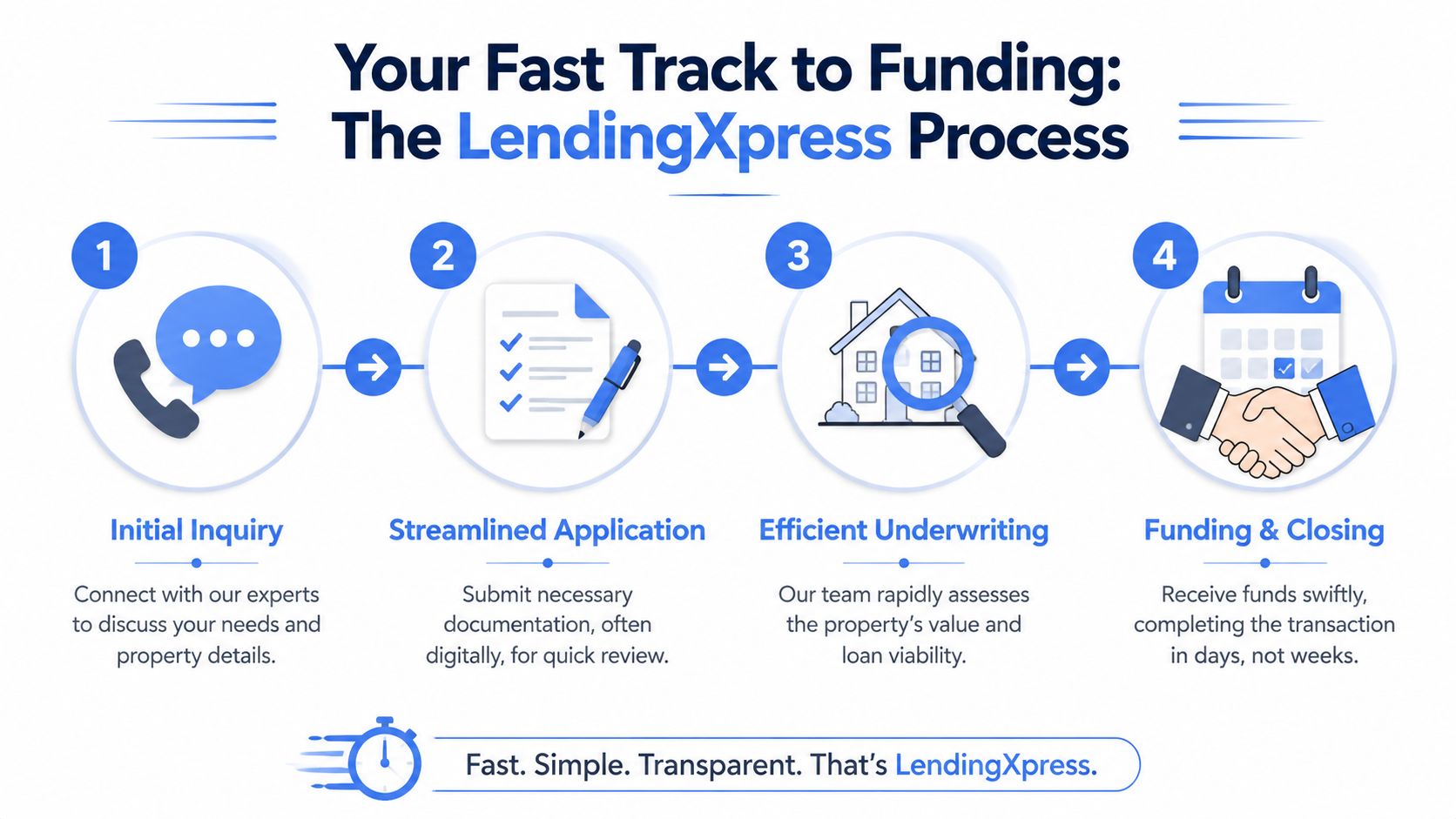
Speed comes from preparation, not magic. Private lenders can move quickly because the process is narrower, the decision chain is shorter, and the underwriting is tied to the asset. But borrowers and brokers still need to bring the right file.
A rushed file with missing basics wastes more time than a complete file submitted one day later.
What to have ready before you apply
For most non-owner-occupied deals, start with the essentials:
- Purchase contract or payoff statement if it's a purchase or refinance
- Property details including address, asset type, photos, rent roll if applicable, and a short summary of condition
- Borrowing entity documents if title will vest in an LLC, corporation, or partnership
- Exit strategy stated plainly. Sale, refinance, lease-up, or another source of repayment
- Rehab scope and budget if the property needs work
The cleaner this package is, the faster the lender can identify issues that are important.
How the review usually moves
Private underwriting for investment property is usually a direct sequence, not a maze. The lender reviews the request, checks the value story, reviews title, and confirms that the exit and capital structure make sense.
That often includes:
- A valuation review, such as an appraisal or another collateral review method
- Title work to identify liens, ownership, and closing issues
- Borrower and entity review for authority, experience, and basic background
- Loan structuring around term, holdback if needed, and conditions to fund
Some lenders can close in as little as a few days on the right file. The main variable isn't usually willingness. It's whether the borrower has delivered what the underwriter needs to clear the loan.
What brokers can do to avoid delays
The fastest brokers do three things well.
- Pre-frame the weakness. If there's low occupancy, deferred maintenance, or a recent credit issue, explain it up front.
- Keep the exit realistic. “We'll refinance later” isn't enough. Say why and when the property should qualify.
- Control expectations early. If the deal needs title cleanup or valuation support, tell the borrower before docs go out.
One lender in this space is LendingXpress, which offers California investment-property bridge, fix and flip, and rental lending with a simplified application for business-purpose deals. That kind of model works best when the broker submits a complete package and stays close to the file through closing.
Navigating Key California Lending Regulations
California trust deed lending is practical, but it isn't informal. The legal framework matters, and brokers who ignore it usually create problems for everyone in the file.
Licensing is the first issue. California private lending can be conducted through different licensing paths, including a DRE broker license, CFL, or CRMLA license. Guidance summarized by the California Mortgage Association also notes that an unlicensed person generally may make only one commercial loan per year unless an exemption applies, and that the DRE investor-exemption framework includes a $2.5 million total loan limit for that specific structure, as described in the California Mortgage Association's guide to private lending licensing requirements.
Why compliance matters on rehab and construction files
Construction and rehab loans deserve extra attention because collateral can change during the term. California's Department of Real Estate states that for certain construction or rehab loans, the entire loan amount cannot exceed $2,500,000 and the transaction requires an escrow holder, a detailed draw schedule, independent verification of completed work, and a qualified appraisal in that framework.
That isn't red tape for its own sake. Those requirements help control disbursement risk, track progress, and protect the collateral that secures the loan.
The practical takeaway for brokers and investors
If you're brokering or borrowing on an investment property in California, compliance should shape the file from the start.
- Use the correct licensing path
- Structure rehab draws clearly
- Confirm whether the loan fits the applicable exemption framework
- Treat documentation as part of risk control, not paperwork theater
A clean legal structure is one reason trust deed lending remains workable for investment property. It protects the lender's lien, sets expectations for the borrower, and creates a more disciplined funding process.
Why Investors and Brokers Choose LendingXpress
A broker gets a purchase contract accepted on Tuesday. The seller wants a short closing, the property needs work, and the buyer has strong equity but does not fit a bank box. That file usually does not need a long credit committee process. It needs a lender who can size the risk quickly, explain the terms clearly, and close before the opportunity slips.
That is why investors and brokers call us. We focus on business-purpose loans secured by California investment property, and we look at the deal the way experienced operators do. What is the property today, what is the borrower trying to do with it, and what is the exit?

What usually makes the relationship work
For brokers, a good lending partner protects credibility with the client and keeps the transaction from drifting. For investors, it helps to work with a lender that understands the difference between an acquisition bridge, a rehab file, and a loan meant to carry a rental through stabilization.
The practical points are usually simple:
- Clear answers on loan structure, conditions, and timing
- Comfort with non-owner-occupied properties and transitional collateral
- Fast credit decisions once the file is complete
- Risk review based on collateral, exit, and borrower experience rather than a bank-style checklist
Speed matters, but speed by itself is not enough. Files get funded when the story makes sense, the numbers are supportable, and the lender is willing to address the actual issue in front of them instead of forcing the deal into a conventional template.
We take that approach at LendingXpress. If a deal works, we say how to set it up. If it does not, we say that early too. Brokers appreciate that because they can advise their clients quickly. Investors appreciate it because they can move to the next option without losing more time.
Trust deed lending also appeals to capital partners who want real-estate-secured exposure backed by recorded liens and conservative loan-to-value standards, as noted earlier. That discipline is part of what keeps this corner of the market attractive to experienced investors.
If you're brokering or buying a non-owner-occupied property in California and need a practical financing path, LendingXpress is a resource for bridge, rehab, and rental property loans built around speed, collateral, and clear execution. Reach out early in the deal, bring the property story and exit plan, and we'll tell you quickly whether the structure makes sense.