
You find a property that fits your strategy, the seller wants certainty, and the clock starts immediately. That's when commercial real estate financing options stop being a theory exercise and become a deal decision.
Most investors and brokers don't lose opportunities because they can't name enough loan products. They lose them because they choose the wrong tool for the timeline, the property, or the borrower profile. In this market, speed, flexibility, and execution matter just as much as pricing.
The Investor's Dilemma Speed vs Security
A familiar deal goes like this. You've identified a non-owner-occupied property with upside, the seller wants a fast close, and your long-term plan makes sense. Then the financing path splits in two.
One path offers lower cost and long-term stability, but it asks for more time, more documentation, and a cleaner file than many real-world deals can deliver. The other path costs more, but it gives you a realistic shot at closing before the opportunity disappears.

That tension sits at the center of most commercial real estate financing options. The market is large, debt-driven, and highly structured. The commercial real estate market is an $8.8 trillion asset class, and debt financing is dominant, with traditional mortgage LTVs typically averaging 60 to 65 percent, while more aggressive private structures are often used when investors need to layer capital and move faster, as outlined in Northmarq's overview of commercial real estate investment options.
Where deals start to break
The problem usually isn't the property alone. It's the mismatch between a deal's urgency and the lender's process.
- Tight closings: Sellers often reward certainty over a marginally lower rate.
- Transitional assets: Vacancy, deferred maintenance, lease rollover, or repositioning plans can push a deal outside a bank's comfort zone.
- Borrower complexity: A strong investor with multiple entities, recent changes in income, or a nontraditional structure may still struggle in a conventional credit box.
Practical rule: If your business plan depends on speed, flexibility, or post-closing improvements, financing should support that from day one.
Security matters. So does execution. The right answer isn't always the cheapest loan. It's the loan that gets the asset under control and gives you a workable path to your next step.
The Two Paths to Commercial Real Estate Financing
Think of the financing market as two roads.
The first is the main highway. It's familiar, heavily regulated, and built for predictable traffic. That's the world of banks, credit unions, agency-style structures, and other conventional lenders. If your deal is clean and your timeline is forgiving, that route can work well.
The second road is more direct. It isn't for every borrower, but it's often the better route when timing matters or the asset needs work before it qualifies for long-term debt. That's where private lenders, bridge lenders, and other alternative capital providers come in.

Traditional lenders focus on the past
Banks usually underwrite by asking whether you fit their model. They want complete financials, stable income, strong debt coverage, clear property performance, and few surprises. Their approach can make sense for stabilized assets and borrowers with straightforward documentation.
That process protects the lender, but it can leave investors stuck when a deal has moving parts. A property that needs rehab, lease-up, or a quick refinance often doesn't line up with a conventional timeline.
Alternative lenders focus on the path forward
Private and bridge lenders usually start from a different place. They still care about risk, but they often spend more time on the asset, the exit strategy, and whether the business plan is credible. That's a different underwriting philosophy.
For many investors, that distinction matters more than the label on the loan. If the property will improve after repairs, new leasing, or a cleanup of title or occupancy issues, an asset-based lender may see a path where a bank sees a problem.
For investors comparing routes, real estate investor financing options are easiest to understand when you separate them by process, not just product name.
A good financing decision starts with one question: what has to happen between closing and payoff?
Here's a short visual primer that helps frame the difference in approach:
The trade-off most people miss
Lower pricing can become expensive if you miss the acquisition, lose hard deposit money, or can't stabilize the property on schedule. On the other hand, speed without a clear exit can create pressure later.
That's why experienced investors don't ask only, “What rate can I get?” They ask:
- Can this lender close inside my contract window?
- Will they lend on this property in its current condition?
- Does the loan structure match my actual business plan?
Those three questions usually narrow the field quickly.
Navigating Traditional Financing Options
You tie up a deposit on a clean neighborhood retail center. Occupancy is stable, the leases are readable, and the numbers support long-term debt. On that kind of deal, traditional financing usually deserves the first look because the lower cost of capital can outweigh the slower process.
That advantage only matters if your deal fits the bank's box.
Conventional commercial mortgages
Conventional bank debt works best for stabilized properties with predictable income and borrowers who can document everything clearly. Lenders want to see operating history, rent rolls, borrower financials, liquidity, entity documents, and third-party reports that hold up under scrutiny. If the property is already doing what it is supposed to do, this channel often gives you the longest term and the lowest pricing.
The trade-off is time and rigidity. Credit approval is only one step. Appraisal, environmental review, lease analysis, insurance, legal, and closing conditions can drag out the calendar even after a lender issues terms. I have seen borrowers win on rate and lose on timing.
That is why experienced investors separate “bankable” from “closable.” A deal can qualify for conventional financing and still miss the contract window. If you are weighing bank debt against private money lenders for commercial real estate deals, that distinction matters more than a headline rate.
SBA loans
SBA financing has a place, but it is narrower than many investors assume. These loans are generally designed for businesses that will occupy the property, not investors buying pure rental real estate.
The U.S. Small Business Administration explains that its main real estate-related programs include 7(a) loans and CDC/504 loans, with occupancy and use requirements that limit fit for non-owner-occupied investment property, as outlined on the SBA's official funding programs pages. For an investor buying a property strictly for cash flow, that usually takes SBA off the table early.
For an owner-user buying a warehouse, office, or mixed-use building for their own operating business, SBA can be attractive. For a broker or investor working an acquisition with outside tenants and a short deadline, it usually is not the cleanest path.
Portfolio and relationship lending
Community banks and regional banks sometimes keep loans on their own balance sheet instead of selling them into a larger channel. That can create more room on structure, especially for smaller commercial deals, local sponsors, or properties that are solid but not perfectly polished.
Relationship lending still requires a real credit story. A local bank may be more reasonable on a vacancy issue, a lease rollover, or a borrower with strong deposits and history in the market. It is still a bank process, though. Documentation standards remain high, and committee timing can still control the closing date.
This option tends to work best when the deal is financeable today and the borrower brings context the lender already trusts.
When traditional financing works, and when it doesn't
Use a simple screen before you spend weeks in underwriting.
- Strong fit: Stabilized asset, consistent cash flow, clean records, and enough time for third-party reports and committee approval.
- Possible fit: Mostly stable property with a few issues a portfolio lender may accept if the sponsorship is strong.
- Poor fit: Heavy rehab, major vacancy, title problems, unusual collateral, or a contract deadline that leaves no room for delays.
Traditional lending remains a strong tool for the right asset and timeline. The mistake is treating it like the default answer for every commercial deal. Investors who close consistently match the loan to the business plan, the property's current condition, and the amount of time they have.
Unlocking Deals with Alternative and Private Money Loans
Alternative financing isn't just a fallback for rejected borrowers. In many situations, it's the correct first move.
That's especially true when the property needs work, the seller wants speed, or the investor's value comes from acting before everyone else gets comfortable. The market has been moving that way. Private lenders captured 30% more commercial real estate bridge loan volume between 2025 and 2026, and the ability to close in as few as 3 days with asset-based underwriting instead of extensive income verification gave investors an edge, according to Linc Realty's review of alternative CRE financing options.
Bridge loans
A bridge loan is short-term capital designed to get you from today's problem to tomorrow's better financing.
That problem might be vacancy. It might be deferred maintenance. It might be an acquisition that has to close before a bank can get through committee. Bridge lending is often the right tool when the property is financeable in principle, but not yet financeable in conventional form.
Use cases include:
- Acquisition with a short deadline
- Refinance of a maturing loan while you stabilize operations
- Lease-up or repositioning before takeout financing
- Cash-out for improvements that support a near-term exit
Hard money loans
Hard money usually goes even more directly to collateral and execution. These loans are often useful when the borrower has credit wrinkles, the property has condition issues, or the deal has enough complexity that a traditional underwriting model won't touch it.
That doesn't mean hard money should be casual money. It works best when the investor knows the plan, the timeline, and the payoff route. Short-term debt without a clear exit can turn a good project into a rushed one.
Fix-and-flip and rehab financing
For investors buying a commercial or mixed-use asset with a clear renovation plan, rehab funding can be the difference between doing the project right and running out of capital halfway through. A practical fix-and-flip structure funds acquisition and repairs in a way that matches construction progress.
Some private lenders will also finance the rehab portion through staged draws. That matters when your own liquidity needs to stay available for carrying costs, overruns, or the next opportunity. Private money lending programs for investors often fit this category, especially when the deal needs asset-based underwriting and a fast response.
What private lenders look for
The best alternative lenders aren't ignoring risk. They're underwriting it differently.
They usually want to understand:
The asset today
What is the property, what condition is it in, and what issue is keeping conventional lenders cautious?Your business plan
Are you improving occupancy, renovating units, curing deferred maintenance, or refinancing a problem loan?Your exit
Sale, refinance, or another defined payoff event. If that answer is vague, the loan gets harder.
Fast money only works when the borrower is as prepared as the lender.
LendingXpress is one example of this model in California, offering bridge and fix-and-flip financing on non-owner-occupied properties, including rehab funding and rapid closings for investors who need a workable path when bank financing falls short.
Comparing Your Commercial Financing Choices Head-to-Head
You can lose a solid deal by choosing the right rate with the wrong execution.
That happens more often than borrowers expect. A bank term sheet may look cheaper on paper, but if the file needs exceptions, the property needs work, or the closing window is short, a lower coupon does not help if the lender cannot get to the finish line. With a heavy volume of upcoming loan maturities, that gap between pricing and execution is becoming more important for owners and investors who need a lender that can close within the actual deal timeline.
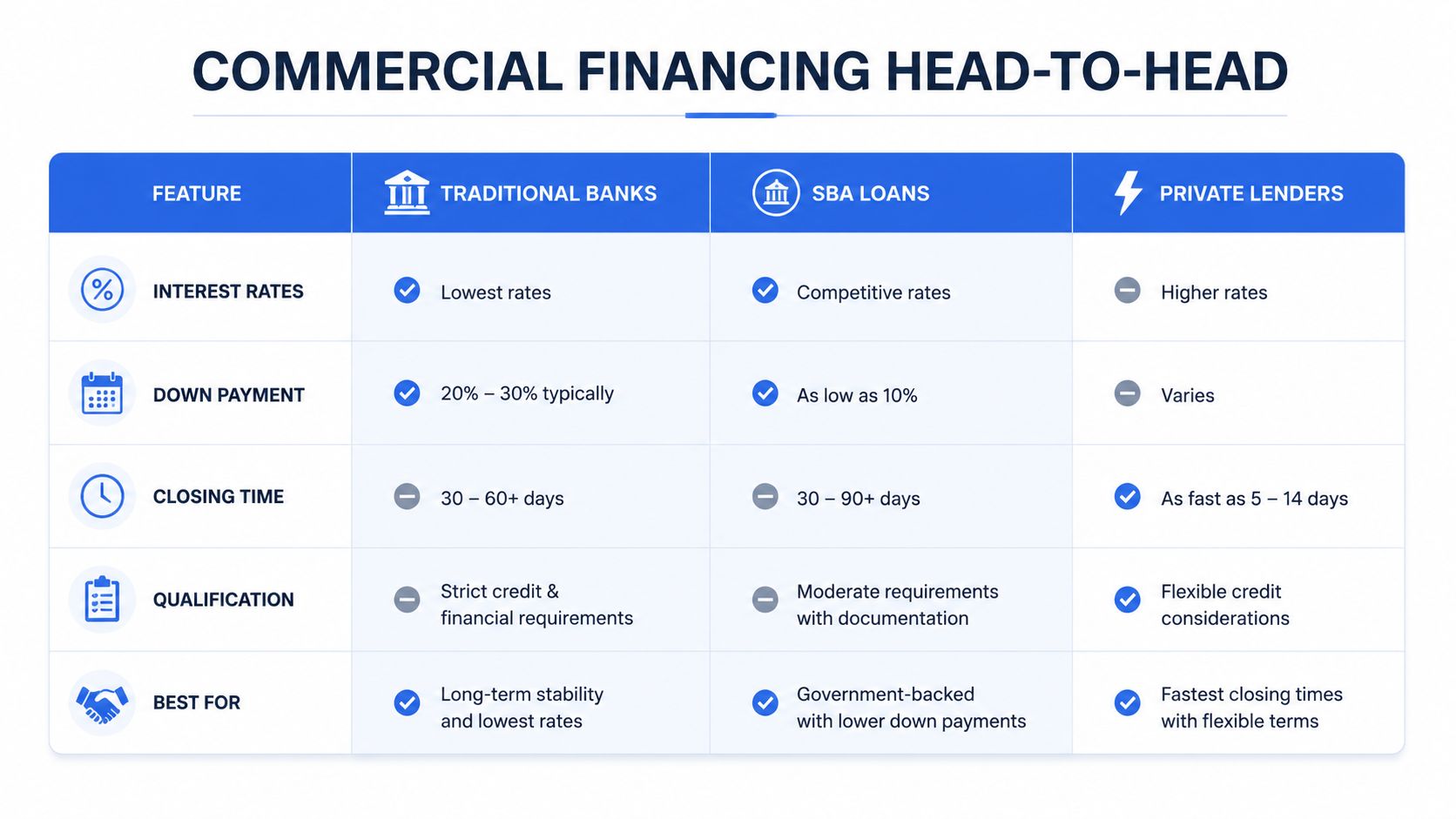
Commercial Financing Options At-a-Glance
| Loan Type | Speed to Close | Typical LTV | Best For | Primary Consideration |
|---|---|---|---|---|
| Traditional bank loan | Slower, documentation-heavy | Often conservative | Stabilized income property and strong borrower files | Process rigidity |
| SBA loan | Moderate to slower | Depends on program structure | Business-use situations rather than pure investment property | Occupancy and program eligibility |
| Bridge loan | Fast | Varies by asset and plan | Time-sensitive acquisitions, refinance pressure, stabilization | Short-term exit must be clear |
| Hard money loan | Very fast | Asset-driven | Borrowers or properties outside bank guidelines | Higher cost for flexibility |
| Fix-and-flip or rehab loan | Fast with draw structure | Varies by scope and asset | Value-add projects with improvement plan | Execution risk during renovation |
| Portfolio lender | Moderate | Often case-by-case | Smaller or relationship-driven deals | Still documentation-heavy |
How to read the table
Use this as a decision tool, not a ranking.
Traditional bank debt usually wins on long-term cost for stable properties with clean rent rolls, strong borrower financials, and enough time to clear underwriting. SBA financing can work well for owner-users, but it is not built for every investment scenario. Portfolio lenders sit in the middle. They may offer more common-sense flexibility than a large bank, but they still want a file they can document and defend.
Alternative financing earns its place when the deal has a timing problem, a property problem, or both. Bridge debt can give you time to stabilize occupancy, clear deferred maintenance, or refinance out of a maturing loan. Hard money can keep a deal alive when collateral is stronger than the paperwork. Rehab financing fits projects where value will be created after closing, not before.
Financing should match the business plan, not just the interest rate.
The practical takeaway
If you are a broker, this comparison helps you filter quickly before sending a client down a path that cannot close. If you are an investor, it helps you separate permanent financing from transitional financing and rescue capital.
That is the true head-to-head comparison. Cost matters. So do certainty, speed, structure, and whether the loan gives you enough room to execute your plan. In time-sensitive commercial deals, alternative finance is often a strategic first choice, not a fallback.
A Practical Framework for Choosing the Right Loan
Most financing mistakes happen before the application. They happen when the borrower picks a loan type based on headline rate instead of deal reality.
A simple framework fixes that. Start with the deal, not the product.

Ask these four questions first
How fast do you need to close?
If the answer is “very fast,” you've already narrowed the field. Don't spend a week pursuing a lender that can't move on your timeline.What does the property need after closing?
Stabilization, repairs, lease-up, clean title work, tenant turnover, or simple hold. The answer points to either permanent debt or transitional debt.How clean is the borrower file?
Strong financials and clear documentation open more doors. If the file is complex, focus on lenders who underwrite the asset and exit plan with more flexibility.What's the exit?
Sale, refinance, or hold. If you can't state the exit clearly, the financing is probably premature.
Three common scenarios
Scenario one
You're buying a property with a short closing window and a bank can't meet the deadline. A bridge loan usually makes more sense than trying to force a conventional process that won't finish in time.
Scenario two
You're acquiring a value-add asset that needs renovation before it will support long-term debt. A rehab-focused private loan often fits better because it aligns funding with the work plan.
Scenario three
You already own a stable commercial property with consistent performance and time to complete underwriting. That's where a conventional commercial mortgage can be the right answer.
A fast self-screen
Use this before you call any lender.
- Timeline check: Is your purchase contract or payoff deadline tight enough that slow underwriting creates real risk?
- Asset check: Is the property stabilized, or does it need changes before a bank will like it?
- Document check: Can you produce the records a bank will require without delays?
- Exit check: Can you explain exactly how this loan gets paid off?
Borrowers get better loan terms when they present a clear plan, not just a request for money.
Once you thoroughly answer those four questions, most of the confusion around commercial real estate financing options disappears.
Your Next Steps to Get Your Deal Funded
The strongest borrowers make it easy for a lender to say yes. That doesn't mean sending a giant folder of random files. It means presenting the deal clearly, with enough information to support a quick decision.
Build a lender-ready package
Prepare these items before you start shopping the deal:
- Executive summary: Explain the property, the request, and the business plan in plain language.
- Purchase contract or payoff details: A lender needs to understand the timing pressure and transaction structure.
- Property information: Rent roll, trailing income and expenses if available, photos, current condition, and any major issues.
- Scope of work: If rehab is involved, include your budget and timeline.
- Borrower background: Ownership structure, experience, and a simple overview of liquidity and credit profile.
- Exit strategy: State whether the payoff comes from sale, refinance, stabilization, or another identified source.
What brokers should do differently
Brokers create more value when they frame the file before they send it out. Don't just forward raw documents. Explain what the issue is, why the borrower still makes sense, and which lending lane fits the deal.
That saves time for everyone. It also helps you build repeatable lender relationships instead of chasing one-off approvals.
What investors should avoid
Don't wait until the last minute to define the exit. Don't assume a lender will fill in gaps in your plan. And don't lead with rate if the actual risk is time.
If your deal is time-sensitive, secured by a non-owner-occupied property, and needs a practical lending partner in California, contact LendingXpress with the basics of the transaction. A clear summary, purchase details, property information, and exit plan are usually enough to start a real conversation quickly.