
You spot a worn-out house with overgrown shrubs, dated cabinets, and a price that looks low enough to leave room for profit. On paper, it feels simple. Buy it right, renovate it fast, sell it for more.
That is the version beginners see first. The version that works in real life comes down to stricter math, tighter timelines, and financing that does not fall apart when a traditional bank drags its feet or declines the deal.
A profitable first flip usually gets decided before demo starts. If the purchase price is too high, the rehab budget is too loose, or the funding structure leaves you short on cash halfway through the project, the spread disappears fast. I have seen plenty of first-time investors focus on paint colors and resale dreams before they have a clear handle on holding costs, draw schedules, and their maximum allowable offer.
The opportunity is real, but the margin for error is thinner than many beginners expect. Projects often take months, and every extra week can mean more interest, more taxes, more insurance, and less profit.
If you want to succeed at flipping houses as a beginner without walking into a money pit, start with discipline. Use rules that professionals rely on, like buying with enough margin under after-repair value and lining up funding before you make offers. For first-time investors who need speed and structure, fix and flip financing for new investors can make the difference between a deal you can control and one that controls you.
From Dream to Deal The First-Time Flipper Mindset
You tour a property on Saturday, run a quick estimate in your head, and can already picture the listing photos after the rehab. That is the moment first-time flippers get in trouble. Profit starts slipping when excitement shows up before the numbers, the funding plan, and the timeline.
The first shift is to treat the property like inventory. A flip has to pencil out on purchase price, rehab scope, carrying costs, and resale timing. If any one of those gets loose, the deal can turn into an expensive lesson.
Think like an investor, not a homeowner
The beginners who do best usually are not the ones chasing the biggest spread on paper. They are the ones who stay disciplined when a house has charm, a hot zip code, or a seller pushing urgency. They ask better questions early. What is the realistic after-repair value? How much cash goes out before the first draw? How long can this project sit before interest, taxes, and insurance start cutting into the margin?
A flip is a business project from day one. You are buying a time-sensitive asset with financing attached to it.
Practical rule: A good first flip is bought with a margin, renovated with a tight scope, and sold before holding costs eat the deal alive.
That mindset also changes how you look at risk. Gross profit figures can make flipping look attractive, but beginners need to remember that gross profit is not net profit. Permits take longer than expected. Contractors miss deadlines. Materials cost more than your first estimate. The investors who last are the ones who build in room for mistakes before they ever make an offer.
What beginners get wrong early
I see three early mistakes over and over:
- They pay based on hope. They assume the resale will cover a thin deal instead of buying at a number that leaves room for real costs.
- They choose a project that is too heavy for a first run. Structural work, additions, and layout changes can stretch budget and timeline fast.
- They treat financing like an afterthought. If the money is slow, incomplete, or tied to a lender that does not understand investment property, the rehab stalls.
That last point gets overlooked. A first-time flipper can make a decent buy and still lose momentum because the capital stack is weak. Speed matters. So does knowing whether your loan covers just the purchase, or the rehab too. For a beginner, fix and flip financing for first-time investors can provide structure that keeps the project funded instead of forcing you to scramble mid-rehab.
Start with a property you can understand, a budget you can defend, and financing you can close quickly. That is how a first flip moves from dream to deal.
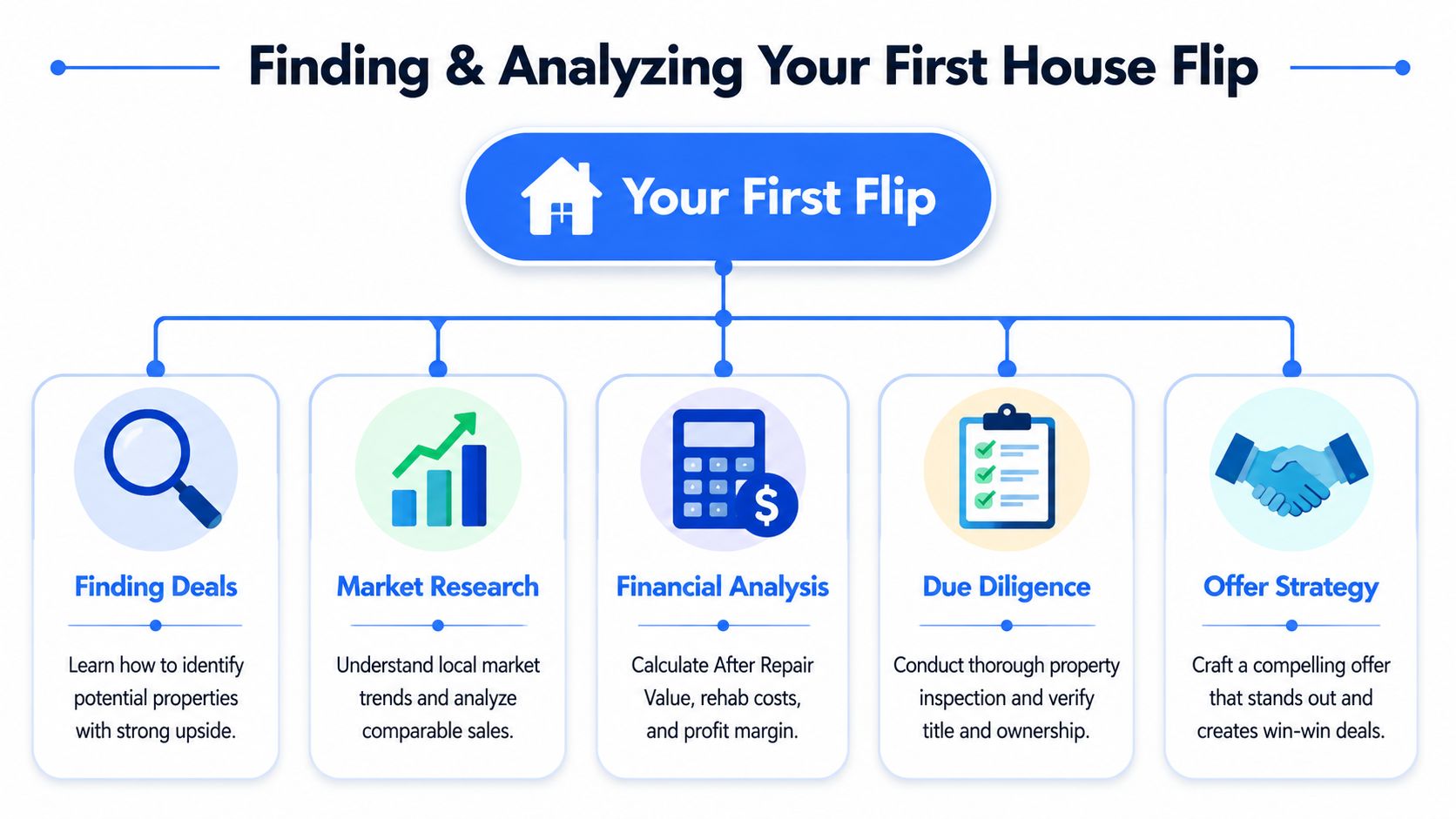
Finding and Analyzing Your First Flip
The money is made when you buy. Everything after that is damage control or margin protection.
A lot of beginner advice says “find a good deal,” which sounds helpful until you're staring at a property with old cabinets, worn flooring, and a seller asking more than the house can support. You need a screening tool, not motivation.
Use the 70% rule first
The most common starting formula is the 70% rule. It says your maximum purchase price should be no more than 70% of the after-repair value minus repair costs. Rocket Mortgage gives the example clearly: if a property's ARV is $500,000 and repairs are $50,000, the maximum purchase price is $300,000. That formula is explained in Rocket Mortgage's guide to the 70% rule.
That rule matters because it forces discipline before emotion gets involved.
Here's the math again in plain language:
- Estimate what the property should sell for after renovation.
- Multiply that number by 0.70.
- Subtract your repair budget.
- The result is your ceiling, not your target.
If the seller wants more than that ceiling, you either negotiate, change the scope, or move on.
How to estimate ARV without guessing
Beginners often make one expensive mistake here. They use optimistic resale numbers instead of supportable ones.
ARV should come from comparable sales, not wishful thinking. Look for recently sold homes that match the subject property as closely as possible after your planned renovation. Focus on homes that compete with yours, not the nicest one in the neighborhood.
Use these filters when pulling comps:
- Match the product. Similar size, bed and bath count, lot type, and general neighborhood appeal.
- Match the finish level. If your plan is a clean mid-range rehab, don't price against a luxury remodel.
- Match the timeline. Recent sales matter more than stale listings.
- Match the buyer. A starter home buyer and a move-up buyer don't shop the same inventory.
If you need to stretch the ARV to make the deal work, the deal doesn't work.
Build a fast repair screen
You don't need a perfect budget on day one, but you do need a reliable first-pass estimate. Walk the property and sort the work into two buckets.
Value-driving cosmetic work
- Paint
- Flooring
- Countertops
- Landscaping
- Fixture updates
High-risk scope
- Foundation concerns
- Roof failure
- Plumbing replacement
- Electrical rework
- Layout changes
- Permit-heavy additions
The first bucket is where beginners usually do better. The second bucket can still be profitable, but only if the scope is well defined and the purchase price leaves room for surprises.
A practical way to decide fast
When I look at a first-time flip candidate, I want simple answers to simple questions:
| Question | What you want to see | What should worry you |
|---|---|---|
| Is resale value clear? | Strong nearby comps | Wide pricing spread |
| Is the rehab straightforward? | Mostly cosmetic work | Structural or system uncertainty |
| Can the budget be scoped early? | Visible tasks and known finishes | Hidden conditions and vague contractor pricing |
| Is the seller realistic? | Room to negotiate | Price anchored to emotion |
| Can you exit cleanly? | Broad buyer appeal | Over-improved or odd layout |
A first flip doesn't need to be flashy. It needs to be understandable. If you can't explain the ARV, the repair plan, and the purchase ceiling in a few calm sentences, keep looking.
Financing Your Flip When Banks Say No
A solid flip can still die if your financing doesn't fit the job.
Traditional banks are built for long-term ownership and documented borrower income. A flip is different. The property may need work before it qualifies for conventional financing. The closing window may be tight. The investor may be self-employed, scaling, or buying through an entity. That's why many first-time flippers find out quickly that a standard mortgage path doesn't line up with a time-sensitive investment deal.

Why private lending fits flips better
For a flip, the main financing priorities are usually speed, asset-based logic, and access to rehab funds. That's where private and hard money loans come into the conversation.
The comparison is straightforward:
| Financing type | Better for | Common problem on flips |
|---|---|---|
| Traditional mortgage | Long-term, stable owner-occupied or conventional investment purchases | Slow process, stricter property condition standards |
| Private or hard money loan | Short-term acquisitions, distressed properties, renovation projects | Higher cost if the project drags |
| Cash | Fastest closings and clean offers | Ties up capital that could be used elsewhere |
The trade-off is simple. Flexible money usually costs more than bank money, so the deal has to justify it. But on a flip, speed often protects the deal itself. A lower rate doesn't help if you miss the purchase, can't fund repairs, or lose weeks in underwriting.
How rehab funding usually works
Many flip loans are structured around the purchase and the renovation. You close on the acquisition, then access rehab funds through staged draws as work is completed. That draw system matters because it keeps the project accountable. It also helps borrowers preserve cash instead of fronting every construction expense out of pocket.
One option in this space is LendingXpress fix and flip loans, which are designed for non-owner-occupied investment properties and can finance up to 100% of rehab costs, with closings in as little as three days according to the publisher background provided for this article.
Fast financing doesn't fix a bad deal. It helps you close a good one before someone else does.
For a beginner, the right loan is the one that matches the project. If the house needs work, the closing timeline is tight, and the property won't fit a conventional box, a private lending structure usually makes more sense than trying to force a bank product into a flip.
Planning the Renovation for Maximum ROI
You get the keys on Friday. By Monday, the budget is already slipping because the contractor priced “kitchen update” one way, you pictured something else, and the electrician found two code issues behind the walls. That is how first flips turn into money pits.
Profitable renovations start on paper. The goal is not to make the house impressive. The goal is to make the resale math work.
Start with a written scope of work
A real scope of work is specific enough that two contractors can price the same job and come back close. If the scope is vague, the bids will be vague, the draw schedule will be messy, and your budget will drift.
Write the project by room and by trade. “Update bathroom” is too loose. List the vanity size, flooring material, tile height, faucet finish, toilet replacement, mirror, light fixture, and whether the tub stays or goes. Do the same for the kitchen, flooring, paint, doors, trim, exterior cleanup, and any system repairs.
That level of detail protects you in three ways. It tightens contractor bids. It helps you track overruns before they get serious. It also gives your lender a clearer picture of how rehab funds will be used, which matters if your loan includes construction draws.
A workable beginner scope usually includes:
- Demolition such as tear-out, haul-away, dumpster costs, and site cleanup
- Health and safety repairs like electrical fixes, plumbing leaks, HVAC issues, roofing problems, and water damage
- Interior finishes including flooring, paint, trim, cabinets, counters, fixtures, lighting, and doors
- Exterior improvements such as landscaping, pressure washing, mailbox replacement, fencing, and entry touch-ups
- Closeout items including punch-list work, final cleaning, and listing preparation
Spend on what helps resale
First-time flippers get in trouble when they renovate for personal taste instead of market value. The buyer for an entry-level flip usually wants clean, bright, functional, and move-in ready. That buyer rarely pays extra for premium finishes if the rest of the block does not support them.
Use the neighborhood as your ceiling. If comparable homes have shaker cabinets, quartz or granite-look counters, LVP flooring, and simple bath updates, match that standard. Do not install high-end custom work in a middle-market house and expect the appraisal or the buyer pool to bail you out.
I usually tell new investors to separate repairs into two buckets. The first bucket is required work, items that affect financing, safety, insurance, or inspection results. The second is resale work, updates that help the home show better and sell faster. Required work comes first every time.
Clean, durable, and consistent usually beats upgraded in the wrong places.
Build the budget from the resale number backward
Discipline matters at this stage. The renovation budget cannot be a guess based on what feels reasonable. It has to fit the deal.
Start with the after repair value, then apply your buying formula. Many investors use the 70% rule as a quick screen:
Maximum offer = (After repair value × 70%) – repair costs
It is a rule of thumb, not a guarantee. In a tighter market, taxes, insurance, interest carry, and selling costs can force you to be more conservative. But it gives beginners a hard stop, and that is useful. If the rehab budget rises and the deal no longer fits, the answer is usually to lower the offer or walk away.
Use a line-item budget so you can see where the risk sits. Here is a simple example:
| Expense Category | Estimated Cost | Notes |
|---|---|---|
| Purchase closing costs | $3,500 | Title, escrow, recording, lender fees |
| Demolition and debris removal | $1,500 | Includes haul-away and dump fees |
| General construction labor | $12,000 | Based on contractor bid and scope |
| Materials and finishes | $9,500 | Cabinets, flooring, paint, fixtures, hardware |
| Electrical and plumbing | $4,000 | Repairs, replacements, code items |
| Permit and inspection costs | $1,200 | Verify local requirements early |
| Landscaping and exterior cleanup | $1,800 | Curb appeal, overgrowth, safety items |
| Staging and sale prep | $2,000 | Final cleaning, touch-ups, presentation |
| Contingency reserve | $5,000 | Buffer for hidden damage and change orders |
A budget like this does two jobs. It tells you whether the project still fits the target margin, and it shows your weak spots early. If there is no contingency, or if the deal only works with unrealistically low labor and carry costs, the flip is too tight.
Match the renovation plan to the financing
Beginners often focus on rate and miss the bigger issue. Cash flow during the rehab can decide whether the project stays on schedule.
If your loan includes rehab draws or up to 100% rehab funding, build your scope and budget in a way that matches the draw process. Break work into logical stages, keep invoices organized, and avoid front-loading upgrades that do not move the project toward marketable condition. Speed matters on a flip because every extra week adds holding costs.
That does not mean rushing bad decisions. It means planning the work so the money and the schedule support each other.
Get multiple bids and compare the scope
Three bids usually tell you more than one “cheap” bid ever will. Large gaps between numbers often mean one contractor missed part of the job, assumed lower-grade materials, or did not include cleanup, permit handling, or punch-list work.
Compare bids line by line:
- Who is supplying materials
- What permits are included
- How change orders are priced
- What the payment schedule looks like
- Whether cleanup and final punch are included
- How long the work is expected to take
The best renovation plan for a first flip is clear, boring, and profitable. If the scope is tight, the budget is realistic, and the finish level matches the neighborhood, you give yourself a real shot at a clean exit.
Managing Your Rehab Project and Contractors
You close on the house, the crew starts, and by week two the questions hit all at once. Who approved the extra electrical work? Why is the tile allowance already gone? Why is a contractor asking for another draw before the last phase is finished?
That is how first flips get expensive.

A rehab project needs active management, especially when you are using borrowed money and carrying costs are running every month. Good contractor oversight protects more than your budget. It protects your timeline, your draw schedule, and your exit.
Hire slowly, manage with paperwork
A contractor can be talented and still be wrong for a flip. First-time investors need people who can follow a written scope, hit deadlines, communicate problems early, and work within milestone payments.
Before anyone swings a hammer, confirm the basics:
- License and insurance are current and easy to verify.
- Recent references come from similar jobs, not just handpicked favorites from years ago.
- Written contract spells out scope, materials, timeline, payment stages, and how change orders get approved.
- Lien waivers are collected with every payment when subcontractors or suppliers are involved.
Signed agreements matter because flips fall apart in the gaps between verbal expectations and actual work. Tie payments to completed milestones, not promises. If the contract is vague, the budget usually gets vague right after it.
Control the draw schedule
Many beginners lose money by paying too much too early. Once a contractor has your cash, your bargaining power drops fast.
Use a simple payment structure tied to visible progress:
- Demo and trash-out complete
- Rough plumbing, electrical, and HVAC complete
- Inspections passed where required
- Drywall, paint, and prep complete
- Cabinets, flooring, fixtures, and trim complete
- Final punch list complete
That approach also works better with rehab financing. If your lender uses draws, your project should be organized so completed work can be inspected and reimbursed without confusion. At LendingXpress, this is one of the biggest differences between flips that stay on schedule and flips that stall. The borrower planned the work in stages the lender could fund.
The contractor should know exactly what gets paid next, and you should know exactly what must be finished first.
Track three things every week. What was completed. What is delayed. What changed in the budget. That sounds simple because it is. A first flip does not need fancy software. It needs a current scope, a clean budget sheet, dated photos, and fast decisions.
A quick visual refresher on project oversight can help here:
Cut change orders before they cut your margin
Change orders are where beginners get hurt. Some are legitimate. Rotten subfloor, failed plumbing, and code issues have to be handled. Others come from loose planning, vague allowances, or impulse upgrades that do not help resale.
Treat every change order like a new investment decision. Ask four questions:
- Does it fix safety, code, or a hidden defect?
- Does it protect the timeline?
- Does it improve resale enough to matter?
- Does the deal still meet your target margin after this cost?
If the answer is no, skip it.
Financial discipline separates a flip from a money pit. Your profit is usually decided before the property hits the market. It gets decided in small jobsite decisions, one after another.
Keep resale at the center
Contractors build. Investors edit.
The job is not to create your ideal house. The job is to finish a clean, marketable product that fits the neighborhood and sells quickly. Stick with updates buyers notice right away and appraisers can support. Durable flooring, clean kitchens and baths, neutral paint, solid lighting, working systems, and sharp curb appeal usually do more for a first flip than custom details.
Speed matters here too. Every extra week can mean another interest payment, another utility bill, another insurance month, and more exposure to price changes. Manage the rehab with the exit in mind, and the numbers have a better chance of working when it is time to sell.
Mitigating Risks and Planning Your Exit
A first flip can look profitable on paper and still turn into a weak deal at the finish line.
The usual problem is not one big disaster. It is a stack of smaller misses. You carry the property longer than planned. A few repair costs come in high. The list price is based on old comps. Then stress shows up, and beginners start making rushed decisions with real money on the line.
That is why risk management for a flip needs to cover three things at once. Cash, time, and judgment.

Manage financial and timeline risk together
Holding costs do not wait for your contractor, your permit, or your buyer. Interest, taxes, insurance, utilities, and maintenance keep running until the property sells. On a first flip, that carry cost is often underestimated.
Underwrite the deal with enough margin to absorb delays. If the project only works on a perfect schedule and a perfect resale price, it was thin from the start. That is one reason experienced investors are strict about purchase math, conservative ARV assumptions, and keeping liquidity available after closing. Fast funding helps, but speed only works if the numbers still make sense when the job takes longer than expected.
A practical risk plan usually includes:
- A contingency reserve for hidden damage, code issues, and scope gaps
- A finish level that matches the neighborhood instead of chasing upgrades buyers will not pay for
- A short decision process so repairs, price changes, and contractor issues get handled quickly
- An exit price based on current comps instead of the numbers you hoped to see at acquisition
As the rehab wraps up, shift from construction thinking to sales thinking. Walk competing listings. Check pending activity. Review fresh solds. A clean house priced to move often outperforms a prettier house that sits while carrying costs eat the spread.
Control the emotional risk
The financial side gets the attention. The emotional side does real damage too.
First-time flippers usually expect the deal analysis to be hard. They do not expect the grind. Waiting on permits, settling contractor disputes, reworking a budget, and seeing days pass without visible progress can push people into bad decisions. They overspend to make themselves feel better about the project. They hold out for a price the market is not giving them. They keep a deal alive that should have been trimmed or exited earlier.
Good operators use rules before stress hits. Set your max budget. Set your pricing strategy. Set the point where you cut extras, lower the list price, or switch to a backup exit. Then follow the plan.
When the project gets messy, return to the numbers. Scope, budget, carry cost, and resale value should decide the next move.
Have more than one exit in mind
Your exit plan should be written before closing, not invented when the listing goes live.
Start with the primary sale strategy. Know your likely buyer, target price range, and minimum property standard before photos, staging, and showings. Then pressure-test a second path in case the market softens or the home does not move on your timeline.
At minimum, define:
- your target buyer
- your listing standard
- your pricing and reduction plan
- your backup exit if retail demand comes in weak
For some investors, that backup may be a price cut. For others, it may be renting the property, refinancing out of a short-term loan, or selling to another investor at a smaller profit. The right answer depends on your financing terms, cash position, and local demand. I tell first-time borrowers the same thing all the time. The deal is safer when you know how you can get out before you get in.
Calm, disciplined investors usually do better than aggressive ones who assume the market will save them.
Your First Flip Success Checklist
Print this out. Use it before you make an offer, before you close, and before you list.
Deal analysis
- Confirm the ARV with real comps. Don't stretch the resale value to force the deal.
- Run the 70% rule. If the purchase price blows past your ceiling, renegotiate or walk.
- Screen the rehab scope early. Cosmetic projects are usually cleaner first flips than heavy structural jobs.
- Check the neighborhood fit. Your finish level should match what buyers expect there.
Financing
- Choose a loan that fits a flip. A slow conventional path can be the wrong tool for a distressed investment property.
- Understand the draw process before closing. Know what documentation and milestones trigger rehab funds.
- Protect your liquidity. Don't spend every dollar on acquisition and leave no room for the job.
Renovation planning
- Write a full scope of work. Room by room, trade by trade.
- Get multiple contractor bids. Compare scope and assumptions, not just price.
- Create a line-item budget. Include permits, cleanup, and sale prep.
- Prioritize resale-driven updates. Keep the finish plan clean, durable, and market appropriate.
Project management
- Use a signed contract. Scope, timeline, milestone payments, and change orders should all be in writing.
- Verify insurance and lien waiver process. Don't skip the paperwork because the contractor seems trustworthy.
- Walk the site every week. Small misses become expensive if no one catches them early.
- Pay based on completed work. Not promises.
Sale and exit
- Refresh comps before listing. Markets move while you renovate.
- Finish the punch list before photos. Buyers notice incomplete details.
- Price for activity, not ego. A clean fast sale protects the overall outcome.
- Stay calm if the plan changes. Good investors adjust without abandoning discipline.
If you're evaluating your first non-owner-occupied flip and want a financing option built for speed, rehab funding, and real-world underwriting, LendingXpress can help you review the deal structure before you commit.