
You're reviewing a non-owner-occupied property, the seller wants a fast answer, and the lender needs an opinion of value before the opportunity disappears. The purchase price may look attractive, but the deal only works if the future value, renovation plan, loan amount, and exit strategy all survive a closer review. That's where a comparable market analysis, or CMA, becomes more than a pricing worksheet.
For investors and private lenders, a CMA is a working underwriting tool. It helps determine what a property may be worth today, what it could be worth after improvements, and how much debt the finished project can support. A weak comp package can inflate an offer and leave a borrower short of cash. A disciplined one can help an investor move quickly without confusing optimism with evidence.
Why Every Investor Needs a Solid Comparable Market Analysis
A buyer has a $650,000 duplex under contract in Orange County. The property is non-owner-occupied, the renovation scope appears manageable, and the seller wants the transaction moving into escrow. The investor has to make three numbers line up quickly: the offer price, the after-repair value the hard money lender will use, and the profit spread left after debt, improvements, carrying costs, and resale expenses.
Those numbers don't come from separate documents. They trace back to one well-built comparable market analysis prepared before the offer.
The investor begins with recently sold duplexes that match the subject in location, size, condition, unit configuration, parking, and income potential. A nearby renovated sale may support the projected after-repair value, while an inferior property may need an upward adjustment. A sale across a major road, near heavy traffic, or in a different school or flood environment may look close on a map but fail as a true comparable.
The CMA controls the first underwriting conversation
The lender isn't asking, “What does the borrower think the property will be worth?” The lender wants to know whether the proposed value is supported by closed transactions and whether the resale buyer will recognize the same features. California appraisal guidance describes the sales comparison approach as a process of comparing a subject property with recently sold, similar properties, then adjusting for differences such as location, size, condition, and amenities. It also emphasizes reporting at least three closed comparable sales in the approach. California Department of Real Estate appraisal guidance supports that evidence-based framework.
For the Orange County duplex, the CMA influences the maximum loan amount, the amount of borrower equity, and whether the renovation budget is realistic. If the lender accepts a lower ARV than the investor projected, the borrower may need more cash or may have to renegotiate the purchase.
Practical rule: Treat the CMA as the deal's evidence file, not as a polished presentation designed to justify the price you already want to pay.
The spread is only as strong as the comps
Investors often focus on the purchase discount and understate the importance of the exit value. That's a mistake. A small change in the supported ARV can affect the loan amount, loan proceeds, resale assumptions, and the margin available for unexpected work.
The rest of the analysis should answer practical questions: Which sales belong in the set? How should each difference be adjusted? What happens when data is thin? And how does a private lender convert the final value opinion into a bridge or fix-and-flip loan?
What a Comparable Market Analysis Is
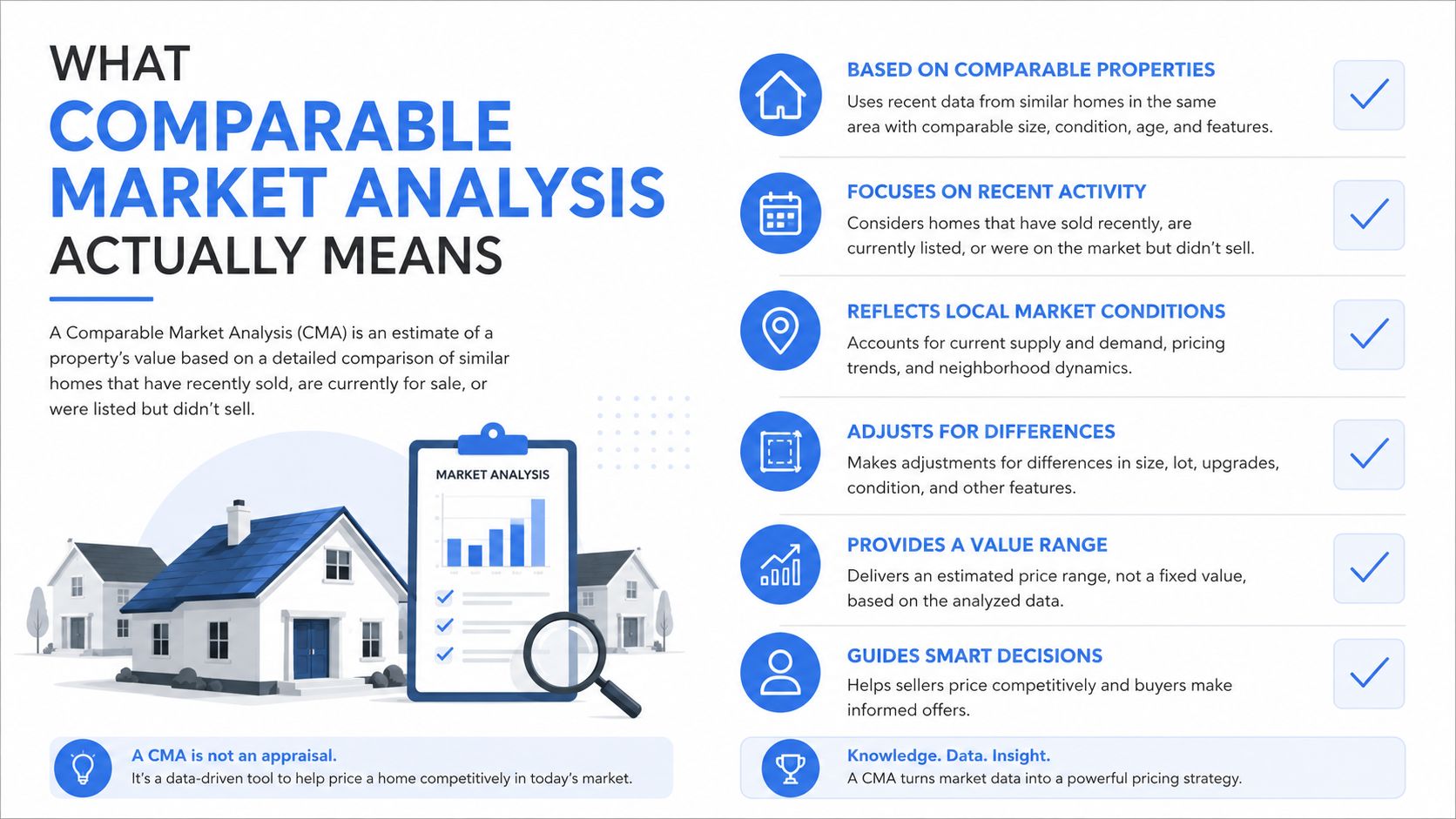
A comparable market analysis is a working value opinion built from recent sales of similar properties. For an investor or private lender, it answers a lending question as much as a pricing question: what would informed buyers likely pay for this property, and how much of that exit value can support the proposed loan?
The analysis begins with closed, arm's-length transactions. Each sale is compared with the subject property, then adjusted for meaningful differences. The adjusted indications are reconciled into a value range or conclusion. Comparables requiring fewer and smaller net adjustments generally provide stronger support, although a close physical match can still be weak if its location or buyer pool differs. The Institute of Professional Auctioneers and Valuers comparative approach guidance describes this adjustment and reconciliation process.
A CMA does not replace a full appraisal. A licensed appraiser prepares an appraisal for a lender under professional and regulatory requirements. An investor, agent, broker, or lender can prepare a CMA as an early underwriting document, using it to test acquisition price, renovation assumptions, bridge-loan proceeds, and the likely resale value before ordering or relying on an appraisal. It is useful precisely because it exposes weak assumptions early.
Start narrow, then justify exceptions
A practical starting set contains three to five closed sales. More examples can add context, but a larger list does not fix poor comparability. In California, closed-sale evidence anchors the sales comparison approach, so the analyst should explain why each selected property belongs in the set rather than filling a table with convenient listings.
In an urban submarket, begin with a tight radius such as half a mile. Rural analysis may require one or two miles because transactions occur less often. Those distances are screening guidelines, not automatic rules. A freeway, neighborhood boundary, different utility service, or materially different land use can make a nearby property less useful than a farther property with the same buyer profile.
Start with sales from the past three to six months when the market provides enough activity. In a slower market, the window may stretch to twelve months, but older sales need a market-condition adjustment. Fannie Mae's comparable sales guidance directs appraisers to select sales with similar physical and legal characteristics and report at least three closed comparables.
Digital tools can organize candidate properties and expose listing patterns before the analyst verifies the transaction record. The Zillow comparable listings API can support initial discovery. It cannot replace closed-sale verification, MLS review, title information, or a physical comparison. Thin markets demand documented judgment, not false precision.
The Five Adjustments That Drive a CMA
A CMA supports two decisions at once: what the property may sell for and how much debt the deal can support. The final value opinion depends on how clearly the analyst explains differences between the subject and each comparable. The five adjustment categories are location, size, condition, amenities, and time.
Location changes the buyer pool
A location adjustment reaches beyond the ZIP code. School boundaries, flood exposure, freeway access, street noise, hillside position, walkability, and traffic patterns can change the resale audience. Two homes in the same city may attract different buyers when one sits on a busy arterial and the other is on a quiet residential street.
Size covers gross living area and lot size. A local price-per-square-foot indicator is useful only after it has been checked against prior transactions and the subject's property type. Multiplying square footage without examining layout can mislead, especially when extra area is poorly configured, non-permitted, or less useful than the primary living space.
Condition matters most on renovation exits
Condition often drives the largest adjustment in fix-and-flip analysis. A dated kitchen, deferred roof work, obsolete bathrooms, or damaged flooring can separate an as-is sale from a retail-ready exit. The adjustment should represent buyer reaction, not just the contractor's invoice. Renovation cost and contributory value can differ.
Amenities also affect buyer appeal. Pools, ADUs, garages, usable outdoor areas, solar systems, and views may support a higher price, but the result depends on the local buyer pool and the feature's quality. An investor should not credit every improvement at its full cost.
Time adjustments bring older sales to the effective valuation date. Fannie Mae's adjustment guidance calls for analyzing market-condition changes between the comparable's contract date and the appraisal's effective date. Its guidance also calls for property value trends to reflect at least twelve months of market data, with illustrative adjustments of 1% to 2% when appreciation differences support them.
| Adjustment Category | What It Covers | Typical Dollar Range | Most Common Investor Mistake |
|---|---|---|---|
| Location | Street position, access, school area, flood exposure, traffic | Must be supported by local evidence | Treating every nearby address as equivalent |
| Size | Living area, layout, lot size, usable land | Based on validated local indicators | Applying a blunt price-per-square-foot formula |
| Condition | Renovation level, deferred maintenance, finishes | Tied to market reaction and scope | Assuming renovation cost equals added value |
| Amenities | Garage, pool, ADU, view, outdoor improvements | Based on buyer preference and comparable sales | Crediting every feature at full cost |
| Time | Movement between sale date and valuation date | Based on market-condition evidence | Leaving older sales unadjusted |
For lending, defensibility matters more than a polished value conclusion. Each adjustment needs a source, a rationale, and a clear connection to recent files or sales reviewed by the underwriter. A comp adjusted upward for condition, size, or location can change the indicated value range, and therefore the loan sizing conversation. Unsupported adjustments make the CMA read like advocacy instead of analysis.
Running the Numbers on a Fix and Flip CMA
Consider a Sacramento ranch purchased for $475,000. The subject is a three-bedroom, two-bath, 1,400-square-foot single-family home in as-is condition, with a planned $65,000 renovation. The investor expects a modernized kitchen, refreshed bathrooms, repaired finishes, and a clean retail presentation.
The first pass is to pull two or three closed sales within roughly half a mile. The analyst should look for similar ranch homes with comparable bedroom and bathroom counts, similar layouts, and a condition profile that can be adjusted without guesswork. Online discovery tools can help identify candidates, and resources covering undervalued property spotting techniques can provide ideas for finding overlooked opportunities. The actual CMA still needs verified closed-sale data and property-level review.
A sample adjustment grid
The following illustration uses hypothetical comp addresses and illustrative adjustments to show the mechanics. The numbers in the grid aren't market facts or a lender quote. They demonstrate how an analyst converts different properties into subject-equivalent indicators.
| Comp Address | Sale Price | Sq Ft Adj | Garage Adj | Condition Adj | Adjusted Value |
|---|---|---|---|---|---|
| 1824 Arden Way | $620,000 | +$8,000 | +$12,000 | -$5,000 | $635,000 |
| 4417 Marconi Avenue | $645,000 | -$10,000 | -$8,000 | +$8,000 | $635,000 |
| 2931 El Camino Avenue | $610,000 | +$15,000 | +$5,000 | +$5,000 | $635,000 |
The subject-equivalent values reconcile to an illustrative ARV of about $635,000. That figure should be supported by the actual comp set, photographs, permits, renovation quality, and current competition. Investors who want a separate explanation of the value-after-renovation concept can review LendingXpress's ARV guide.
Now test the project before discussing use of funds. The basic uses are the $475,000 purchase price and $65,000 renovation budget. Holding costs must be added from the investor's actual timeline, insurance, interest, utilities, taxes, and other carrying expenses. Selling costs also reduce the exit proceeds. Applying an illustrative 8% selling-cost deduction to the $635,000 ARV produces $50,800 in selling costs, leaving $584,200 before the purchase, renovation, and holding-cost calculation.
The lender doesn't fund the story. The lender funds a value opinion and a repayment path.
For a simplified 70% ARV structure, the gross loan ceiling would be $444,500, calculated as 70% of $635,000. That isn't the same as the final loan amount. A lender may also limit proceeds by cost, require borrower equity, hold back renovation funds, or reduce risk when the scope, borrower experience, or exit appears weak.
A 65% ARV bridge structure would produce an illustrative gross ceiling of $412,750, calculated as 65% of $635,000. A bridge lender may focus more heavily on the refinance or sale exit, property income, debt-service coverage, combined loan-to-value, and the borrower's ability to carry the asset.
A $15,000 ARV change in either direction changes a 70% ARV loan ceiling by $10,500, which is why the comp selection itself is the deal. If the ARV rises to $650,000, the illustrative ceiling becomes $455,000. If it falls to $620,000, the ceiling becomes $434,000. Those shifts can change the required equity and the project's feasibility before construction begins.
How Different Readers Use the Same CMA
The same CMA can produce different decisions because each reader has a different risk. A listing agent is trying to position the property for market exposure. An investor is trying to preserve margin. A hard money lender is protecting collateral and repayment. A bridge-loan underwriter is asking whether the borrower can refinance or sell within the planned exit window.
The anchor changes by audience
A listing agent usually anchors on the reconciled market value and may recommend a price near the optimistic end of the supported range to win the listing. That approach can help attract attention, but it may not reflect the price a conservative lender will use for loan sizing.
The investor treats the after-repaired value, or ARV, as a ceiling rather than a target. The offer must leave room for repairs, holding costs, selling expenses, financing, and execution risk. The well-known 70% rule is a screening shortcut, not a substitute for a full budget and CMA.
A hard money lender generally starts with the lowest credible ARV supported by the comp set. The underwriter stress-tests the upside, studies the resale window, and asks who will buy the finished property. A high comp that requires aggressive condition or location adjustments may receive little weight.
Bridge-loan underwriting introduces a different emphasis. The underwriter may review debt-service coverage, combined loan-to-value, and whether the comps support a refinance takeout within nine to eighteen months. Those underwriting considerations are distinct from a flip's resale-only analysis.
| Audience | Primary Number | Risk Lens | Typical ARV Cushion |
|---|---|---|---|
| Listing agent | Adjusted comp value | Marketability and list-price positioning | Qualitative, often optimistic |
| Investor | ARV less total project costs | Margin and maximum purchase price | Conservative enough to protect the exit |
| Hard money lender | Lowest credible ARV | Collateral value and resale risk | Qualitative stress case |
| Bridge-loan underwriter | Refinance value and repayment profile | DSCR, CLTV, and takeout feasibility | Qualitative repayment reserve |
The most disputed adjustments usually involve gross living area, condition, and lot size. A borrower may describe a finished garage or enclosed patio as living area, while an appraiser or buyer may treat it differently. A lender will want the status, utility, and market acceptance documented rather than assumed.
Handling Thin Markets and Low-Confidence Comps
The standard answer to a thin market is often “find more comps.” That advice fails when the market doesn't have more reliable transactions. Rural subdivisions, new-construction communities, unusual properties, private sales, and rapidly changing urban pockets can leave an investor with only two or three plausible sales in the relevant period.
The better response is to measure confidence instead of pretending every comp deserves equal weight. The World Bank comparables toolkit notes that data access and coverage can be constrained in developing and private markets. RICS also recognizes that more data and analytical tooling don't eliminate the need for human judgment about geographic proximity, timing, and source reliability.
Assign confidence before assigning weight
Use a simple high, medium, and low scale:
- High confidence: A close, recent resale with a similar size, legal use, layout, and condition, supported by a normal financed transaction.
- Medium confidence: A reasonably similar property that requires several adjustments, has a wider geographic separation, or has less complete condition information.
- Low confidence: A foreclosure, probate sale, unusual financing situation, distressed transaction, or sale that spent more than thirty days before closing, especially when the property condition is unclear.
The confidence rating doesn't change the sale price. It changes how much influence the adjusted value should have in reconciliation. A high-confidence comp may carry the main weight, while a low-confidence sale may establish a boundary or explain a market segment without controlling the conclusion.
Use secondary indicators carefully
Price per square foot can help identify the range supported by available sales, but it shouldn't become the entire analysis. Active competition adds context, particularly in a fast-moving market, although listings aren't substitutes for closed sales. New construction may require a second methodology, such as cost per square foot, because completed sales may not yet show the operating or finish profile of the subject.
In a fast-moving market, cap comps at 90 days old unless you have a clear reason to use older evidence and a defensible time adjustment. Confirm condition through photographs, contractor observations, inspection reports, and permit records where available. MLS descriptions often compress important differences into vague labels such as “updated” or “excellent.”
For investors working through unfamiliar submarkets, a structured review of market research methods can help separate verified transaction evidence from assumptions. The key question in a thin market isn't “What is the comp?” It's “How much confidence should this comp receive?”
CMA Best Practices and Your Next Step
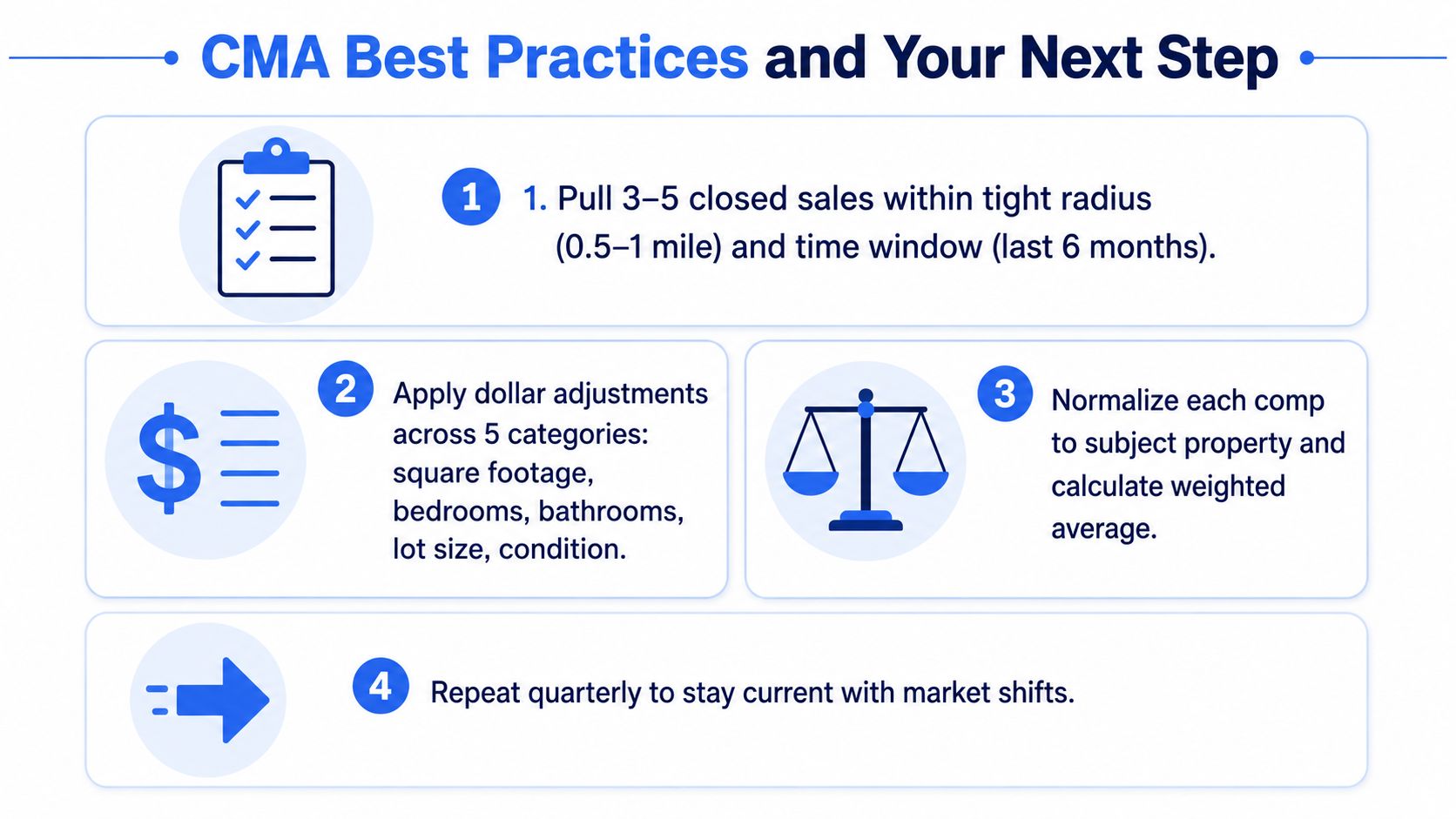
A lender-ready CMA should be repeatable. Start by defining the subject property precisely, including legal use, unit count, living area, lot, condition, parking, access, and planned improvements. Pull three to five closed sales within a tight geographic and time window, then explain every exception when the set expands beyond those boundaries.
Apply adjustments across location, size, condition, amenities, and time. Reconcile the adjusted indicators into a single ARV or current value opinion, but keep the underlying range visible in the work file. A reviewer should be able to trace each conclusion to a source, date, photograph, inspection note, public record, or other supporting document.

Remove the errors that weaken loan sizing
Several mistakes appear repeatedly in investor packages:
- Ignoring site differences: A nearby home may have different traffic, access, flood, slope, or utility conditions.
- Using listings as closed evidence: An asking price reflects a seller's position, not a completed transaction.
- Double-counting renovation value: The investor may add the full rehab budget and then credit the same improvement again through an aggressive comp adjustment.
- Inflating ARV with stale sales: Older or distant properties can support context, but they need a clear reason and market-condition treatment.
- Skipping the exit buyer: A retail-looking ARV may not support a rental refinance, a small multifamily exit, or a property with unusual operating characteristics.
The Pinnacle Property Media pricing guide offers useful context on why pricing requires more than selecting a headline number. For an investor, that principle translates into documentation that reads like underwriting evidence, not a marketing pitch.
Build the lending package around the analysis
Pair the CMA with the scope of work, contractor bids, draw schedule, borrower experience, entity documentation, liquidity evidence, and exit strategy. A private lender can then review the asset, borrower, and plan together instead of judging the property from an isolated ARV.
Traditional bank guidelines can be restrictive for non-owner-occupied acquisitions. Fannie Mae's published benchmark uses a 15% minimum down payment for a single-unit non-owner-occupied home and 25% for a non-owner-occupied two-to-four-unit property. Its guidance also addresses non-occupant borrowers in manual underwriting, including a 90% maximum LTV and a 43% DTI limit based only on the occupant borrower's qualifying income and liabilities. Fannie Mae's investment property and multiple-financing guidance illustrates why some investors turn to private financing when conventional eligibility doesn't fit the transaction.
A disciplined CMA won't eliminate every uncertainty. It will show the lender that the investor understands the uncertainty, has priced it, and has a credible way to manage it. That preparation can influence terms, and certainty of close far more than a confident ARV paragraph.
LendingXpress structures private bridge, hard money, fix-and-flip, and rental-property financing for non-owner-occupied California properties, including renovation funding with staged draws and flexible asset-focused underwriting. Package your comparable market analysis with your scope of work and exit plan, then visit LendingXpress to discuss a financing structure built around the actual deal.