
You found a rental deal that makes sense on paper, but your bank still says no. That usually happens for one reason. The bank is underwriting you like a salaried borrower instead of underwriting the property like an investment.
That’s where dscr loans requirements matter. A DSCR loan is built for non-owner-occupied real estate. It looks at whether the property can carry its own debt, which makes it useful for self-employed investors, portfolio buyers, and borrowers whose tax returns don’t reflect their real earning power.
The catch is simple. DSCR loans are easier than conventional loans in some ways, but they’re stricter in others. If the property is borderline, vacant, newly rehabbed, or run as a short-term rental, the details of underwriting matter a lot. That’s where many deals get stuck.
What is a DSCR Loan and Who Needs One
A DSCR loan is an investment property loan based primarily on the cash flow of the property, not your personal W-2 income. For real estate investors, that changes the whole conversation.
A traditional bank usually wants pay stubs, tax returns, and a clean debt-to-income picture. That works fine for a borrower with a steady salary and one or two financed properties. It breaks down fast when the borrower owns several rentals, writes off aggressively, or runs income through a business.
A DSCR loan asks a different question. Can the property support the payment?
That’s why these loans fit:
- Self-employed investors: Your tax returns may not show the income a conventional lender wants.
- Portfolio landlords: You don’t want every new purchase tied to your personal debt-to-income ratio.
- Short-term rental operators: Your income may be real, but it doesn’t always fit a standard bank box.
- Buyers moving fast: The underwriting is asset-focused, which can simplify the process for the right deal.
A practical way to think about it is this. A conventional loan underwrites your household. A DSCR loan underwrites the property.
Practical rule: If the rental income tells a stronger story than your tax returns, a DSCR loan usually deserves a closer look.
These loans are for non-owner-occupied properties only. They’re meant for investors buying or refinancing rental real estate, not primary homes. If that’s your lane, reviewing current DSCR loan options for investors is often the fastest way to tell whether the deal can work before you spend weeks chasing a bank approval that was never likely.
How to Calculate Your DSCR
A lot of investors lose time here because they use a back-of-the-napkin rent number, plug in a payment estimate, and assume the deal works. Then underwriting applies a tighter rent figure, adds real expenses, and the ratio comes in short. That happens often on recently rehabbed properties, vacant units, and short-term rentals converting to long-term use.
DSCR = Net Operating Income ÷ Total Debt Service
The ratio answers one practical question. After normal property expenses, does the income cover the loan payment with enough cushion to satisfy the lender?

Start with the income side
For DSCR, lenders usually start with the property’s income, then back out operating expenses to reach Net Operating Income, or NOI. NOI does not include the new mortgage payment. It is the property’s earnings before debt service.
For a standard rental, use the current lease if it is in place and supportable. If the property is vacant or just finished rehab, the lender may rely on market rent from an appraisal instead. That distinction matters. Transitional properties often look stronger in a broker’s pro forma than they do in an underwriter’s file.
A quick screening process helps:
- Use supportable rent. Start with in-place lease income or appraiser-supported market rent.
- Subtract real operating costs. Taxes, insurance, maintenance, HOA dues, and management should be treated like fixed ownership costs, not optional line items.
- Use the payment you are requesting. Rate, amortization, and loan size all change the final ratio.
That last point trips up new investors. A deal can pencil at one loan amount and fail at another.
Then calculate the debt side
Debt service is the full monthly loan obligation the property needs to carry. In practice, lenders often size the loan around whether the rent can support that payment at the quoted rate and terms.
A 1.0 DSCR means the property’s NOI exactly matches the debt payment. On paper, it covers itself. In real ownership, that leaves very little room for vacancy, repairs, or a tax increase.
Here is the simple math:
- NOI: $2,500 per month
- Debt service: $2,000 per month
- DSCR: 1.25
That file is usually easier to place than a deal at 1.00 because the property shows some cushion.
Borderline deals need tighter math
This matters even more for post-rehab properties, delayed stabilization, and short-term rentals. A house that looks excellent after renovation may still be underwritten off market rent, seasoning rules, or a rent schedule that comes in lower than expected. An STR may have strong gross revenue, but the lender may use a different method than the operator uses in their own spreadsheet.
That is why I tell investors to run two numbers before applying. First, calculate the ratio using your optimistic rent assumption. Then run it again using the rent figure an appraiser is more likely to support. If the second number is thin, structure becomes the issue. Reduced borrowing, more reserves, or a different loan program may solve it faster than arguing with underwriting.
A simple example
Say a duplex brings in $3,200 a month in rent. Operating expenses total $700, so NOI is $2,500. If the proposed monthly debt service is $2,500, the DSCR is 1.0. Some lenders will consider that. Terms usually tighten because the file has no cushion.
If debt service drops to $2,000, the DSCR becomes 1.25. Same property, same rent, different structure. That is why experienced investors do not stop at asking whether a deal cash flows. They ask whether it cash flows under the lender’s math.
Before you submit an application, calculate DSCR the way underwriting will. Use supportable rent, honest expenses, and the actual loan terms you expect to request. That one habit helps you spot weak deals early and gives borderline properties a better shot at approval.
Key DSCR Loan Requirements for Approval
A deal can cash flow on paper and still miss approval because the file is thin in the wrong place. I see that often with post-rehab properties, vacant units coming online, and short-term rentals that look strong in the operator’s numbers but weaker in lender underwriting.
For DSCR approval, lenders are usually looking at four things together. DSCR, credit, reserves, and loan-to-value. If one piece is borderline, the other three have to carry more weight.
The four pillars lenders look at
DSCR ratio is still the starting point. Many programs look for at least break-even coverage, and stronger terms usually come with more cushion, based on verified 2026 DSCR program ranges.
Credit score affects flexibility. A stronger borrower profile can help a lender get comfortable with a tighter ratio or a property that needs a little more explanation. Weaker credit does the opposite. It shrinks the approval box and usually raises cost.
Reserves are a real underwriting issue, not a side note. Borderline and transitional properties need room for vacancy, repairs, or slower lease-up. A lender wants to see that one rough month will not throw the whole deal off track.
Loan-to-value sets the lender’s exposure. The higher the financing amount relative to the property value, the less room there is for a thin ratio, limited reserves, or a property with uneven income history.
How the trade-offs actually work
DSCR loans are often approved in tiers. A clean file with strong credit, solid reserves, and a lower loan-to-value request gets easier treatment than a file asking for maximum proceeds on a property still stabilizing.
That matters on borderline deals. A lender may still approve the loan, but with a larger down payment, more post-close liquidity, or tighter property conditions. For a newly rehabbed home that does not yet have a full operating history, that structure change can be the difference between getting funded now and waiting months.
I tell investors to stop viewing DSCR approval as a simple yes or no. It is usually a structure question. How much are you borrowing, how much cash will you keep after closing, and how much confidence does the file give the underwriter?
DSCR Loan Qualification Tiers
| DSCR Ratio | Minimum Credit Score | Maximum LTV | Typical Scenario |
|---|---|---|---|
| Below 1.00x | Strong compensating factors needed | Lower cap | Borderline cash flow, larger down payment, reserves carry more weight |
| 1.00x to below 1.25x | Program dependent | Below top tier | Break-even to moderate cash flow, outcome depends on the full file |
| 1.25x+ | Strong credit helps | Higher cap | Better pricing, higher financing amount, cleaner approval path |
What usually works and what doesn’t
Files that get approved quickly usually have three things. Clear rent support, enough liquidity after closing, and a loan request that matches the actual risk of the property.
Files that stall tend to run into familiar problems:
- The loan request is too aggressive: The borrower wants top-tier LTV on a thin DSCR deal.
- Cash is tight after closing: Down payment is covered, but reserves are not.
- Rent support is weak: The appraisal, lease, or market rent conclusion comes in softer than expected.
- The property is in transition: Rehab is done, but occupancy, seasoning, or income history still needs to be explained clearly.
- Credit gets ignored: It matters less than in conventional lending, but it still affects pricing and flexibility.
For investors buying or refinancing transitional properties, the goal is not to make the deal look perfect. The goal is to present it in a way underwriting can approve. That is where experienced DSCR lenders, including LendingXpress, tend to separate from banks that only want stabilized, easy files.
Underwriting Nuances for Special Properties
A borrower finishes a rehab, the property looks rent-ready, and the numbers work on paper. Then underwriting asks the question that decides the file: is this property stabilized, or is it still a story in progress?
That distinction matters more on special properties than on plain vanilla rentals. Borderline deals often fail because the asset is bad, but because the file does not match the actual stage of the property. Post-rehab homes, mixed-use buildings, vacant units, and short-term rentals can all qualify under DSCR programs. They just have to be underwritten on the right basis.
Short-term rentals get underwritten differently
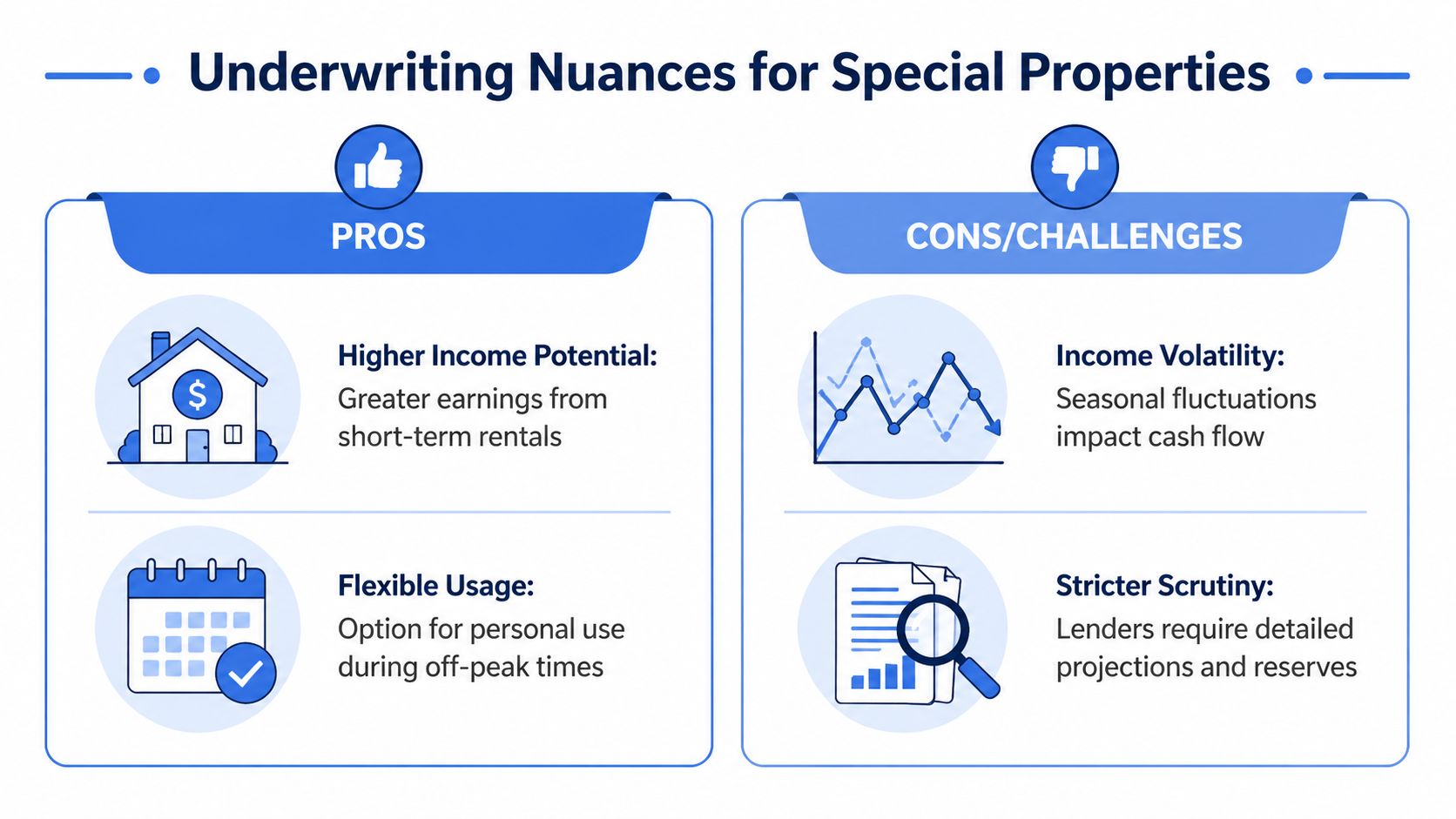
Short-term rental income usually does not get full credit. Lenders tend to haircut projected revenue because occupancy swings, platform fees, and seasonality can turn a strong summer property into a weak annual performer, as discussed in The Lender’s review of DSCR issues for short-term rentals.
That is why a beach house with great Airbnb screenshots can still miss the mark. Underwriting wants income it can defend, not just income the owner expects.
The cleanest STR files usually include:
- Documented booking history from a recognizable platform or property manager
- Market rent support from the appraisal, especially when operating history is short
- A clear expense approach that accounts for cleaning, management, and turnover
- Liquidity after closing because uneven monthly cash flow raises risk
- A simple explanation of use if the property recently shifted from long-term to short-term rental
I see investors get in trouble here when they submit gross revenue and assume underwriting will fill in the rest. It will not. If the property is an STR, present it like a business-backed rental with seasonality, not like a standard lease property.
Transitional and post-rehab properties need proof of timing
A rehabbed property can be financeable before it has a full operating history. The issue is timing. Underwriters need to know whether the work is done, whether the unit is rent-ready, and how soon the projected income becomes real.
The file gets stronger when the borrower answers those questions up front. NASB’s discussion of DSCR qualification gaps notes that lenders often focus on stabilized income, operating history, and the plan to reach full occupancy on transitional assets.
For a post-rehab DSCR loan, the package should show:
- What work was completed
- Whether the property is fully rent-ready now
- What comparable units are leasing for
- How long lease-up should take
- How the borrower covers the property if stabilization takes longer
That last point is where solid lenders separate themselves from banks. A bank may treat the file as a problem because the lease is not signed yet. LendingXpress and other DSCR lenders that work these deals every day can often structure around the transition, if the borrower can document the path from rehab to stable rent.
Borderline properties live or die by context
Special properties rarely fit a clean box. A mixed-use building may have strong residential rents but a vacant storefront. A rural property may cash flow but still face tighter program rules. A newly converted STR may show demand, but not enough history for every lender.
Those files do not get approved by forcing them into a standard rental template. They get approved by matching the loan request to the actual risk.
That usually means trade-offs. A smaller loan amount can solve a thin ratio. More reserves can offset uneven income. Better documentation can make a recent rehab feel less speculative. A borderline file is not automatically a decline. It just needs the right structure, the right program, and a file that explains the property as it exists today, not as the borrower hopes it will look six months from now.
How to Strengthen Your DSCR Loan Application
A lot of DSCR files are lost before underwriting even starts. The borrower sends a property that could work, but the submission leaves too many open questions about rent, condition, reserves, or timing. That problem shows up constantly on post-rehab rentals, new STR conversions, and properties that are technically rentable but not fully stabilized.

Improve the ratio before the lender touches the file
A stronger DSCR usually comes from a few practical fixes, not from trying to out-argue the underwriter.
Start with income. Use rent the lender can defend. For a long-term rental, that means a signed lease, a market rent schedule, or clean comps. For a short-term rental, it means documented performance or supportable third-party data, not an optimistic nightly-rate projection pulled from a booking app.
Then look at the loan request itself. If the ratio is thin, a slightly lower loan amount can make the file workable fast. I see investors spend days arguing over small expense line items when a modest paydown would solve the issue in one move.
The main factors are usually straightforward:
- Supportable rent: Use current leases, market rent schedules, or documented STR income that matches the asset type.
- Accurate expenses: Inflated taxes, insurance estimates, or messy operating numbers can drag the ratio down.
- Other property income: Parking, storage, and laundry may help, but only if the lender can verify them.
- Loan size: Less debt often fixes a borderline file faster than any spreadsheet revision.
Clean up the file package
Good DSCR submissions feel easy to approve. The lender should not have to guess who owns the borrowing entity, whether rehab is complete, or how the property will perform over the next few months.
For a standard rental, that means clear entity documents, current leases, a rent roll if applicable, proof of liquidity, and a clean insurance quote. For a transitional deal, add a short written summary that explains the current stage of the property. If units were just finished, say so. If the STR is live but only has limited history, show booking data, management details, and reserve strength.
Borderline files often get slowed down because the package mixes old and new information. The appraisal says one thing, the lease says another, and the borrower is describing a third version of the property. Keep every document aligned to the same story.
If the asset is moving from rehab into rental stabilization, it helps to work with a lender that understands both stages of the deal. LendingXpress also offers guidance on the investment property financing process, which is useful when the property is close to DSCR-ready but not packaged like a bank file yet.
A quick visual explainer can help if you’re still comparing loan paths:
Focus on the few factors that matter most
Borrowers often chase small adjustments and ignore the variables that determine an approval.
These usually carry the most weight:
- Credit profile: Better credit gives the lender more room on pricing and structure.
- Liquidity: Reserves matter more on uneven properties, especially recent rehabs and STRs.
- Property condition and positioning: A rent-ready asset with market support gets a different review than a half-stabilized property.
- Execution: Missing leases, outdated entity docs, and appraisal delays can turn an approvable deal into a stalled file.
Strong DSCR applications are clear, consistent, and easy to defend. That matters most when the property is in transition and a standard lender is already looking for a reason to say no.
Financing Your Next Deal with LendingXpress
Some deals don’t fail because the property is bad. They fail because the financing path is wrong for the stage of the asset.
That’s common with post-rehab rentals, vacant properties waiting for lease-up, and borrowers moving from short-term bridge debt into a stabilized DSCR exit. A conventional lender may want a fully seasoned file. A private lender may understand the transition but not offer the right takeout path. Investors get stuck in the middle.
For those situations, a practical starting point is understanding the full investment property financing process. The right structure depends on what phase the property is in today, not where you hope it will be later.
The useful approach is straightforward:
- Use bridge capital when the asset is still being fixed or stabilized
- Move into DSCR financing once rent and cash flow are supportable
- Match funding to actual risk, not the optimistic pro forma
- Work with a lender who can review imperfect files without forcing a bank template onto them
That matters most when banks say no for technical reasons that don’t reflect the actual quality of the deal. If the property has a clear path to stabilization, the financing should reflect that path.
If you’re financing a non-owner-occupied purchase, refinance, or post-rehab rental, talk with LendingXpress about the deal before you waste time on the wrong loan channel. A quick review can tell you whether the property fits DSCR now, needs a bridge first, or needs a different structure altogether.