
You've got a property under contract, the numbers look strong, and the seller wants a fast close. Then the main problem shows up. Your cash may cover the purchase, or it may cover the rehab, but not both at the same time.
That's where many new investors stall out. Banks move too slowly, don't like distressed properties, and usually won't structure a loan around the actual work needed to turn an ugly house into a saleable asset. Meanwhile, the deal clock keeps running.
Fix and flip loans with 100% rehab funding are built for that exact gap. But the phrase gets marketed in a way that can confuse even smart investors. It sounds like unlimited financial power and zero cash required. That's rarely how it works in practice.
The core value is simpler. You can preserve capital, move faster on the right project, and finance approved renovation work through a structured draw process. The catch is that the deal still has to fit the lender's risk box, and you still need to be ready for costs the loan won't cover.
The Investor's Dilemma Finding the Perfect Flip
A common first flip looks like this. An investor finds a tired house in a good neighborhood. The layout works, the resale comps support the plan, and the contractor says the updates are straightforward. New flooring, paint, kitchen, baths, landscaping, maybe a roof.
The investor can scrape together enough for the down payment, but then the rehab budget becomes the roadblock. If all available cash goes into closing, the project starts underfunded. If the investor holds cash back for repairs, the purchase may never happen.
That tension kills a lot of promising deals.
Traditional financing usually makes it worse. Distressed properties can trigger condition issues. Timelines stretch. Underwriters focus on income documents and bank-style loan standards that don't match an investor's real objective, which is to buy, improve, and resell a non-owner-occupied property fast.
A flip rarely fails because the investor lacked vision. It usually fails because the capital stack didn't match the project.
Private lending exists for this reason. The loan is built around the property, the rehab plan, and the exit strategy. That gives investors a way to compete for houses that need work and can't wait on a long approval cycle.
Still, speed alone doesn't solve the problem. The financing has to fit the deal, and the deal has to fit the financing. If the property needs a level of renovation the lender won't support with a high proportion of borrowed funds, or if the borrower assumes “100% financing” means no cash needed anywhere, the transaction gets messy fast.
Where new investors misread the opportunity
Most beginners don't misjudge the property. They misjudge the structure.
They assume:
- Purchase money is the whole challenge: It isn't. Rehab liquidity matters just as much.
- A strong ARV solves everything: It helps, but lenders also care about execution risk.
- Fast financing means loose financing: It doesn't. Private lenders can move quickly and still stay disciplined.
The best borrowers treat financing like part of the acquisition strategy, not an afterthought. They know what the lender will reimburse, what the lender won't, and how the draw process affects contractor scheduling before they close.
What 100% Rehab Funding Really Means
The phrase 100% rehab funding usually refers to a fix-and-flip structure where the lender finances the acquisition and the approved renovation budget. That's the headline version. The operational version is more specific.
A key feature of these loans is that they're often marketed as full financing for both purchase and rehab, but the total loan is still constrained by the property's after-repair value, or ARV. Industry explainers and lender programs commonly describe the ceiling as about 70% to 75% of ARV, including examples from Rehab Financial's 100% financing product.

The easiest way to think about ARV
ARV is the lender's safety rail. It's the projected value of the property after the work is done and the home is ready for resale. If the total loan amount pushes too high against that future value, the lender won't stretch just because the rehab budget is legitimate.
That's why “100% financing” doesn't mean unlimited financing.
A lender may say yes to:
- The full purchase price
- The full approved rehab budget
- Staged draws for the renovation work
But the lender can still say no if the combined exposure sits too high against the expected resale value.
Why this structure exists
This isn't marketing trickery. It's risk control.
The lender wants room in the deal if:
- the rehab runs longer than planned,
- the resale comes in softer than expected,
- or the project needs a price reduction to move.
That ARV cap protects the lender's exit position, and it also forces the borrower to buy better. If a deal only works when financing is pushed to its limits, it probably isn't a strong flip.
Practical rule: If the deal only pencils because you assume every dollar of cost will be financed with no margin constraints, the deal is too tight.
What 100% rehab funding does well
When structured correctly, this loan type solves a real investor problem.
It can:
- Preserve cash for overlap costs: Utilities, insurance, and other project expenses still happen while the rehab is underway.
- Improve buying power: You can pursue distressed homes that need capital on day one.
- Keep funds tied to the business plan: Purchase funds close the deal, and rehab funds are released against approved work.
That's why fix and flip loans with 100% rehab funding are useful. They aren't blank checks. They're disciplined, asset-based tools for deals that fit within the lender's view of future value.
How the Numbers Work A Real-World Example
A simple deal makes this easier to understand.
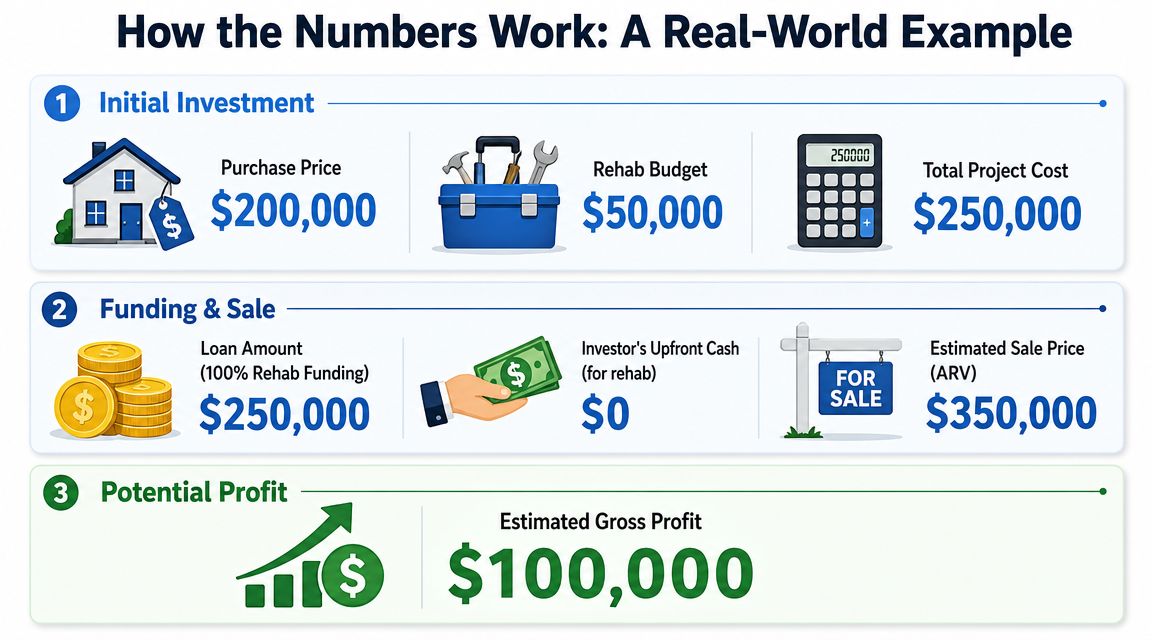
Say you're buying a property for $200,000, your rehab budget is $50,000, and your total project cost is $250,000. If the projected sale price after repairs is $350,000, the gross spread between total cost and expected resale is $100,000.
That's the exact kind of example investors often use when they first start shopping for fully funded financing.
What the headline numbers show
Using the example above, a 100% rehab funding structure would appear to cover:
- Purchase price: $200,000
- Rehab budget: $50,000
- Total loan structure: $250,000
- Investor cash for rehab work itself: $0 upfront for approved renovation items in the budget
On the surface, that sounds like the investor needs almost no cash.
That's where many first-time borrowers make a bad assumption.
What the headline numbers leave out
Even when a loan is marketed as covering 100% of purchase and rehab, borrowers generally still need cash for closing costs, origination fees, and cash reserves, as explained in Dominion Financial's discussion of fix-and-flip loans.
Those items matter because they don't disappear just because the rehab line is fully financed. You still need liquidity to get through closing and to handle the project if something runs behind.
Zero down and zero cash to close are not the same thing.
That distinction changes how you evaluate a flip. The investor who only budgets for purchase and construction often gets trapped by everything around the project rather than the project itself.
How to underwrite the deal like a lender
Before you get attached to a property, run the deal through a simple filter:
Does the purchase plus rehab fit the lender's structure?
If your renovation plan is aggressive relative to the value after repairs, the financing amount may get cut back.Can you cover the non-financed items comfortably?
Fees, reserves, and normal transaction costs still require real cash.Is the projected resale realistic enough to support the risk?
The better the comps and the cleaner the scope, the easier the conversation.
A calculator helps here, especially when you're comparing multiple deals quickly. If you want to pressure-test a scenario before submitting a file, use the LendingXpress fix and flip loan calculator.
What works and what usually doesn't
A deal like this works better when the scope is clear and the resale story is easy to support. Cosmetic rehabs, standard floorplans, and neighborhoods with active comparable sales tend to translate better to lender confidence.
Deals struggle when the initial budget is too optimistic, the contractor scope is vague, or the investor forgets carry costs. The loan may finance the approved rehab. It won't save a project that was underplanned from the start.
Understanding the Rehab Draw Process
Most borrowers hear “rehab funding” and assume the lender wires the renovation budget at closing. That's not how these loans are typically administered.
The purchase funds are handled at closing, but the rehab portion is usually released through a draw process. That means the money is staged and disbursed as work is completed, not handed over in one lump sum on day one.
How draws usually move
The process is structured for control.
A typical sequence looks like this:
- Scope approval before closing: The lender reviews your rehab budget, line items, and project plan.
- Work gets completed in phases: Your contractor finishes the approved items tied to a draw request.
- Inspection confirms progress: The lender or an inspection partner verifies that the work was completed.
- Funds are released: The next reimbursement or draw is sent based on the approved progress.
That system protects both sides. The lender confirms that construction money is improving the collateral. The borrower gets a framework that helps keep the contractor accountable.
Why experienced investors like the structure
At first, staged draws can feel restrictive. New borrowers often want every dollar available immediately. In practice, the draw schedule brings discipline to the rehab.
It helps with:
- Budget control: You catch scope drift earlier.
- Contractor management: Payment follows verified progress.
- Project visibility: Everyone knows what's done and what's next.
Borrowers who organize their scope of work before closing usually move through draws with fewer problems than borrowers who “figure it out” after they own the property.
Common mistakes during the draw phase
Most draw issues come from basic planning failures, not from the draw system itself.
Watch for these problems:
- Incomplete scope documents: If line items are too vague, expectations break down later.
- Out-of-order work: A contractor may complete visible finishes before core items that were meant to come first.
- Poor communication: Missed inspections and delayed paperwork can slow reimbursements.
A good loan officer will explain the draw rules early so you can plan labor, materials, and scheduling around them. That matters more than people think. A borrower who understands the process before closing usually runs a smoother project than one who learns it mid-renovation.
Qualifying for Full Rehab Funding
Not every borrower, and not every property, fits a true full-funding structure. The strongest approvals tend to follow a pattern. The borrower has some experience, the property is straightforward, and the rehab plan is measurable rather than speculative.
One of the most useful reality checks in this niche is that true 100% financing is often reserved for experienced flippers, commonly those with at least three successful flips in the past two years, and the qualifying projects are usually light, cosmetic rehabs on standard residential assets rather than rural properties, complex renovations, or specialty property types, as outlined by Private Lender Link's review of 100% financing for fix-and-flip projects.
The borrower profile lenders like
Experience reduces lender anxiety. It shows that the borrower can manage contractors, make rehab decisions, and exit the project without learning every lesson the hard way on this specific property.
That doesn't mean newer investors are shut out of the market. It means true financing structures offering the most significant capital are more realistic when the file shows:
- Completed projects: A track record gives the lender evidence, not hope.
- Liquidity beyond the deal: Cash reserves signal that the project can absorb normal surprises.
- Clean execution materials: A detailed rehab budget and coherent plan matter.
If you want to understand the broader approval factors, this guide on how to qualify for a hard money loan is a practical starting point.
The properties that fit best
Lenders usually prefer standard residential investment properties with rehab scopes they can price and inspect cleanly.
The best candidates are often:
- Cosmetic or moderate updates: Kitchens, baths, paint, flooring, fixtures, and similar work
- Conventional asset types: Properties that resell easily to the most common buyer pool
- Clear comparables: Neighborhoods where value after repairs is easier to support
The weaker candidates are usually the ones with too many moving parts. Heavy structural work, unusual layouts, mixed-use components, remote locations, or specialty assets create more uncertainty. That doesn't always make them unfinanceable. It often makes full rehab funding less likely.
A practical self-test before you apply
Ask three direct questions.
| Question | Strong answer | Weak answer |
|---|---|---|
| Have you completed similar projects? | Yes, and I can document them | No, this is my first construction-heavy deal |
| Is the property easy to value after repairs? | Yes, standard residential comps are clear | No, the asset is unusual or thinly traded |
| Is the rehab scope easy to verify in stages? | Yes, defined line items and contractor bids | No, scope is evolving as we go |
If your deal lands more often in the right-hand column, full funding may not be the right expectation. You may still have a financeable project, but you'll likely need a more conservative structure.
How These Loans Compare to Other Financing
Investors usually compare three paths when they need purchase money plus renovation capital. They look at a full rehab funding loan, a partial-rehab hard money loan, and a traditional bank loan.
The right choice depends on what's constraining the deal. If speed and flexibility matter most, private lending usually wins. If cost of capital is the only priority and the property is already bankable, conventional financing may fit better.

Financing options at a glance
| Feature | 100% Rehab Funding Loan | Partial Rehab Hard Money Loan | Traditional Bank Loan |
|---|---|---|---|
| Rehab funding | Covers approved rehab budget | Covers part of rehab budget | Usually limited for distressed flip projects |
| Cash needed for improvements | Lower | Higher | Highest |
| Underwriting focus | Asset and exit strategy | Asset and exit strategy | Borrower income, documentation, property condition |
| Speed | Fast | Fast | Slowest |
| Best fit | Investors preserving cash on strong flips | Investors willing to bring rehab capital | Stabilized or near-stabilized properties |
The real trade-off
The highest-risk option gives you the least room for sloppiness.
As rehab funding moves closer to full coverage, private lenders often tighten ARV-based loan-to-value ratios, sometimes moving from 75% toward 70% of ARV, to preserve exit-margin protection when rehab cost is high relative to purchase price, as explained in Ridge Street Capital's fix-and-flip loan guide.
That means full rehab funding can be the right tool, but only for deals with enough spread and enough clarity. If the renovation is large, the property type is unusual, or the resale is harder to pin down, a lender may offer partial rehab funding instead.
When each option makes sense
Use a 100% rehab funding loan when the project is clean, the scope is defined, and preserving your cash matters more than squeezing for conventional pricing.
Use a partial rehab hard money loan when you have capital available and want more flexibility on a deal that may not qualify for high loan-to-value ratios.
Use a traditional bank loan when the property condition, timing, and paperwork all fit a conventional box. That usually isn't the case with serious flips.
For a broader plain-English overview of why these loans are underwritten around the asset rather than the borrower's income in the usual bank sense, Homebase explains asset-based financing in a way many first-time investors find useful.
A lender option in this space is LendingXpress, which offers non-owner-occupied fix-and-flip financing with staged rehab draws and can finance up to 100% of rehab costs on qualifying projects.
Your Application Roadmap to Get Funded Fast
The fastest files are the cleanest files. Investors lose time when they submit partial budgets, unclear scopes, missing entity documents, or a purchase contract that still has loose terms.
Start by getting your package organized before you shop the loan.

What to prepare first
Have these ready:
- Executed purchase contract: The lender needs to see the actual deal terms.
- Detailed rehab budget: Line items should be specific enough to support draw administration.
- Property information: Photos, comps, and your business plan for the exit.
- Borrower and entity documents: If you're closing in an LLC or another entity, get the paperwork in order early.
- Liquidity evidence: You still need to show you can cover the non-financed parts of the transaction.
A clean package does two things. It speeds up underwriting, and it tells the lender you're serious about execution.
How to avoid self-inflicted delays
Many delays happen because borrowers treat private lending like casual bridge money rather than a documented transaction. Small mistakes create avoidable friction. Title issues go undisclosed. Contractor numbers change after submission. The borrower assumes the lender will sort out inconsistencies later.
A useful outside checklist is David J. Greiner's mortgage tips. It isn't written specifically for fix-and-flip investors, but the core discipline applies. Keep documents consistent, don't create confusion during the process, and respond quickly when underwriting asks for clarification.
This walkthrough is also worth a few minutes if you want a visual explanation of the funding process before you apply.
What a good lending conversation sounds like
A productive first call is direct. You should be able to explain the purchase, the rehab, the resale plan, your timeline, and what cash you have available for fees and reserves.
The lender should be equally direct about:
- What part of the rehab budget is financeable
- How draws are handled
- What conditions could reduce financing
- What you'll still need to bring to close
If those answers feel vague, keep asking questions. Good deals move fast, but fast shouldn't mean unclear.
If you've got a non-owner-occupied flip that needs purchase financing and rehab capital, a conversation with LendingXpress can help you determine whether the project fits a full-funding structure, what cash you'll still need at closing, and how quickly the file can realistically move.