
You get a property under contract on Tuesday. The seller wants proof you can close fast, your bank is still asking for updated statements, and the rehab budget is too messy for a conventional underwriter anyway. That is the point where hard money stops being a backup option and becomes the tool that keeps the deal alive.
Dallas gives investors plenty of choices, but more choice does not make the decision easier. A lender that works well for a light cosmetic flip may be a bad fit for a heavy rehab, a rental refinance, or a bridge loan on a small commercial asset. Rate matters, but it is rarely the deciding factor on a real deal. Speed to term sheet, draw process, appraisal approach, extension policy, and exit flexibility usually matter more.
That is the frame for this guide.
The goal here is to help you choose among hard money lenders in dallas texas based on the deal in front of you, not just a headline rate or a polished website. We compare established Dallas lenders, where local market familiarity can help, and we also point to a remote option for investors who want broader lending reach, faster execution, or more flexibility across asset types. If that is your priority, this guide to Dallas hard money lenders from LendingXpress is worth reviewing alongside the local names.
Dallas is an active investor market, which usually leads to better process discipline from lenders that do this work every day. That can mean cleaner underwriting, more predictable rehab draws, and fewer surprises before closing. It can also mean sharper screening. Strong lenders move quickly, but they still want a clear scope of work, a realistic exit, and a borrower who knows the numbers.
Use this list as a decision framework. Match the lender to the property, the timeline, and the exit plan first. Then compare pricing.
1. Longhorn Investments (Dallas)

You get a Dallas flip under contract on Monday. The seller wants a quick close, the house needs real work, and you do not have time to chase a lender for basic terms. Longhorn is a practical option for that kind of deal because they put more of the box in plain view than many local private lenders.
That matters more than investors sometimes think. Clear loan guidelines help you decide fast whether the deal fits the lender, before you spend money on inspections, insurance, or appraisal. If you already know your purchase price, rehab budget, and exit, Longhorn is easier to screen early than lenders that keep everything behind a phone call.
Where Longhorn fits best
Longhorn is built around investor-use cases, especially rental and fix-and-flip properties where after-repair value and rehab execution drive the file. For Dallas borrowers working distressed houses, tired rentals, or dated inventory, that is the right starting point.
The main advantage is not just speed. It is speed with a structure investors already understand. Rehab draws, short-term bridge debt, and underwriting that looks at the asset after repairs all line up well for operators who buy below market, improve the property, and exit through sale or refinance.
If you want to compare that local model with a lender that can also handle investor loans across more markets and property types, review hard money lending options through LendingXpress alongside the Dallas names in this guide.
Practical rule: A fast close helps at acquisition. A bad draw process hurts for months. Ask how draws are approved, how often they fund, what extensions cost, and what happens if your exit slips.
Best fit and trade-offs
Longhorn works best for:
- Value-add residential deals: Projects where current condition is weak but the upside after repairs is clear.
- Investors who want visible loan parameters: Public-facing program details cut down wasted time.
- Repeat borrowers: The model makes the most sense for people doing more than one deal and refining their process.
There are trade-offs. Shorter loan terms can work well on clean flips with a disciplined contractor and a clear resale window. They create pressure on heavier rehabs, permit delays, or deals where the refinance is not lined up early. On those files, a slightly higher rate with more term flexibility can be cheaper in the end.
Pricing can also improve with borrower history. That is common in private lending, but first-time borrowers should expect the relationship to matter. For a newer investor, the question is whether Longhorn’s process fits the deal well enough to offset any pricing gap.
I’d put Longhorn on the shortlist when the project is straightforward, the numbers are already built, and you want a Dallas lender whose program is easy to evaluate without guesswork.
Visit Longhorn Investments.
2. Noble Mortgage & Investments (Dallas)
Noble is the lender I’d look at when the hard money loan is only part of the plan. A lot of investors don’t just need acquisition funding. They need the next step mapped out too, whether that’s DSCR, rehab-to-perm, or a refinance after stabilization.
That broader product menu is Noble’s main advantage. You don’t always want to stitch together one lender for purchase, another for refinance, and a third for long-term rental debt. Every handoff adds friction.
Why the product menu matters
Noble’s Dallas program pages are built around more than one deal type. That matters when the asset could shift strategies midstream. A property you planned to flip might pencil better as a rental. A rehab project might need to convert into longer-term debt if resale timing changes.
For brokers and investors who want a lender relationship beyond one short-term note, LendingXpress as a hard money lender belongs in the same conversation because the value isn’t just funding, it’s structuring the right bridge and exit from day one.
Noble also makes a practical promise around timing. Their Dallas materials emphasize quick residential closings and longer but still defined commercial timelines. That’s helpful because vague speed claims are a red flag. You need to know whether a lender can move on your asset type.
What to watch before you apply
Noble is a fit for:
- Investors who want multiple loan options: Flip, rehab-to-perm, DSCR, and commercial bridge in one shop.
- Borrowers with evolving exit plans: Useful when the business plan may change after acquisition.
- Small to mid-sized commercial and residential investors: Especially where a conventional bank won’t move fast enough.
The main downside is rate visibility. Noble doesn’t post full pricing online, so you’ll need a quote. That’s not unusual, but it does make side-by-side comparison slower if you’re trying to underwrite several lenders quickly.
Commercial borrowers should also pay attention to sizing. If your project needs a very large check, you’ll want to confirm capacity early instead of assuming every commercial page means institutional-scale funding.
A wide product menu helps only if the lender can explain the exit clearly. Ask what the refinance path looks like before you close the bridge, not after the rehab is done.
For investors who want flexibility more than teaser pricing, Noble is a practical option.
Visit Noble Mortgage & Investments.
3. DFW Investor Lending, LLC

You find a deal on Tuesday, the seller wants proof you can close fast, and your margin is too thin to tolerate surprise points or vague draw terms. That is where DFW Investor Lending stands out. They publish more of the numbers up front than many local hard money lenders, including rates, fees, sample structures, and calculators.
That matters for Dallas investors who underwrite before they call. If you run your own rehab budget, stress-test resale value, and compare multiple lending paths, clear pricing saves time. It also helps you decide whether a local lender is the right fit or whether a faster national option like LendingXpress makes more sense for a deal that needs broader flexibility.
Best for borrowers who want fewer pricing surprises
DFW Investor Lending fits investors who prefer to screen a lender before handing over a full package. Posted terms will not replace a real quote, but they do help set expectations. That alone is useful in a market where many lenders advertise speed first and explain the economics later.
Their local focus also has practical value. Dallas, Tarrant, and Collin County deals do not always underwrite the same way, especially on older housing stock, heavy rehab scopes, or fringe submarkets where comps get thin. A lender familiar with local valuation patterns and contractor pacing can often identify issues earlier, which makes closings cleaner.
This is a lender for disciplined buyers.
Where the trade-off shows up
Transparency cuts both ways. A lender that posts rate floors and fee ranges can look more expensive at first glance than a competitor advertising best-case pricing. In practice, the more useful question is whether the final HUD matches the early conversation.
Watch these points before you apply:
- Visible pricing can look higher: Sometimes that reflects honest front-end quoting, not worse execution.
- Loan proceeds may stay conservative: If your cash reserves are thin, confirm required equity and rehab holdback terms early.
- Project timelines matter: Shorter terms work well for clean flips, but they can pressure deals with permit risk or slower construction.
For a newer investor, the biggest issue is usually cash in the deal. For an experienced operator, it is speed versus flexibility. A local lender like DFW Investor Lending can be a strong fit when you want clear terms and market familiarity. If the deal needs a more customized structure, broader geographic reach, or a faster exception process, that is when comparing them against a remote lender becomes worthwhile.
Visit DFW Investor Lending, LLC.
4. DHLC Investments, Inc.
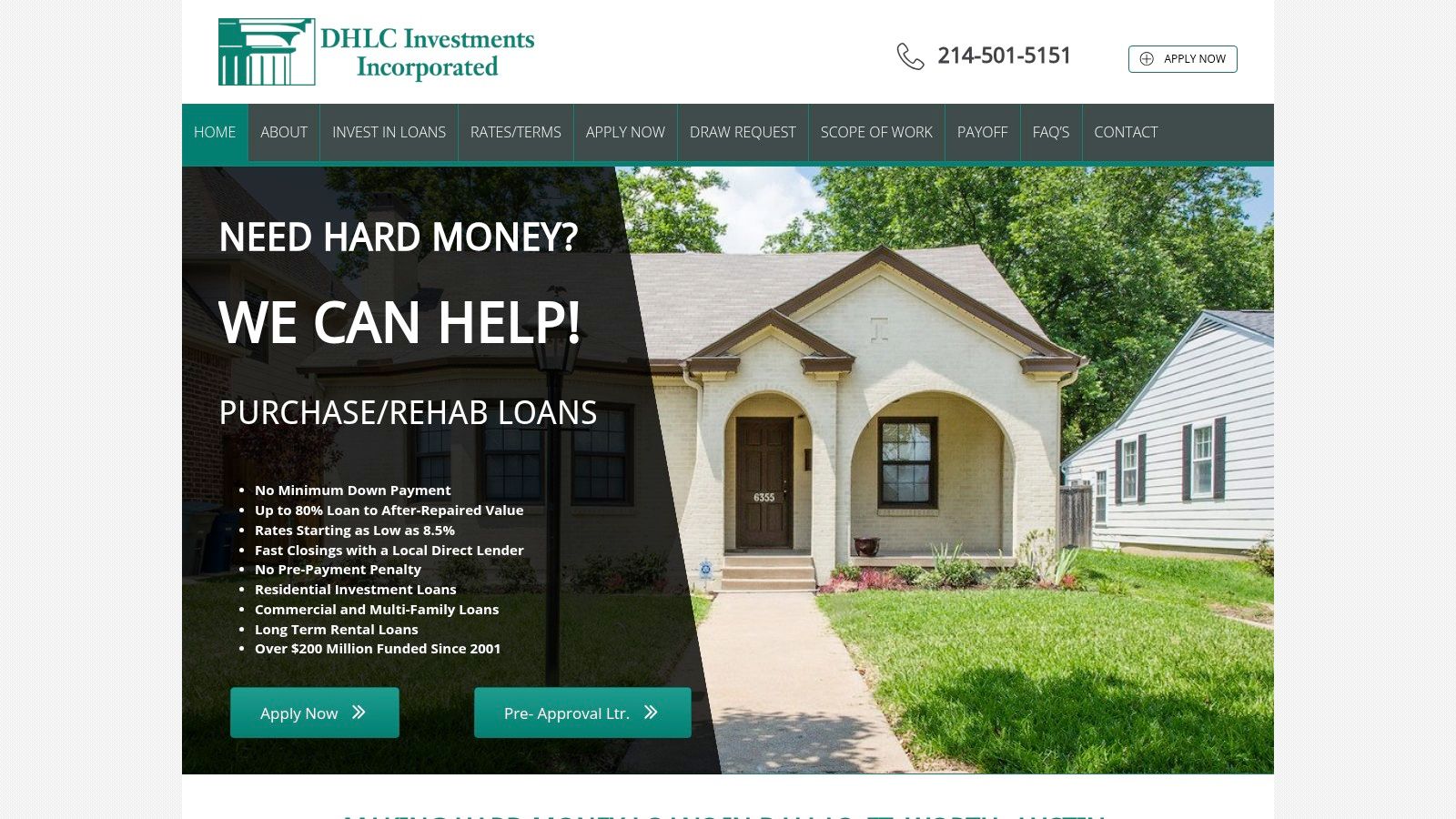
A Dallas investor finds a property with strong after-repair upside, but the house is rough, the seller wants a fast close, and the rehab budget is too large for a conservative lender. That is the kind of file where DHLC usually enters the conversation.
DHLC stands out for borrowers trying to push proceeds higher on a value-add deal. In plain terms, this is a lender to compare when the deal works on paper but lower loan-to-cost or lower after-repair advance from another lender leaves too much cash in the project.
That matters in Dallas because plenty of good opportunities are won or lost on capital structure, not just rate. If your margin is tight, an extra point of advance can help. It can also raise your risk fast if the rehab drifts, bids come in light, or the resale takes longer than planned.
Where DHLC makes sense
DHLC is worth a serious look in a few situations:
- Purchase and rehab deals that need stronger financing to pencil
- Borrowers working across residential, multifamily, or some commercial assets
- Investors who prefer a lender with a long Texas operating history
- Projects that fall outside the clean, cookie-cutter single-family flip box
In this context, the decision framework matters. A lender offering higher proceeds is not automatically the best lender. It may be the right lender if preserving cash helps you control more projects, protect reserves, or avoid bringing in expensive outside capital. It may be the wrong lender if the added debt leaves no room for permit delays, change orders, or a soft resale.
The real trade-off
DHLC advertises attractive starting rates. Treat those as entry-point pricing, not likely pricing.
Private money cost usually moves with the parts of the file that create risk. Higher proceeds, rougher collateral, title cleanup, thin liquidity, first-time rehab execution, and a weak exit plan all tend to raise the true cost. The website number gets attention. The closing statement tells the truth.
I tell investors to ask three direct questions before they spend time on an application:
- How much cash will I need at closing, including reserves and interest carry?
- How is rehab money released, and how fast do draws fund?
- What happens if the project runs past the original term?
Those answers matter more than teaser pricing.
DHLC also fits a broader comparison many Dallas borrowers should make. A local lender can be useful when the asset is unusual and you want someone who understands Texas collateral. A remote lending partner such as LendingXpress can be the better option when speed, wider program flexibility, or a more scalable approval process matters more than local presence. That is the practical lens for this article. Not just who lends in Dallas, but which lender fits the deal in front of you.
One final caution. Long operating history is a positive, but investors should still verify current terms, asset coverage, and process details with a live scenario. Program pages can lag behind actual credit policy.
Visit DHLC Investments, Inc..
5. Longleaf Lending (Dallas)

A common Dallas scenario looks like this. The purchase is fine, the margin looks fine, and the deal still gets strained because the rehab draw process is slow or the construction budget was not underwritten correctly at the start. Longleaf deserves attention for that reason.
They publish a wider set of investor programs than many local shops, including fix and flip, experienced flipper products, construction financing, multifamily bridge, and DSCR rental loans. That range matters if you are building a repeatable borrowing strategy instead of solving for one closing at a time. It also makes Longleaf useful in this article’s broader framework. Compare the local lender fit against a remote option like LendingXpress when speed, program flexibility, or a more standardized process matters more than sitting across the table from a Dallas office.
A better fit for projects with real moving parts
Longleaf stands out less because it says “fast” and more because it gives investors enough program detail to pre-screen a deal before applying. That usually helps experienced borrowers move quicker because they can tell whether the project fits the lender’s credit box.
For Dallas rehab investors, that is practical value. The pressure point on these loans is often the construction side, not the purchase side. If the scope is messy, the budget is light, or the draw expectations are vague, the project can lose time even after the loan closes.
Longleaf is strongest when the borrower already runs a disciplined project. Clean scope of work, realistic ARV, contractor bids that hold up, and entity documents that are ready tend to matter as much as the property itself.
Where the trade-offs show up
This is not the lender profile I would hand to a borrower who is still learning how rehab execution works. A fast lender can help a good operator. It can also expose weak planning very quickly.
Focus on these points before you commit:
- Rehab funding structure: Ask how draws are approved, what inspections are required, and how long reimbursement usually takes.
- Construction change orders: Confirm what happens if material costs rise or the scope changes after closing.
- Experience expectations: Some programs are more attractive for repeat investors than for first-time flippers.
- Exit timing: Short-term debt works best when the resale or refinance path is clear before day one.
Those questions separate a lender that looks good on a rate sheet from one that fits the job.
Longleaf can be a strong option for Dallas investors who need acquisition and rehab financing under one roof and already know how to keep a project on schedule. If your priority is speed with a more scalable national process, LendingXpress may be the better comparison. If your priority is a lender whose programs are built around rehab and construction execution, Longleaf belongs on the short list.
Visit Longleaf Lending Dallas.
6. Capital Fund 1 (Dallas)

A seller accepts offers at noon, wants proof of funds immediately, and has no patience for a bank timeline. That is the kind of Dallas deal where Capital Fund 1 makes sense.
Capital Fund 1 is built for speed. The published investor pitch centers on asset-based underwriting, soft credit pulls, and no tax return requirement on certain programs. For an investor trying to secure a distressed property or close before another buyer gets organized, that matters more than a slightly lower rate quote from a slower lender.
A practical fit for deadline-driven deals
Some lenders compete on price. Capital Fund 1 competes on response time and transaction momentum.
That can be the right trade if the deal is fragile, the property condition limits conventional options, or the seller is choosing the buyer who looks most ready to close. In those situations, fast proof of funds and a lender that understands investor files can help win the contract.
They also highlight features investors usually care about, including no prepayment penalty on certain loan options. That helps if the plan is to refinance or sell quickly instead of carrying expensive short-term debt longer than expected.
As noted earlier, Dallas has an active hard money market for flips, bridge loans, and rental acquisition strategies. Capital Fund 1 fits that part of the market well. The bigger question is whether speed is the main problem you need to solve.
Where investors need to be careful
Fast approval does not fix a weak file. It also does not guarantee the best economics once fees, draw logistics, and extension terms show up on the closing statement.
Before you commit, get direct answers on these points:
- How pricing is finalized: Website summaries are not the same as a real term sheet. Ask for points, lender fees, interest structure, and any extension cost.
- What can delay closing: Entity documents, insurance, title issues, and incomplete purchase contracts can slow down even a fast lender.
- How post-close service works: If the loan includes rehab funds, ask about inspections, reimbursement timing, and payoff responsiveness.
- What your exit window looks like: A fast-close loan works best when the resale or refinance path is already realistic.
This is where the local versus national decision matters. A Dallas investor with a highly time-sensitive purchase may prefer Capital Fund 1 because the process is geared toward speed at the front end. An investor who wants broader program flexibility or a more scalable remote lending process should also compare LendingXpress before choosing.
Capital Fund 1 belongs on the shortlist for borrowers who need a lender to move now, not next week. If your timeline is more forgiving, compare total borrowing cost and servicing quality before you decide.
Visit Capital Fund 1 Dallas fix and flip loans.
7. Ridge Street Capital (Dallas)

You find a Dallas deal on Monday, need to close fast, and still want enough lender detail to know whether the loan will work. That is where Ridge Street Capital earns a look. They publish more Dallas-specific guidance than many lenders, which helps investors screen themselves before they burn time on calls that go nowhere.
That matters in a busy DFW investor market. Local volume creates options, but it also creates noise. A lender that clearly spells out borrower expectations, rehab structure, and qualification standards can save a borrower from chasing the wrong capital source.
Good fit for borrowers who want clear rules
Ridge Street stands out less for hype and more for process clarity. If you already borrow through an entity, understand your scope of work, and want to know how a lender views the deal before you apply, that has real value.
I like lenders that make it easier to disqualify a weak file early. Serious investors should want that too. A quick no is cheaper than a vague maybe that turns into revised terms at closing.
Their Dallas positioning also fits the way many local investors operate. Borrowers here often need bridge financing with rehab funds, but they also need a lender that explains how the deal will be underwritten. Ridge Street appears to give more of that upfront than many hard money shops.
Where Ridge Street makes sense, and where it does not
Ridge Street can be a solid option for BRRRR and rehab-heavy deals when the borrower is organized. If your insurance, entity docs, budget, and title work are still messy, this is probably not the lender to call first.
A few practical takeaways matter here:
- Clear qualification standards: Better for investors who want to know the rules before submitting a file.
- Rehab-friendly structure: Useful when renovation scope and draw planning are part of the investment thesis.
- Local market focus: Helpful for Dallas investors comparing lenders that are familiar with local deal types.
The trade-off is straightforward. Borrowers who are still figuring out whether to buy in their personal name, do not have clean documentation, or need a lender to coach them through every step may feel friction here. That is not always a bad sign. It usually means the lender expects the borrower to operate like an investor, not a first-time retail buyer.
This is also where the article's broader framework matters. Ridge Street is worth comparing against Dallas-based lenders if local fit and upfront clarity are your top priorities. If your file is more complex, your timeline is tighter, or you want a wider product menu with remote execution, LendingXpress also belongs in the comparison set.
For investors who value clear expectations over marketing promises, Ridge Street is one of the more practical hard money lenders in dallas texas to review.
Visit Ridge Street Capital Dallas hard money loans.
7 Dallas Hard Money Lenders: Quick Comparison
| Lender | 🔄 Implementation Complexity | ⚡ Resource Requirements | ⭐📊 Expected Outcomes / Impact | 💡 Ideal Use Cases | ⭐ Key Advantages |
|---|---|---|---|---|---|
| Longhorn Investments (Dallas) | Moderate, ARV‑driven underwriting with rehab draws and Choice Program tradeoffs | Moderate borrower cash; up to 70% ARV (flips) / 75% ARV (rentals); rehab financed via draws | ⭐⭐⭐, Predictable pricing and rehab support; shorter 9‑month standard term impacts timeline 📊 | Fix‑and‑flip and rental bridges where transparency and ARV underwriting matter | ⭐ Clear published programs; loyalty tiers for repeat borrowers |
| Noble Mortgage & Investments (Dallas) | Medium‑high, broad product menu increases setup/underwriting steps | Flexible capital options; $50K–$3M residential, commercial up to $3M; some 100% LTC scenarios | ⭐⭐⭐, Fast closings and flexible exit products enable diverse deal structures 📊 | Rehab‑to‑perm, DSCR exits, new construction and larger residential/commercial deals | ⭐ Wide product range and in‑house long‑term exit options |
| DFW Investor Lending, LLC | Low, transparent grids and online tools simplify application and underwriting | Moderate cash required (max LTV ~73–75%); published rate floors (example ~12.49%) | ⭐⭐⭐, Very fast approvals/funding; transparent costs aid deal planning 📊 | Speed‑sensitive flips needing clear pricing and quick funding | ⭐ Fast turnarounds and published rate/fee grid with calculators |
| DHLC Investments, Inc. | Moderate, standard direct‑lender workflows, established processes | Higher leverage possible (up to 80% LTARV); rates “as low as” advertised for top tiers | ⭐⭐⭐, High LTARV supports larger purchase/rehab deals; proven volume and local presence 📊 | Purchase/rehab and multifamily borrowers seeking higher LTARV | ⭐ Established Texas lender with high LTARV ceiling |
| Longleaf Lending (Dallas) | Medium, multiple program tracks with granular guidelines (fast timelines) | High leverage options (up to 95–100% LTC, 100% rehab draws); rapid close requirements | ⭐⭐⭐⭐, Extremely fast closes (as fast as 48 hrs) and full rehab financing for qualified borrowers 📊 | Experienced sponsors, ground‑up construction, multifamily and expert flips | ⭐ Very fast closings and program‑specific published minimums |
| Capital Fund 1 (Dallas) | Low latency but operationally demanding, asset‑driven, needs clean files for ultra‑fast closes | Soft credit pulls, no tax returns; asset underwriting; suitable proof‑of‑funds | ⭐⭐⭐, Potential for as‑fast‑as‑24‑hour funding for time‑sensitive acquisitions 📊 | Trustee sale acquisitions, time‑sensitive fix‑and‑flip deals | ⭐ Extremely fast funding and investor‑friendly documentation |
| Ridge Street Capital (Dallas) | Higher, entity requirements and borrower eligibility add setup complexity | Very high LTC (up to 80–90% purchase + 100% rehab for experienced); FICO/ entity requirements | ⭐⭐⭐, Transparent local rate bands and high leverage for experienced sponsors improve deal economics 📊 | Experienced investors using entities, BRRRR and DSCR exits | ⭐ Clear published rates and scalable rehab/LTC for repeat sponsors |
Final Thoughts
You get a deal under contract on Monday. Closing is in nine days, the seller wants proof you can perform, and your exit only works if rehab funds arrive on schedule. At that point, your lender choice is not a directory exercise. It is a deal decision.
Dallas gives investors plenty of options, which is useful and messy at the same time. Rate matters, but it is rarely the deciding factor on a hard money loan. The better question is whether the lender fits the asset, your experience level, your cash position, and your exit plan. A cheap quote can still be the wrong loan if the draw process is slow, the underwriting drifts, or the payoff structure creates problems at refinance.
As noted earlier, North Texas remains active enough that private capital keeps showing up for workable deals. That does not mean every file gets approved on attractive terms. Lenders still care about basis, after-repair value, reserves, title, insurance, and whether the borrower has a credible plan to sell or refinance.
A hard money loan needs to do three things well. It needs to close on time. It needs to leave enough proceeds in the deal for the renovation or hold strategy to work. It needs a realistic exit. Miss one of those, and the loan gets expensive in a hurry.
Here is the framework I would use.
Pick the lender based on the deal
- Choose Longhorn for local purchase and rehab financing when ARV-driven underwriting is the main priority.
- Choose Noble when you want a cleaner path from bridge debt into DSCR, rehab-to-perm, or a commercial takeout.
- Choose DFW Investor Lending when posted guidelines and straightforward math help you pressure-test the deal before you apply.
- Choose DHLC for broader asset flexibility and larger projects where higher proceeds can materially change the deal.
- Choose Longleaf when speed and rehab draws sit at the center of the business plan.
- Choose Capital Fund 1 when timing is tight and a fast proof-of-funds and closing process may help you win the property.
- Choose Ridge Street when you value clear pricing, entity-based borrowing, and a structure built for repeat investors.
- Choose LendingXpress when a local lender is not the best fit and you need national investor-lending experience, quick execution, and flexible structuring across bridge, fix and flip, and rental scenarios.
What usually works and what usually doesn't
Clean files close faster. That means a signed contract with no loose ends, an entity that is already formed, insurance lined up, title questions surfaced early, a rehab budget that matches the scope, and enough liquidity to cover the gap between lender proceeds and total cash needed at closing.
Unclear plans create problems. If the strategy shifts between flip, rental, and refinance depending on who asks, the lender has to price in uncertainty. Private lenders can handle complicated projects. They do not like avoidable confusion.
Cash to close is another point investors often underestimate. Full rehab funding does not mean no-money-in. In many Dallas deals, the borrower still brings earnest money, closing costs, interest reserves, part of the purchase, or contingency cash. Newer investors usually need more room in the budget than they expect.
This is also where the decision-making framework matters. Local lenders can be a strong fit when neighborhood knowledge, in-person access, or Dallas-specific product familiarity helps the file. Remote lenders deserve a serious look when consistency, speed, and broader investor-lending experience matter more than zip-code proximity. LendingXpress fits that second category well. They are worth comparing against the local names above if you want practical underwriting and a team that understands non-owner-occupied deals.
The best lender for a Dallas investor is the one that can fund the deal cleanly, explain the terms plainly, and set up an exit you can execute.
If you’re comparing hard money lenders in dallas texas and want a second opinion from a lender that knows investor timelines, LendingXpress is a strong option to put on your shortlist. They focus on non-owner-occupied residential and commercial deals, move quickly when banks won’t, and structure bridge, fix and flip, and rental loans with practical underwriting. For brokers, agents, and investors who need a responsive lending partner instead of a call-center quote, LendingXpress is worth the conversation.