
You've found an investment property that looks promising, but the monthly numbers don't cooperate. Rent covers the operating expenses, yet a fully amortizing mortgage pushes debt service high enough to weaken or even eliminate cash flow. That's where interest only loan benefits become practical, not theoretical. By postponing principal repayment for a defined period, an investor may preserve liquidity, improve debt-service coverage, and create time to renovate, lease, or refinance. The trade-off is equally real: the balance doesn't decline, and the payment can rise sharply later.
The Investor Cash-Flow Problem
A broker is reviewing a non-owner-occupied rental acquisition. The property has a credible repositioning plan, but the first underwriting pass uses a standard fully amortizing loan. After taxes, insurance, maintenance, vacancy assumptions, and debt service, the property falls short of the lender's cash-flow requirement.
The problem isn't necessarily the asset. It's the timing of the cash flow.
During the first phase of ownership, the investor may need money for repairs, tenant improvements, leasing costs, reserves, or carrying expenses. A fully amortizing payment sends part of the monthly cash flow toward principal immediately. That builds equity, but it can also leave too little liquidity to execute the plan that makes the property more valuable.
An interest-only period changes the calculation by removing principal from the required payment for a defined time. The borrower still pays accrued interest, but the monthly obligation is usually lower than it would be under a fully amortizing structure. The Federal Reserve's guidance on nontraditional mortgage-product risks explains that principal isn't repaid during the interest-only period, while also emphasizing the need to understand the later payment change.

The bridge between purchase and performance
Suppose the investor expects the property's net operating income to improve after renovations and lease-up. The interest-only structure doesn't make the renovation profitable by itself. It gives the investor more time and usable cash to complete the work before the loan payment changes.
That distinction matters. The structure works when the lower payment supports a specific operational objective, such as stabilizing occupancy, completing improvements, or preparing for a sale. It doesn't work when the borrower relies on the lower payment to hide a permanently weak deal.
Practical rule: Treat the interest-only period as a time-bound operating strategy, not as proof that the property can support the debt indefinitely.
The same logic applies to short holding periods. An investor planning to sell after improving the asset may value liquidity more than early principal reduction. An investor planning to hold for the long term may prefer amortization because every scheduled principal payment reduces the outstanding balance.
The financing decision should follow the property's timeline. If the deal needs time to become productive, an interest-only period can act as a tactical bridge. If the property already produces stable cash flow and the investor's priority is long-term debt reduction, fully amortizing debt may be the cleaner fit.
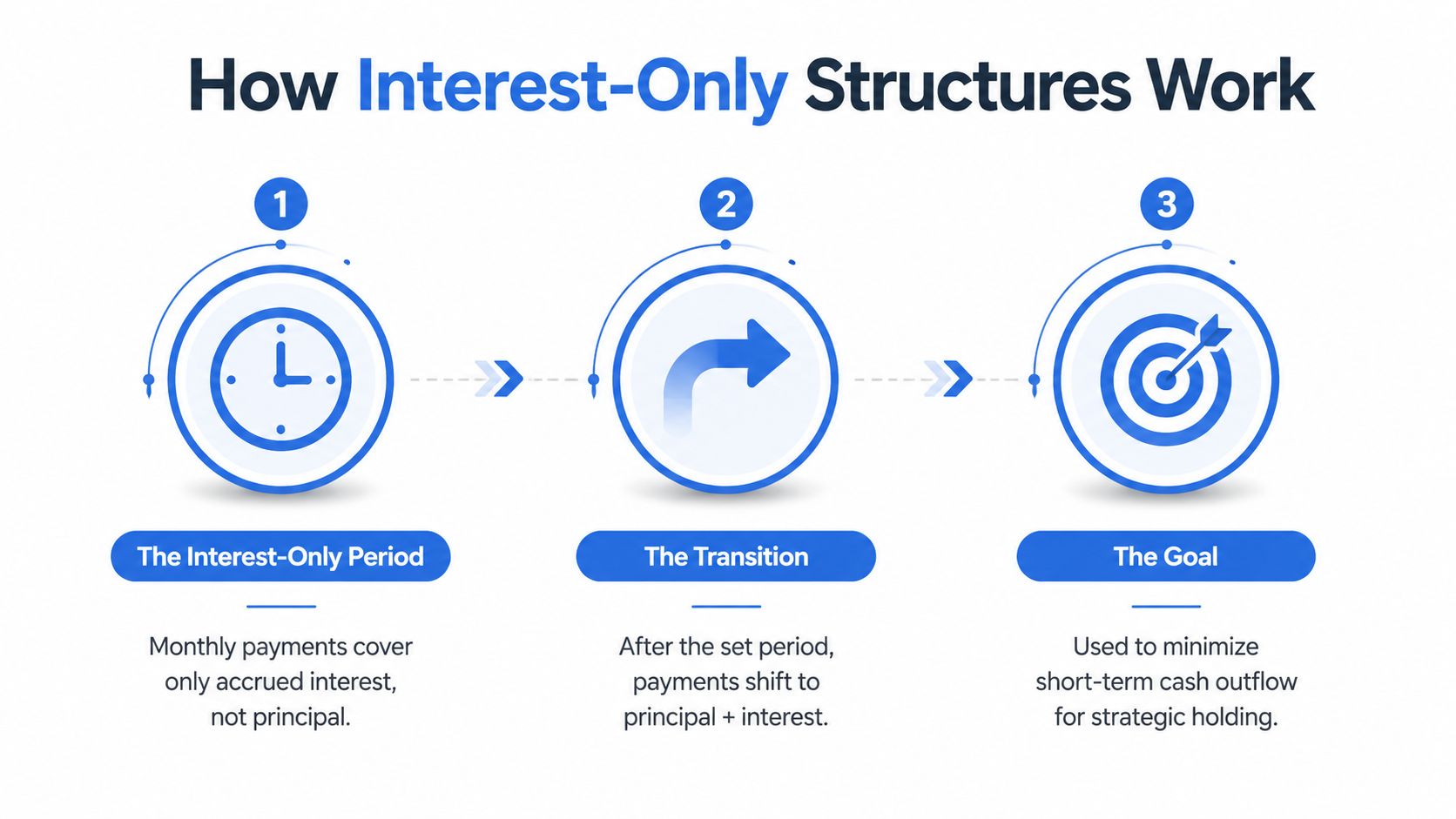
How Interest-Only Structures Work
An interest-only investment-property loan requires the borrower to pay the interest accrued on the outstanding balance during the interest-only period. The required payment doesn't include scheduled principal reduction, so the loan balance remains unchanged unless the borrower makes an optional principal payment or another contractual adjustment applies.
The basic payment estimate is straightforward:
Loan balance × annual interest rate ÷ 12
For example, the calculation starts with the outstanding loan balance, applies the annual interest rate, and divides the result by twelve monthly periods. That estimate addresses principal and interest only. Property taxes, insurance, association dues, and other project expenses may still affect the investor's total monthly outlay.
What changes during the loan
During the interest-only period, the borrower keeps more cash that would otherwise go toward principal. The investor can direct that liquidity toward renovations, reserves, lease-up costs, or another investment, provided the use of funds fits the investment plan and loan documents.
The cost is that the balance stays at its original level. A fully amortizing mortgage reduces principal with each scheduled payment, while an interest-only structure delays that reduction. Because interest continues to accrue on a larger balance for longer, the total interest expense can be higher than with an otherwise comparable amortizing loan.
The Federal Reserve's consumer guidance describes the central trade-off clearly in practical terms: borrowers receive lower early payments but don't build principal equity through scheduled payments during the interest-only phase. For an investment property, that means the investor's equity growth depends more heavily on appreciation, improvements, voluntary paydown, or the eventual sale.
The transition requires planning
When the interest-only period ends, the loan may convert to principal-and-interest payments, recast over the remaining term, or require repayment or refinancing depending on the note. The new payment reflects the same outstanding balance being repaid over a shorter remaining period, which can create a substantial increase.
An investor should model the post-interest-only payment before closing. The deal must have a credible path to support that payment through stronger operating income, a sale, a refinance, or another defined source of repayment. A low initial payment is useful only when the later obligation has a solution.
Payment Comparison and DSCR Impact
The clearest benefit appears in the underwriting math. A recent DSCR cash-flow comparison tested a 30-year fully amortizing payment against a 10-year interest-only structure on a 40-year term. Under its stated assumptions, the interest-only option reduced monthly PITI by 12% to 14% and raised DSCR by approximately 0.13 to 0.15. In some West Coast markets, that difference moved properties above the 1.00 DSCR threshold, changing an unfinanceable deal into a cash-flow-positive one. Review the detailed DSCR loan payment comparison and the DSCR loan program details for the calculation framework.
| Loan Feature | 30-Year Amortizing | 10-Year Interest-Only |
|---|---|---|
| Scheduled early payment | Principal and interest | Interest only during the defined period |
| Principal reduction | Begins with the first scheduled payment | None during the interest-only period |
| Monthly PITI in the comparison | Higher | 12% to 14% lower |
| DSCR effect in the comparison | Lower starting DSCR | Approximately 0.13 to 0.15 improvement |
| Balance at transition | Reduced through amortization | Remains outstanding |
| Strategic use | Long-term debt reduction | Short-term carry relief and repositioning |
Why the DSCR can flip
DSCR is commonly calculated as net operating income divided by annual debt service. Lower required debt service produces a higher ratio when operating income remains constant. The financing structure changes the cash needed for debt service, while the property's rent and operating results remain unchanged.
That distinction matters during underwriting. A property that misses the lender's DSCR requirement with a fully amortizing payment may qualify with an interest-only payment because more operating cash remains after debt service. The lower obligation can also preserve renovation reserves while income is still developing.
The ratio rises from the financing structure change alone. The property's operating income is unchanged.
A threshold crossing remains a financing result, not proof that the asset has become stronger. Underwrite the property after the interest-only period using realistic rent, vacancy, expense, and refinance assumptions. If the asset cannot support the later payment, the initial qualification has only delayed the pressure.
For brokers, the workflow is practical: calculate both payment structures, measure the DSCR difference, and then test the exit plan. That comparison shows whether interest-only financing addresses a temporary timing gap or just makes a weak acquisition appear financeable. The lower payment can change the approval outcome, but the outstanding balance and future debt service still require a defined repayment strategy.
Best Use Cases for Investors and Brokers
Interest-only financing fits a specific investment timeline. It's most useful when the property's income or value is expected to change before the loan requires principal repayment.

Bridge purchases
A bridge acquisition often involves a short hold while the investor completes a defined project. The borrower may purchase a property with vacant space, deferred maintenance, or below-market operations, then sell or refinance after the asset is improved.
Interest-only payments can reduce carry during that bridge period. Some real-estate investing use cases commonly use 12- to 24-month interest-only terms, while broader mortgage products may offer windows from 5 to 10 years, according to this guide to interest-only real estate investing loans. The right period should match the acquisition, improvement, lease-up, and exit schedule.
Fix-and-flip projects
A fix-and-flip investor usually wants capital available for the work, not tied up in scheduled principal reduction during construction. Lower required debt service can help preserve funds for contractors, materials, permits, and unexpected scope changes.
The structure only makes sense when the renovation budget and resale assumptions are disciplined. A delayed payment doesn't protect profit if the investor underestimates the work or misses the sale window. Model interest carry through the full expected holding period, including delays.
Rental stabilization
A recently acquired rental may need time to complete repairs, sign tenants, resolve deferred maintenance, and establish dependable operating income. Interest-only financing can provide a runway during that transition before the property reaches stabilized performance.
For investors operating in California, financing should be reviewed alongside ownership, tax, and disposition decisions. A resource covering California real estate tax strategies can help frame questions for a qualified tax professional.
The payment itself can be estimated as loan balance × annual interest rate ÷ 12, because the scheduled payment covers interest and doesn't reduce principal during the defined period, as described in this investment-property interest-only payment guide.
Bridge and renovation financing need different exit plans from stabilized rentals. Match the interest-only window to the business plan, and don't choose a term just because the initial payment looks attractive.
A short video can help visualize the financing decision before a borrower compares term sheets:
Navigating Risks and Requirements
The main risk is payment shock. After the interest-only period, the borrower must begin repaying principal or satisfy the loan through a refinance, sale, or another contractual repayment event. Since scheduled payments have not reduced the balance, the new principal-and-interest payment can rise sharply.
Model that change before closing, rather than waiting for the first recast statement. Use conservative rent and expense assumptions, test the property's refinance value, and identify the asset or cash source that will repay the balance if the planned exit is delayed.
Qualification is usually stricter
Investment-property interest-only loans often demand stronger borrower credentials than owner-occupied lending. Requirements vary by lender and market, but common qualification points include:
- Deposit or equity: Most lenders require at least a 20% deposit.
- Serviceability: Some lenders assess affordability at the principal-and-interest rate instead of relying only on the lower interest-only payment. ANZ's investment-property guidance notes that serviceability may be tested at that higher payment, and that some lenders cap interest-only periods at 5 years, while eligible borrowers may receive up to 10 years.
- Financial profile: Common criteria can include a 43% debt-to-income limit, a credit score around 700 or higher, and documented reserves, subject to lender policy and jurisdiction.
Most lenders require at least a 20% deposit, and common criteria include a 43% debt-to-income limit and a credit score around 700 or higher, according to investment-loan qualification guidance.
The payment comparison affects approval as well as cash flow. A lower interest-only payment may improve the property's monthly coverage, but a lender may still qualify the borrower against the later principal-and-interest obligation. The deal can appear financeable on current DSCR math while failing the lender's repayment test.
A workable loan therefore has two payment plans, the payment made now and the payment or payoff already planned for later.
Why Private Lenders Excel at Interest-Only
Traditional bank underwriting often works best for standardized borrowers, stabilized properties, and long documentation cycles. A non-owner-occupied acquisition with renovation needs, unusual income, or a short exit timeline may not fit that process even when the collateral and strategy are sound.
Private lenders evaluate the transaction through a different lens. They still review credit, liquidity, collateral, loan-to-value, property condition, and repayment capacity, but they may give more weight to the asset, the sponsor's plan, and the exit strategy. That flexibility matters when the investor needs an interest-only period that aligns with construction, lease-up, or sale.
Speed has operational value
A delayed approval can cost an investor a purchase opportunity. A slow closing can also leave the borrower paying for inspections, contractors, or a negotiated transaction without certainty that the financing will arrive.
LendingXpress structures private and hard money loans for residential and commercial investment properties, including bridge, fix-and-flip, and rental scenarios. Its stated process supports closings in as little as three days, which can matter when a borrower needs capital that matches a seller's timeline or an auction deadline.

Underwriting should remain practical
Private financing isn't a substitute for analysis. The lender should be able to explain the rate, fees, interest-only period, recast mechanics, extension terms, prepayment provisions, reserves, and exit assumptions in plain language.
It also helps when the lender can structure renovation draws, account for property condition, and evaluate a refinance or sale plan instead of judging the deal only by conventional bank ratios. Investors and brokers comparing private money lenders should ask how the lender handles incomplete properties, lease-up periods, and payment changes.
The best fit is a lender that moves quickly without skipping the math. Speed helps close the deal, but transparent underwriting determines whether the structure remains manageable after closing.
Frequently Asked Questions
How long do investment-property interest-only periods last?
The answer depends on the loan purpose, lender, and market. Some real-estate investing loans use 12- to 24-month periods, while broader mortgage products may use 5- to 10-year windows. Residential investment-property guidance also shows that some eligible borrowers can receive up to 10 years, while some lenders limit investment-property interest-only repayment to 5 years.
Match the period to the business plan. A bridge or fix-and-flip borrower may need a short window tied to construction and sale. A rental investor may need more time for stabilization, but should still model the payment after conversion.
What's the difference between pure and partial interest-only?
A pure interest-only mortgage makes no scheduled principal reduction during the interest-only period. A partial interest-only structure provides interest-only payments for an initial phase, then moves into principal-and-interest repayment.
The distinction affects equity growth, the future payment, and the exit plan. UK Finance reported 541,000 pure interest-only homeowner mortgages and 174,000 partial interest-only mortgages outstanding at the end of 2024, demonstrating that the two formats remain distinct in a major mortgage market. The figures are reported in the consumer-finance study reference.
For investment properties, read the note rather than relying on the label. Confirm when principal begins, how the payment is recalculated, and whether the balance is due at maturity.
Can I pay off an interest-only loan early?
Often, borrowers can repay principal early, but the loan agreement controls the result. Check for prepayment provisions, minimum interest requirements, extension charges, or other contractual costs before assuming an early payoff is penalty-free.
Early repayment may make sense after a sale, refinance, or strong operating period. It can also reduce the balance before recast, which may lower future debt service. The decision should account for available liquidity, the expected use of capital, and the cost of replacing the financing.
Are interest-only loans better for investors?
They're better when the investor values near-term liquidity and has a credible plan for the unchanged balance. The lower payment can improve DSCR, preserve renovation cash, and support a short holding period. It isn't automatically better for a long-term hold where predictable amortization and equity reduction are the primary goals.
LendingXpress offers fast, flexible private financing for non-owner-occupied residential and commercial properties, including bridge, renovation, and rental strategies. Visit LendingXpress to discuss the property, the interest-only timeline, and the exit plan with a lending partner that can evaluate the deal on its actual business terms.