
You find a property that fits the plan. The seller wants a fast close, the rehab budget is real, and tying up too much cash in monthly debt service would choke the project before the work even starts.
That's where interest only loan payments can make sense for an investor. Not because they're cheap in the long run. They usually aren't. They work because they can preserve liquidity when speed, renovations, lease-up, or a short bridge period matter more than paying principal right away.
For non-owner-occupied properties, that trade-off can be useful. It can also turn into a problem if the exit is vague, the timeline slips, or the borrower treats a short-term tool like a permanent financing solution. Investors who do well with these loans usually know their numbers, know their timeline, and know exactly how they'll pay the loan off or refinance it.
A Strategic Tool for Maximizing Investor Cash Flow
A common investor situation looks like this. You locate a value-add rental or a fix-and-flip with upside, but the property needs work before it can qualify for better long-term financing. You need capital now, and you need to keep cash available for contractors, carrying costs, insurance, and surprises.
In that setting, interest only loan payments can create breathing room. Instead of forcing principal paydown from month one, the loan keeps the required payment lower during the early stage of the project. For an investor, that can mean more money left in reserve for the part of the business that creates value, the rehab, the lease-up, or the transition to sale.
That doesn't mean interest-only debt is automatically the best choice. It means it can be the right tool when the project has a clear purpose and a short to medium time horizon.
Why investors use it
Private money borrowers usually care about three things first:
- Speed to close: A strong deal can disappear while a bank is still reviewing paperwork.
- Flexibility: Many non-owner-occupied properties don't fit neat bank guidelines, especially if the asset needs repairs or the borrower is in transition.
- Cash preservation: Lower required payments can keep working capital available for the investment itself.
A good underwriting model helps you see whether the lower payment improves the deal or just postpones the pain. If you want to pressure-test timing, debt service, rehab assumptions, and exit proceeds, this guide to real estate financial modeling is a useful framework.
Practical rule: If the loan is solving a timing problem, it can help. If it's covering up a weak deal, it usually makes the outcome worse.
Used well, an interest-only structure supports financial capacity and execution. Used poorly, it just delays a cash flow problem until the loan gets more expensive.
How Interest Only Loan Payments Actually Work
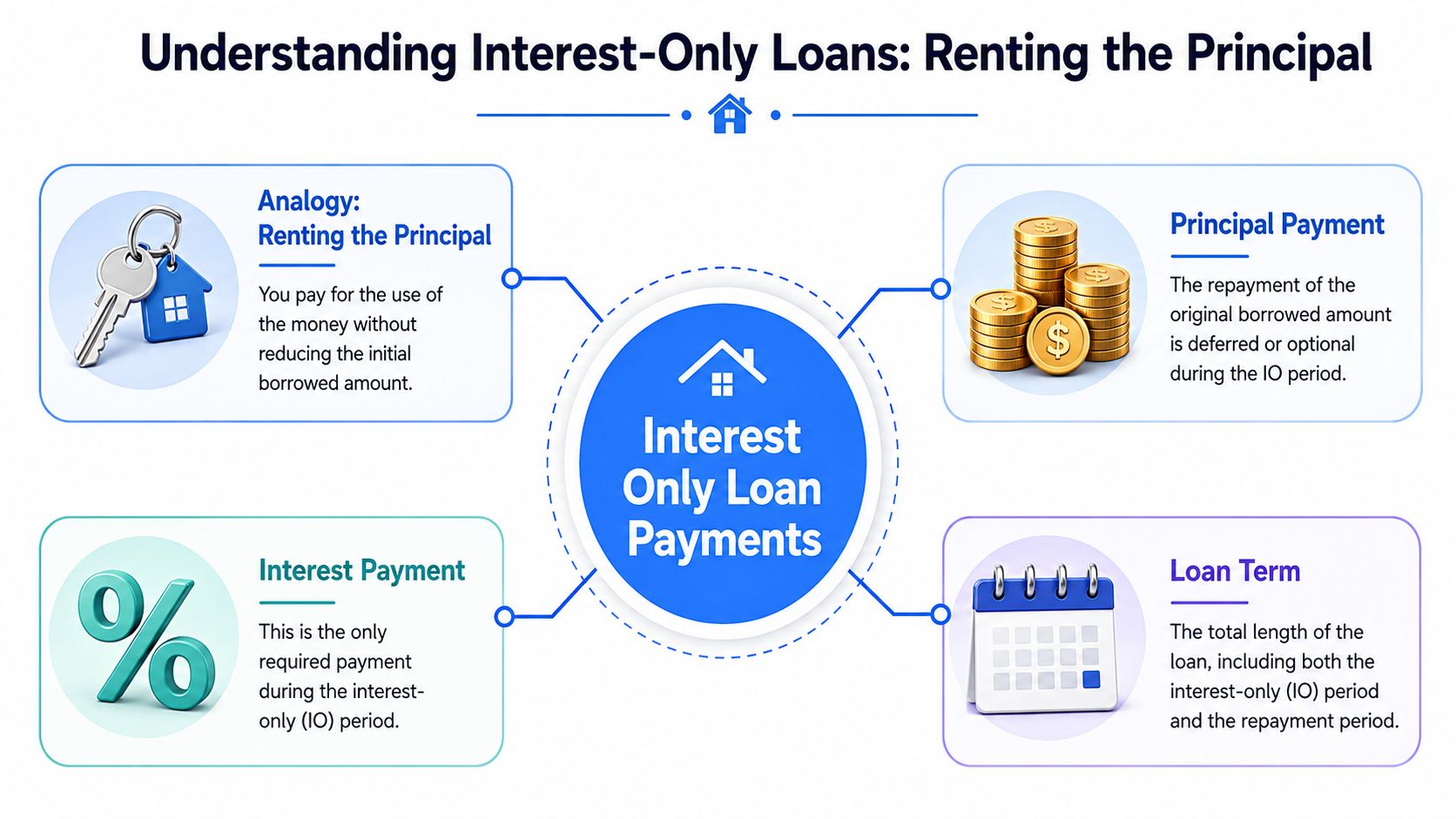
Think of an interest-only loan as renting the principal for a set period. Your required payment covers the cost of borrowing the money, but it doesn't reduce the amount you borrowed.
That point matters. During the interest-only period, your loan balance doesn't go down unless you choose to pay extra principal.
The basic formula
The required monthly payment during the interest-only phase is:
(Interest Rate × Loan Amount) ÷ 12
That's the core calculation investors need to understand. It's simple, and it tells you exactly what your minimum payment covers.
A worked example
An interest-only mortgage typically allows borrowers to pay only the interest for a specified introductory period, most commonly five, seven, or 10 years, according to Investopedia's explanation of interest-only mortgages. Using the same source example, a $400,000 loan at 6.5% produces a monthly payment of exactly $2,166.67, and that payment covers only interest.
Here's what that means in practice:
- Loan amount: $400,000
- Interest rate: 6.5%
- Monthly interest-only payment: $2,166.67
- Principal reduction from required payment: $0
If you make only the required payment each month, you still owe the same $400,000 at the end of the interest-only period.
What changes later
The lower payment lasts only for the interest-only term. After that, the loan converts and the borrower has to start paying principal and interest over the remaining term. That's why these loans feel easy at the front end and much tighter later.
For investment properties, many borrowers use that early period to do one of four things:
- Renovate and sell
- Stabilize and refinance
- Bridge from one asset event to another
- Improve property income before taking permanent debt
You're not building equity through the required payment during the interest-only window. Your equity comes from your down payment, value creation, or market appreciation, not from monthly amortization.
Why the structure appeals to investors
For a project with short-term objectives, the lower required payment can be useful because it frees up cash while the property is under construction, vacant, or not yet producing stable income.
What doesn't work is assuming the lower payment means the debt is cheaper. It only means the required payment is lower for a period of time. The principal is still there, waiting.
IO Loans vs Traditional Amortizing Loans
An interest-only loan and a fully amortizing loan can finance the same property, but they behave very differently. The choice isn't just about monthly payment. It's about what the payment is doing for you.
A fully amortizing loan starts paying down principal immediately. An interest-only loan doesn't require that during the initial period. That can help a project early, but it also creates a later adjustment that many first-time investors underestimate.
The side-by-side difference
| Feature | Interest-Only Loan (First 5 Years) | Fully Amortizing Loan |
|---|---|---|
| Required monthly payment | Lower, because it covers interest only | Higher, because it covers principal and interest |
| Principal balance | Stays unchanged if you only make the minimum payment | Declines with each scheduled payment |
| Equity from payments | None from required payments during the IO period | Builds steadily through amortization |
| Best fit | Short-term bridge, flip, lease-up, transition | Long-term hold with stable debt plan |
| End of introductory period | Payment rises when amortization begins | No sudden structural change if rate stays fixed |
| Total interest cost | Often higher over time | Often lower over time |
What payment shock means
Payment shock is the jump that happens when the interest-only period ends and the loan starts amortizing over a shorter remaining timeline. The balance hasn't been reduced by the required payments, so now the borrower has to cover both interest and principal.
Bankrate's example shows the difference clearly in structure. On a $1,000,000 loan at 7%, the monthly interest-only payment is $5,833.33, while a fully amortizing 30-year loan at the same rate is $7,453.06, according to Bankrate's interest-only mortgage payment calculator guide. The same source notes that when the interest-only term ends, the payment can rise sharply, often 30% to 50% higher, even if the rate itself doesn't change.
A lower payment at origination doesn't remove repayment pressure. It shifts that pressure forward.
Which structure fits which borrower
A long-term rental investor with stabilized income often benefits from predictable amortizing debt. A borrower planning to renovate, lease, refinance, or sell on a shorter timeline may prefer an interest-only structure because the early cash flow burden is lighter.
If you're comparing both options on a live deal, it helps to review financing choices in the context of the property's business plan. This overview of how to finance investment property is a useful starting point for non-owner-occupied scenarios.
The mistake is choosing the lower payment without matching it to a real exit.
The Pros and Cons for Real Estate Investors
Interest-only debt gives investors flexibility. It also removes the built-in discipline of principal paydown. That's why experienced borrowers tend to like it for the right project and avoid it for the wrong one.
Where the structure helps
The biggest advantage is simple. Lower required monthly payments can leave more cash available for the property.
That matters when you're paying contractors, covering vacancy, waiting for permits, buying materials, or funding leasing costs. In a private lending environment, that flexibility can be more valuable than the comfort of slow amortization, especially when the property's value is going to come from execution rather than day-one stability.

A few investor-friendly uses stand out:
- Rehab-heavy projects: Lower carrying costs can preserve capital for construction.
- Bridge periods: If the property is in transition, interest-only payments can reduce monthly drag until the next financing event.
- Rental stabilization: A borrower can focus on occupancy and operations before moving into longer-term debt.
Where investors get into trouble
The weak spot is also simple. The principal doesn't go down from the required payment during the interest-only phase.
That means you aren't building equity through amortization. If the project stalls, the sale takes longer, the refinance doesn't pencil, or the property value softens, the borrower has less margin for error.
Comparative mortgage analysis cited by Military Benefit's discussion of interest-only mortgage costs found total interest paid on an interest-only mortgage at $216,779, while a conventional mortgage saved $30,266 in interest over the same period. That's the long-run trade-off in plain terms. Lower early payments can lead to higher total borrowing cost.
The practical trade-off
Investors usually win with this structure when the loan is tied to a defined operational plan. They usually struggle when they use it to stretch into a deal they can't comfortably carry.
- Works well when: The property has a clear value-add path, a realistic timeline, and an identified refinance or sale strategy.
- Works poorly when: The borrower is hoping appreciation or “something will work out” fixes the payoff problem.
- Worth remembering: The loan is buying time. Time has to be used productively.
If the property won't be better, more valuable, or easier to finance before the loan changes, the lower payment today probably isn't enough reason to use it.
Strategic Scenarios for Using an Interest Only Loan
The best use cases are specific. Investors usually don't choose interest-only payments because they love debt structure. They choose them because the property is in a temporary phase and cash needs to stay flexible.

Bridge financing between two events
A borrower may need to close on one non-owner-occupied property before another asset sells or before long-term financing is available. In that case, the loan is really a bridge between now and a near-future payoff event.
For commercial real estate, the Office of the Comptroller of the Currency notes that interest-only loans often used for bridge or construction financing typically have tenors of only three to five years maximum, as described in the OCC commercial real estate lending handbook. That shorter window matches the way many investors use private capital. Get in, execute, exit.
Fix-and-flip projects
This is one of the cleanest fits. A flip doesn't usually need long-term amortization. It needs controlled carrying costs while the investor renovates and sells.
If the property is vacant and under construction, every dollar that doesn't have to go toward principal can stay available for labor, materials, permits, and contingency. That doesn't make the loan cheap. It makes it aligned with a short project cycle.
A practical step here is to watch rate direction because a shifting rate environment can affect refinance timing and resale assumptions. For that reason, some investors follow broader projections such as this overview of expected interest rates for 2026 when they're planning exits that may extend beyond the current year.
Rental acquisition and stabilization
A rental that needs repairs, repositioning, or tenant turnover may not qualify for ideal permanent financing on day one. An interest-only period can give the borrower room to improve the property, raise occupancy, and then replace the short-term loan with a better long-term structure.
That's especially useful when the investor's real objective is a refinance into stabilized debt, not holding the private loan for the full term.
A quick explainer can help if you want to see how investors think about the basic structure in practice:
What all three scenarios have in common
They share one trait. The property is changing.
- Bridge deals: You're waiting for a sale, payoff, or refinance event.
- Flips: You're converting distressed condition into marketable value.
- Stabilization plays: You're moving from weak or transitional income to financeable performance.
Interest-only payments fit that middle stage. They don't replace the exit. They support it.
How Private Lenders Underwrite Interest Only Loans
Traditional banks often focus heavily on tax returns, W-2 income, and long approval timelines. Private lenders usually look first at the asset, the equity position, and whether the business plan makes sense.
That matters for investors because many strong deals don't look clean on paper at the borrower level. A self-employed sponsor, a property mid-rehab, or a vacant building in transition can all fall outside standard bank boxes.
What gets reviewed first
Private underwriting is usually more practical than people expect. The lender wants to know:
- What is the property? Condition, type, location, and current status matter.
- How much cash is going in? On non-owner-occupied investment properties, rates are typically 0.25% to 0.50% higher than owner-occupied homes, and down payments are often 15% to 30%, as outlined by Rocket Mortgage's guide to interest-only mortgage qualification.
- Can the borrower handle the project? Experience helps, especially on rehab or bridge execution.
- What is the exit? Sale, refinance, or another clear payoff source has to be credible.
The same Rocket Mortgage source notes that qualification benchmarks for interest-only products are often 680+ credit scores with debt-to-income ratios in the 43% to 50% range. In private lending, those metrics may be part of the file, but they usually aren't the whole story.
Why exit strategy matters so much
An interest-only loan is underwritten backward from the payoff. A lender wants to know how the note gets retired before the structure becomes a problem.
That usually means the file needs a clear narrative:
- Acquisition or refinance purpose
- Property improvement or stabilization plan
- Timeline to completion
- Exit through sale or refinance
Private lenders can move fast, but fast underwriting still needs a believable payoff story.
What borrowers should expect
For rehab projects, lenders may also structure funds in draws rather than handing over every renovation dollar on day one. That protects both sides. The lender tracks progress, and the borrower receives capital as work gets completed.
If you want a better feel for how asset-based capital providers evaluate these deals, this overview of private money lenders is a helpful reference for investment-property borrowers who don't fit conventional bank channels.
The borrowers who get approved smoothly usually present a clean file, realistic scope, and a practical exit. The ones who struggle often have one missing piece, usually the payoff plan.
Your Borrower Checklist and Next Steps
Interest-only debt works best as a specialized investor tool. It's useful when the property is in motion and the borrower needs room to execute. It's a poor fit when the only benefit is that the initial payment feels easier.
Before taking one on, slow down and run a disciplined review.
The checklist that matters

- Know the payment structure: Understand when the interest-only period ends and what happens after that.
- Model the deal accurately: Include carrying costs, rehab timing, lease-up assumptions, and realistic refinance or sale timing.
- Define the exit before closing: If you can't explain the payoff plan clearly, the loan probably needs more work.
- Keep reserves available: Lower required payments help, but projects still run into delays and cost surprises.
- Choose a lender with investment-property experience: Non-owner-occupied deals need a lender that understands transitions, draws, timing, and asset-based decisions.
A simple borrower test
Ask yourself three questions:
- Am I using this loan to create value, or just to qualify for more debt?
- Do I have a real exit, not a hopeful one?
- If the project takes longer, do I still have room to operate?
If the answers are solid, interest only loan payments can support a smart strategy. If the answers are soft, the same structure can magnify risk fast.
If you're financing a non-owner-occupied property and need a lender that understands bridge, fix-and-flip, and rental transition scenarios, LendingXpress is worth a conversation. Their team works with investors who need speed, practical underwriting, and flexible loan structures when traditional banks don't fit the deal.