
You found a rental that works on paper. The numbers are clean, the location has demand, and the seller wants a quick close. Then the financing problem shows up.
The bank wants a long application, tax returns, explanations for every deposit, and time you don't have. Meanwhile, the deal sits exposed. Another buyer can move faster, or the seller can change terms, or your earnest money starts feeling less secure than it did on day one.
That's where a lot of investors get stuck. They assume a buy to let mortgage lender is interchangeable with any other lender. It isn't. On an investment property, the lender you choose can matter as much as the property itself, because speed, flexibility, and deal fit often decide whether the transaction closes at all. If you're comparing markets for short-term rentals while you underwrite locations, ScanStay's guide for Airbnb hosts is a useful companion read because location strategy and financing strategy need to line up from day one.
The Investor's Dilemma Finding the Right Funding Fast
A buy to let mortgage is simple in principle. It's financing for a property you won't live in, but plan to rent out for income.
In practice, it gets more complicated fast. A lender isn't just asking whether you can sign loan documents. They're asking whether this asset, this borrower, and this timeline fit their model. Some lenders like clean suburban rentals with straightforward borrowers. Some will work with mixed scenarios, light rehab, title issues, entity borrowers, or compressed closing dates. Some won't.
Where investors lose deals
The biggest mistake is going after the cheapest-looking money before confirming whether the lender can execute. A low quoted rate from a slow lender doesn't help if the appraisal drags, underwriting keeps reopening the file, or the credit box excludes your property type halfway through the process.
I've seen investors focus on terms before they confirm lender behavior. That's backwards. First ask whether the lender can close your kind of deal. Then ask what it costs.
Speed matters most when the property is right and the window is short. In those moments, certainty beats a pretty quote.
Why different lenders exist
The market has different lender types because investor situations aren't all the same. A first-time landlord buying a conventional single-unit rental is not the same borrower as someone refinancing a portfolio, buying through an entity, or trying to stabilize a non-owner-occupied property with recent vacancy.
That's why the range of lenders matters. Some lenders are built for policy consistency. Others are built for exceptions. If your deal fits the box, a traditional lender can work. If it doesn't, you need a lender that underwrites the opportunity instead of rejecting the file on contact.
Understanding What a Buy to Let Lender Really Wants
A buy to let mortgage lender isn't looking at your deal the same way a lender looks at an owner-occupied home loan. With a primary residence, personal income usually sits at the center of the file. With an investment property, the property itself carries much more weight.
The lender is reviewing a small business attached to a piece of real estate. They want to know whether the business plan works. Can the rent support the debt? Is the property marketable? Is the borrower capable of operating the asset without creating avoidable risk?

The property has to carry its own weight
Lenders usually start with income from the property, not your salary. They want to see that the projected rent can cover the mortgage obligation with room to spare. They also care about location, condition, tenant appeal, and exit options if they ever need to step in.
This asset-first mindset changes how you should prepare. Don't just submit your personal documents and hope for the best. Bring a clear rent estimate, a solid purchase contract, a realistic renovation scope if needed, and a clean explanation of your plan.
Your profile still matters
Property income leads the file, but your borrower profile still matters. Credit history, liquidity, landlord experience, and ownership structure all affect how comfortable a lender feels. A lender may like the property but tighten terms if the borrower has weak reserves or unresolved credit events.
Tax treatment also matters once you own the property. Investors who want to understand how mortgage interest fits into the bigger picture should review how to qualify for rental property deductions before they lock in a financing structure.
Practical rule: A lender funds the property, but they're still betting on the operator.
What doesn't work
What fails most often is vague presentation. If your file says the property will “probably rent well” or your rehab budget is rough and unsupported, you create doubt. Lenders don't want optimism. They want evidence, logic, and a clear path to repayment.
That's especially true when the deal has any complexity. The more unusual the property or borrower profile, the more clearly the story has to be told.
The Three Main Types of Buy to Let Lenders
Not all buy to let lenders solve the same problem. Most deals fall into one of three buckets. High-street banks, specialist lenders, and private or hard money lenders.
The right choice depends less on theory and more on your timeline, property type, and tolerance for friction.
High-street banks
These are the familiar names. They work well when the borrower is straightforward, the property is standard, and the file fits policy without much explanation. In the UK market, Nationwide held a 20% share in 2024 with £6.78 billion in gross lending, while Lloyds Banking Group held 14.8% with £5.02 billion, according to Finder's buy-to-let market summary.
Banks can be attractive for long-term hold borrowers who want predictable products and can wait through the process. The trade-off is rigidity. If the property has light complexity, the income story is unusual, or the closing deadline is aggressive, the bank route can become hard to manage.
Specialist lenders
Specialist lenders sit between mainstream banks and private capital. They're often more comfortable with landlords, entities, portfolio structures, and scenarios that need underwriting judgment.
A useful shift in this category is that modern buy-to-let lenders are extending mortgage terms to 35 years, cutting self-employed income history from two years to one, and raising loan-to-value limits on new builds to 75% to serve a broader investor base, as noted in this industry discussion on changing buy-to-let lender criteria.
That doesn't mean easy money. It means more adaptable policy. If your deal is sound but not perfectly conventional, this is often the first place to look.
Private and hard money lenders
Private lenders are built for execution. They usually focus on the asset, the exit, and the timeline. If a borrower needs to buy quickly, refinance out of a maturing obligation, fund rehab, or close on a property that a bank won't touch today, private money often becomes the workable path.
The cost is usually higher than long-term bank debt. But private lending is often solving a different problem. It's buying certainty, speed, and flexibility when missing the deal would cost more than paying up for the right capital.
If the deal is time-sensitive, compare lenders by reliability first and pricing second.
Comparing Buy to Let Lender Types
| Factor | High-Street Banks | Specialist Lenders | Private / Hard Money Lenders |
|---|---|---|---|
| Best fit | Clean, standard rental purchases | Investors with more nuanced borrower or property profiles | Fast acquisitions, bridge scenarios, properties outside bank guidelines |
| Speed | Usually slower | Moderate | Usually faster |
| Flexibility | Lowest | Medium to high | Highest |
| Documentation | Heavy | Moderate | More streamlined, property-focused |
| Property tolerance | Standard assets only | Broader range | Broadest range when there's a clear exit |
| Rate focus | Lower long-term pricing is often the draw | Balanced between pricing and flexibility | Higher cost, but solves difficult timing and structure problems |
| Ideal borrower | W-2 or straightforward investor with time | Landlord, entity borrower, self-employed investor | Investor who needs certainty, speed, or exception handling |
Some investors use more than one lender type depending on the stage of the deal. They might use fast money to secure the property, then refinance into cheaper long-term debt once the asset is stabilized. That's often a smarter strategy than forcing one lender to do a job they weren't built to do. For a broader look at financing structures for non-owner-occupied deals, this guide on how to finance investment property is worth reviewing.
Key Criteria Lenders Use to Underwrite Your Loan
A file can look strong to an investor and still fail underwriting in ten minutes.
The reason is simple. Lenders are not judging the deal the way you do. They are asking whether the property gives them enough collateral coverage, whether the rent supports the debt under stress, and whether anything in the borrower or asset raises the chance of a problem before payoff.
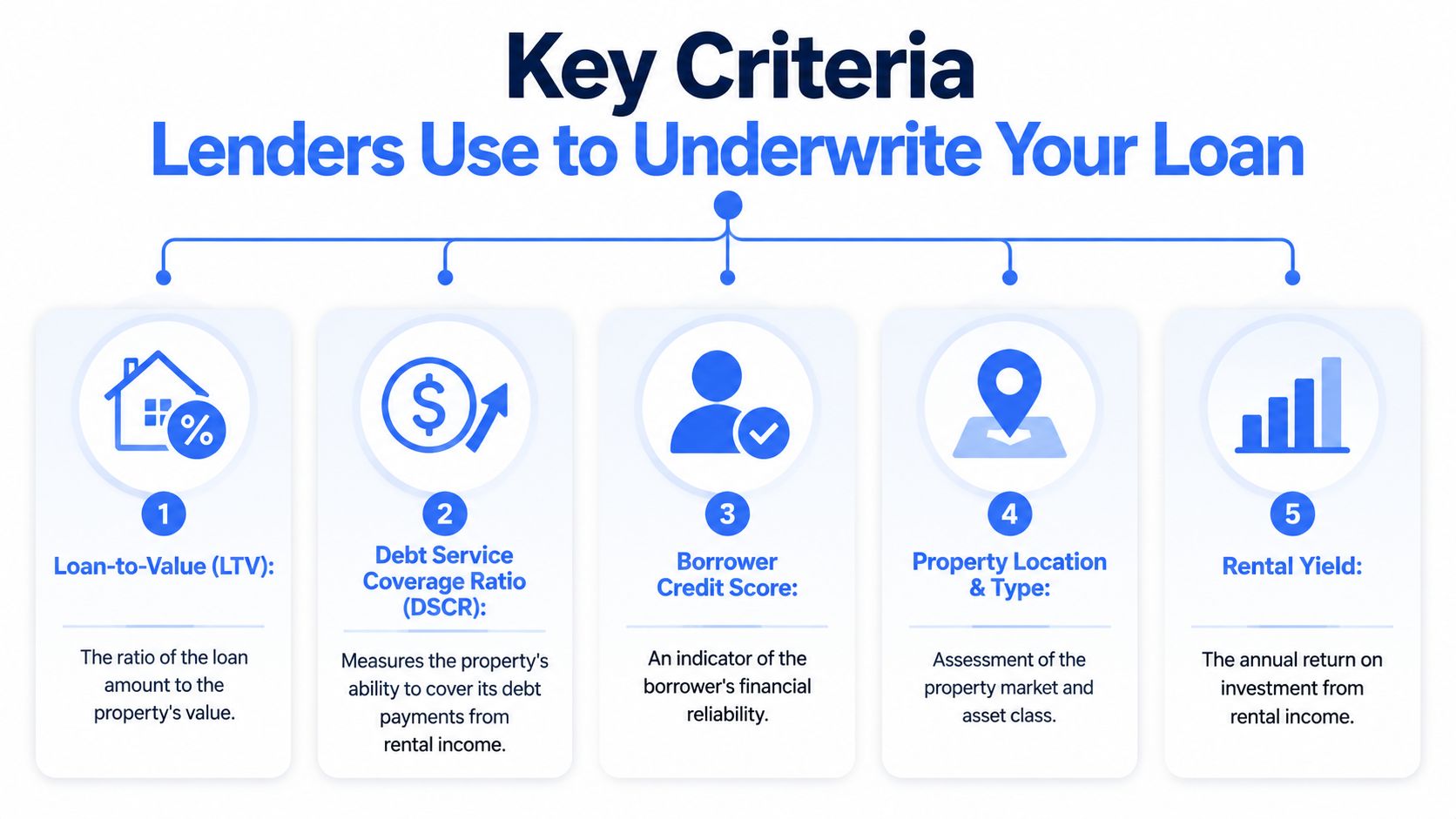
Loan-to-value sets the lender's downside
Loan-to-value, or LTV, is the first screen. It measures the loan amount against the property value. Higher LTV means less room for error if the appraisal comes in light, the rehab runs over budget, or the market softens before refinance or sale.
For standard buy-to-let lending, many lenders top out at 75% LTV, according to this guide to buy-to-let mortgage limits and lender criteria. In practice, a lower LTV gives you more options. Banks like the lower risk. Specialist and private lenders may still fund higher-risk scenarios, but pricing, reserves, and structure usually get tighter.
That trade-off matters. If speed is the priority, a lender may overlook a less conventional file. They will still want enough equity in the deal to protect their position.
Rent coverage decides whether the loan works on paper
The second major test is Interest Cover Ratio, or ICR. This is the rent-to-interest calculation buy-to-let lenders use to check whether the property can carry the debt.
Most buy-to-let lenders require projected rental income to be at least 125% of the mortgage interest cost. For higher-rate taxpayers or more conservative lenders, that can rise to 145%, according to this guide to buy-to-let mortgage affordability and ICR rules.
A simple example makes the point. If the stressed monthly interest payment is 1,000, a lender using 125% ICR wants 1,250 in rent. At 145%, that number rises to 1,450.
A common point of failure for deals arises. The purchase price may be fine. The borrower may have experience. But if the valuer gives a lower market rent than expected, the loan amount gets cut. Investors who understand that before they make an offer save time and avoid dead deals.
Run the rent coverage before you submit. It is faster to fix a weak structure early than to renegotiate after underwriting trims the proceeds.
The rest of the file can still stop the deal
LTV and ICR do most of the heavy lifting, but they are not the whole decision.
Underwriters also look at credit history, cash reserves, property condition, tenancy strength, licensing issues, entity structure, and location. A standard flat with clean rent comparables gets a very different reception than a semi-commercial unit, a heavy-value-add property, or an asset with title or lease complications. Traditional banks often struggle with those edge cases. Flexible lenders may handle them, but they will want a clear story on risk and exit.
That is why experienced investors pre-screen the file the same way a lender will. They check the numbers, the asset, and the weak spots before application. For a practical list of what lenders usually ask for, review these rental property loan requirements.
Navigating the Application and Funding Process
The funding path tells you a lot about the lender. Traditional banks and private lenders can both finance non-owner-occupied property, but they move through the file very differently.
That difference matters when the closing date is real and the seller won't wait.

The bank route
A bank process usually starts with a full application and broad document collection. Expect personal financials, income verification, entity documents if applicable, rent schedules, and repeated requests as the file moves from one reviewer to another.
Then comes valuation, underwriting, conditions, and committee-style decision making. None of that is wrong. It's just slower and less forgiving when a file falls outside standard policy.
The private lender route
A private lender usually starts by asking a tighter set of questions. What's the property, what's the loan purpose, what's the level of debt, what's the rent or exit, and how quickly do you need funds?
The review is more focused. Instead of building a file around every personal detail, the lender looks hard at the asset, the structure, and the path to repayment. That doesn't mean no diligence. It means fewer moving parts and fewer handoffs.
A fast lender still underwrites. They just underwrite what actually drives the risk.
What borrowers should prepare upfront
Investors make funding easier when they organize the file before the first call. Bring the essentials early:
- Purchase details: Signed contract, addenda, and any seller deadlines.
- Property support: Rent roll, lease information, market rent estimate, or rehab scope if the unit needs work.
- Borrower package: Entity docs, vesting structure, basic financial background, and a clear ownership story.
- Exit plan: Hold as rental, refinance after stabilization, or another documented path.
When borrowers do this well, lenders can make decisions faster and with fewer revisions. When borrowers drip information over several days, avoid direct answers, or send inconsistent numbers, even a flexible lender slows down.
How to Choose the Right Lending Partner for Your Goals
A lender quote doesn't tell you enough. You need to know how that lender behaves when the file gets real.
That means asking questions that expose process, judgment, and deal fit. Asking these questions helps many investors and brokers save themselves from a bad lending relationship.
Questions that matter before you apply
Start with the practical items that affect execution:
- Closing speed: Ask how quickly they usually move from complete file to funding on a non-owner-occupied property.
- Property fit: Ask whether they lend on your exact asset type and condition, not just “investment property” in general.
- Rehab scope: If the property needs work, ask whether they can finance improvements and how draws are handled.
- Prepayment terms: Ask whether there are penalties, minimum interest periods, or extension fees.
- Decision maker access: Ask who approves exceptions and whether you can speak with that team if needed.
Then ask one question that cuts through the sales pitch. “What kind of deal do you usually decline?” A serious lender will answer directly.
Where traditional options often fall short
Small-balance rentals are a common example. Many investors struggle to find financing for small-balance properties under $100,000 because high fixed origination costs make those loans unattractive for many traditional lenders, as explained in Pew's analysis of why small mortgages are too hard to get.
That matters if you buy older entry-level rentals or lower-priced assets in secondary markets. The property may cash flow well and still fail to attract mainstream financing because the loan size doesn't fit the lender's economics.
What a good lending partner looks like
A useful lending partner doesn't just quote terms. They identify issues early, explain what will kill the file, and tell you what can be fixed.
Look for these signs:
- Straight answers: They tell you quickly if the deal fits.
- Clear document requests: They don't hide the actual approval conditions.
- Consistent communication: Calls get returned and updates are specific.
- Scenario awareness: They understand bridge, refinance, delayed stabilization, and non-standard borrower structures.
If you're a broker, this matters even more. Your value isn't just access to capital. It's matching the deal to the lender that will perform.
Gaining an Edge with a Responsive Lending Partner
The investor advantage usually doesn't come from finding a magical loan product. It comes from reducing friction at the exact moment a deal could fail. Fast review, practical underwriting, and realistic terms change outcomes.

That's why responsive capital matters in non-owner-occupied real estate. A borrower may need to close on a rental before a bank can finish committee review. Another may need a bridge loan while a vacant unit is being turned and leased. Another may need a refinance structured around the property instead of a rigid consumer-mortgage template.
LendingXpress fits that kind of work. It provides private lending for investment properties, including bridge and rental scenarios, with simplified applications, common-sense underwriting, and loan amounts from $100,000 to $18 million+, according to the company background provided here. It can also close in as little as three days and finance up to 100% of rehab costs for renovation projects, based on the same company information.
Why responsiveness changes deal quality
A responsive lender helps before closing, not just at closing. They flag debt-related issues, push back on weak rent assumptions, and tell you whether the exit plan makes sense. That kind of feedback helps investors avoid forcing bad deals.
For brokers, responsiveness also affects lead conversion. If your intake process is slow, good borrowers can go cold before they ever talk to a loan officer. Teams looking at client response workflows may find this breakdown of how AI books mortgage consultations useful when they want more consistency at the front end.
A quick overview of the lending flow helps illustrate what borrowers are looking for in a partner:
The point is simple. If the deal is standard and time is loose, conventional financing may work fine. If the property is non-owner-occupied, the timeline is tight, or the file needs judgment, a more agile lending partner can preserve the opportunity instead of slowing it down.
If you're financing a non-owner-occupied property and need a lender that can evaluate the deal quickly and speak plainly about what works, talk to LendingXpress. A short conversation can tell you whether the file fits, what documents matter, and how to structure the next step without wasting time.