
You find a property that fits the numbers. The seller wants certainty, the rehab is straightforward, and your exit makes sense. Then the bank asks for more tax returns, more seasoning, more committee time, and the deal starts slipping away.
That’s the moment many investors stop thinking about financing as a commodity and start treating it like part of the strategy. For non-owner-occupied real estate, the wrong lender can kill a good deal. The right one can help you close, execute, and move to the next project without wasting momentum.
Private money lenders for real estate fill that gap. They’re not designed for every scenario, and they’re rarely the cheapest capital on paper. But for investors buying distressed property, bridging a timing problem, funding rehab, or refinancing an asset a bank won’t touch yet, private money often fits the job better than a conventional loan.
When Banks Say No Fast Deals Say Go
A lot of investors learn this lesson the same way. They get a property under contract at a price that leaves room for profit, only to discover that the bank cares less about the deal in front of them than the paperwork behind them.
A bank may like stabilized properties, straightforward borrowers, and long timelines. Investors often need the opposite. They need to close before a competing buyer shows up, buy a property with deferred maintenance, or fund a transition period before a sale or refinance. That’s where private money starts making sense.

In California, this shift isn’t theoretical. Private lenders have doubled their share of loan originations compared to pre-pandemic levels, and average private loan amounts in the market reached over $900,000 according to Private Lender Link’s California lending data. That tells you two things. Investors are using private capital at meaningful scale, and lenders are stepping in where banks have pulled back.
Why speed changes the deal
A slow approval process doesn’t just create inconvenience. It changes negotiating power.
If you can’t show a seller that you’ll close on time, your offer gets weaker. If you can’t fund rehab fast enough, your contractor schedule slips. If your bridge loan takes too long, your refinance window can close before you get there.
Private money works best when time has real value. In investment property lending, speed isn’t a bonus. It’s often part of the return.
What private money really solves
Private money is useful when the property has a clear business case but the deal doesn’t fit a conventional box.
- Transitional assets: A property needs repairs, lease-up, cleanup, or repositioning before bank financing makes sense.
- Time-sensitive closings: Auction deals, inherited properties, distressed sellers, and maturing debt don’t wait for committee review.
- Borrower profile mismatch: The investor may have strong experience and liquidity but tax returns or income structure that don’t fit bank guidelines.
Good investors stop asking, “What’s the cheapest rate?” and start asking, “What capital helps me finish this deal correctly?” Those are different questions.
Private Money vs Traditional and Hard Money Loans
Traditional bank financing, hard money, and private money all fund investment real estate. But they don’t think the same way.
A bank acts like an auditor. It wants a file that fits policy, stable income documentation, lower risk, and time to process everything. A generic hard money lender often acts like a pricing machine. If the collateral fits the box, it quotes terms and moves on.
A private money lender is closer to a deal partner. The focus is the property, the business plan, the borrower’s execution ability, and whether the exit is believable.
Financing Options at a Glance
| Criteria | Traditional Bank Loan | Hard Money Loan | Private Money Loan (LendingXpress) |
|---|---|---|---|
| Underwriting focus | Borrower income, tax returns, credit, debt ratios | Mostly collateral and quick resale value | Asset, exit plan, sponsor strength, and property story |
| Best use | Stabilized rental or long-term hold | Distressed or urgent purchase needing fast capital | Bridge, fix and flip, rehab, rental transition, cash-out on investment property |
| Speed | Slowest | Fast | Fast with more room to structure around the deal |
| Property condition tolerance | Lowest | Higher | Higher, especially for transitional assets |
| Flexibility | Lowest | Moderate | Higher when the lender understands investor business plans |
| Borrower experience review | Often secondary to documentation | Sometimes limited | Usually meaningful, especially for repeat investors |
| Relationship value | Limited | Often transactional | Stronger if the lender stays active across multiple deal types |
The practical difference
The biggest mistake new investors make is treating all non-bank lending as the same product. It isn’t.
Hard money is a broad category. Some hard money lenders are useful for one-off transactions but operate with rigid templates, limited communication, and little interest in the details of your plan. Private money lenders for real estate often go deeper into the actual deal. They want to know what you bought, why it’s underpriced, what you’ll spend, what it will be worth after improvement, and how you’ll exit.
That difference matters when a deal gets messy. Rehab budgets change. Title issues surface. A tenant won’t vacate on schedule. A buyer backs out and you need more time. A relationship-driven lender is usually more workable in those moments than a lender built only to push files through a fixed structure.
When each option makes sense
- Use a bank loan when the asset is clean, the timeline is forgiving, and you want long-term financing at a lower cost.
- Use a hard money loan when speed matters and the terms still fit your profit margin.
- Use private money when the deal needs speed plus judgment, especially if the property is in transition.
If you’re comparing loan paths for your next non-owner-occupied purchase, this guide on how to finance investment property helps frame the decision around the asset and exit, not just the quoted rate.
Key Private Money Loan Products for Investors
Most investors don’t need “a loan.” They need the right loan for the stage of the property.
That’s the easiest way to understand private money. Each product solves a different problem in the life of a deal. If you match the financing to the property’s stage, the project tends to move cleaner.
Bridge loans for timing problems
A bridge loan works when the property or borrower isn’t ready for permanent financing yet, but the opportunity is real right now.
A common example is an investor buying an asset with vacancy, deferred maintenance, or a short closing window. A bank may finance it later, after the units are leased or the property is cleaned up. But the investor needs money today to buy it.
Bridge debt covers that gap. It gives the investor time to stabilize the asset, improve operations, or line up the refinance.
Practical rule: If the deal is solid but the timing is awkward, bridge financing is often the cleanest answer.
Fix and flip loans for purchase plus rehab
Private funding serves as a true operating tool. A fix and flip loan is built for investors buying below market value, renovating quickly, and exiting by sale or refinance.
That matters because speed is central to flipping. In Q3 2024, investors completed 74,618 single-family home flips, and a meaningful share of those deals depended on quick funding, as noted in Invesco’s overview of private real estate lending. You can’t compete for distressed inventory with a slow lender and still expect consistent volume.
What works in a flip file is simple:
- A believable scope of work: The rehab plan should match the neighborhood and target buyer.
- Clean comparable sales: Your projected value has to be supported by nearby, relevant sales.
- A realistic timeline: Aggressive schedules sound good until permits, inspections, and contractor delays hit.
What doesn’t work is inflated ARV, vague construction budgets, or no backup exit if the resale takes longer than expected.
Some lenders in this space also finance rehab through staged draws and may fund up to 100% of rehab costs for qualifying projects. That structure helps investors preserve liquidity for carrying costs, overruns, and the next acquisition.
Rental property loans for the transition to hold
Not every investor wants to sell. Some buy underperforming properties, improve them, increase rent, and hold for cash flow.
A private rental property loan can help in two moments. First, at acquisition, when the property’s current condition or tenancy makes conventional financing difficult. Second, after light upgrades, when the investor needs time before a long-term refinance.
This loan type is useful for:
- BRRRR-style investors: Buy, rehab, rent, refinance, repeat only works if the initial capital moves quickly.
- Portfolio buyers: Investors picking up multiple non-owner-occupied properties often need flexible execution more than perfect pricing.
- Cash-out repositioning: Equity in one investment property can support improvements or another acquisition.
LendingXpress offers bridge, fix and flip, and rental property loans for non-owner-occupied residential and commercial assets, with loan sizes from $100,000 to $18 million+ and closings in as little as three days based on the publisher’s company information.
The right product starts with the exit
Before you ask about rate, ask how the deal ends.
If the answer is “sell after rehab,” that points one way. If the answer is “stabilize and refinance,” that points another. Private lenders for real estate don’t just fund purchases. They fund transitions. The cleaner the transition plan, the easier the loan discussion usually becomes.
How to Qualify for a Private Money Loan
Private lenders don’t ignore the borrower. They just start with a different question than banks do.
A bank often asks whether your financial profile fits a policy box. A private lender asks whether the property and plan create enough protection for the loan to make sense. That’s why Loan-to-Value, or LTV, is typically capped at 65% to 75% in this space, as explained in Note Servicing Center’s discussion of private lending metrics. The equity cushion protects the lender and helps the file move faster.

What lenders look at first
If you want a better shot at approval, package the deal the way a lender underwrites risk.
Value today
The lender needs a credible view of the property’s current value. That usually means appraisal support, a BPO, or strong local comps.Value after improvements
If the property needs work, your after-repair value has to be defendable. Unsupported optimism is one of the fastest ways to lose credibility.Budget and timeline
A line-item rehab budget is much stronger than a rough guess. So is a schedule that reflects the actual scope.
What strengthens the file
Private money lenders for real estate will usually respond better when the borrower presents a complete business plan instead of a stack of disconnected documents.
A strong submission often includes:
- Sponsor profile: Your experience, prior projects, and any relevant team members.
- Property summary: Purchase price, condition, photos, and neighborhood context.
- Exit strategy: Sale, refinance, or another defined path, with reasoning.
- Liquidity picture: Enough reserves to handle carrying costs and surprises.
Bring the answer before the lender asks the question. That’s how you speed up underwriting.
What hurts approval
Three issues come up constantly.
- Overstated ARV: If your value depends on perfect execution and top-of-market resale, the lender will discount it.
- Thin contingency planning: Renovations rarely go exactly as forecast.
- No clear exit: “I’ll figure it out later” isn’t an exit strategy.
Credit still matters at the edges, especially if the file already has weaknesses. But a strong asset with a clear plan will usually get more attention than a polished borrower profile attached to a weak deal.
Your Step-by-Step Guide to Securing Funding
The process is usually simpler than new investors expect. Private lending moves quickly because the file is built around the property and the plan, not a long list of bank-style conditions.
That speed is one reason investors use it for acquisition, rehab, and bridge scenarios. Private money loans often carry terms of 6 to 24 months with interest-only payments and can close in as little as two weeks, compared with 30 to 45 days for banks, according to Groundfloor’s guide to private money lending.
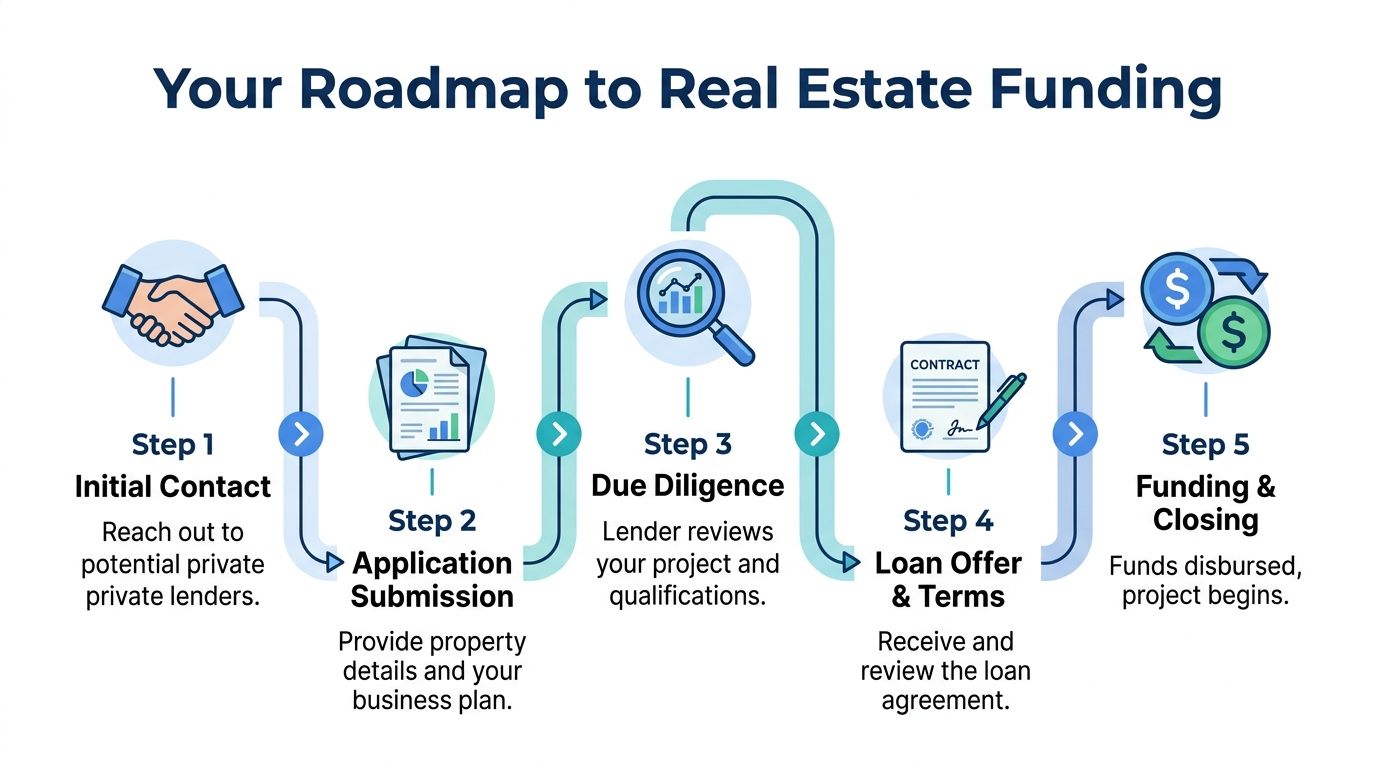
Step 1 and Step 2
Initial inquiry and deal submission
Start with the basics. The lender needs the property address, purchase price or payoff, scope of work if there’s rehab, timeline, and your intended exit.
Then comes preliminary review. If the deal fits the lender’s appetite, you’ll usually get early feedback on structure, debt financing, pricing range, and required documents.
Step 3
Property valuation and due diligence
At this stage, the lender verifies the story. Value, title, condition, and feasibility all get tested.
Be ready for requests like these:
- Comparable sales: Especially important for flips and distressed acquisitions.
- Rehab detail: Contractor bids, budget lines, and draw expectations.
- Entity and borrower documents: Formation docs, bank statements, and purchase contract or payoff information.
If you’re preparing a rehab file, this article on working with private money lenders for rehab loans gives a practical view of how lenders assess the plan behind the property.
Step 4 and Step 5
Final approval, loan documents, and closing
Once underwriting signs off, legal documents go out, title coordinates closing, and funds are disbursed. On rehab projects, construction money is often released through draws instead of all at once.
The fastest closings happen when the borrower submits a complete file early. Delays usually come from missing purchase contracts, weak comps, unclear budgets, or slow title cleanup.
What borrowers can do to move faster
Use a checklist before you ever apply.
- Get the purchase contract ready: Not “coming soon.” Ready.
- Know your numbers cold: Purchase, rehab, holding costs, and exit value should all be easy to explain.
- Organize entity documents: Last-minute scrambling slows otherwise good deals.
- Answer directly: If the lender asks about a risk, address it clearly instead of trying to sell around it.
The smoother your package, the more the lender can focus on approval instead of cleanup.
Choosing the Right Private Lending Partner
Rate matters. It just shouldn’t be your only filter.
Investors get in trouble when they choose a lender based on the quote sheet alone. Cheap capital that doesn’t close on time, communicate clearly, or handle complexity can cost far more than a higher-priced loan that performs when the deal gets real.
What to check before you commit
Look for signs that the lender can support the business you’re running.
- Term clarity: Fees, extension terms, draw process, reserves, and prepayment expectations should be understandable before closing.
- Execution record: Ask practical questions about how the lender handles title issues, valuation disputes, rehab draws, and timeline pressure.
- Decision access: You want access to people who can explain structure and solve problems, not just collect documents.
- Asset familiarity: A lender who understands investor property types underwrites differently than one treating every file like an exception.
Stability matters more than most borrowers realize
A private lender’s capital base affects the borrower experience. If the lender’s funding is unstable, approvals can change late, closings can drag, and draw requests can become painful.
One useful signal is whether the lender also has a transparent investor-side platform. LendingXpress’s debt fund targets a 9% return and is backed by more than $558 million in originations, aligning with industry averages of 8% to 11% according to the verified benchmark provided from MM Private Lending. The point isn’t just yield. It’s that transparent capital and real origination history usually translate into more reliable execution for borrowers.
A lender with stable capital tends to behave differently. It can honor timelines, structure around real problems, and stay consistent from term sheet to closing.
Questions worth asking
Before you choose a lender, ask these directly:
- How do you handle extensions if the project runs long?
- What triggers rehab draw releases?
- Who makes the final credit decision?
- How often do terms change after the initial quote?
Good answers are specific. Weak answers are vague or evasive. If a lender can’t explain its own process plainly, expect friction later.
Frequently Asked Questions about Private Money
Can I get approved with less-than-perfect credit
Sometimes, yes. Private money lenders for real estate care heavily about the property, the financing structure, and exit plan. Weak credit won’t help, but it doesn’t automatically kill a strong asset-based deal the way it might with a conventional bank.
Why are private money rates higher than bank rates
Because the job is different. Private money is built for speed, flexibility, transitional assets, and scenarios that banks often won’t fund. Investors usually justify the higher cost when quick execution helps them buy right, finish the project, and exit profitably.
How fast can a private money loan close
It depends on the quality of the file, title, valuation, and how quickly the borrower provides documents. In practice, private loans move in days or weeks, not months, when the deal is organized and the lender is set up for asset-based underwriting.
What are the usual exit strategies
Most private loans end one of two ways. The investor sells the property after completing the business plan, or refinances into longer-term debt once the asset is stabilized. The cleaner the exit path, the easier the original loan approval tends to be.
Is private money only for distressed deals
No. It’s common for distressed purchases, but it’s also useful for bridge financing, cash-out on investment property, rental transitions, and acquisitions where certainty of close matters more than chasing the lowest rate.
If you’re evaluating a non-owner-occupied deal and need a lender that understands bridge, rehab, rental, and investor-focused financing, LendingXpress is one place to start. Review the asset, know your exit, and bring a clean package. That’s usually the fastest path to a real answer.