
You find a rental that fits your buy box. The location works, the numbers are close, and the seller wants a fast close. Then the bank asks for more tax returns, more reserve documentation, more explanations, and more time.
That's where many investors lose good deals.
Traditional financing still has a place, but it isn't built for every non-owner-occupied purchase. It struggles when the borrower is self-employed, when the property needs work, when the title sits in an LLC, or when speed matters more than shaving every possible fraction off the rate. Serious investors usually learn this the hard way. The loan that looks cheapest on paper can be the most expensive choice if it causes you to miss the asset.
The better way to think about rental property financing options is simple. Match the loan to the deal. A stabilized rental with strong personal income may fit conventional financing. A cash-flowing property owned by an investor with heavy write-offs may fit DSCR. A distressed property that needs to close quickly usually needs private or hard money first, then a refinance once the property is ready.
That shift in thinking changes everything. Hard money isn't always a fallback. DSCR isn't always the answer. The right structure depends on timing, property condition, income stability, and your exit plan.
Beyond the Bank Your Guide to Investment Property Loans
A common investor story goes like this. You submit an offer on a rental, get accepted, and immediately start dealing with a lender who underwrites as if every borrower has one salary, one house, and neat tax returns. Meanwhile, the seller wants certainty, the listing agent wants proof you can close, and the property won't wait for a slow file.
Banks tend to like clean files and predictable borrowers. Investors rarely look like that. You may have multiple entities, uneven tax returns from write-offs, several financed properties, or a building that isn't rent-ready yet. None of that means the deal is bad. It just means the loan needs to fit the nature of investing.
Practical rule: The financing should support the business plan for the property, not fight it.
That's why non-bank rental property financing options matter. They give investors room to move when conventional lending can't. Some loans focus on your personal income. Others focus on the property's cash flow. Others focus mainly on the asset and your exit strategy.
What usually blocks investors at a bank
- Personal income rules: Many investors earn well but report modest taxable income after deductions.
- Property condition issues: A distressed unit or vacant building often won't fit standard bank guidelines.
- Timeline pressure: If a seller wants speed, a long underwriting process can kill the deal.
- Entity ownership: Some borrowers want to close in an LLC and keep business separate from personal borrowing.
The investors who keep growing usually stop asking, “What's the cheapest loan?” and start asking, “What loan gets this specific deal across the finish line with a workable exit?” That's the question that leads to better decisions.
The Conventional Mortgage Path for Investors
A conventional loan works well when the deal is plain vanilla. The property is rent-ready, the borrower has strong documented income, and the closing timeline leaves room for a full underwriting process. In that situation, bank money is often the lowest-cost option.
The catch is that conventional financing is built for stability, not speed or complexity. Investors who buy clean, turnkey rentals can do well with it. Investors buying under time pressure, through entities, or with tax returns that understate real cash flow often hit friction fast.
What conventional lenders usually require
Start with cash to close. Fannie Mae's eligibility matrix for investment properties shows higher minimum down payments for non-owner-occupied purchases, including 15% down in some one-unit cases and 25% down for certain two- to four-unit transactions, depending on occupancy and transaction type, in its selling guide matrix. In practice, many investors should expect to bring more than the minimum if they want stronger pricing or an easier approval.
Reserves are part of the conversation too. Freddie Mac's seller-servicer guide for reserves outlines post-closing reserve requirements that can increase based on the number of financed properties and overall risk in the file. That matters because cash tied up in reserves is cash you cannot use for repairs, vacancy, or the next acquisition.
Documentation is still centered on the borrower. Conventional lenders look closely at tax returns, W-2s or other income records, debts, assets, credit, and property history. That model favors borrowers with simple financials. It gets harder when the investor owns several rentals, runs income through multiple entities, or shows low taxable income because the tax strategy is doing its job.
Where conventional financing makes sense
Use a conventional loan when the deal benefits more from lower long-term cost than from speed or flexibility.
It usually fits best when:
- The property is fully habitable and rent-ready.
- Your income is easy to document and your debt picture is clean.
- You have enough liquidity for down payment, closing costs, and reserves without squeezing operations.
- The seller is not forcing a fast close.
For a stabilized buy-and-hold purchase, that can be a solid fit. Conventional debt is often the right answer for investors who want to keep financing costs down and are not trying to solve a timing problem.
Where investors outgrow it
Conventional financing starts to strain when the file looks like a real investor file instead of a homeowner file. Tax returns may not reflect actual earning power. The property may need work before it can qualify. The borrower may want to close in an LLC. The seller may want certainty in two weeks, not a long approval cycle with multiple conditions.
Pricing also shifts on investment property loans. Fannie Mae's loan-level price adjustment matrix shows that investment property transactions carry added risk-based pricing adjustments compared with owner-occupied loans. That does not make conventional financing a bad product. It means the cheapest headline rate in the market is not always available on an investor deal.
Strategy matters here. If the property is clean, the timeline is forgiving, and your file fits agency rules, a conventional loan can be efficient. If the deal needs speed, flexibility, or underwriting based more on the asset than your personal tax returns, investors often skip the bank route and use options such as DSCR rental property loans or private capital by choice, not because they ran out of options.
That distinction matters in practice. Smart investors use conventional financing when it matches the deal. They use private or asset-based financing when the deal would be lost waiting on a bank.
Financing Based on Cash Flow With DSCR Loans
A common investor problem looks like this. The property cash flows, the borrower has reserves and experience, but the tax returns do not tell a clean enough story for a bank underwriter. A DSCR loan solves that mismatch by putting more weight on the property's income than on personal income documentation.

How DSCR works in plain English
DSCR stands for Debt Service Coverage Ratio. The lender compares the property's qualifying rent to its housing payment, then decides whether the income supports the debt with enough margin. The Consumer Financial Protection Bureau explains that lenders use debt-service coverage to measure whether income is sufficient to cover loan payments in business-purpose lending contexts, which is the core logic behind DSCR underwriting for rental property loans: CFPB small business lending guide.
In practice, investors use DSCR loans when the asset is the strongest part of the file. That often includes self-employed borrowers, portfolio investors whose personal DTI is already crowded, and buyers who want to hold title in an LLC where the program allows it.
If that matches your situation, review current DSCR loan programs for rental property investors.
What you gain, and what you give up
The main advantage is flexibility. You can often qualify without handing over the same level of personal income documentation a conventional lender wants, which matters when depreciation, write-offs, or multiple entities make tax returns look weaker than the business really is.
The trade-off is cost. DSCR pricing is usually higher than conventional financing, and the lender will pay close attention to rent support, reserves, property type, and your experience. Rocket Mortgage notes that DSCR loans generally require stronger down payments than primary residence loans and are designed around the property's ability to cover its debt, not around owner-occupant underwriting rules: Rocket Mortgage guide to DSCR loans.
Here is the practical view:
| Item | Typical DSCR expectation |
|---|---|
| Down payment | Often higher than conventional owner-occupied financing |
| Property coverage | Rent usually needs to support the payment at the lender's required ratio |
| Closing timeline | Often faster than a conventional bank loan, depending on appraisal and title |
| Cash-out refinance | Common option for stabilized rentals with enough equity and income |
When DSCR is the right move
Use DSCR when the property is already leased, or close enough to stabilized that market rent and debt coverage are straightforward to document. It is a strong fit for long-term rentals and some short-term rental scenarios if the lender has a program for them and the income can be supported.
Skip DSCR when the property still needs heavy rehab, has no reliable path to near-term rent, or the business plan depends on improvements before the asset can carry permanent debt. In those deals, a short-term private or bridge loan is often the cleaner first step, followed by a refinance into DSCR once the property is producing.
That is the key role of DSCR financing. It is not a fallback for borrowers who failed at the bank. It is a hold loan for investors who want underwriting tied to the asset's cash flow and a process built around investment property reality.
When Speed Is Your Strategy Use Hard Money and Bridge Loans
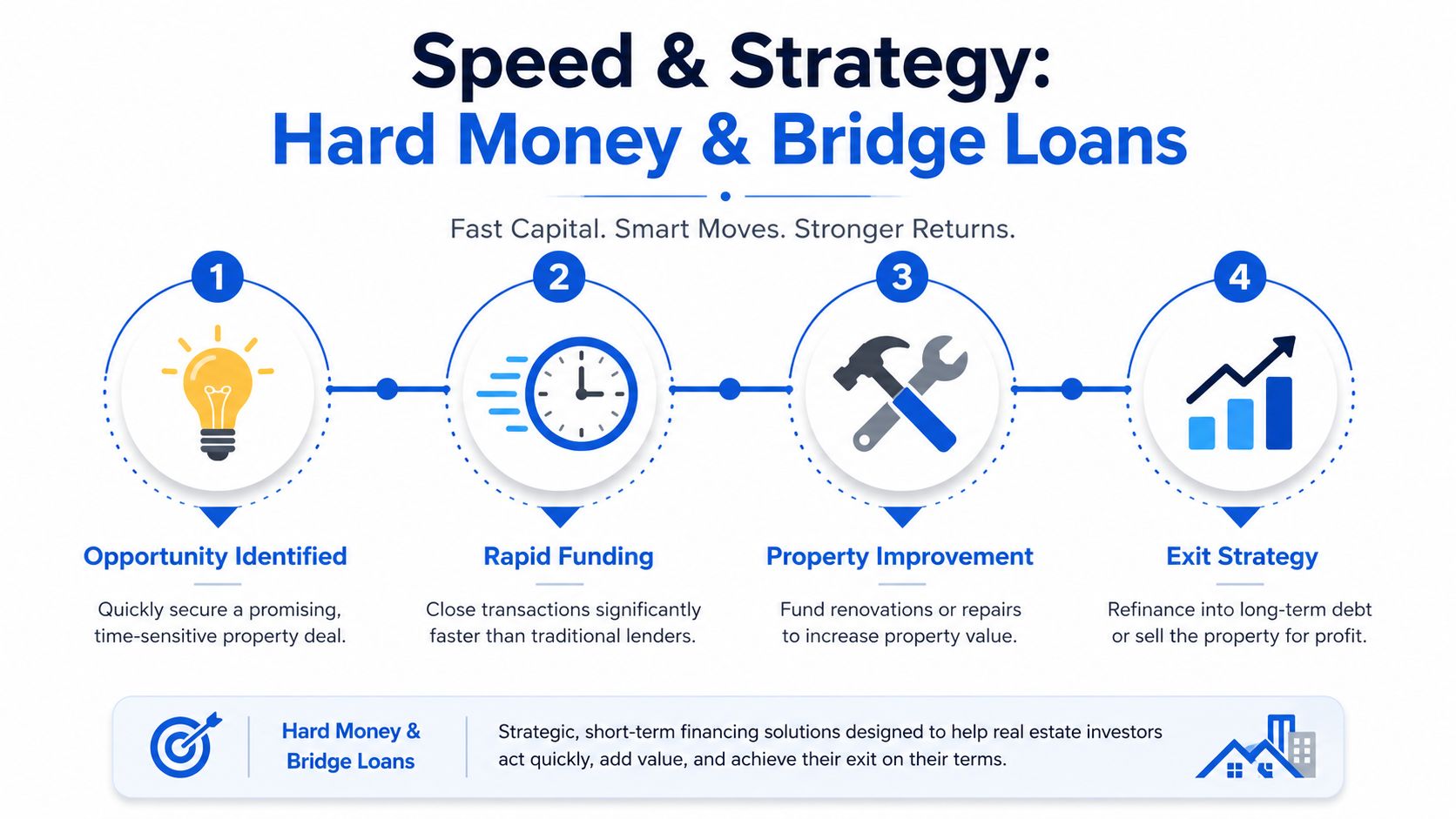
A seller accepts offers on Monday and wants proof you can close before the weekend. The property has deferred maintenance, the unit mix needs work, and a bank underwriter will stall on condition alone. In that deal, speed is part of the return. If you cannot close fast, you do not get the asset.
Why experienced investors use hard money on purpose
Hard money and bridge loans work best when timing, property condition, or borrower structure would slow down a conventional lender. The underwriting centers on the asset, your plan, and the exit. That makes these loans useful for purchases with light or heavy rehab, short lease-up periods, and acquisitions that need entity flexibility or quick execution.
Private lending shines in these scenarios:
- Fast acquisition: Private lenders often close much faster than banks, which matters when you are competing against cash or negotiating with a seller who values certainty over a long escrow.
- Property-first underwriting: The focus is usually the collateral, available equity, and your business plan, rather than the same income documentation a consumer mortgage requires.
- Bridge use cases: These loans fit the period between purchase and stabilization, when the property is not ready for long-term debt but the deal still makes sense.
For investors in that position, a specialized hard money lender for investment property deals can be the right fit when the timeline or asset condition would kill a bank loan.
The cost and the discipline
Hard money gives you speed and flexibility. You pay for both.
Rates are higher than long-term rental debt, fees are usually higher, and the term is short. The National Association of Realtors notes that hard money loans are commonly used as short-term financing secured by real estate, often by investors who need quick funding or who are buying properties that need improvement before permanent financing is available, as explained in the NAR real estate glossary entry on hard money loans. The same basic rule applies on every deal I see. If there is no clear path to refinance or sale, the loan term becomes the main risk.
Later in the deal cycle, many investors watch this video to understand how the bridge phase works in practice:
The mistake isn't using hard money. The mistake is using hard money without a clear refinance or sale plan.
The exit plan should be specific. Know what repairs will be completed, what rent level or occupancy you need, how much equity you expect after the work, and which permanent loan you plan to use next. Insurance matters too, especially during rehab or vacancy periods. Many investors also review landlord insurance insights for agents before closing so the coverage lines up with the business plan.
Best-fit scenarios
Hard money is often the right tool when:
- The property needs repairs before it can qualify for permanent debt.
- The seller values speed and certainty over a long escrow.
- You need a bridge from acquisition to stabilization.
- You already know how you will exit, through refinance or sale.
Used that way, hard money is not a fallback. It is a deliberate way to win deals, control timing, and move an asset from problem property to financeable rental.
More Tools in Your Financing Toolkit
Not every deal fits neatly into conventional, DSCR, or a straight bridge loan. Investors often need a financing stack, not a single product.
That's where the less-discussed tools matter. They solve the gaps that standard articles skip.

Portfolio loans and cross-property solutions
A portfolio loan can help when you own multiple rentals and want one lender to look at the broader relationship instead of underwriting every property through rigid agency rules. Investors use these when they value simplicity, entity flexibility, or a custom structure more than standardized bank execution.
A portfolio structure can also help when one property is stronger than another, or when you want to manage debt across several assets with one lending relationship. The exact structure varies by lender, so the key question is whether the lender understands investment property operations, not just consumer mortgage guidelines.
Rehab-to-rent structures
This is one of the biggest blind spots in rental property financing options. A distressed rental often needs capital for both purchase and renovation, but the long-term loan usually won't fund both stages.
That matters because DSCR loans generally require the property to be income-producing at closing, which means borrowers cannot typically use one DSCR loan to buy and rehab a distressed rental, according to Hemlane's overview of rental property loan options.
So the practical structure often looks like this:
- Step one: Use bridge or private money to acquire and rehab.
- Step two: Stabilize the property with rent-ready condition and occupancy.
- Step three: Refinance into long-term debt once the asset supports it.
That sequence is normal. The mistake is pretending a distressed rental should go straight into a permanent loan product.
Equity-based funding from another property
Some investors use a HELOC or home equity loan on another asset to fund a down payment, renovation budget, or fast earnest money needs. That can work when you have strong equity elsewhere and want to preserve flexibility on the new rental acquisition.
It also adds risk because you're tying the new investment to another property you already own. If you use this route, treat insurance, liability, and entity structure seriously. For agents and investors reviewing risk management around rental holdings, these landlord insurance insights for agents are useful context before you close and lease the property.
Choosing Your Best Financing Option
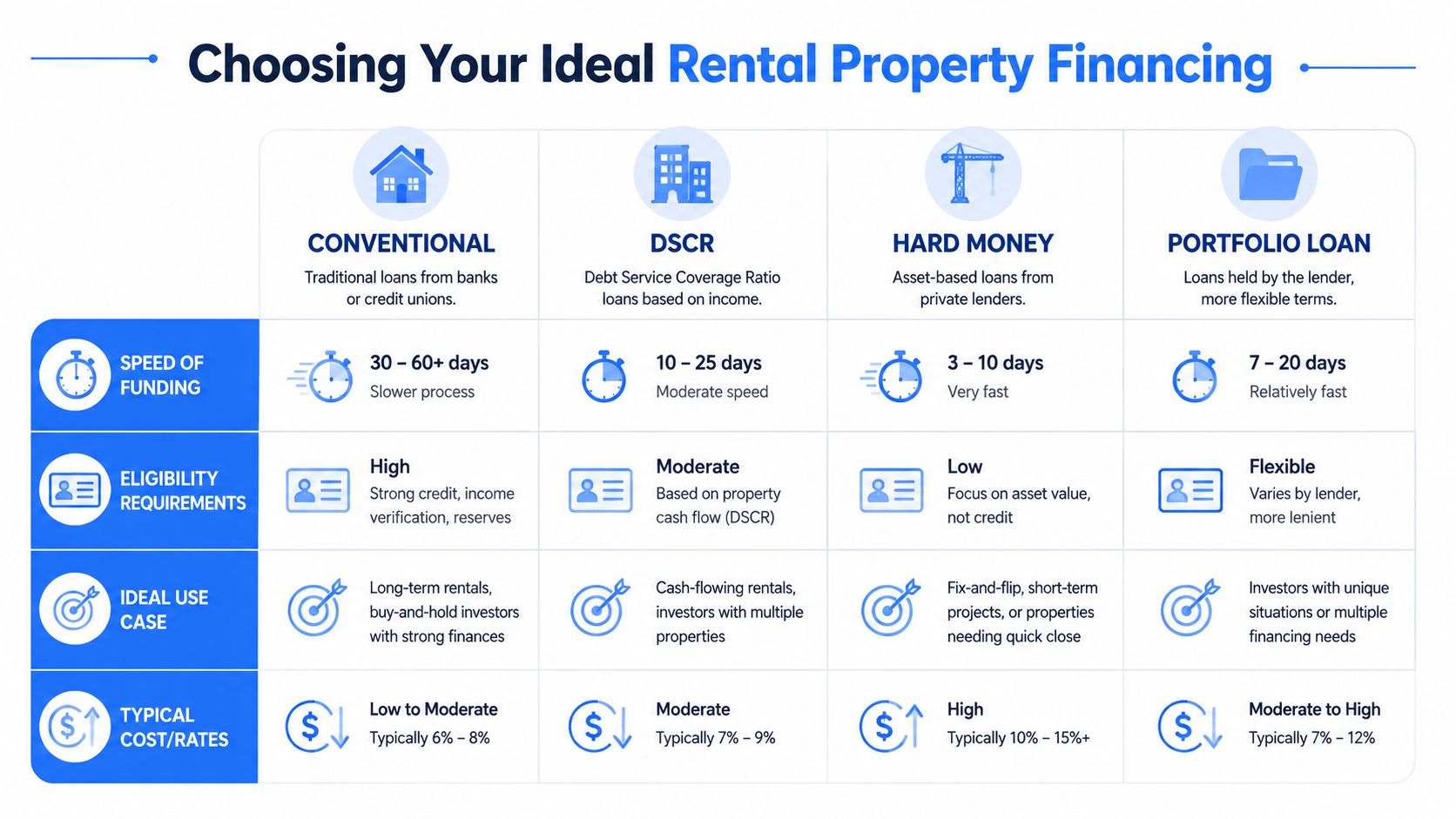
A seller accepts your offer on Tuesday and wants to close next week. The property needs work, the rents are below market, and your bank says it can look at the file once the unit mix and income are stabilized. At that point, the best financing option is the one that fits the deal in front of you, not the one with the lowest advertised rate.
A practical comparison
| Loan type | What drives approval | Best fit | Main trade-off |
|---|---|---|---|
| Conventional | Personal income, reserves, full documentation | Stabilized rental, strong borrower file | Slow process and tighter rules |
| DSCR | Property cash flow | Income-producing rental held for cash flow | Higher cost than conventional |
| Hard money | Asset value and exit plan | Fast close, rehab, lease-up, short hold | Short term and higher carrying cost |
| Portfolio | Lender-specific underwriting | Multiple properties or custom structuring needs | Terms vary widely by lender |
The actual decision point is not just rate. It is timing, property condition, documentation, and what has to happen before the asset qualifies for permanent debt.
If the property is already performing and you want a long-term hold loan without full income documentation, DSCR usually makes sense. If the asset needs repairs, vacancy work, or a fast close, private money often makes more sense first. That is not a fallback. It is often the cleanest way to get control of the deal, execute the plan, and refinance once the property is ready.
Cost versus execution
DSCR often lands in the middle on pricing and flexibility. The down payment is usually larger than a conventional loan, and the rate is usually higher. In exchange, the loan is built around the asset's income instead of your tax returns. For many investors, especially self-employed borrowers and owners with multiple properties, that trade is reasonable.
For a current market view of investor loan structures, terms, and underwriting differences, the Rocket Mortgage guide to investment property loans gives a useful overview.
Hard money and bridge loans cost more, but cost has to be measured against outcome. If a private lender helps you close in days, fund rehab, and carry the property through vacancy or repositioning, that loan may produce a better result than a cheaper option that misses the closing date or declines the property condition.
I see investors make this mistake all the time. They compare loans by rate before they compare them by fit.
Match the loan to the business plan, the timeline, and the property's current condition.
If you are underwriting the deal as a rental, not just shopping debt, this guide on a good cash on cash return is a useful companion. Financing terms and return targets have to work together.
A quick decision filter
- Choose conventional when the property is stabilized, your documentation is clean, and you have time for a traditional process.
- Choose DSCR when the rental already supports the payment and you want long-term financing based more on cash flow than personal income.
- Choose hard money when speed, property condition, seller pressure, or rehab scope makes bank debt unrealistic today.
- Choose portfolio lending when you need exceptions, cross-collateral options, or a lender willing to underwrite the full relationship instead of one file.
The right answer usually becomes obvious once you answer two questions. What condition is the property in today, and what does your capital need to do over the next six to twelve months?
Prepare Your Application and Find the Right Partner
A clean application speeds up any loan process. Private lenders move faster than banks, but they still need a complete picture of the deal.
What to have ready
- Entity documents: If you're buying in an LLC or other entity, have formation and ownership documents available.
- Purchase contract: Lenders need the signed agreement and basic closing timeline.
- Property details: Rent roll, lease information, current condition, and any known issues.
- Scope of work: If the asset needs rehab, outline what you're doing and why it supports value or rent.
- Exit plan: State whether you expect to refinance into long-term debt or sell after improvement.
- Borrower summary: Include your experience, liquidity, and any recent projects that show execution ability.
What to look for in a lending partner
You want a lender who gives direct answers early. Can they fund a property in its current condition? Will they lend to your entity? Do they understand bridge-to-DSCR transitions? Can they explain the draw process if rehab is involved?
Those questions matter more than polished marketing.
A private lender like LendingXpress can be a practical option for California investors who need bridge, rental, or rehab financing secured by non-owner-occupied residential or commercial property, especially when speed and flexible underwriting are part of the deal. The fit comes down to whether the lender understands the asset, the timeline, and the exit.
The right financing doesn't just fund a purchase. It creates room to execute the plan.
If you're weighing rental property financing options and need a lender who understands bridge scenarios, rehab-heavy acquisitions, and rental property execution, talk with LendingXpress. A fast review of the deal can tell you whether the right move is conventional, DSCR, private money, or a staged bridge-to-perm strategy.