
You've got a borrower who wants to close fast on a non-owner-occupied deal, the file is otherwise clean, and then tax return analysis slows everything down because someone can't tell whether the income is sustainable, one-time, or already spoken for. That's the part that costs brokers time, not the loan itself. The fix is a faster, more disciplined read of the return, one that separates tax-optimized numbers from real repayment capacity and keeps bridge, fix & flip, and rental files moving.
In the U.S. alone, the IRS processed 271.4 million federal tax returns in FY 2024, which is a good reminder that return-level analysis sits inside one of the largest recurring data systems in the world, not a niche corner of lending. IRS tax statistics update For brokers and investors, that scale matters because the return is often the first document underwriters see, and it has to be read quickly, consistently, and with the deal type in mind. If you want a document-first workflow that helps sort through messy files faster, PDF AI for financial document analysis can be a useful reference point for structuring the review.
Introduction to Tax Return Analysis
A bridge borrower calls on Monday, the rehab budget is already set, and the seller wants a quick close. The return arrives late, the Schedule C includes deductions nobody can interpret at a glance, and the file pauses while everyone argues about what counts as income. That kind of stall is avoidable when the analyst knows how to isolate the numbers that matter for a non-owner-occupied loan.
Tax return analysis is really a cash-flow exercise with a tax wrapper on top. The return tells you what was reported, but not always what will reliably service debt, especially when the borrower owns businesses, holds rentals, or mixes wages with self-employment income. In private lending, speed matters, but speed only works when the income review is structured enough to survive scrutiny later.
Practical rule: read the return for repayment capacity, not for tax posture.
For investors and mortgage brokers, that means asking a simple question early, what in this file is stable enough to support a bridge, fix & flip, or rental loan, and what is just noise? That question drives the rest of the process, from form reading to normalized income calculations to documentation requests. With the right workflow, the loan can still move on a three-day timeline without turning underwriting into guesswork.
Reading Key Tax Forms
The fastest way to lose time on a file is to read every line equally. Lenders don't need every tax detail, they need the lines that help them estimate cash flow, identify add-backs, and spot gaps between reported income and actual repayment ability. The core forms are Form 1040, Schedule C, Schedule E, and Schedule SE, and each one answers a different question about the borrower.

Form 1040 signals the top line
On Form 1040, the first stop is adjusted gross income, because it gives a clean view of income after major adjustments. From there, total income and taxable income help frame whether the borrower's tax picture is being compressed by deductions or supported by recurring earnings. For non-owner-occupied deals, this is usually the page that tells you whether the file is simple enough to move quickly or whether you need to drill into business schedules.
Schedule C shows business reality
Schedule C is where many investor files get interesting. The key fields are gross income, total expenses, and net profit or loss, because those numbers show whether the business produces cash or just paper income after deductions. Depreciation, home office deductions, and one-time expenses matter here because they can reduce taxable income without reducing actual cash flow, which is why they should be reviewed, not accepted blindly.
Schedule E and SE complete the picture
Schedule E matters when the borrower owns rentals or receives pass-through income. It helps underwriters see net rental income, depreciation, and K-1 income that may support the deal, but only if the recurring pattern holds up under review. Schedule SE confirms self-employment tax obligations, which is useful because it helps connect reported business earnings to an income stream that should also show up in the broader file.
The IRS Examination Techniques handbook says examiners verify that net income per books aligns with Schedule M-1, and if it doesn't, they ask for the reconciliation and the workpapers behind it. IRS Examination Techniques handbook That same discipline helps lenders, because when the tax return and the books don't line up, the gap is usually where underwriting problems start.
Normalizing and Verifying Income
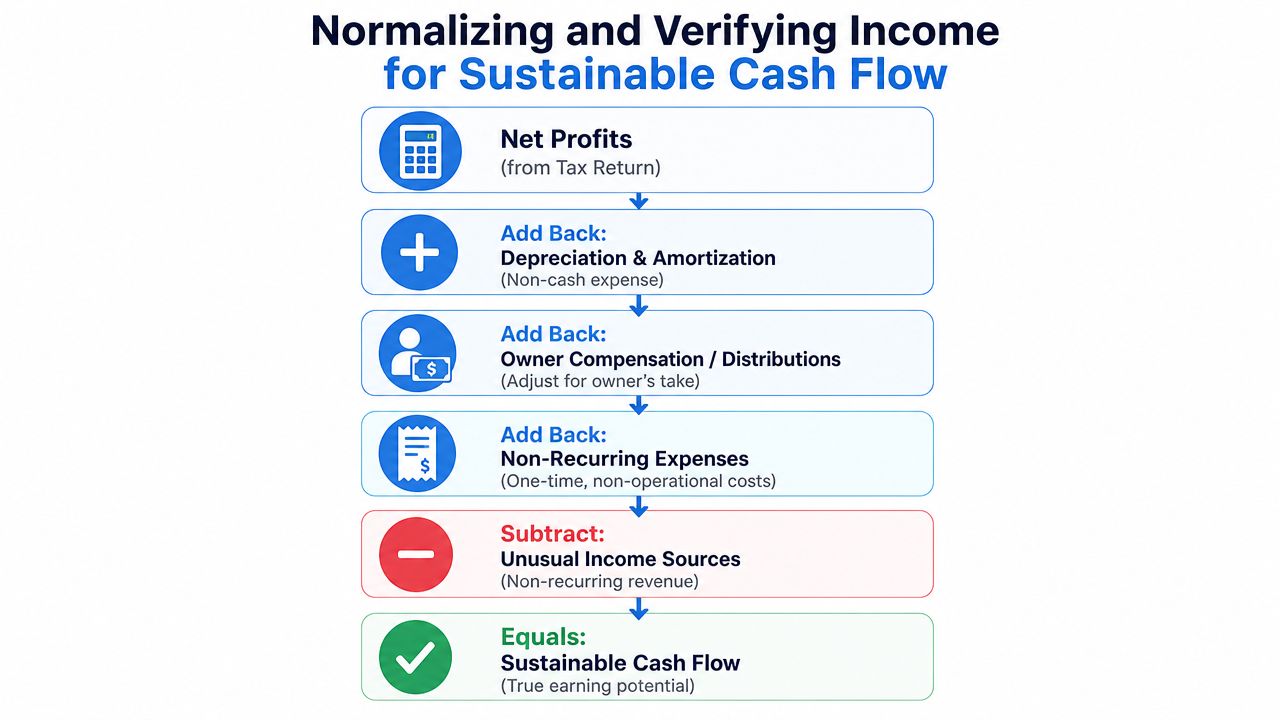
A tax return rarely gives you the number you'll underwrite. It gives you a starting point, then the analyst has to strip out distortion, add back non-cash charges, and test whether the remaining income is still there in the bank records. That's the part that turns a filing into a qualifying number.
Start with normalized earnings
The basic adjustment set is straightforward. Begin with reported net profit, then add back depreciation and amortization, owner compensation or distributions where appropriate, and identifiable one-time items that don't reflect ongoing operations. A robust workflow also looks for interest expense and other tax-shaping entries that can make the borrower look weaker on paper than they are in cash flow terms. A practical reference on this approach is the overview on investment property deductions, because the same categories that reduce tax liability often need to be re-read when income is being normalized.
Verify the story with third-party records
Once the tax number is normalized, verify it against the true money trail. That means checking bank deposits, business accounts, and recurring expense records, not just accepting the return as-is. If a borrower's self-employment income is important to the deal, it also helps to reconcile W-2s and 1099s so the story on the return matches the income documents the lender will rely on.
The IRS Financial Analysis Handbook says analysts should determine disposable income by subtracting allowable expenses from gross income and reviewing cancelled checks and credit card statements for the last three months to verify declared expenses. IRS Financial Analysis Handbook That's a lender-friendly standard because it forces the review back to actual payment behavior instead of trusting the tax return alone.
What matters is not whether the borrower optimized taxes. What matters is whether enough cash remains after those choices to support the loan.
For self-employed borrowers and rental owners, the best result is a normalized figure you can explain in one sentence. If you can't explain where the income came from, what was added back, and why the final number is sustainable, the file isn't ready. For practical underwriting on non-owner-occupied deals, that's where you save time by being strict early instead of loose now and stuck later.
Calculating Qualifying Income
Qualifying income should be the final, lender-facing number, not the raw tax return total. The cleanest way to get there is to move from normalized earnings to a conservative payment-support figure, then apply the deal type and the borrower type. That keeps bridge, rental, and fix & flip files aligned with common-sense underwriting instead of forcing one formula onto every borrower.
Use a different method for each income stream
For self-employed borrowers, two years of returns are often the first comparison point, but the ultimate decision comes from how stable the trend looks and whether the business is growing, shrinking, or distorted by unusual deductions. A declining trend should be treated cautiously, while a rising but volatile trend may still qualify if the supporting documents are strong. Professional judgment matters here because multi-entity borrowers and pass-through structures often need separate treatment for each income source.
For rental income, underwriting usually starts with lease or market rent support and then checks whether the property's cash flow can carry the debt after normal operating assumptions. Vacancy reserves and debt service coverage logic matter because gross rent alone doesn't tell you whether the property can support itself. If the borrower has multiple rentals, review each unit or entity separately so one strong property doesn't hide a weaker one.
Practical rule: if the income source can't be tied to a recurring pattern, don't count it at face value.
The IRS says analytical tests are built around comparisons and relationships, and that's the same mindset lenders need when a file crosses from tax review into qualification. A good analyst looks at the ratio of income to recurring obligations, then checks whether the numbers still make sense once the tax return is normalized. The goal isn't to maximize income, it's to avoid overstating it.
One way private lenders keep the process moving is by using a consistent worksheet that starts with normalized cash flow, then applies borrower-specific overlays, then maps the result to the deal's debt limit. In practice, that keeps a rental refinance from being analyzed like a flipper exit, or a bridge draw schedule from being treated like a long-term debt service file. The result is a cleaner path to approval and a more realistic borrowing limit.
Spotting Red Flags and Required Documentation
The biggest mistake in tax return analysis is assuming a signed return is enough. It isn't. Returns often understate real cash flow, and more than 80% of the gross tax gap comes from underreporting, so lenders have to verify off-return income sources instead of relying on the return alone. EisnerAmper lifestyle income analysis
If a file has large deductions, mismatched deposits, or repeated losses, the answer is usually more documentation, not more debate. The borrower may still qualify, but only if the file supports the story.
| Red Flag | Supporting Document | Verification Method |
|---|---|---|
| Large non-recurring deductions | CPA-prepared P&L | Compare to prior-year return and confirm the item won't repeat |
| Gross receipts don't match deposits | Business bank statements | Reconcile deposits to reported receipts |
| Frequent Schedule C losses | K-1 statements or management reports | Test whether another entity is absorbing the real profit |
| High expenses with thin support | Itemized receipts | Match receipts to the expense category and timing |
| Rental income that looks overstated | Lease agreements | Confirm term, rent amount, and current occupancy |
For a quick reference on the kinds of issue patterns that can trigger deeper review, discover IRS audit red flags before you send a file in half-documented. That doesn't replace underwriting judgment, but it helps brokers ask for the right backup before the loan desk has to chase it later.
The paperwork list should be practical, not bloated. Request the documents that clarify the weak point in the return, then stop once the income is supportable. For lenders and brokers, a concise document request package is easier for borrowers to satisfy and easier to compare against the tax file, especially when you're working from loan documentation requirements.
Worksheets and Case Examples
A useful worksheet does three things fast. It shows the normalized income, it shows what the lender will recognize, and it shows whether the requested loan still meets the financing structure and repayment requirements. For non-owner-occupied deals, that keeps the conversation centered on the asset and the borrower's true cash flow, not just the tax filing.
Bridge loan for a quick flip
A borrower brings in a fix & flip file with a Schedule C that shows solid gross receipts but heavy depreciation and one-time professional fees. The worksheet starts with reported net profit, adds back the non-cash items, then subtracts any income that won't repeat after the flip closes. The key underwriting question is whether the borrower's normalized earnings, combined with the project structure, can support the bridge payment during the hold period and the staged draw schedule.
A simple bridge worksheet can read like this:
- Reported net profit: start with the Schedule C bottom line.
- Add-backs: include depreciation, amortization, and other non-cash items.
- Adjustments: remove any one-off gains or unusual income.
- Final figure: compare the result to the borrower's other obligations and the project payment.
If the rehab budget is staged, the cash-flow review should assume draw timing instead of pretending all funds are available on day one. That matters because a borrower who is light on reserves can still be a fit if the draw structure and exit plan are clear. In files like this, LendingXpress can structure bridge and fix & flip financing around the asset and the timeline, which is exactly where fast underwriting helps.
Rental acquisition with pass-through income
A rental borrower is a different exercise. The income worksheet should separate wage income, pass-through income, and net rental income, then test the rent stream against the property's own debt service. If the borrower owns multiple properties, isolate each one so one strong building doesn't mask a weak unit or a thin reserve position.
A clean rental worksheet usually includes:
- Normalized borrower income: self-employment income after add-backs.
- Expected rent support: lease or market rent on the acquired property.
- Debt service check: does the rent stream comfortably support the proposed payment and reserves?
- Entity review: do the supporting K-1s, leases, and bank deposits line up?
The point isn't to force every file into the same box. It's to show, line by line, how the borrower's real income interacts with the property cash flow. When the worksheet is filled out this way, brokers can explain the loan to the borrower without guessing, and investors can see why the file fits a conservative private-lending structure.
Conclusion and Next Steps
Fast non-owner-occupied underwriting depends on a simple habit, read the return, normalize the income, verify the support, and flag the weak points before they become delays. That workflow works for bridge loans, fix & flip deals, and rental acquisitions because it respects both speed and structure. If you want a lender that can adapt the income review to the deal instead of forcing every file into the same template, LendingXpress is built for that kind of private-loan process.
A CTA for LendingXpress.