
You bought well. The numbers looked solid. Rent covered the payment, rehab stayed close to budget, and the property started producing income fast.
Then tax season hit, and the return didn't look nearly as good as the deal did on paper.
That happens more often than investors expect. They focus hard on purchase price, financing options, rent potential, and exit strategy, but they treat deductions like cleanup work for later. In practice, investment property deductions shape real cash flow. They affect how much income you keep, how confidently you can reinvest, and how strong your file looks when you apply for financing on the next property.
From the lending side, I can tell you this much. Investors who know their expenses, separate repairs from improvements, and keep clean records usually move through underwriting with fewer delays. They don't need to scramble for explanations. They already know their numbers.
Why Smart Investors Focus on Deductions Not Just Deals
A lot of investors learn the same lesson the hard way. They find a strong rental, close quickly, get it occupied, and assume the hard part is over. But a profitable property can still produce a disappointing after-tax result if the owner misses deductions, classifies expenses poorly, or waits too long to organize records.
That's not just a tax problem. It becomes a financing problem too.
Lenders look at more than the property itself. We look at how the borrower operates. If your rent deposits run through one account, contractor payments through another, and your tax records don't clearly show what happened, your file becomes harder to interpret. Even when the deal is workable, messy documentation slows things down.
Why tax efficiency affects financing
Every investor wants higher returns. Deductions help by reducing taxable income, but they also do something less obvious. They create a cleaner financial story.
A borrower who tracks expenses well can usually answer practical questions fast:
- What did you spend on repairs: and which items were one-time versus recurring?
- How is the property performing: after taxes, insurance, and financing costs?
- Was that renovation a true upgrade: or just maintenance needed to stabilize the asset?
- Can the current income support a refinance: or a DSCR-style rental loan?
Those answers matter when you're trying to close on a timeline.
Practical rule: The investor who can document income and deductions clearly is usually easier to underwrite than the investor who says, “My CPA has it somewhere.”
What investors miss
The biggest mistake isn't failing to buy a good property. It's assuming a good property automatically turns into a strong long-term return.
That gap usually comes from everyday issues:
- missed operating deductions
- confusion around repairs versus capital improvements
- incomplete depreciation records
- passive loss rules that block a deduction the owner expected to use
- poor entity and recordkeeping decisions that make both tax prep and loan approval harder
Investors who scale well don't treat taxes as a once-a-year event. They build deduction awareness into acquisition, rehab planning, rent strategy, and refinance timing. That's where the advantage shows up.
The Everyday Deductions Every Landlord Should Claim
Most investment property deductions aren't exotic. They come from ordinary ownership costs that show up every month. If you own non-owner-occupied real estate, the first win is making sure you capture the routine expenses tied to running it.
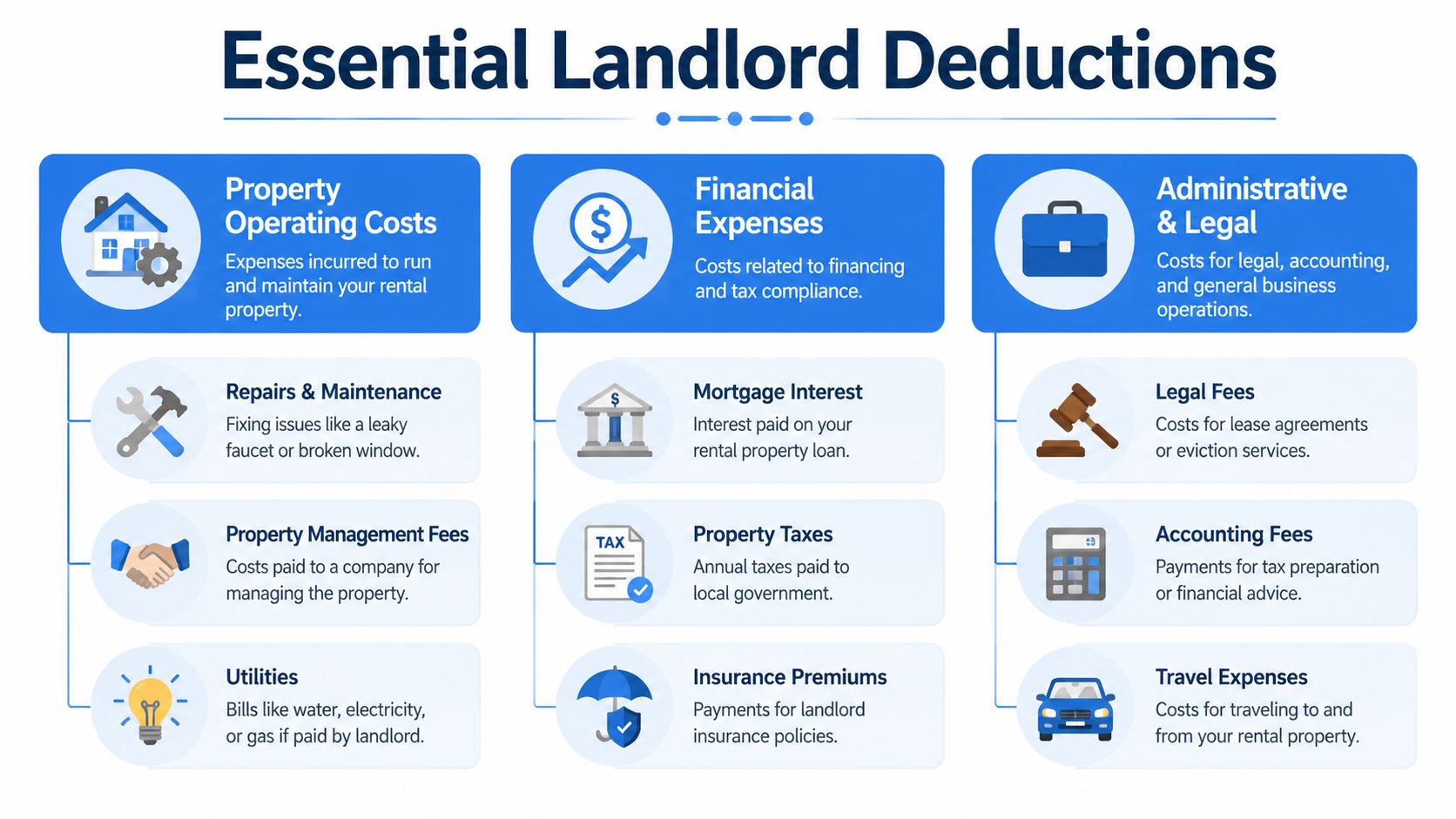
Core operating costs
These are the expenses most landlords see regularly and should track from day one.
- Mortgage interest matters because financing has a cost. For many investors, interest is one of the biggest recurring expenses tied to holding a rental.
- Property taxes directly reduce the property's net income, so they need to be recorded accurately and consistently.
- Insurance premiums protect the asset, but they also belong in your operating picture, not as an afterthought.
- Utilities paid by the landlord count when the lease structure leaves water, gas, electric, or similar bills in your name.
If you review your property only by rent collected minus monthly payment, you'll miss how much these items shape true performance.
Leasing and management costs
Vacancy and tenant turnover create their own expense layer. Investors often remember the lost rent but overlook the smaller charges connected to getting the unit leased again.
Keep an eye on costs such as:
- Advertising spend for listing the property
- Tenant screening fees tied to background or application review
- Property management fees if a third party handles leasing, maintenance coordination, or rent collection
These costs are part of operating the property. They also tell a lender something useful. A professionally managed property with documented expenses is easier to evaluate than one run from memory and scattered receipts.
If you can't show where the money went, you can't defend the deduction or explain the asset's real performance.
Admin, legal, and support expenses
Some expenses don't happen every month, but they still belong in the file.
- Legal fees for lease drafting, notices, or eviction-related matters
- Accounting fees for tax prep or rental bookkeeping support
- Travel tied to property business when you're inspecting, managing, or addressing issues at the property
These items are easy to lose if you run everything through a personal card. That's one reason seasoned investors separate business and personal spending early.
For investors outside the U.S., rules differ in important ways. If you're comparing frameworks or you own property abroad, this overview on understanding property tax in Australia is a useful reference point.
A simple claiming habit that works
You don't need a complicated system. You need a consistent one.
Try this checklist:
- Use one account per property or portfolio group: It creates a clean expense trail.
- Label transactions monthly: Don't wait until tax season to remember what a vendor charge was for.
- Store invoices with short notes: “Turnover cleaning” is better than an unlabeled PDF.
- Review your profit and loss regularly: That helps you spot missing categories before year-end.
Basic discipline here pays twice. It helps at tax time, and it makes future financing much smoother.
Repairs vs Improvements A Critical Distinction for Your Bottom Line
This is one of the areas that trips up investors most often. Two projects can look similar at the property, but they don't get treated the same for tax purposes.
The practical divide is simple. A repair keeps the property in working condition. An improvement makes it better, restores it in a broader way, or adds something new that extends its useful life. That distinction affects timing. Repairs are generally deducted now, while capital improvements are recovered over time through depreciation.
Why this matters in real life
If you classify too aggressively, you risk overstating current deductions. If you capitalize everything out of caution, you may give up deductions you could have taken this year.
That timing difference changes cash flow. It can also affect how you plan a rehab, when you refinance, and how your year-end financials look to a lender.
| Expense Type | Repair (Deduct Now) | Improvement (Depreciate Over Time) |
|---|---|---|
| Window work | Fixing a broken window | Installing all new energy-efficient windows |
| Plumbing | Repairing a leak under a sink | Replacing the full plumbing system |
| Flooring | Patching a damaged area | Installing entirely new flooring throughout |
| Roofing | Fixing a localized roof leak | Replacing the whole roof |
| HVAC | Servicing or fixing a failed component | Installing a new HVAC system |
A better way to think about it
Ask what the work did.
- Did it keep the property operating as intended: That usually points toward a repair.
- Did it materially upgrade or restore a major part of the property: That usually points toward an improvement.
- Was it part of a larger repositioning project: That often leans toward capitalization.
The gray area is where investors get into trouble. A single invoice that bundles maintenance, replacements, and upgrades can be hard to defend later. Break jobs out clearly when possible. Separate labor scopes. Keep contractor descriptions detailed.
Bottom line: Don't let the contractor's casual wording decide the tax treatment. The paperwork should describe what was actually done.
Financing angle investors overlook
This distinction matters outside the tax return. When a lender reviews a recent rehab, we want to understand whether the property was lightly repaired, fully renovated, or materially upgraded. Those aren't the same story.
Clear categorization helps support valuation, cash-out requests, and refinance timing. If your records show exactly what was fixed versus improved, you're in a much stronger position than someone handing over a stack of vague receipts labeled “rehab.”
Understanding Depreciation Your Largest Non-Cash Deduction
Depreciation is one of the most powerful tax tools in real estate because it's a non-cash deduction. You're not writing a new check each year to claim it. Instead, the IRS treats it as recovery of the building's cost over time.
For many rental owners, that means taxable income can drop even when the property is producing positive cash flow.
How it works
For residential rental property, the standard recovery period is 27.5 years, while commercial property is depreciated over 39 years. A residential rental depreciated under MACRS uses a fixed annual rate of about 3.636%. Depreciation begins when the property is placed in service, and it's based on the property's purchase price excluding land according to Instead's explanation of investment property tax planning.
That last point matters more than many investors realize. Land doesn't wear out for depreciation purposes, so you can't depreciate the full purchase price.
A simple practical example
If you buy a residential rental, the starting question isn't “What did I pay?” It's “How much of that price belongs to the building?”
Once the building portion is identified, that amount is spread over 27.5 years under the residential rules noted by Instead's depreciation overview. In practical terms, that annual deduction is often one of the largest line items on the return, even though no corresponding out-of-pocket payment happens that year.
This is why an investor can have:
- rent coming in
- loan payments being made
- cash left over each month
and still show reduced taxable income because depreciation offsets part of the earnings on paper.
What investors get wrong
The most common mistakes are operational:
- Starting too early: depreciation doesn't begin until the property is placed in service.
- Using the full acquisition cost: land has to be excluded.
- Mixing up repairs and improvements: improvements usually get recovered over time instead of deducted immediately.
- Failing to maintain a depreciation schedule: that creates problems later when you refinance, sell, or hand records to a new CPA.
If you want a plain-English overview of accelerated methods outside the standard rental framework, this piece on HireAccountants on fast depreciation is a helpful comparison.
Depreciation often explains why a rental can feel profitable in the bank account but look much smaller on the tax return.
Why lenders care
Depreciation doesn't just reduce taxes. It changes how your returns read. When investors understand that difference, they're better prepared to explain why tax income and property cash flow don't match exactly. That makes underwriting conversations much cleaner.
Navigating Passive Loss Rules and Material Participation
A rental can show a tax loss on paper, especially after depreciation. That doesn't automatically mean you can use that loss against wages or other active income.
For U.S. rental properties, the IRS generally treats rental activity as passive, which means losses usually can't offset active income unless the taxpayer meets specific participation standards. There is an important exception. The IRS provides a special allowance of up to $25,000 in rental real-estate losses for taxpayers who actively participate and have modified adjusted gross income below the phase-out range. That allowance begins to phase out above $100,000 MAGI and is eliminated at $150,000 MAGI, as outlined by Anders CPA on active or material participation.

What active participation means in practice
Investors need to stop thinking only in broad terms. “I own the property” isn't the same as “I qualify to use the loss the way I expected.”
In real life, active participation usually means you're involved in meaningful management decisions, such as:
- Approving tenants
- Authorizing repairs
- Setting lease terms
- Making operational calls on the property
That's different from being completely hands-off.
Why this catches high-income investors off guard
An investor may assume a paper loss will reduce total taxable income right away. Then the passive activity rules block that result. The loss may not disappear, but it may not help in the current year the way the investor expected.
That has a financing consequence too. If you're relying on a tax result to improve liquidity, support reserves, or shape a refinance timeline, you need to know whether the loss is currently usable or likely to be suspended.
What to do before year-end
Keep this practical:
- Document your role: show that you make real management decisions.
- Coordinate with your tax preparer early: not after the return is already drafted.
- Review projected income before year-end: especially if you're near the phase-out range.
- Keep records that support your participation: emails, approvals, invoices, and management communication all help tell the story.
The tax code doesn't reward assumptions here. It rewards documentation.
Advanced Tax Strategies for Serious Investors
Once an investor moves beyond basic deductions, tax planning starts to affect acquisition strategy, rehab scope, refinancing, and exit timing. The tax side stops being a reporting exercise and becomes part of deal design.

Three moves that separate casual owners from operators
Cost segregation is one of the first strategies serious investors look at with their tax advisors. The concept is straightforward. Instead of treating every eligible component the same way, the study identifies property elements that may be recovered differently from the main structure. The result can shift deductions earlier, which can improve near-term tax efficiency and free up capital for the next project.
Timing expenses is less flashy, but it works. If you know a property needs legitimate maintenance, the calendar matters. A repair paid and completed before year-end may affect this year's return differently than the same job pushed into the next year. Good operators plan those decisions deliberately instead of letting vendors or scheduling drift make the call.
1031 exchange planning matters when you're selling appreciated investment property and want to defer gain rather than cash out entirely. If you need a clear primer on the mechanics, LendingXpress has a useful overview of what a 1031 exchange is.
Structure supports strategy
A smart tax plan can fall apart if the ownership structure and documentation don't support it. Investors who are scaling should review how title, entity choice, and long-term goals fit together. This guide to real estate investment structures is a solid starting point for that conversation.
The financing side should match that plan. Some investors need a short bridge while stabilizing a rental. Others need rehab funds before moving into long-term debt. In those cases, products like bridge loans, fix-and-flip financing, or DSCR-based rental loans can fit the tax and hold strategy better than a conventional bank process built for owner-occupied borrowers. LendingXpress is one lender in that space for non-owner-occupied deals.
A short walkthrough helps make the planning side more concrete:
Where investors go wrong
The usual problem isn't lack of effort. It's fragmented planning.
- They talk to the lender too late: after contract terms are already tight.
- They talk to the CPA too late: after expenses are already booked badly.
- They choose an entity without thinking through financing and tax reporting together.
- They wait until sale time to ask whether an exchange was possible.
Astute investors don't treat financing, tax planning, and ownership structure as separate tracks. They line them up early.
Your Lender-Ready Tax Deduction Checklist
Tax readiness is credit readiness. Investors who can produce organized records tend to move faster because the file tells a clean story. Income is easier to verify, expenses are easier to understand, and there's less confusion about how the property is really performing.

The checklist that actually helps at loan time
Use this before you apply for financing on your next non-owner-occupied property:
- Keep separate bank activity: Don't mix personal spending with property operations.
- Maintain current profit and loss statements: A basic property-level P&L answers a lot of underwriting questions quickly.
- Store receipts by category: Especially for repairs, maintenance, legal, insurance, and leasing costs.
- Separate repairs from improvements clearly: That avoids confusion in both underwriting and tax prep.
- Keep depreciation schedules current: If they're outdated or missing, your file gets harder to interpret.
- Document rental history: Leases, rent rolls, and deposit records should be easy to pull.
- Retain completed tax returns and Schedule E support: Existing property performance matters when you're growing a portfolio.
- Prepare a short property summary: Current rent, recent work completed, and your plan for the asset.
Why this speeds up financing
When a borrower has all of this ready, the conversation changes. Instead of spending time reconstructing the past, the lender can focus on the deal in front of them.
That's especially useful when you're pursuing a fast close, a refinance after stabilization, or a rental loan that depends on the property's income profile. If you're planning your next acquisition or refinance, this guide on how to finance investment property is a practical next step.
Organized borrowers don't just look more professional. They make it easier for a lender to say yes with confidence.
If you're buying, refinancing, or repositioning a non-owner-occupied property, talk with LendingXpress. A clean tax and expense record can make financing decisions faster, and the right loan structure can help you turn those deductions into stronger long-term returns.