
LTC in real estate means loan-to-cost, and the formula is Loan Amount ÷ Total Project Cost. If a deal costs $1 million and the lender funds $700,000, the LTC is 70%.
That's the number a private lender looks at when you're buying a non-owner-occupied property, planning repairs, and trying to figure out how much debt the project can carry without getting ugly. If you're staring at a purchase contract, a contractor bid, and a stack of closing costs, LTC is the first math problem that tells you whether the deal still fits.
What LTC Means Across Industries and in Real Estate
LTC is one of those abbreviations that changes meaning the second you change industries. In healthcare, it usually means long-term care, and in common usage that refers to services that help people with chronic illness, disability, or cognitive decline when they can't manage everyday tasks alone, as described by the U.S. Administration for Community Living and reinforced by Cambridge's dictionary entry for LTC. In the military, LTC can mean lieutenant colonel, a rank used in Army contexts. In crypto, it can mean Litecoin, the 2011 Bitcoin-derived network with a 2.5-minute average block time and roughly 4x faster block creation than Bitcoin, according to Investopedia's Litecoin overview.
For investors, the meaning that matters most is loan-to-cost. That's the underwriting ratio private lenders use to measure how much of a project's total cost is financed by debt. The formula is simple, Loan Amount ÷ Total Project Cost, and that simplicity is why brokers and borrowers use it so often on fix-and-flip, bridge, and construction deals.

Why real estate lenders care about LTC
Traditional banks tend to lean on the borrower's income and the property's appraised value. Private lenders look harder at the project itself, because non-owner-occupied deals live or die on acquisition price, rehab budget, timeline, and exit plan.
Practical rule: if the money is being used to buy, improve, or reposition a property, LTC tells the lender how much of the project it is actually financing.
That distinction matters because LTC is about cost, not value. On renovation-heavy deals, that gives lenders a cleaner way to price risk before the property is stabilized or sold. It also tells you, as the borrower, whether the deal is being sized around your actual budget or around a hoped-for future value.
The Loan-to-Cost Formula With Worked Examples
The formula stays the same no matter how simple or complicated the project is, Loan Amount ÷ Total Project Cost. What changes is the denominator, because a real project usually includes more than the purchase price. Acquisition fees, rehab, contingency, and carrying costs can all sit inside that total.
| Worked LTC Examples for Three Project Types | Total Project Cost | Loan Amount | LTC |
|---|---|---|---|
| Light cosmetic flip | $300,000 | $210,000 | 70% |
| Moderate rehab with contingency | $500,000 | $400,000 | 80% |
| Ground-up construction deal | $1,000,000 | $900,000 | 90% |
How the math works on each deal
A light cosmetic flip might look like this, purchase price plus acquisition closing costs plus a modest rehab budget. If the total project cost is $300,000 and the lender funds $210,000, the LTC is 70%. That means the borrower is bringing meaningful equity to the table, which usually makes the file easier to underwrite.
A moderate rehab gets trickier because the rehab number is no longer just paint and fixtures. If the project total reaches $500,000 after you add purchase, closing, rehab, contingency, and carrying costs, then a $400,000 loan creates an 80% LTC. That's still financeable in the private-money world, but the lender will read it as a thinner equity cushion.
A ground-up build can push the ratio even higher because the cost stack gets bigger and the lender may be funding the project in stages. At $1,000,000 of total cost and $900,000 of debt, the LTC hits 90%. That's a high-risk structure, so the lender will want a tighter look at scope, budget discipline, and exit strategy.
For a deeper look at how contractors break down budgets and line items, Aureli Construction cost breakdowns is a useful reference point.
LTC answers one question cleanly, how much of this project am I financing? The higher the number, the more skin the lender has in the deal.
How LTC Compares to LTV and ARV
LTC, LTV, and ARV are related, but they do different jobs. LTV means loan-to-value, which measures the loan against the property's appraised value. ARV means after-repair value, the projected value after the work is finished, and it often shows up in the 70% rule conversation for flips. For a plain-language overview of ARV, see LendingXpress's ARV explanation.
| Metric | What it divides by | What it tells the lender |
|---|---|---|
| LTC | Total project cost | How much of the deal is being financed |
| LTV | Appraised property value | How exposed the lender is to the current asset value |
| ARV | Projected post-renovation value | What the property might be worth after the work is done |

Why the same deal can look different under each metric
Take one property through the lifecycle of a flip. At purchase, the lender may look at the as-is value and the cost to close the deal. Mid-renovation, the lender cares about draws, budget control, and whether the work still fits the original scope. At sale, the value conversation shifts toward the finished product and the exit price.
That's why LTC often drives loan sizing on renovation-heavy projects. The ratio stays tied to project cost, so when your rehab budget rises, the denominator rises too, and the lender sees a different risk picture. LTV stays anchored to value, which can make it less responsive to the cash going into the deal.
When each metric matters most
If the deal is mostly acquisition with light work, LTV tends to matter more because the property's current value is doing most of the work. If the deal is heavy on construction, LTC usually takes the lead because the lender is funding the project, not just the asset. ARV sits beside both as the forward-looking value estimate that helps frame the exit.
How Private Lenders Use LTC in Underwriting
A borrower sends in a purchase contract, contractor bids, and a rough rehab schedule. The lender adds up the project cost, runs the LTC, and decides whether the request fits the target range before anything is funded.

What gets reviewed before the file moves forward
The headline ratio matters, but it doesn't tell the whole story. A lender still wants to know whether the rehab budget is backed by real bids, whether the contingency matches the scope, and whether carrying costs line up with the borrower's timeline. If those pieces are sloppy, the LTC number can look cleaner than the deal deserves.
That's where private money is different from a traditional bank. A bank can get bogged down in income tests and rigid boxes. A private lender can underwrite the project on its own terms, which is why speed and flexibility matter so much on non-owner-occupied properties.
How a fast lender reads the deal
In practice, a lender is asking a simple question, does this file still make sense if the project takes longer or costs more than planned? If the LTC is reasonable and the support is clean, the loan can move quickly. If the ratio is aggressive, the file usually needs stronger equity, tighter scope, or a clearer exit.
LendingXpress works in that kind of environment, with typical loan sizes from $100,000 to $18 million+, closings in as little as three days, and the ability to finance up to 100% of rehab costs through staged draws. That setup matters on fix-and-flip and bridge deals, where the lender needs to fund the project as the work progresses, not just at closing.
For more on the kind of lender that can handle these files, see private money lenders.
Practical Ways to Improve Your LTC
If your LTC is too high, the easiest fix is usually not a fancy structure. It's getting the project cost down without breaking the deal.
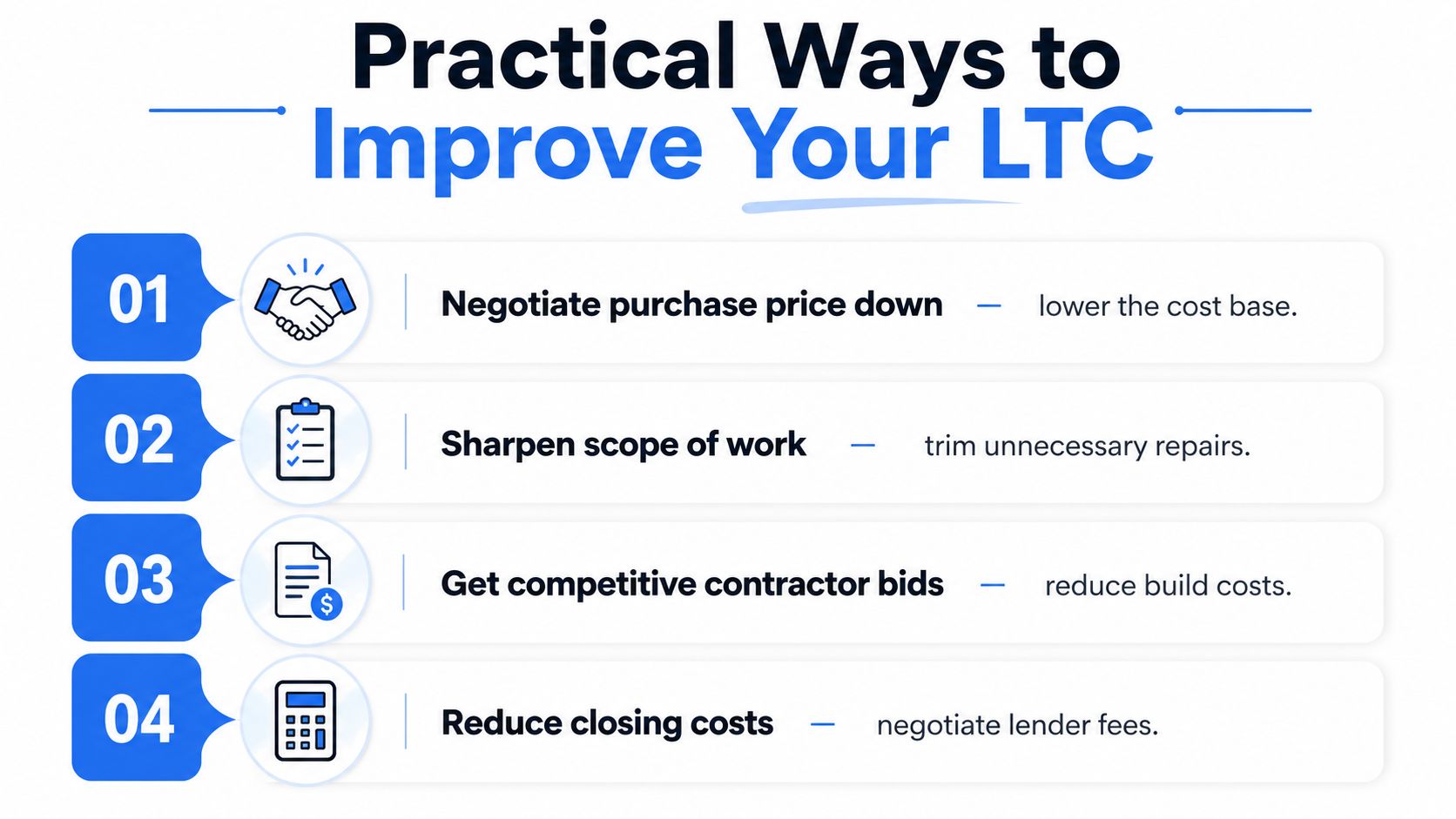
The levers that move the ratio
- Negotiate the purchase price down. Lower purchase price means a smaller cost base, so the same loan covers a smaller share of the project.
- Tighten the scope of work. If you trim unnecessary repairs, the denominator shrinks and the LTC improves without changing the loan amount.
- Get competing contractor bids. Better bids can keep the rehab budget honest, which protects the project from bloated assumptions.
- Watch closing and soft costs. Those line items add to total project cost fast, so a cleaner fee stack can improve the ratio before the lender ever sees the file.
Why lenders like disciplined numbers
A realistic contingency reserve is better than an inflated one, but it still needs to match the risk of the work. If the project is a straightforward cosmetic flip, the budget should look like a straightforward cosmetic flip. If it's a heavier rehab, the lender expects the numbers to reflect that reality.
Borrower rule: the strongest LTC usually comes from lower cost, not clever math.
Shortening the timeline can help too, because carrying costs have a habit of creeping into the denominator. The cleanest LTC in the world won't rescue a deal with no exit plan, so the borrower still has to show how the property gets sold or refinanced.
What a Strong LTC Signals to a Lender
A lower LTC tells the lender the borrower has real equity at risk. That usually means the borrower has more reason to protect the deal, stay on budget, and push the project to completion.
A higher LTC sends a different signal. It says the deal is more heavily financed, so any cost overrun, delay, or dip in resale price can hit the loan harder. On a thin file, the lender may respond with a smaller advance, tighter draw controls, or more conditions before closing.
Why the ratio changes the tone of the deal
Conservative underwriting matters. A lender with a relationship-driven process can still stretch on a borderline transaction, but only if the file makes sense from top to bottom. The numbers have to support the story, and the story has to make sense for the property type, the market, and the exit.
LendingXpress says it has exceeded $558 million in originations across California, which is the kind of track record that helps a lender stay practical when a deal is close but not perfect. That kind of history matters because underwriting isn't just about saying yes or no, it's about knowing when a project deserves a closer look.
What a borrower actually gets from a strong ratio
A strong LTC often means a faster yes, fewer conditions, and more flexibility on draw schedules. It doesn't guarantee approval, but it gives the lender room to move if the rest of the file is clean. On private-money deals, that can be the difference between closing on time and losing the property.
Putting LTC to Work on Your Next Deal
Run LTC before you make the offer, not after. If the ratio is already too high at the contract stage, the deal is harder to rescue later because you have less room to adjust price, scope, or borrower cash.
Bring LTC, LTV, and ARV into the same conversation so you can see which number is capping the loan. On some deals, value sets the limit. On renovation-heavy projects, cost becomes the tighter test, and that is the piece newer investors often miss.
For a useful reminder of the other key areas to assess before investing before money goes out the door, keep that checklist beside your loan package. It helps you check the file the way a lender does, with attention on the property, the budget, the exit, and the risks that can show up between contract and closing.
If you are buying a bridge, fix-and-flip, or rental property that does not fit a bank's checklist, private lending can keep the process moving. Speed matters, flexibility matters, and so does a lender that can structure staged draws when the rehab budget needs to be funded over time. A California private lender like LendingXpress will usually read the LTC first because it shows how much of the total project is being financed, then compare that number with the rest of the file to see whether the request fits the deal.
Common Questions About LTC Answered
What counts in total project cost? In real estate underwriting, it usually means the purchase price plus the costs needed to get the project done, such as acquisition closing, rehab, contingency, and carrying costs. If a lender defines the bucket differently, use that lender's version, not your own.
Does LTC include lender fees? It can, if the lender treats those fees as part of the project cost. The cleanest move is to ask for the underwriting definition before you submit the file, because one extra fee can change the ratio more than borrowers expect.
Does LTC change during renovation? The original ratio is based on the full project budget, but draw timing can change how the loan is funded over time. If the rehab runs long or the scope changes, the lender may revisit the file, even if the original LTC was acceptable.
What if my LTC is above the lender's target? Reduce the project cost, increase borrower equity, or both. A borrower who can't close the gap usually needs either a different capital stack or a different lender.
If you want to test a deal against a real underwriting desk, bring the numbers to a lender that works with non-owner-occupied properties and reads the file the way investors do.
If you've got a fix-and-flip, bridge, or rental deal on your desk, run the LTC before you submit it and see where the pressure points are. LendingXpress offers fast private lending, staged rehab draws, and common-sense underwriting for investors who need a number that works in the world.