
You're under contract on a Brooklyn or Queens property, and the clock is already working against you. The seller wants certainty, the broker wants a fast answer, and your bank is still waiting on appraisal, committee review, and a stack of documents that never seems to shrink. That's the moment most investors stop asking whether hard money is “expensive” and start asking whether it's the only way to save the deal.
Hard Money Lenders NYC are built for that exact pressure. They're not a fit for every project, and they're definitely not cheap in the way a long-term bank loan is cheap, but they can be the right tool when the property, the equity, and the exit plan are stronger than your paperwork. In New York, that matters because speed is not a luxury. It's often the difference between closing and losing the contract.
Why NYC Investors Turn to Hard Money in the First Place
A small multi-family in Brooklyn gets attention fast. You walk through it on a Thursday, get the numbers to pencil on Friday, and by Monday there are already multiple bidders circling. Wait for a conventional loan and you may win on rate, then lose the property.
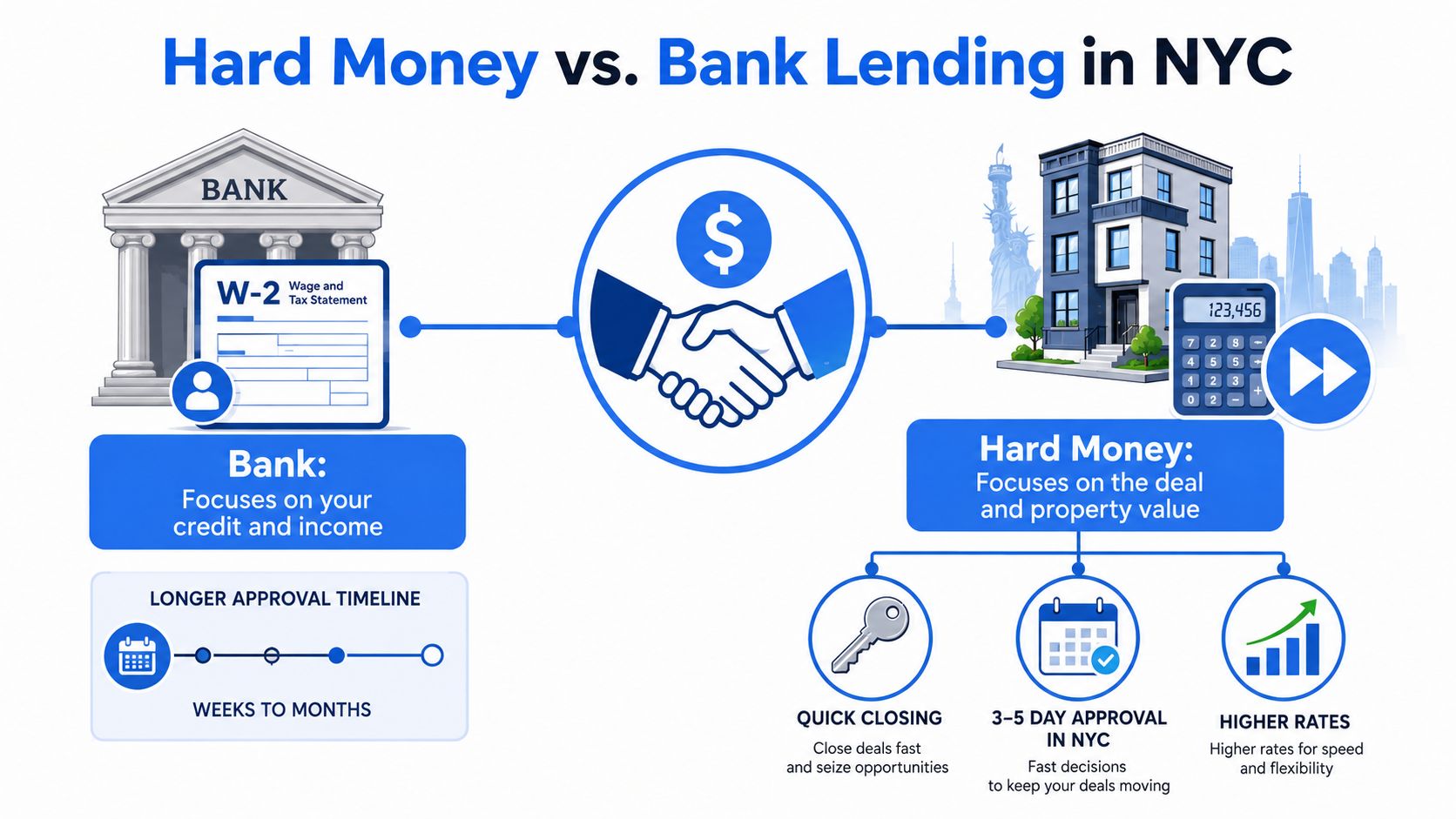
That is why investors call hard money lenders nyc. They are solving a timing problem, not chasing a philosophical one. A bank wants tax returns, a deeper file, and a process that can take 30 to 50 days. In NYC hard money, deals are often completed in 7 to 10 business days Manhattan Bridge Capital. Speed matters because a missed closing usually costs more than a few extra points on the front end.
The moment conventional financing stops working
The deal usually breaks in a predictable place. An appraisal gets delayed, a condo project gets rejected, or the contract window is too tight to survive the bank's process. At that point, the investor does not need more theory. They need capital written against the property, the equity, and the exit plan.
Hard money fills the gap between a good opportunity and a slow lender. It also fits borrowers who do not want to present a perfect W-2 file just to buy a non-owner-occupied asset.
Practical rule: If the deal dies because of speed, documentation, or borrower profile, hard money belongs on the table.
In New York City, that use case is common because competition is intense and hold times matter. Investors use short-term capital for acquisitions, renovations, bridge situations, and non-owner-occupied assets where the end goal is to refinance or sell, not sit on a loan for years. The right question is not whether hard money is ideal in a vacuum. It is whether the property can carry a shorter, more expensive loan long enough to reach the exit without crushing your monthly carry or killing project IRR.
The full all-in cost matters. Points, origination, extensions, exit fees, and any prepayment penalty can change the math fast, especially on a deal with thin margin or a stretched capital stack and mezzanine risk. A loan that looks manageable on the rate sheet can become expensive once you add carrying costs, delay costs, and a forced hold that runs longer than planned. That is the number investors should underwrite first, because in NYC a cheap-looking loan that drags the project off schedule is not cheap at all.
What Hard Money Actually Is and How NYC Lending Differs
A hard money lender does not buy your story. The lender buys the deal. If the property has enough equity, the exit is clean, and the collateral can support the loan, the file can move fast even when the borrower's income documents are messy or thin.
That is why NYC hard money is asset-based. The lender underwrites the property, the after-repair value, the equity position, and the exit strategy first. A lender also cares about the full cost of being wrong in New York, because a bad exit in this market is expensive to unwind. The result is a structure that can look simple on paper but gets costly once you add points, origination, extensions, exit fees, and any prepayment penalty. Those charges hit your monthly carry and your project IRR hard, especially if the rehab slips or the sale takes longer than planned.
Who fits this kind of financing
Hard money belongs on non-owner-occupied deals. Fix-and-flip investors use it to buy and renovate. Rental buyers use it when bank timing will not line up with the contract. Commercial buyers use it when the asset is solid but the lender needs a shorter runway and a cleaner collateral story.
The trade-off is blunt. You get speed and flexibility, and you give up low cost and long amortization. You also give up the illusion that the cheapest rate is the best deal. A loan with more points, a heavier origination fee, or a punishing extension schedule can be the more expensive choice even if the headline rate looks fine. Underwrite the all-in cost first, then decide whether the deal still works.
If you are stacking debt behind senior financing, review capital stack and mezzanine risk before you push financing higher. A tight stack can make a good project brittle fast.
What the lender is really evaluating
A serious NYC hard money lender is looking at a small set of questions. What is the property worth today. How much equity is already in it. How much room is there between basis and exit. Can the deal survive if the market softens or the rehab runs long.
The lender is not funding a résumé. The lender is protecting collateral.
That is why thin documentation does not automatically kill a file if the deal is strong. It is also why weak property economics get shut down quickly. Hard money is selective in a different way, and in New York that selectivity shows up in pricing, fees, and the way the lender structures the exit.
For a clearer sense of how collateral strength affects borrowing capacity, review this guide on loan-to-value ratio. In hard money, that number controls how much risk the lender is willing to carry, and it tells you a lot about how aggressive the quote really is.
NYC Rates, LTVs, and Terms in Real Numbers
If you are shopping quotes in NYC, ignore the sales pitch and look at the full carry. One directory estimated about 50 hard money lenders active in the market, with a 10.9% median interest rate, average loan amounts of about $482,151, a typical note length of 20 months, an average origination fee of 2.7%, and an average 69% loan-to-value Private Lender Link. That is the baseline. A quote that sits far outside that band needs a reason, and a good one.
New York pricing stays high for a simple reason. A New York lender market guide says NYC hard money rates usually run from 9.5% to 13.5%, about 0.5% to 1% above comparable markets, because New York uses a judicial foreclosure process Hard Money Scout. That same source cites a foreclosure timeline of roughly 400 to 900 days versus 45 to 90 days in non-judicial states. Lenders price that delay into the note, and borrowers pay for it in points, fees, and carry.
Typical NYC hard money loan snapshot
| Metric | Typical NYC Range | What It Means for You |
|---|---|---|
| Interest rate | 9.5% to 13.5% Hard Money Scout | This is the price of speed and collateral-based underwriting. |
| Median interest rate | 10.9% Private Lender Link | A quote near the middle is normal unless the deal is especially weak or unusually clean. |
| Loan-to-value | 69% HardMoneyHome | The lender wants cushion, not full-value exposure. |
| Origination fee | 2.7% Private Lender Link | Points hit your return on day one, especially on short holds. |
| Note length | 20 months Private Lender Link | Short terms force you to plan the exit before closing. |
Use the loan-to-value ratio guide if you want a cleaner way to read how aggressive a term sheet really is. That ratio tells you how much equity the lender wants you to keep in the deal.
The cost is not the headline rate. It is the rate, the points, the origination fee, the extension schedule, and any exit charge, all working against your hold period. A loan at 10.9% with a chunky fee stack can be fine on a quick flip and a bad trade on a project that slips. Monthly carry goes up fast once you add interest, fees, and any delay in takeout.
A short example makes the point. A borrower who pays more upfront and needs an extra month to sell is not just losing time, the project IRR takes the hit too, because the fee burden gets spread over a longer hold. That is why the cheapest-looking quote often turns into the most expensive deal once you account for the full cycle.
A simple rule helps. Lower loan amounts, cleaner title, and a tighter exit usually earn better pricing. If the lender sits at the top of the range, ask what is driving it. If the answer stays vague, walk.
New York Lending Rules Every Borrower Should Know
A New York hard money deal lives or dies on structure. If you are borrowing against non-owner-occupied property, the first question is whether the quote fits the state's lending rules and the borrower entity matches the way the loan is being made.
A lender in New York must obtain a license before making loans of $25,000 or less to an individual or $50,000 or less for business or commercial loans if it charges more than the legal interest rate allowed for non-licensees New York DFS. That is why investment-property loans usually sit in an entity, not in a consumer-style structure. Get that wrong and the rest of the term sheet starts to wobble.
The rate boundaries you need to respect
New York's civil maximum interest rate is 16% per year for the lending categories covered by the small-loan rules, and the state also sets a criminal usury threshold of 25% per year FSA Japan PDF on New York usury limits. Those ceilings are the guardrails. They shape what a lender can charge and how the loan has to be papered.
A real hard money quote should fit inside those guardrails without gymnastics. If the lender cannot clearly explain the entity setup, license status, or why the pricing is where it is, treat that as a warning. If an investor property is pushed into a consumer-style loan, the structure is wrong before you even talk about rate.
What to verify before you sign
- License status: Confirm the lender is licensed for the loan size and the way the loan is being made.
- Entity structure: Make sure the note and mortgage are written to the right borrowing entity, not a consumer setup.
- Fee disclosure: Get points, origination fees, extension fees, exit fees, and prepayment terms in writing.
- Default path: Ask how missed payments, maturity pressure, and a takeout delay are handled.
- Closing mechanics: Confirm title work, recording, and any closing conditions before you spend money on appraisal or reports.
The bigger issue is cost stacking. In New York, the legal framework is only part of the story. The primary trade-off is how the lender protects itself in a judicial foreclosure state, and that risk gets pushed into the term sheet. Higher pricing, tighter terms, and a more expensive extension schedule are the usual result. If your exit slips, the loan stops being a simple bridge and starts chewing into carry and project IRR fast.
How to Vet a NYC Hard Money Lender
A lender can quote fast and still be a bad fit. The test is whether the quote is clean, the costs are fully disclosed, and the lender can explain what happens if your exit slips. In NYC hard money, that matters more than a pretty term sheet.
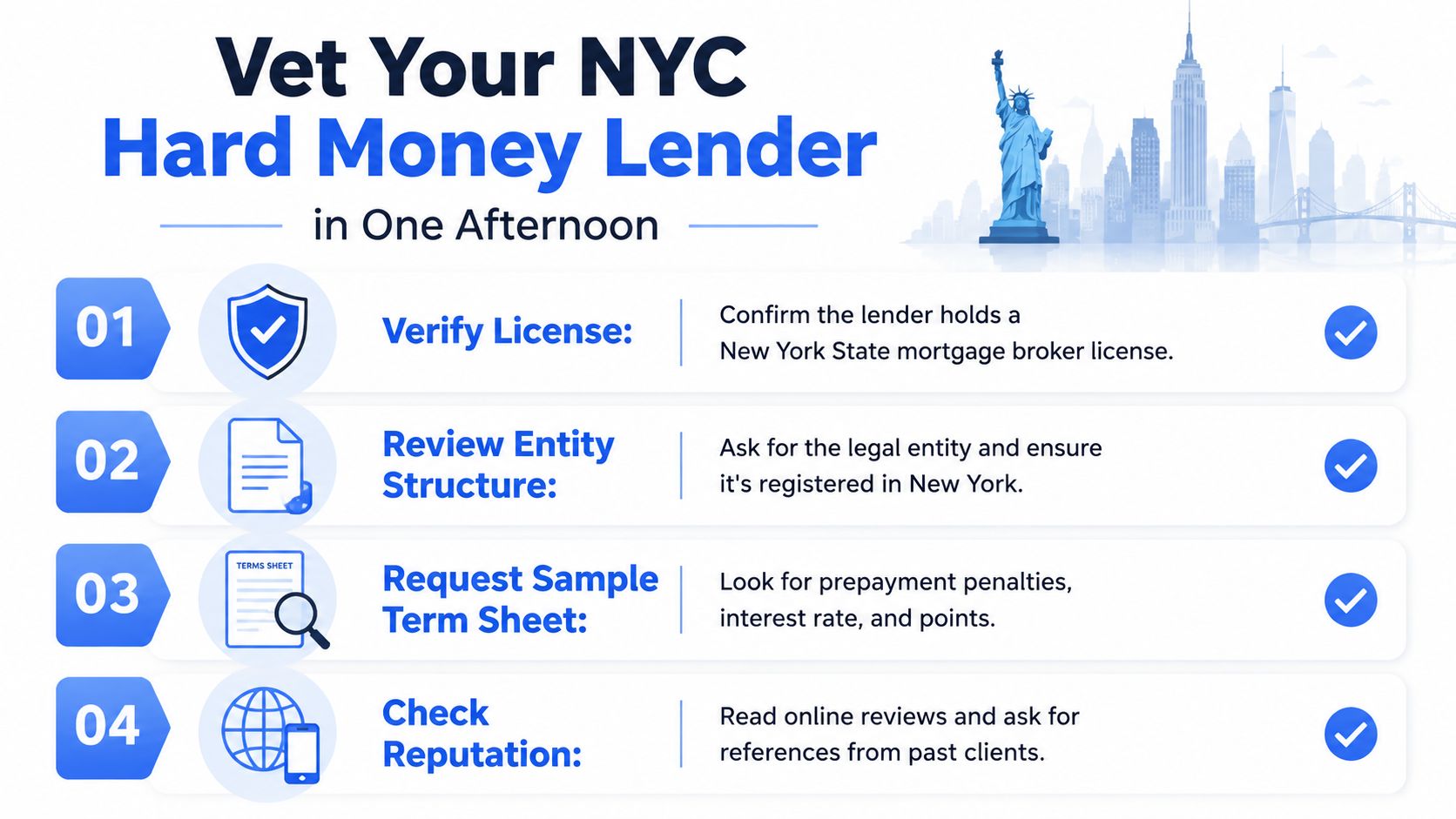
The four things I'd check first
- Verify the license. Confirm the lender is allowed to make the type of loan you need in New York.
- Review the entity structure. Ask who is lending and how the note and mortgage are held.
- Request a sample term sheet. Look for rate, points, prepayment terms, extension language, and any exit fee language.
- Check reputation. Ask for references and read reviews that speak to closings, not just marketing.
The fee stack needs to be plain English. Points, origination fees, extension fees, exit fees, and any prepayment penalty should be spelled out before you commit. If a lender gets vague there, they are usually hiding the all-in cost of the loan.
That all-in cost is what hits your monthly carry and project IRR. A deal can look fine on rate and still turn ugly once you add points at closing, a paid extension, or a penalty for paying off early. If you want a hard cost example by deal type, save that comparison for the scenario section later in the article. Here, the job is to spot the lender who will quote the whole stack upfront.
Red flags I wouldn't ignore
Vague fee language is a deal killer. So is pressure to sign before you get a written quote. If the lender will not provide a full amortization schedule, that usually means they do not want you looking closely at the actual cost.
I also want a lender to be clear about renewal options before closing. If the deal may need more time, the extension fee should be on paper before the note matures. The same goes for prepayment penalties. A profitable sale can turn into a weak trade if the lender traps you with a bad exit clause.
For a useful outside reference on what borrowers should ask lenders, the red-flag guidance from Gauntlet Funding's lender checklist is worth reading. It reinforces the same point. Hidden terms are where borrowers get hurt.
If you want a second pass on your own package, use LendingXpress's hard money qualification guide to sanity-check your file before you start shopping term sheets.
Compare two or three lenders side by side
Do not assess offers one by one. Line them up. Put the rate, the points, the maturity, the fees, the extension terms, and the prepayment terms on the same page so the differences jump out. That is the only clean way to see who is cheaper.
Practical rule: A lender who answers questions clearly in the first conversation usually closes more cleanly later.
Walking Through the Application and Closing Process
A hard money closing in NYC moves faster than a bank loan, but fast does not mean light on paperwork. You still need a clean title position, a property that supports the collateral story, and an exit that makes sense on paper. The difference is simple. Hard money lenders underwrite the deal first and the borrower file second.
The process usually starts with a direct call, then a short application, then a document request that gets specific quickly. If the file is clean, title work and appraisal run at the same time. That is why these loans can close in days when the structure is tight.
Before you focus on the headline rate, map the all-in closing cost. Points, origination, legal fees, title charges, and any expected extension fee all hit your carry. If you are trying to judge whether a flip or bridge deal still works after expenses, use the housing closing cost tool and then stress the numbers against your hold period and exit timing.
What to have ready before you call
- Property address and basic deal summary
- Your entity information
- Exit plan, sale or refinance
- Renovation scope, if there is one
- Any existing debt on the property
- Recent purchase contract or broker opinion of value if available
If your structure is messy, expect delay. The lender will spend time cleaning up entity details, payoff questions, and title issues before anyone talks about funding. Investors who come prepared get the cleanest closings because they can answer the basic questions without back-and-forth.

Three common term shapes
A quick flip usually gets short interest-only financing with points due up front and a balloon payoff at sale. A rental refinance can run longer if the borrower needs time to stabilize cash flow or satisfy seasoning requirements. A bridge loan sits between the two and exists to buy time, not to act like permanent debt.
The label matters less than the carry. Points, interest, extension fees, and any exit penalty determine whether the project still clears. If the financing costs eat the spread, the deal is too thin no matter how good the asset looks.
A borrower who wants fewer surprises should review the hard money qualification guide before sending a file out. It helps you tighten the package, cut avoidable questions, and close with less friction.
Sample Term Scenarios for Common NYC Deals
The biggest mistake NYC borrowers make is treating every hard money quote like a flat cost. It is never flat. Points come out at closing, interest runs every month, and any extension or exit charge changes the actual return fast. A deal can look fine on the term sheet and still drag project IRR into the ground if the hold stretches or the sale slips.
Scenario one, quick Brooklyn flip
A borrower buys a small Brooklyn property, renovates it quickly, and sells on schedule. That is the cleanest use case for hard money, because the loan exists for a short period and the exit is a sale, not a long hold. The borrower should focus on the full carry, not just the note rate.
Points hit first. If the lender charges up front fees and the project needs an extension, the cost stack changes immediately. A flip survives only when the sale closes on time and the debt does not keep aging past the original plan.
Scenario two, stabilized rental refinance
A stabilized rental refinance is a different animal. The borrower may have equity, but the lender still wants a clean exit through permanent financing or a sale. If the refinance drags, monthly carry matters more than the headline rate.
Prepayment terms can sting here. A borrower who expects to refinance quickly and then gets hit with an early payoff charge pays more than the quote suggested. The full all-in cost is the important number, not the first rate you see.
Scenario three, small commercial bridge
A small commercial bridge loan usually sits between acquisition and a longer-term solution. The property may already produce income, but the borrower needs time to stabilize, lease, or reposition it. That extra time is what the loan is buying.
The lender prices the deal around the exit. A clear refinance path usually gets better terms than a vague plan built on optimism. If the exit is weak, the lender knows it, and the quote reflects that risk.
The costs that change the math
- Points and origination: These are front-loaded costs. They reduce proceeds on day one and make the project carry heavier from the start.
- Extension fees: A short delay can erase the spread on a flip. One extra month of carry can matter more than a small rate difference.
- Exit fees and prepayment penalties: A profitable sale or refinance can still leave less money in your pocket if the loan charges to get out early.
- Monthly carry: Interest, taxes, insurance, and project overhead keep running. If the hold stretches, IRR falls quickly.
- Thin equity cushion: Borrowing at the top of the LTV range leaves no room for rehab overruns or a softer resale number.
A borrower comparing term sheets should read the whole cost stack, then measure it against the hold period and the expected sale price. That is how you find out whether the deal works or just looks good on paper.
Hard money is cheapest when the exit is fast and clean. It gets expensive when the deal lingers.
If you want to judge the lender, use the vetting points from the prior section. If you want to judge the deal, look at monthly carry versus hold time, then test the payoff math under a slower sale or refinance. A higher-rate bridge loan can still make sense on a fast exit, but once the project starts running long, the fee stack decides the return.
Your Next Steps and How LendingXpress Can Help
Stop shopping for a lender before you know the deal shape. First, confirm the property is non-owner-occupied and that the exit is real. Second, clean up the entity, title, and rehab plan. Third, request term sheets from two or three lenders and compare the full cost, not just the rate.

LendingXpress is one option for borrowers who need a private lending partner that works outside their home state. It offers bridge, fix-and-flip, and rental property loans, conservative LTV structures, closings in as little as three days, and staged rehab draws that can cover up to 100% of renovation costs. If you want a term sheet that fits a real deal instead of a generic template, that's the conversation to start.
Use the same discipline you'd use on the property itself. Ask about fees, extensions, and prepayment terms. Ask how the lender handles a delayed sale or refinance. Then choose the offer that leaves you enough room to finish the project and exit cleanly.
If you've got a Brooklyn, Queens, or Manhattan deal that needs fast capital, visit LendingXpress and talk to a loan officer about the structure, the exit, and the all-in cost. Bring the property details, your entity info, and your timeline, and you'll get a straight answer on whether the loan fits the deal.