
A trust deed investment is a loan secured by real estate. The investor acts as the lender, earns contractual interest, and a neutral trustee holds legal title to the property until the borrower repays the debt. It occupies a small private niche inside an enormous real-estate-secured credit market.
The advice you hear most often is simple. Buy first position, keep loan-to-value under 65%, and you're safe. That advice is half right, and the missing half is exactly where investors lose money.
A lien position tells you where you stand in line when a property is sold. It says nothing about whether the borrower can pay, whether the valuation survives a forced sale, whether the trustee moves quickly, or how long your capital stays frozen during a workout.
First position means you get paid first from a foreclosure sale, not that the sale covers your principal. A property underwritten at 65% LTV can bring far less at auction, and every month of legal process adds carrying cost. Security and certainty are different things. The deed secures the debt; underwriting the borrower, the collateral, and the exit is what decides whether you get repaid.
What Is a Trust Deed Investment?
A trust deed investment is a debt investment secured by real estate. You lend money to a borrower; the borrower signs a promissory note that creates the debt; a deed of trust recorded against the property attaches that debt to the collateral. A neutral trustee holds legal title for the lender's benefit until the loan is repaid.
That three-party structure is what separates a deed of trust from a mortgage. The borrower is the trustor. The lender is the beneficiary. The trustee has no ownership interest at all; it exists to reconvey title when the loan pays off and to run the sale if it doesn't. As the Federal Reserve's financial accounts data illustrates, this is a small private corner of a very large real-estate-secured credit market.
Two documents, two jobs. The note is the promise to pay. The deed of trust is the security behind the promise.
Be the bank, not the landlord
Your return is contractual interest, origination fees, or both. You don't collect rent, you don't handle a broken water heater at 11 p.m., and you don't share in the property's appreciation. If the borrower sells the building for twice what they paid, you still get your principal and your coupon, nothing more.
What you get in exchange is priority. You hold a creditor claim against the property, ranked by lien position, and that claim gets paid before the owner's equity sees a dollar.
Why private capital fills this gap
Banks are slow and rigid on non-owner-occupied loans. A fix-and-flip investor who needs to close in ten days on a property with deferred maintenance is not a bank's customer. Neither is a landlord who needs cash out on a building with a complicated rent roll. Private lenders and trust deed investors are who those borrowers call, and the premium they pay for speed is your yield.
Understanding the asset comes down to four things: how the money moves, where your lien sits, what the return is after delays, and what happens the day payments stop.
How a Trust Deed Investment Works Step by Step
Every deal follows the same spine. The concept map below traces the flow from a borrower who needs cash to an investor getting principal back.
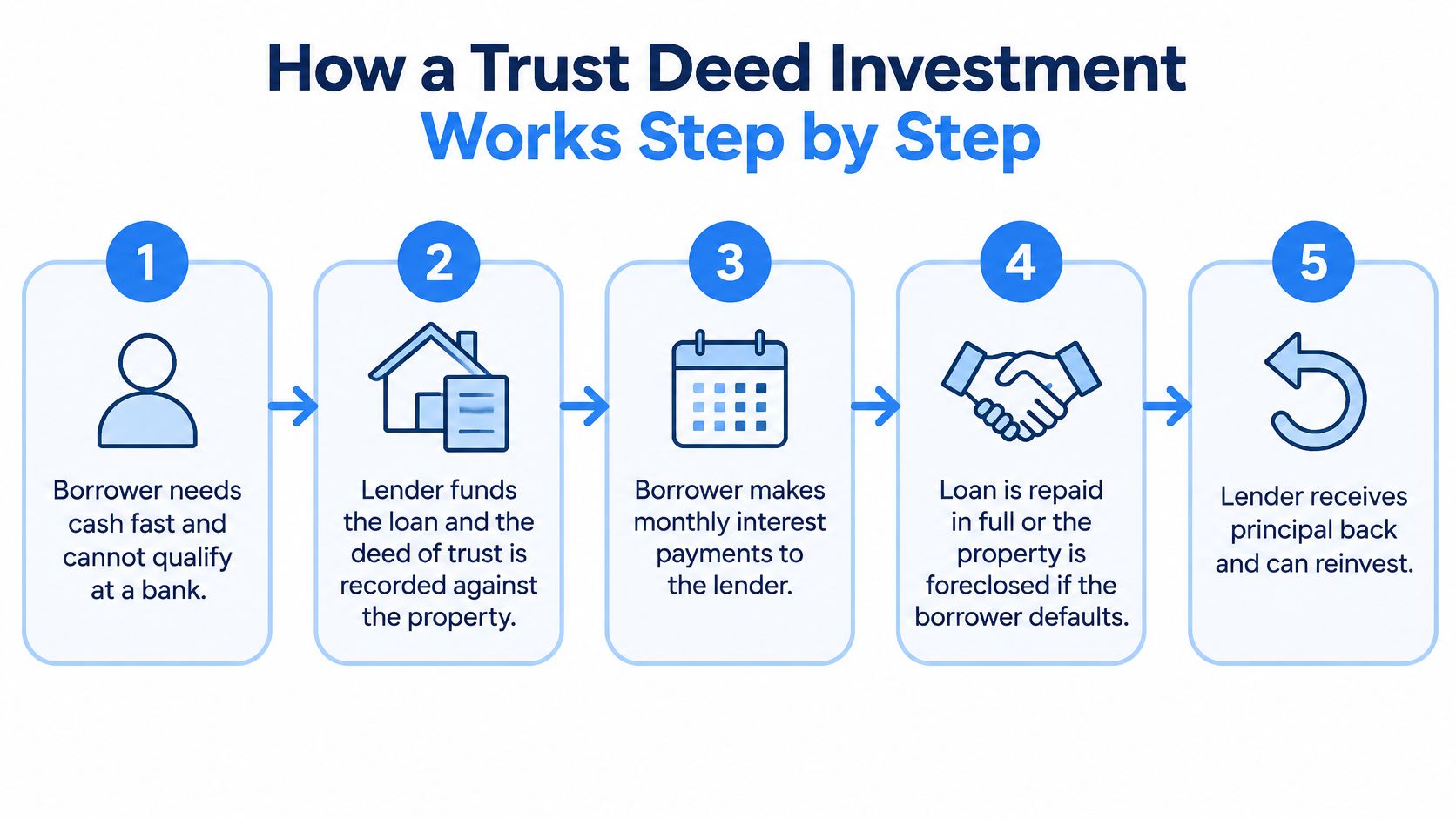
1. A borrower needs capital fast. Usually a fix-and-flip investor, a landlord refinancing out of a balloon, or a small commercial owner buying a non-owner-occupied building. They've been told no by a bank, or told yes in 45 days, which is the same thing when a purchase contract has a 10-day contingency.
2. The investor funds the loan and the note sets the terms. Rate, term, payment schedule, default provisions, and late charges all live in the promissory note. Read it before you read the marketing page.
3. The deed of trust is recorded with the county. Recording is what makes the lien enforceable and what fixes priority. The trustee named in the document holds legal title as security, and the recorder's timestamp is what decides who gets paid first among competing liens.
4. The borrower makes monthly payments. Most private trust deeds are interest-only, with the full principal due as a balloon at maturity. Terms commonly run from six months out to five years, and the shorter end is where most fix-and-flip money sits.
5. The loan exits through a sale, a refinance, or rental income. A flipper sells the renovated house. A landlord refinances into permanent debt once the property is stabilized. Either path returns your principal.
6. If payments stop, the trustee enforces. The power of sale in the deed of trust lets the trustee foreclose without filing a lawsuit, and the proceeds pay lienholders in order of priority.
The arithmetic on a typical deal
Say an investor funds a $400,000 first trust deed at 9% interest-only. The borrower pays about $3,000 a month. When the flip sells in month eight, the investor collects eight payments and the $400,000 comes back. No tenants, no repairs, no listing.
That speed premium cuts both ways. The borrower accepts a higher rate because a bank can't get there in time, which means your borrower is often someone a bank already declined.
The walkthrough below covers the same sequence from the investor's side of the table.
Lien Positions and Why First Position Matters
Lien position is the pecking order for repayment when a secured property is sold or foreclosed. Picture an auction line: first position stands at the front and collects from the first dollar of proceeds. Junior positions stand behind and absorb losses first.
The recovery waterfall runs in a fixed sequence. Gross sale proceeds come in, then trustee and attorney fees, transfer costs, and unpaid property taxes come off the top. The senior lien is satisfied next, then junior liens in recording order, and only what remains reaches the borrower's equity.
That's why position matters so much to the risk profile. A first-position deed of trust has priority over junior liens, so sale proceeds generally repay the senior lender before subordinate creditors, as research on private real estate debt funds describes. That priority lowers loss risk without eliminating it, because recovery still depends on realizable value, foreclosure expenses, unpaid taxes, legal delays, and how liquid the local market is when the trustee sells.
What first position actually buys you: the right to be made whole before anyone junior to you sees a dollar. It does not buy you a borrower who pays, a valuation that holds, or a fast sale.
The trade-off is asymmetric in a way that surprises new investors. Coupon and principal cap your upside, while a default or an impaired property can produce a materially larger downside. Senior real-estate debt behaves more like fixed income than like equity, and it correlates far less with property-market returns than mezzanine exposure does, which is precisely why the coupon is modest.
| Lien position | Repayment priority | Risk level | Typical return profile | Best suited for |
|---|---|---|---|---|
| First trust deed | Paid first from sale or foreclosure proceeds | Lowest in the capital stack | Fixed interest, often high single digits | Investors prioritizing capital preservation |
| Second trust deed | Paid after the first lienholder is made whole | Elevated; wiped out if proceeds run short | Higher coupon to offset added risk | Experienced investors accepting more downside |
| Junior or mezzanine debt | Paid after all senior liens | Highest; first to absorb losses | Highest promised yield | Sophisticated investors who can absorb a total loss |
Junior positions pay more because they eat losses first. That's the whole explanation for the rate gap. If you're structuring or evaluating a deal, understand how liens against properties are prioritized before you compare coupons, because a 12% second is not a better investment than a 9% first. It's a different instrument with a different failure mode.
How Trust Deed Returns Work in Practice
Most trust deeds pay monthly interest-only, with principal returned at maturity. Total yield can also include origination points paid at funding, late fees when payments slip, and extension fees when a borrower needs more time. That mix matters, because a deal with a lower coupon and two points can beat a higher coupon with no fees and a sloppy borrower.
What moves the rate
Six variables do most of the pricing work. Lien position comes first, since a second sits behind a first in the waterfall. Loan-to-value comes next, because it measures how much equity absorbs a decline before you're exposed. Property type and condition matter, with raw land and special-use buildings pricing wider than a stabilized duplex. Term length, borrower strength, and whether the exit is a sale or a refinance round it out.
First-position trust deeds on non-owner-occupied property typically carry coupons in the high single digits to low double digits. That sits above savings accounts and many bonds, and the gap pays for real work: you or your servicer underwrite the borrower, monitor the collateral, and accept that the money is illiquid.
The same deal in numbers
Say an investor funds a $200,000 first trust deed at 9% interest-only against a $300,000 rental purchase. That's a 67% LTV, and the borrower pays $1,500 a month. After 12 months the borrower refinances, and the investor receives $18,000 of interest plus the $200,000 principal back.
Now run the same deal with a slip. The borrower needs six more months and the loan extends at the same coupon with no extension fee. You still earned $18,000, but it took 18 months, so the annualized return on $200,000 is roughly 6%, not 9%. The coupon didn't change; the calendar did.
Track time-to-repayment, not just the stated rate. A yield that arrives late, or arrives in a settlement check after a foreclosure sale, is not the yield you underwrote.
Interest received is generally taxed as ordinary income in the year it's paid, and your actual treatment depends on your entity structure and bracket. Confirm it with a tax advisor before funding, not after the first payment lands.
Key Risks Every Trust Deed Investor Should Weigh
Secured is the wrong word to relax on. A deed of trust gives you a claim against a property, not a borrower who can pay, a valuation you can trust, or a fast route to cash. Losses trace back to a short list of causes.
- Borrower default. The note is only as good as the borrower's ability and willingness to pay, so underwrite the person and the property together instead of leaning on the collateral.
- Collateral shortfall. If values fall sharply, even a first lien can recover less than the balance owed once interest arrears and costs are added to the payoff.
- Illiquidity. These are private positions with no exchange and, in most structures, no early exit. Your capital is committed until maturity or until a workout resolves.
- Foreclosure timeline drag. In California, a nonjudicial foreclosure normally begins with a recorded Notice of Default, and the borrower generally has 90 days to cure, after which a Notice of Trustee Sale must be recorded and provided at least 20 days before the scheduled sale, per the California courts' foreclosure guide. Missed payments can interrupt income for months before any recovery.
- Workout costs. Attorney fees, property taxes, hazard insurance, and maintenance during the process all come out of the recovery, and they accrue while you wait.
- Fraud. The SEC's investor bulletin on real estate schemes describes a case where a promoter offered promissory notes bearing purported annual rates of 12% to 20% and allegedly pledged the same real estate collateral to multiple investors. High yield with no risk is a sales pitch, not a structure.
A lien secures the claim. It does not guarantee repayment.
The operational layer decides how much value survives a default. A lender with a written foreclosure process, a named decision-maker, and reserves for advances loses less than one who waits three months hoping the payment shows up. That's why a conservative LTV, a realistic distressed-sale valuation, and clear control over property advances matter more than the headline rate.
Due Diligence Before You Fund a Trust Deed
Once you wire the money, the only thing protecting you is the work you did before you sent it. The coupon tells you what you are promised. Diligence tells you whether the borrower, the collateral, and the workout plan can deliver it. Run the same checks in the same order on every deal.
- Pull a title report first. Confirm the deed of trust is recorded in the position you were promised, with no surprise senior lien, judgment, or tax lien ahead of you. A sponsor who refuses to share the preliminary title report is telling you something.
- Order an independent valuation. Get a broker price opinion or appraisal from someone you selected. Compute LTV on current value, never on the after-repair number the borrower is projecting.
- Underwrite the borrower, not just the deal. Credit, liquidity, and a track record on projects of similar scope. A first-timer proposing ground-up construction is a stop sign, however clean the collateral looks.
- Confirm the exit. Sale, refinance, or ongoing rental income, with a maturity date that fits the plan. "They'll figure it out" is not an exit strategy.

- Read the note and the deed of trust. Check default definitions, cure rights, extension terms, and who pays what during a foreclosure. Vague servicing language in a document you cannot enforce is a red flag.
- Verify insurance and taxes. Hazard coverage naming the lender, taxes current, and the property in rentable or sellable condition.
- Know who services the loan. First position lowers your risk, yet recovery still depends on execution. You want a named servicer with a written default procedure and a phone number you have called before funding.
- Check licensing and paperwork transparency. Ask for a license number you can verify. We hold California DRE license number 02072559, and any honest operator will hand theirs over without hesitation.
Benchmark the cushion, not the pitch
Experienced lenders tend to keep collateral cushions inside a fairly narrow band. Treat the figures below as typical conservative ceilings rather than legal limits. They still give you a yardstick for judging whether the debt load in front of you is aggressive.
| Property type | Typical conservative LTV ceiling | What it signals to investors |
|---|---|---|
| Raw land | About 65% | Lowest ceiling for the least liquid collateral |
| Land development | About 75% | Lower ceiling reflects unfinished improvements |
| Commercial, multifamily, and other nonresidential construction | About 80% | Based on defined value with staged draws |
| Improved property and 1-4 family residential construction | About 85% | Top of the band; careful lenders stay well below it |
The math shows why the cushion matters. On a $1 million commercial property, lending at roughly 80% of value means about $800,000 of loan against $200,000 of borrower equity. That equity is what absorbs a price decline, a slow sale, and the carrying costs of taking the property back. A deal priced well above these bands deserves a hard second look and a better explanation than "the market is strong."
A structured vetting process catches what a glossy offering memo skips. Work through Kons Law's 8-point vetting checklist before signing any subscription documents.
First position tells you where you stand in line. Diligence tells you whether standing there gets you paid.
Trust Deed Investments vs Other Real Estate Investments
A trust deed is a debt position in real estate, not ownership. That single distinction changes what you earn, who you rely on, and how fast you can get out.
| Investment | What you own | Income | Liquidity | Effort required | Main risk |
|---|---|---|---|---|---|
| Trust deed investment | A secured loan on real estate | Fixed interest, usually monthly | Low, private and held to maturity | Low once funded | Borrower default and collateral value |
| Rental property | Full ownership | Rent plus appreciation | Low, weeks to months to sell | High, tenants and maintenance | Vacancy, repairs, market swings |
| Fix-and-flip | Ownership during renovation | Profit on resale | Low, tied to the project timeline | Very high | Construction overruns and slow sales |
| REITs | Shares in a property portfolio | Dividends | High, exchange-traded | Low | Market volatility and fees |
Trust deeds trade appreciation upside for contractual interest and almost no day-to-day work. Rentals and flips buy you equity growth and control, but they demand capital, time, and market timing, and a slow year in either can wipe out two good ones. REITs are the most liquid of the four and the easiest to own, but you're holding a stock, not a lien, and you pay fund-level fees for the convenience.
Liquidity is where the comparison gets uncomfortable. Private real-estate investments commonly have limited liquidity, no established secondary market, and restricted or absent redemption rights, per the SEC's report on private investments. You may be unable to exit when you need to, even when the property behind the loan has plenty of equity.
If you'd rather spread the risk across dozens of loans instead of one, a pooled vehicle is the structural answer. Our real estate debt fund holds multiple loans rather than one, which diversifies borrower risk but doesn't turn an illiquid asset into a liquid one.
Is a Trust Deed Investment Right for You?
The fit test is short. A trust deed works for investors who want real-estate-secured income without managing property, who accept that a lien reduces risk rather than removing it, and who can keep capital committed through the full loan term. It fits badly for anyone who might need the cash back in a hurry or who'd panic at a delayed payment.
Answer three questions before you fund anything:
- Can I hold this for the full term, including an extension if the borrower asks for one?
- Can I absorb a six-month delay or a partial loss without derailing my own cash needs?
- Have I verified title, lien order, and LTV with an independent valuation rather than the lender's summary?
If any answer is no, go back to the checklist. The deal will still be there, or a better one will.
Investors who want to see how a professionally structured opportunity is documented can review our trust deed investments and ask for the same title, valuation, and servicing paperwork covered above. Our Debt Investment Fund targets a 9% annual return and is secured by first-position liens on real estate assets, so the lien documentation is the first thing worth reading. Borrowers who need non-bank financing on a non-owner-occupied property can start a loan request the same way, and our team will walk through what's required to qualify.
LendingXpress funds business-purpose loans on non-owner-occupied residential and commercial property, and we offer accredited investors access to trust deed opportunities secured by first-position liens. If you've been underwriting these deals alone and want a partner who will show you the title report, the valuation, and the servicing file before you commit, visit LendingXpress and tell us what you're trying to accomplish.