
A Single-Family Rental, or SFR, is a residential property with 1 to 4 units that an investor owns to produce rental income, not to live in. It also makes up over 50% of the U.S. rental housing stock, which is a big reason so many investors and brokers keep coming back to this asset class.
When looking for your next rental and deciding if a house, townhouse, or small residential property fits your strategy, you're asking the right question. In practice, an SFR is a standalone residential investment property that sits between a primary home and a larger apartment deal. It gives investors a familiar property type, but with underwriting, management, and financing decisions that are very different from buying a home for yourself.
A lot of newer investors first run into SFRs when a bank slows the deal down, declines the borrower, or won't fund the rehab the property really needs. That's where understanding the asset matters. Once you know what an SFR is, how lenders look at it, and what numbers drive approval, you can move faster and avoid chasing deals that won't pencil.
The Investor Shift to Single-Family Rentals
Investors usually arrive at SFRs for one of two reasons. They're either tired of the uncertainty that comes with short-term flips, or they want rental income without taking on the complexity of a larger multifamily project.
That shift makes sense. Single-family rentals represent over 50% of the United States' total rental housing stock and are treated as a distinct asset class that includes detached homes, townhomes, and condos, according to Arbor's SFR market overview. The same source notes that SFRs have attracted attention because of their stability and long-term growth potential, especially as lifestyle renting expands and homeownership becomes harder to attain.
Why this asset keeps showing up in investor searches
An SFR is easy to understand at street level. It's a house people want to live in. Families know the neighborhoods, tenants often stay longer than they do in smaller apartment units, and resale paths are usually straightforward because you're holding a property type with broad demand.
That doesn't mean it's effortless. A single vacancy hits one property's income all at once. Repairs are yours alone. There isn't a hallway full of doors spreading out the risk.
Practical rule: Investors who do well with SFRs usually treat them like operating businesses, not passive trophies.
Where SFRs fit in a real portfolio
For newer investors, SFRs can be an entry point because the asset is simpler to inspect, easier to understand, and more familiar than a larger apartment building. For experienced investors, they can be a way to balance a portfolio with properties that often appeal to longer-term renters.
Another reason SFRs keep gaining traction is that the category has matured. It's no longer just scattered individual houses owned by small landlords. Institutional buyers and developers now treat SFRs as a serious housing segment, which has pushed more brokers, lenders, and investors to get fluent in how these deals work.
If you're asking what is SFR in real estate, the better question is often why so many investors now prefer it as a middle ground. It offers the scale and discipline of an investment business, while staying closer to the residential properties most borrowers already know.
Defining the Single-Family Rental Asset Class
A borrower finds a clean rental house, expects an easy close, then gets stuck when the bank starts treating the deal differently than a primary home loan. That usually happens because the property may look residential, but the lender is underwriting it as an investment asset.
An SFR is a residential rental property with 1 to 4 units that is held for income, not owner occupancy. That definition matters because it drives how the deal is valued, how the loan is sized, and which lenders will fund it.
Once a property goes above 4 units, it usually shifts into commercial multifamily underwriting. The loan process gets more document-heavy. The lender focuses more on property-level performance. For newer investors, that shift can mean a slower closing, a larger down payment, or a flat decline from a conventional bank.
What counts and what doesn't
In practice, the SFR bucket is wider than many new investors expect.
It often includes:
- Detached homes: The standard rental house in a neighborhood setting.
- Townhomes: Common in suburban and infill markets where renter demand is strong.
- 2 to 4 unit residential properties: Still small enough to stay in the residential investment lane with many lenders.
- Condos: Sometimes financeable as rentals, though HOA rules, insurance, and lender overlays can make them harder than a detached house.
It does not include larger apartment buildings, mixed-use assets, or 5-plus-unit multifamily properties. Those deals sit in a different credit box.
That line matters more than people think. A property can be a good rental and still be a poor fit for bank financing. I see that often with condos, heavy-fix properties, non-warrantable projects, or borrowers whose tax returns do not support a conventional loan, even when the property itself cash flows.
Why the asset class has its own financing lane
SFRs are often called horizontal rentals because each home stands on its own lot and operates as a separate income-producing asset. If an investor owns ten houses, that is not one ten-unit building. It is ten separate properties, often with ten separate maintenance profiles, tax bills, and valuation questions.
That operating structure affects financing. A conventional lender may care heavily about personal income, existing mortgage count, or seasoning. A private lender or DSCR lender usually focuses more on the property, the rent, the exit plan, and whether the numbers make sense.
That difference is where many investors find traction after a bank says no.
Build-to-rent communities pushed this category further into the mainstream, but the financing lesson is simple. An SFR is not just a house with a tenant in it. It is an income property with a specific underwriting path. If the deal needs speed, light documentation, or flexibility around borrower income, private money and DSCR loans are often the cleaner fit.
Why Investors Choose SFRs Over Other Properties
When investors compare SFRs to multifamily, they're usually weighing control against efficiency. SFRs are simpler to understand and often easier to sell. Multifamily offers more doors under one roof and stronger operational scale.
Neither is automatically better. The better asset is the one that matches your capital, your management capacity, and your financing options.
The real trade-offs
SFRs often appeal to investors who want a familiar asset and a cleaner exit strategy. If the rental plan changes, the buyer pool can still include investors and, depending on occupancy and local rules, sometimes owner-occupant demand later on. That flexibility matters.
Multifamily usually wins on scale. One roof, one location, and multiple units can make management more centralized. But for many newer investors, that same scale can mean a larger equity requirement, more complicated underwriting, and a steeper learning curve.
| Investment Factor | Single-Family Rental (SFR) | Multifamily Property |
|---|---|---|
| Property layout | One house, townhouse, condo, or small residential asset | Multiple units in one building or complex |
| Tenant profile | Often one household | Multiple households at once |
| Vacancy impact | One vacancy can remove all rent from that property | One vacancy usually affects only part of total income |
| Management style | Simpler day to day, but spread out if you own several homes | More centralized when units are in one location |
| Financing feel | Often more accessible for residential-focused investors | Often more document-heavy and commercial in approach |
| Exit strategy | Can be straightforward because the property type is familiar | Sale process can depend more heavily on investor demand |
| Scale | Limited per property | Better operational scale in one asset |
What tends to work best
SFRs work well for investors who want to build experience one property at a time. They also fit borrowers who need a non-owner-occupied financing solution tied to a specific house that needs light or heavy repositioning.
Multifamily often works better when the investor already has enough capital, management systems, and lender relationships to handle a bigger operation.
If you're still building your process, an SFR is often easier to underwrite correctly than a larger multifamily deal.
There are trade-offs either way. With SFRs, you don't get the same economies of scale. With multifamily, you don't get the same simplicity. Good investors don't ignore that difference. They pick the asset that lines up with the plan they can execute.
How to Fund Your SFR Purchase or Refinance
The financing side is where a lot of SFR deals either move or die. Borrowers often assume a conventional bank loan is the default answer, then discover the timeline doesn't fit the contract, the appraisal comes in messy, the property condition is too rough, or tax returns don't tell the whole story.
That's why investors who buy non-owner-occupied properties need more than one financing lane.
Why bank financing often stalls
Traditional lenders are built for clean files. They like stable income documentation, straightforward property condition, and borrowers who fit standard boxes. That works for some rentals. It doesn't work well when the borrower is self-employed, the property needs serious renovation, or the deal has to close fast.
For context, non-owner-occupied mortgage rates in 2026 are typically 0.5% to 1% higher than rates for primary residences, according to The Mortgage Reports on investment property rates. That's one reminder that lenders already price these loans differently because the risk profile is different.
The two investor tools that matter most
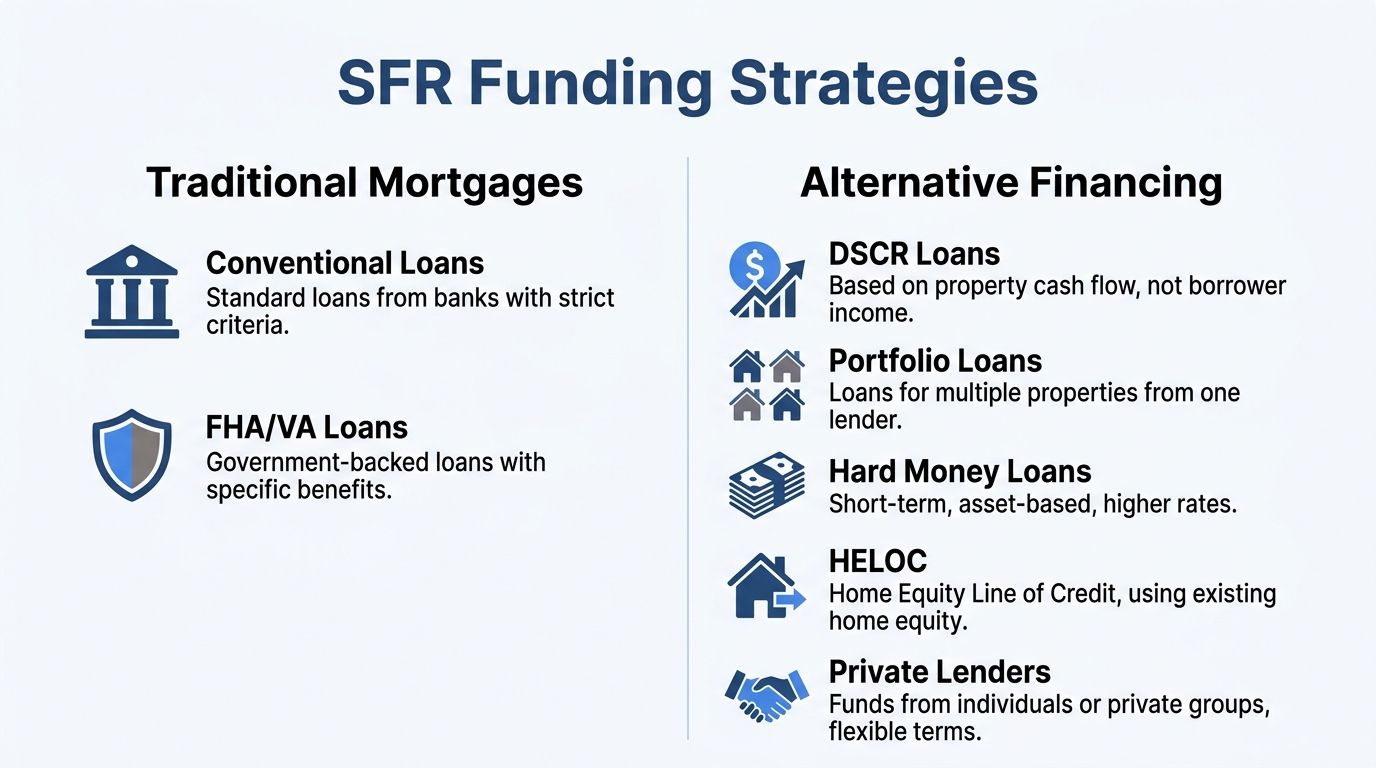
For most active investors, the practical conversation comes down to DSCR loans and private money.
A DSCR loan focuses on the property's cash flow rather than requiring the same kind of income verification you'd expect on a consumer mortgage. Offermarket notes that SFR investors commonly use DSCR loans structured around the asset's cash flow and the borrower's credit profile rather than employment or income verification. That can be a strong fit for long-term rental holds.
Private money is different. It's often the better tool when speed, property condition, or rehab scope makes a conventional loan unrealistic. If the house needs work before it can qualify for takeout financing, private capital can bridge that gap.
To get a clearer picture of how investors structure these deals, review this investment property financing guide.
A quick visual helps if you're comparing paths:
Where rehab financing becomes the deciding factor
Many borrowers find themselves in a difficult situation. The property makes sense as a rental, but it won't lease well, appraise well, or refinance well until repairs are done.
Recent data from the 2025 U.S. Single-Family Investment Report shows that 55% of SFR flips involve structural upgrades, yet only 18% of traditional lenders offer 100% rehab financing with staged draws. In California, 62% of SFR investors report needing immediate capital for code compliance, according to this SFR financing gap analysis. That's the gap private lenders are built to solve.
What works in the field is simple:
- Use DSCR when the property is already rentable: It fits stabilized rental assets better.
- Use private money when time or condition is the issue: Especially for bridge, fix, or fast-close scenarios.
- Match the loan to the exit: If your plan is rehab then refinance, structure the first loan around execution, not just rate.
- Don't force a bank loan onto a non-bank deal: That's where contracts get extended, sellers lose patience, and opportunities disappear.
Running the Numbers on a Potential SFR Deal
A good SFR deal isn't just a nice house in a decent area. It has to carry itself on paper. Investors who stay in this business learn to screen quickly, then underwrite carefully.
The first pass should be simple. The second pass should tell you whether the lender will see enough income support.
Start with the quick screen
The 1% Rule is a common benchmark for SFR analysis. Offermarket describes it as a rule of thumb where monthly gross rent should equal at least 1% of the total purchase price to help support positive cash flow after mortgage, taxes, insurance, and maintenance. It's not a full underwriting model, but it's useful for rejecting weak deals early.

You should also remember the maintenance side. The same source notes that investors often budget repairs at 1% of property value annually. That won't predict every repair bill, but it helps keep your projection grounded.
Know the lender's lens
Lenders don't approve a non-owner-occupied deal because the house looks attractive. They want to see that the income can support the debt.
Non-owner-occupied commercial real estate lenders typically require a DSCR of at least 1.25, meaning the property must generate 25% more net operating income than annual debt payments, according to Ascend Bank's discussion of commercial loan underwriting.
A property can look profitable to an investor and still miss a lender's DSCR standard. Those are not the same test.
Here's the practical sequence investors use:
- Estimate gross rent: Use realistic market rent, not hopeful rent.
- Subtract operating costs: Taxes, insurance, maintenance, management, and recurring property expenses.
- Get to NOI: That gives you net operating income before debt service.
- Compare NOI to annual loan payments: That's your DSCR test.
- Pressure-test the deal: Ask whether the deal still works if rent comes in softer or repairs run longer.
If you want a better handle on valuation before you submit a deal, this cap rate calculation guide is a useful reference.
Credit still matters
Even with rental-focused financing, borrower quality still counts. Rocket Mortgage's overview of non-owner-occupied loan standards notes that investment property loans generally require a minimum credit score in the 620 to 640 range, and borrowers above 700 are better positioned to secure more favorable rates.
That doesn't mean every strong deal needs a perfect profile. It does mean investors should stop thinking the property alone will carry a weak file. In real underwriting, the asset, exit plan, and borrower all matter.
Key Management and Tax Considerations
A single vacancy hits an SFR harder than it hits a larger rental property. One tenant move-out can take income to zero for the month while taxes, insurance, and loan payments keep coming due. That is why good SFR investing depends on tight operations, not just a decent purchase price.
SFRs are usually easier to run than larger multifamily properties, but the trade-off is concentration risk. You have fewer moving parts, fewer common-area headaches, and a simpler rent roll. You also have less margin for error if the tenant stops paying, the turnover runs long, or a major repair shows up right after closing.
Self-manage or hire it out
Self-management works best when the property is close by, the house is in solid condition, and you already have reliable vendors. It also helps if you are comfortable screening tenants, handling maintenance calls, and enforcing the lease without delay.
That approach gets harder once you own in different submarkets or start valuing your time like a business owner instead of a landlord.
A property manager can handle leasing, repairs, inspections, and tenant communication. The right manager protects occupancy and shortens turn times. The wrong one burns cash through weak screening, slow follow-up, and poor repair oversight. I tell newer investors to underwrite management as a real operating cost even if they plan to self-manage at first. That keeps the deal honest and gives them flexibility later.
Weak management can turn a decent SFR into an expensive problem fast.
Set tenant expectations early
Many headaches start before the first repair call. Clear lease terms, documented move-in condition, rent collection procedures, and written maintenance rules reduce disputes later.
Insurance expectations belong in that conversation too. If you're leasing houses in California, this guide to California renters insurance is a practical resource to share with tenants or use when setting lease standards.
Tax planning should match the investment plan
SFR owners often deduct mortgage interest, property taxes, insurance, repairs, management fees, and other ordinary rental expenses. Depreciation can also improve after-tax cash flow. Those benefits are valuable, but they only help if the property is titled and reported the right way.
Ownership structure matters. An LLC may help with liability and bookkeeping. Holding property in your personal name may be simpler in some cases. Trust ownership can make sense for estate planning, but it can also affect how financing is documented. Private lenders and DSCR lenders can often work through those structures more easily than banks, especially when a borrower needs a faster close or wants the loan made to an entity.
Get your CPA involved before closing, not after tax season. The investors who do this well line up financing, title, insurance, and tax reporting from the start. That saves time, cuts cleanup work later, and keeps a good SFR from becoming a paperwork mess.
Taking Action on Your First or Next SFR Investment
The best next step isn't reading one more forum thread. It's getting clear on your plan and lining up the people who can help you execute it.
If you're serious about buying or refinancing a non-owner-occupied SFR, keep it simple.
A practical checklist
Define your strategy first
Decide whether you're buying a long-term rental, refinancing a stabilized property, or acquiring something that needs rehab before it can cash flow.Build the right team
You need an investor-friendly agent, a lender who understands non-owner-occupied property, and reliable closing and vendor support.Screen deals fast
Use rent, expenses, property condition, and exit clarity to eliminate weak opportunities early.Get financing lined up before the offer
Newer investors often lose time if their funding isn't ready. Sellers and brokers take you more seriously when your funding path is already clear.
What separates active investors from stalled investors
Most deals don't fall apart because the asset was impossible. They fall apart because the borrower waited too long to solve the funding piece, or chose the wrong loan product for the condition and timeline of the property.
If the property is clean and stabilized, a DSCR approach may be the fit. If the asset needs work, the borrower needs speed, or traditional underwriting won't cooperate, a private lending route often makes more sense. The key is choosing based on execution, not wishful thinking.
The investors who keep buying aren't guessing. They know their buy box, they know their exit, and they know who can fund the deal when a bank can't.
If you need fast, practical financing for a non-owner-occupied SFR, LendingXpress is built for that moment. The team works with investors who need bridge, rental, fix-and-flip, and rehab funding when traditional banks move too slowly or decline the file outright. If you've got a deal that needs speed, flexibility, or renovation capital, it's worth starting the conversation before your next offer goes out.