
You've found a non-owner-occupied property that works on paper, but the bank's timeline doesn't match the seller's. The monthly payment on a short-term loan looks manageable, yet the term sheet also shows a large payoff due at maturity. That number can feel distant while you're focused on closing, renovations, leasing, or the next acquisition. It becomes the most important number on the loan once the maturity date approaches.
Balloon payment loans can be useful investor tools when the property's exit is clear. They can support a bridge acquisition, a fix-and-flip project, or a rental that needs time to stabilize before a long-term refinance. They can also create a forced sale or refinancing problem if the borrower underwrites only the monthly payment.
The practical question is simple: does the deal work because the monthly payment is affordable, or because the exit is achievable? For investment property, a lender such as LendingXpress should size the loan around the property, the borrower's plan, and the maturity event, rather than treating a generic amortization table as the whole underwriting decision.
The Investor Scenario Most Balloon Loan Guides Skip
A working investor is negotiating to buy a small commercial property that needs repairs and better leasing. The purchase price is acceptable, the renovation budget is defined, and the expected stabilized value supports the plan. A conventional bank could offer a lower long-term rate, but its underwriting process may take too long for the seller's closing deadline.
A private lender offers a short-term structure with lower scheduled payments and a balloon due at maturity. The investor looks at the monthly debt service and thinks, “I can carry that.” That answer is incomplete. The key question is whether the investor can sell, refinance, or otherwise retire the unpaid principal when the term ends.
The distinction matters because the property may look stronger by then, but it may also face higher rates, a lower appraisal, slower leasing, or construction delays. The investor's payment history helps, but it doesn't guarantee that a new lender will approve the replacement loan.
A deal can be affordable and still be unfinanceable
Suppose the investor plans to renovate the property, lease vacant space, and refinance after stabilization. The loan may be appropriate if the renovation schedule, projected income, valuation, and refinance assumptions support that sequence. It becomes dangerous when “I'll refinance later” is the only exit plan.
The same discipline applies to presentation and leasing. An investor preparing a property for market may use practical marketing resources such as create Instagram reels for listings, but better exposure doesn't replace a defensible valuation or a documented payoff strategy.
LendingXpress approaches this type of financing as an investment-property transaction, not as a consumer mortgage built around household budgeting. The lender reviews the asset, the requested proceeds, the borrower's experience, the business plan, and the expected exit. That flexibility can help borrowers who don't fit a traditional bank's process, but it doesn't remove the obligation to prove that the maturity payoff is realistic.
Practical rule: If the only reason the loan works is the low monthly payment, the loan doesn't work yet. Underwrite the balloon before you underwrite the purchase.
How a Balloon Payment Loan Actually Works
A balloon loan schedules payments for only part of the debt's full repayment period. The borrower makes regular installments during the term, but those installments don't fully retire the principal. At maturity, the remaining balance becomes due in one payment.
The scheduled payment and the payoff payment serve different purposes:
- Scheduled payment: This is the amount the borrower pays during the loan term. It may be calculated using a longer amortization period or may cover interest without materially reducing principal.
- Amortization period: This is the hypothetical period used to calculate the payment. It doesn't necessarily match the actual loan term.
- Maturity date: This is when the borrower must pay the remaining balance, refinance it, sell the property, or negotiate another arrangement.
- Balloon payment: This is the large final amount required to retire the loan.
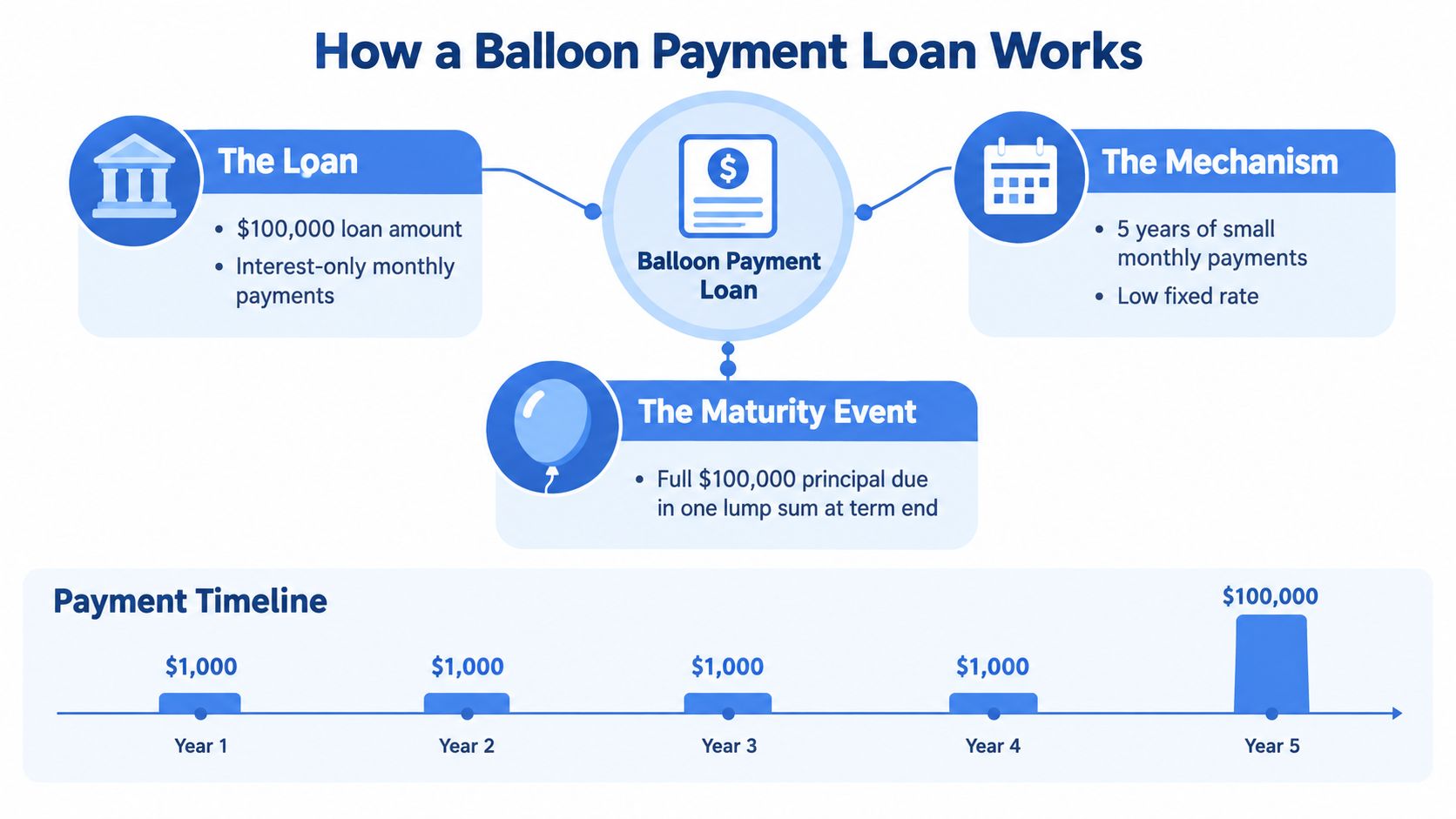
The Consumer Financial Protection Bureau's mortgage-payment example makes the mechanics clear. On a $100,000 mortgage at 4% interest with a 30-year amortization, the monthly principal-and-interest payment is approximately $477. If the loan matures after five years instead of 30, the borrower still owes approximately $90,448 at the end of year five.
That isn't a cheaper loan. It's a loan that postpones repayment of most of the principal. The lower interim payment may preserve cash for acquisition costs, renovations, reserves, or operating needs, but the unpaid balance remains a claim against the property.
For an investment property, the structure can be deliberate. A fix-and-flip borrower may expect to sell after improvements. A bridge borrower may need time to replace temporary financing with permanent debt. A rental investor may plan to refinance after income and occupancy stabilize. In each case, the balloon is acceptable only if the expected exit supports the payoff under conservative assumptions.
Reading an Amortization Schedule the Right Way
An amortization schedule should answer three questions immediately:
- How much principal has the borrower repaid?
- What balance remains at maturity?
- How much interest has the borrower paid to reach that date?
The CFPB defines a balloon payment as a one-time payment at the end of the loan that is generally more than twice the average monthly payment and may represent a significant share of the original balance. You can review the definition in the CFPB's balloon-payment guidance.
For an investor, the schedule is more useful than the headline rate. Consider the following illustrative amortization snapshot for a $750,000 loan at 8% interest, using a 30-year amortization and annual payment calculations. The figures are rounded for readability and are not a loan quote.
| Year | Paid Balance | Remaining Balance | Cumulative Interest |
|---|---|---|---|
| 1 | $9,307 | $740,693 | $59,693 |
| 2 | $19,391 | $730,609 | $118,891 |
| 3 | $30,312 | $719,688 | $177,970 |
| 4 | $42,145 | $707,855 | $236,876 |
| 5 | $54,959 | $695,041 | $295,634 |
The schedule shows why the first five years deserve close attention. The investor has made regular payments, but the outstanding principal remains substantial. The loan may support the project's cash flow, yet the property still needs to generate enough value or refinancing capacity to retire nearly all of the original debt.
Fully amortizing payments versus interest-only payments
A fully amortizing schedule applies part of each payment to principal. Early payments may be interest-heavy, but the balance gradually declines. An interest-only structure generally pays the interest due during the term and leaves the original principal outstanding until maturity.
The two structures can produce very different monthly obligations, but both can end with a balloon. Don't assume that a lower payment means a smaller maturity risk. Ask for the projected payoff amount at the actual maturity date, not merely the amortization period shown on the term sheet.
A useful review method is to mark the maturity balance directly on the property's exit model. Then test whether the projected sale proceeds or refinance proceeds still cover that balance after selling costs, closing costs, reserves, and any required paydown.
The Real Trade-Offs Investors Should Weigh
Balloon financing exchanges one kind of pressure for another. It can reduce the payment burden during the acquisition or repositioning period, but it concentrates repayment risk at a specific date.

Lower payments can preserve operating cash
A lower scheduled payment may leave more cash available for repairs, tenant improvements, leasing commissions, or reserves. That flexibility can be valuable on a property whose income is expected to improve after the loan closes.
The matching risk is principal concentration. If the borrower spends every dollar saved on interim debt service, there may be no liquidity available for the balloon, a required paydown, or an unexpected delay. The payment works only when the borrower treats the monthly savings as project capital, not as extra personal income.
Faster execution can win the acquisition
Private lenders can often evaluate the property and the exit more directly than a conventional bank. That may help an investor pursue a time-sensitive acquisition, refinance a maturing loan, or fund a value-add plan that doesn't fit standard documentation.
Speed comes with a responsibility to finish the underwriting before closing. A fast loan with a weak exit can create a faster maturity problem. The investor should know the balance, the maturity date, the refinance assumptions, and the fallback plan before accepting the proceeds.
Flexibility can support short-term investment plans
A bridge loan or fix-and-flip loan isn't designed to behave like permanent rental debt. A balloon can match a planned sale or refinance, which may make more sense than paying for a long-term structure the investor doesn't intend to keep.
The risk is that the planned hold becomes the actual hold. A renovation can run late, a buyer can withdraw, or a lender can reduce proceeds after a new appraisal. The borrower needs time buffers and backup capital, not just a target date.
Watch this explanation of how balloon structures affect the borrower's maturity obligation:
Consumer mortgage rules also explain why these structures appear more often in private and commercial lending than in conventional consumer products. Under the Consumer Financial Protection Bureau's Ability-to-Repay framework, a standard Qualified Mortgage generally can't contain a balloon payment. A narrow exception applies to certain small creditors serving rural or underserved areas. The CFPB estimated that roughly 10% of the U.S. population lived in those areas and that 2,707 lenders could qualify under the special provision, as summarized in this Congressional Research Service analysis.
That regulatory context doesn't determine whether an investment loan is sound. It does show that balloon structures require careful product classification, documentation, and underwriting. For non-owner-occupied property, the borrower should focus on the contract, the collateral, and the exit rather than assuming the structure behaves like a standard home mortgage.
Where Balloon Loans Fit in an Investor's Toolkit
Balloon financing works when a defined transaction or operating milestone will replace the loan. For investors, that usually means bridge financing, a fix-and-flip sale, or rental and commercial stabilization.

Bridge financing
A bridge loan covers a timing gap. An investor may need to close before selling another asset, refinance existing debt, finish improvements, or secure permanent financing. The balloon should match the event expected to end that gap, rather than relying on appreciation alone.
Underwriting usually centers on current property value, requested proceeds, borrower liquidity, collateral, and the payoff path. A bridge request is harder to support when the borrower has no refinance target, sale plan, or backup source of repayment. Investors comparing terms can use this bridge loan guide for investment property to prepare questions about term, proceeds, collateral, and exit timing.
Fix-and-flip financing
A fix-and-flip loan commonly ends with a sale payoff. Interest-only payments can preserve cash during construction, while staged draws connect funding to completed work. The borrower still carries interest, taxes, insurance, utilities, and other project costs until closing.
A lender will expect the acquisition basis, renovation scope, draw schedule, projected resale value, contractor information, and sales plan. Underwriting should also test a delayed renovation and a lower sale price. Those stresses show whether the borrower has enough liquidity to reach closing without depending on the best-case timeline.
Rental or commercial stabilization
A rental investor may use a balloon loan while improving occupancy, rents, management, or operating performance. A commercial borrower may need time to lease space before refinancing against stabilized income.
The refinance depends on more than property value. The new lender may review rental income, debt-service coverage, credit, reserves, remaining lease terms, and an updated appraisal. The Edinhart Realty financing guide provides additional background for comparing investor financing approaches.
Commercial maturity conditions also make exit timing important. A reported Mortgage Bankers Association analysis projected substantial commercial mortgage maturities, including office, hotel, and motel loans, during the period examined. That projection did not mean every loan would default, but it illustrates why investors should treat the maturity date as an underwriting event, not a calendar reminder. The analysis is discussed in this reported commercial mortgage maturity analysis.
Building an Exit Plan That Survives 2026
A maturity date shouldn't be the first time the borrower asks how the loan will be repaid. Build the exit plan around the actual payoff balance, then test it against a weaker appraisal, a higher refinance rate, slower leasing, and a delayed sale.
The CFPB states that if a borrower can't pay a balloon payment, the borrower may need to refinance, sell the property, or face foreclosure. Refinance eligibility can depend on updated property value, rental income, debt-service coverage, credit, reserves, and lending conditions at maturity, as explained in the CFPB's key mortgage terms.

Sale
A sale is straightforward when the property can reach the market early enough to close before maturity. The model should subtract selling expenses, payoff interest, taxes, commissions, and any other transaction costs before comparing net proceeds with the balloon.
Don't rely on a projected sale price alone. Identify the minimum acceptable sale price, the time needed to market the property, and the action you'll take if offers arrive below the payoff amount.
Refinance
A refinance replaces the balloon with new debt. The replacement lender may use a lower loan-to-value, a higher interest rate, updated income, and stricter reserves than the original lender. A property that supported the acquisition loan may not support the same proceeds after market conditions change.
Start early enough to obtain financial statements, rent rolls, leases, insurance information, an appraisal, and lender feedback. Investors evaluating this route can review refinancing an investment property as part of their preparation.
Extension
An extension can buy time, but it doesn't automatically improve the economics. Ask whether interest is capitalized, whether the principal balance declines, whether a new appraisal is required, whether the lender imposes reserves or a paydown, and what happens if a second extension is denied.
An extension that creates enough time to complete a sale or stabilization plan can be useful. An extension that moves the same large balance into a weaker market may increase risk. Compare the total dollars paid and the completion date under a sale, refinance, extension, principal paydown, or consensual modification.
Cash planning should include property operations and the borrower's broader business obligations. A resource on cash flow forecasting for small businesses can help organize projected inflows, debt service, reserves, and timing gaps.
How LendingXpress Structures and Underwrites These Loans
A private lender should start with the collateral and the exit, then work backward to the payment structure. LendingXpress evaluates non-owner-occupied residential and commercial properties using conservative loan-to-value assumptions, the asset's condition, the borrower's plan, and the expected maturity payoff.
For a bridge or rental transaction, that may mean interest-only or partially amortizing payments with a clearly documented balloon event. For a fix-and-flip project, LendingXpress can support up to 100% of rehab costs through staged draws, while the borrower remains responsible for completing the work, carrying the project, and executing the sale or refinance plan.
What the borrower should prepare
A strong application doesn't need to look like a bank application, but it does need to answer practical questions:
- Property: What is being purchased or refinanced, and what is its current condition?
- Capital stack: How much cash is the borrower contributing, and what other liens exist?
- Business plan: What work will be completed, by whom, and on what schedule?
- Exit: Will the borrower sell, refinance, or use another liquidity event?
- Stress case: What happens if value falls, the rate rises, leasing takes longer, or construction is delayed?
LendingXpress describes typical loan sizes ranging from $100,000 to $18 million and above, with closings in as little as three days when the file, property, and documentation support that timeline. Those figures describe the lender's stated offering, not a promise that every transaction will qualify or close on the same schedule.
Borrowers who don't qualify with traditional banks may benefit from common-sense underwriting focused on the asset and the exit. The flexibility is useful only when the maturity plan is specific enough for the lender to test. LendingXpress also offers trust deed opportunities and a debt investment fund targeting a 9% annual return, secured by first-position liens, for eligible investors evaluating debt investments separately from borrowing.
LendingXpress structures bridge, fix-and-flip, and rental property loans for investors who need speed, flexible underwriting, and a clear plan for the balloon payoff. Visit LendingXpress to discuss your property, requested proceeds, and exit strategy with a lending team that can evaluate the deal around its real maturity risks.