
You're probably in one of three spots right now. A rental property has appreciated, but the equity is trapped. A bridge loan is getting close to maturity, and you don't want a rushed payoff. Or your current loan still reflects yesterday's terms, while today's goal is stronger cash flow and more room to move.
That's when a refi investment property strategy stops being a finance exercise and becomes a business move. You're not refinancing because it sounds smart. You're refinancing because the current debt no longer fits the property, the plan, or the speed you need.
Investors make money when capital stays useful. Dead equity, rigid loan terms, and slow approvals all get in the way. The right refinance can free up cash, stabilize a shaky loan structure, or turn a property from “fine” into something that supports the next acquisition.
Your Guide to Investment Property Refinancing
A lot of investors wait too long to refinance. They tell themselves the current loan is manageable, the balloon payment is still months away, or the next deal matters more. Then the clock gets loud. The lender wants payoff. The rate resets. The property has equity, but none of it is helping you win the next opportunity.
That's the wrong way to handle debt on a non-owner-occupied property.
A refinance works best when you use it early and with a purpose. You're replacing one loan with another that better matches what the property is doing today. If rents are stable, value is up, or the original loan was always meant to be temporary, a refinance can clean up the capital stack and put you back in control.
Start with the real reason
Most investors refinance for one of these reasons:
- Better monthly cash flow: A new loan structure can reduce payment pressure and create breathing room.
- Access to equity: Cash trapped in the property can become capital for repairs, reserves, or the next purchase.
- Longer-term stability: Short-term debt might have helped you acquire or reposition the asset, but it's not always the right loan to hold.
Practical rule: Don't ask, “Can I refinance?” Ask, “What problem am I solving with this refinance?”
That question keeps you focused. If your only reason is “maybe rates improve,” that's weak. If your reason is “this property is carrying the wrong debt and blocking the next move,” now you're thinking like an operator.
Treat the loan like part of the asset plan
Good investors don't separate financing from strategy. The loan is part of the asset. If the debt structure is wrong, the property underperforms even when occupancy and rent look fine.
If you want a broader primer on how owners rethink old financing structures, this resource on how to renovate your mortgage loan is a useful read. The framing matters. Refinancing isn't paperwork. It's loan repositioning.
What It Means to Refinance an Investment Property
Think of your current loan like a basic toolbox. It got the job done when you bought the property, stabilized it, or bridged a timing gap. But once your objective changes, that same toolbox starts slowing you down. A refinance is the specialized set of tools you pick for the work in front of you now.

For non-owner-occupied real estate, refinancing means replacing the existing mortgage with a new one that better supports the property's current role in your portfolio. That sounds simple. The impact isn't. A strong refinance can reshape monthly obligations, release equity, or swap out a loan product that no longer fits the asset.
Goal one is improving the existing debt
Sometimes the smartest move is the least flashy one. You refinance to improve the rate, extend the term, or adjust both. The target is cleaner cash flow and less pressure every month.
That matters when the property performs well but the debt is dragging returns. We see this often with rentals bought in a different rate environment or financed quickly just to secure the deal. If the asset has settled down, the financing should too.
Goal two is pulling capital out for the next move
A cash-out refinance turns built-up equity into usable capital. Investors use that money for renovations, reserves, partner buyouts, or the down payment on another property.
Discipline is crucial. Cash-out can be a growth tool or a mistake. If you're pulling money just because it's there, you're increasing your financial exposure without a plan. If the funds have a clear use tied to value creation or acquisition, the refinance is doing its job.
Refinance should create options, not new chaos.
Goal three is changing the loan product
This one gets overlooked. A bridge loan, adjustable structure, or short-term note might have been the right answer at acquisition. It's often the wrong answer once the property has stabilized and you want predictable debt service.
Changing the product can be just as important as changing the rate. A fixed structure may fit better than a floating one. A longer-term loan may fit better than short maturity debt. The question isn't what the old lender offered. The question is what the asset needs now.
The practical definition investors should use
Use this working definition: refinancing an investment property means replacing outdated debt with debt that matches today's property performance and tomorrow's plan.
That's the only definition that matters in the real world.
Key Refinance Strategies Rate-and-Term vs Cash-Out
Most refi investment property decisions come down to two paths. You either want a better loan on the same balance, or you want to turn equity into working capital. Those are different jobs, and they should be treated that way.

Rate-and-term works when the goal is optimization
A rate-and-term refinance keeps the focus on the existing loan. You're trying to improve the price of debt, the repayment structure, or both. No extra cash comes out, or very little does. The property stays in place, but the financing gets cleaned up.
This is the move to consider when the property already fits your portfolio and you want better economics. Lower payment pressure can improve monthly cash flow. A term change can also help if the current loan maturity is too aggressive for your hold strategy.
Cash-out works when the goal is liquidity
A cash-out refinance is about access to capital. You're replacing the old loan with a larger one and taking the difference in cash. That cash can go toward renovations, reserves, or another acquisition.
There are real limits here, and you need to know them before you build a plan around phantom equity. For investment properties, cash-out refinances are typically capped at 75% LTV for single-family units and 70% LTV for 2 to 4 unit properties, while rate-and-term refinances may sometimes reach 80% LTV on select programs, according to Lendmire's investment property refinance overview.
That equity cushion isn't arbitrary. Lenders want you to keep meaningful skin in the game. We agree with that approach. If you drain too much equity, the deal gets fragile fast.
Side-by-side decision points
| Strategy | Best use | What changes | Main benefit | Main caution |
|---|---|---|---|---|
| Rate-and-term | Existing loan needs improvement | Rate, term, payment structure | Better efficiency | May not unlock capital |
| Cash-out | Equity needs to become usable funds | Loan balance increases | Adds liquidity | Higher leverage |
If you want a deeper look at how equity access works on rentals, this page on cash-out refinance on a rental property lays out the use case clearly.
There's also a bigger market context behind this decision. If you want a legal and practical perspective on how borrowing costs affect property decisions, this article on interest rates and the real estate market is worth your time.
Don't choose cash-out because it feels productive. Choose it because the next use of funds is stronger than the cost and risk of extracting the equity.
Comparing Your Lender Options Traditional vs Private Money
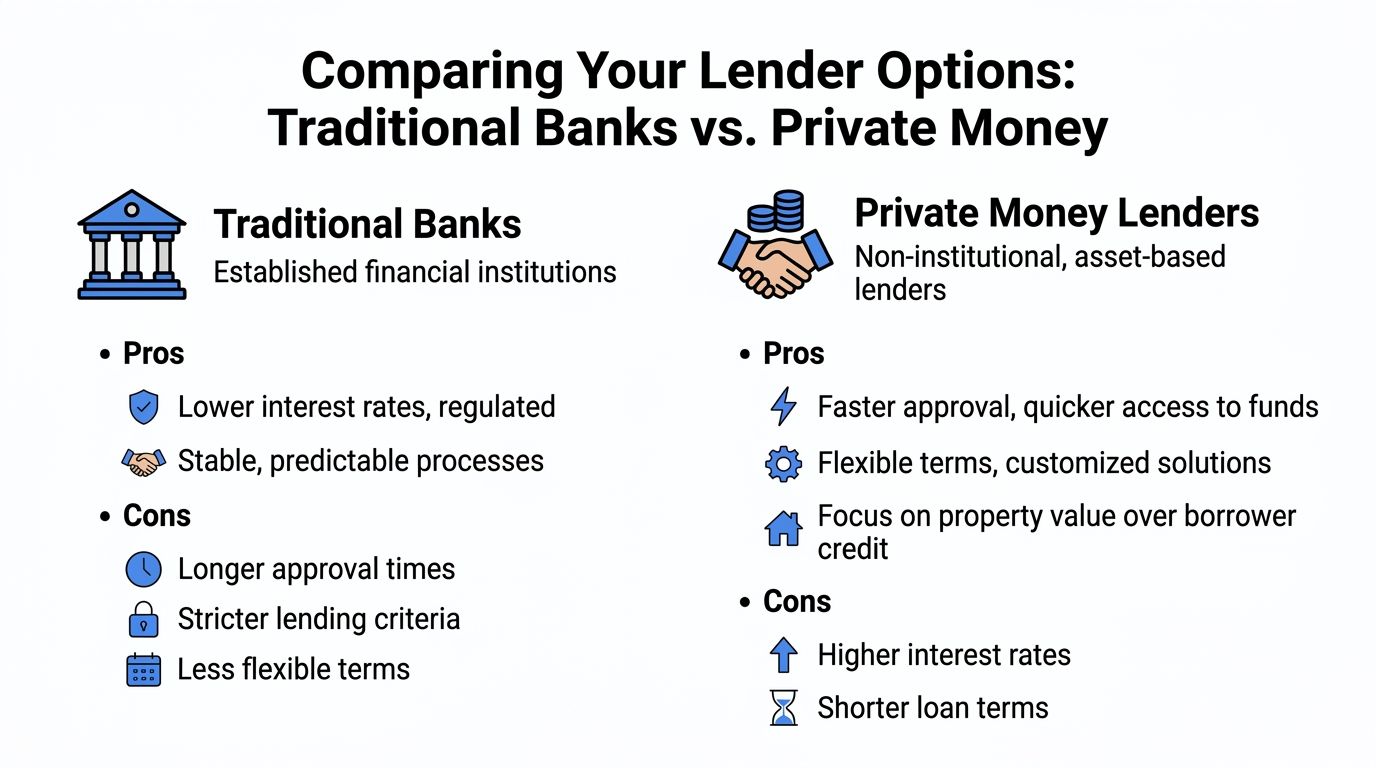
Banks like clean files. Clean tax returns. Clean debt ratios. Clean timelines that don't force them to think too hard. Real investors often don't fit that box.
That's why a lot of strong borrowers get rejected for weak reasons. The property cash flows. The rents are real. The equity is there. But personal income looks irregular, the ownership structure is layered, or the deal needs to close before a bank committee finishes its second round of questions.
What banks usually want
Traditional lenders tend to underwrite the borrower first and the property second. They'll spend serious time on personal income documents, tax returns, reserves, debt obligations, and explanation letters. That can work fine for a salaried borrower with a plain vanilla profile.
It works poorly for investors who are self-employed, write off aggressively, hold multiple entities, or move fast. The more active you are, the less “simple” your file tends to look.
What private money looks at differently
Private lenders usually start with the asset and the exit. They care whether the property supports the debt, whether the story makes sense, and whether the collateral is solid. That's a much better fit for investors who earn money in uneven cycles or hold properties inside LLCs and other entities.
One of the clearest examples is DSCR, or Debt-Service Coverage Ratio. For investment property refinances, lenders typically require a DSCR floor between 1.20x and 1.30x, which means the property's annual NOI must exceed annual debt service by at least 20% to 30% to qualify, as explained in Avana Capital's guide to refinancing investment property.
That matters because DSCR looks at whether the property can carry the loan. It doesn't force every investor into a W-2 borrower template.
Here's a useful overview if you're weighing this route: private money lenders.
To see the contrast in lending styles, this short video is a helpful primer.
Our view from the lending side
We'll be blunt. If your deal is time-sensitive, the bank route can cost you more than a slightly higher rate. It can cost you the whole opportunity. Refinance timing matters when maturity is approaching, when a partner needs to be taken out, or when the next purchase depends on released equity.
Private money isn't for every borrower. But if the file is strong and the paperwork is messy, if the asset performs but your tax returns don't tell the story cleanly, or if speed matters more than bureaucracy, private lending is often the more practical lane.
How to Qualify for an Investment Property Refinance
Most borrowers overcomplicate qualification because they focus on the wrong thing. They obsess over one item, usually credit or income, and ignore the full underwriting picture. A refinance on a non-owner-occupied property gets approved when the whole file makes sense.
The cleanest way to look at it is through three pillars: the property, the borrower, and the paperwork. Each one matters. Private lenders just tend to look at them with more common sense than banks do.
The property has to carry the story
Start here. If the property is underperforming, no amount of borrower charm fixes that.
Lenders will look at appraised value, rent support, operating performance, and whether the requested debt fits the asset. If you're pursuing a rental refinance, they'll want to understand whether the property can support the new debt structure. Strong leases, a stable rent roll, and clear operating history help.
A weak property can still get financed in some cases, but the terms will reflect the risk. If the asset is vacant, recently rehabbed, or transitioning, be prepared to explain exactly where it sits today and what happens next.
The borrower still matters, just not always in the bank way
Banks often make the borrower profile the center of the file. Private lenders still care about borrower quality, but they're generally more flexible about how that quality shows up.
What helps:
- Experience: If you've managed rentals, rehabbed properties, or handled refinances before, say so clearly.
- Liquidity: Even when the property performs, lenders want to know you can handle surprises.
- Credit profile: Imperfect credit doesn't automatically kill the deal, but unresolved problems and poor explanations do.
A borrower with a strong asset and a coherent plan often beats a borrower with pretty paperwork and no real strategy.
Paperwork is where deals either move or stall
A lot of refinances don't die because the deal is bad. They die because the file is sloppy.
Get your documents lined up early. That usually means entity documents, current mortgage statements, insurance, leases, rent rolls, organizational charts if ownership is layered, and anything else that explains who owns what and how the property performs. If the loan is maturing soon, surface that immediately. Don't bury the timeline.
What private lenders tend to appreciate
Private lenders usually respond well when the file is concise and the plan is credible. They don't need a novel. They need a coherent story with support behind it.
That's also where a lender like LendingXpress can fit. It's a California private lender focused on investment property financing, including refinances, with asset-based underwriting for scenarios where traditional financing falls short.
If a bank already said no, that doesn't mean the refinance is impossible. It often means you took the file to a lender that was solving for the wrong problem.
The Refinance Decision Framework When to Pull the Trigger
Refinancing only makes sense when the numbers justify the friction. That's the standard. Not hope. Not optimism. Not “maybe rates go somewhere.” You need a simple framework that tells you whether this move improves the business.

Start with the rate environment you're actually in
For a 30-year fixed-rate investment property refinance, the average rate in November 2025 ranged between 7.0% and 7.5%, and that was consistently 0.5% to 0.75% higher than a primary residence loan, according to AmeriSave's guide to refinancing an investment property. That same source notes refinance costs typically include appraisal fees starting at $300 plus origination charges.
That tells you two things fast. First, investor debt is priced with a risk premium. Second, you can't assume a refinance is automatically cheaper just because it replaces an older loan.
Use a simple break-even test
Run the decision in this order:
- Add up your refinance costs. Include appraisal, origination, title, and other closing costs.
- Estimate the payment change. Compare current monthly debt service to the proposed new payment.
- Divide costs by monthly savings. That gives you the break-even point in months.
- Compare that number to your expected hold period. If you won't hold the property long enough, the refinance may not pencil.
Here's the formula without invented numbers:
| Step | What to calculate | Why it matters |
|---|---|---|
| One | Total closing costs | Tells you your upfront outlay |
| Two | Monthly savings or added cash flow | Shows the benefit of the new debt |
| Three | Costs divided by savings | Gives you break-even timing |
| Four | Hold period versus break-even | Determines whether the refi is worth it |
If the monthly savings are meaningful and you plan to hold well past break-even, the refinance is likely worth serious consideration. If the savings are thin or your exit is near, keep your powder dry.
Ask the harder business questions
A refinance can still make sense even if the monthly payment doesn't drop dramatically. Maybe you're replacing unstable debt with a more predictable loan. Maybe you're removing maturity pressure. Maybe cash-out gives you capital for a better opportunity elsewhere.
Those are valid reasons, but only if they're explicit. Investors get in trouble when they blur “strategic” with “I wanted to do something.”
If the new debt improves either cash flow, control, or optionality in a way you can explain on one page, you're usually looking at a real refinance candidate.
There's one more angle many investors ignore. If your refinance changes how the property is held, improved, or operated, taxes can influence the actual outcome. This practical piece from INTELLI's guide to lowering tax is useful for thinking through that side before you close.
Partner with LendingXpress for a Faster Refinance
If you've made it this far, the pattern is clear. A strong investment property refinance isn't about chasing a headline rate. It's about fixing the debt so the property can do its job. Sometimes that means better terms. Sometimes it means cash out. Sometimes it means moving away from a lender that can't underwrite the deal you have.
Traditional banks still have a place. But when speed matters, the borrower profile is complex, or the asset tells a stronger story than the tax returns do, private lending is often the practical answer. That's especially true for investors, brokers, and agents dealing with non-owner-occupied properties that don't fit a narrow box.
We believe refinance lending should be direct. Look at the property. Understand the business plan. Get the documents in fast. Make a decision. If the deal works, move. If it doesn't, say so quickly and let the borrower adjust.
That's how experienced investors operate, and that's the standard they should expect from a lender.
For California investors refinancing rental or commercial property, LendingXpress is one option built around that approach. The firm handles private and hard money loans secured by residential and commercial assets, uses common-sense underwriting, and can close in as little as three days for qualified scenarios. For borrowers who need flexibility instead of a bank script, that's often the difference between solving a problem and carrying it.
If your current loan is squeezing cash flow, your maturity date is getting close, or your equity needs to start working, don't wait until the file becomes urgent. Put the numbers together, define the objective, and get the conversation started while you still have flexibility.
If you're ready to talk through a refinance on a non-owner-occupied property, connect with LendingXpress. Bring the rent roll, the current loan terms, and your ultimate goal. We'll tell you quickly whether the deal makes sense and what the next move should be.