
Bridge loan interest rates in 2026 generally run from about 8% to 14%, with national averages near 9.99% to 10.07%. The number on the term sheet is only the starting point, because points, reserves, extension charges, and exit fees determine what the loan really costs.
You may be looking at a non-owner-occupied duplex, a value-add apartment building, or a commercial property that needs to close before a bank can finish its process. The seller wants certainty, your equity is tied up elsewhere, and every day of delay creates another chance for the deal to disappear. In that situation, the right question isn't, “What rate can I get?” It's, “What will this capital cost from funding through payoff, and does the financing give me enough time to execute the exit?”
When a Fast Deal Outpaces a Bank Timeline
A Southern California investor finds a duplex listed below market. The numbers work, the neighborhood is familiar, and three other buyers are circling. The seller wants escrow closed inside 14 days, but the conventional lender's underwriting clock keeps slipping. Appraisal coordination takes longer than expected, income documentation raises new questions, and the promised timeline starts looking closer to a month and a half than two weeks.
At that point, the investor has a choice. Walk away and preserve liquidity, or use short-term private capital to secure the property and refinance or sell after the business plan is complete. A bridge loan may cost more than a conventional mortgage, but it can solve the timing problem that caused the conventional loan to fail in the first place.
For many California investment properties, speed is part of the financing product. Industry sources report that bridge loans can close in as little as 5 to 10 business days, while other transactions average 10 to 15 days and can occasionally close in 2 to 3 days when the file is ready and the parties move quickly. LendingOne's overview of bridge and hard-money financing describes why investors use these loans when conventional financing can't meet the transaction schedule.
Practical rule: If the seller's deadline is firm, compare the cost of certainty against the cost of losing the property. Don't compare a bridge coupon with a permanent-loan coupon as if both products solve the same problem.
A fast close doesn't make an overpriced deal profitable. It does give an investor control over an opportunity that a slower lender may not be able to fund. LendingXpress explains its approach to rapid investment-property execution through its real estate bridge loans with 3 to 5 day closing. The useful takeaway is broader than any lender's timeline. Bridge loan interest rates are the price of short-duration certainty, and the price only makes sense when the property, execution plan, and exit can support it.
What Bridge Loan Interest Rates Represent
A bridge loan rate is the interest charged on unpaid principal during a short, business-purpose loan term. For non-owner-occupied investment properties, the loan is commonly interest-only and supports an acquisition, refinance, renovation, lease-up, or sale before permanent financing is available.
Bridge loans are short-term instruments built around a defined window. The property may need time for renovations, stabilized occupancy, or a sale, while the lender expects repayment through that planned exit. The shorter term can justify a higher rate than permanent debt, but the rate is only one part of the borrowing cost.
Most commercial bridge loans use a floating rate tied to SOFR. Market spreads commonly fall around 350 to 650 basis points over SOFR, with capital structure, sponsor strength, and renovation risk pushing pricing toward either end of that range, as explained in this 2026 commercial bridge-rate overview. Since the benchmark can move, the rate at closing may not remain unchanged throughout the term.

The coupon isn't the complete price
A lender may quote a note rate, but monthly carry depends on the outstanding balance and on whether interest is paid monthly or reserved from loan proceeds. The basic calculation is:
Outstanding principal × annual interest rate ÷ 12 = approximate monthly interest
A $1,000,000 balance at 10% produces approximately $8,333 in monthly interest before other charges. That quote does not include origination points, underwriting fees, extension provisions, draw fees, reserves, or a payoff charge.
Market coverage for 2026 places bridge pricing broadly in the high single digits to low teens, with many loans clustering in the low double digits. The National Private Lenders Association market report describes a market in which underwriting quality and exit certainty help explain why similar properties can receive different quotes.
Asset class also affects the spread. A stabilized rental, a renovation project, and a property with lease-up risk do not carry the same execution or exit risk, even when the headline rate appears comparable.
The practical question is the all-in cost after points, reserves, extension terms, and exit fees. Request a complete sources-and-uses schedule, then compare the cash required and expected payoff amount, not just the coupon.
The Six Factors That Move Your Rate
A lender may quote the same note rate on two California properties, yet the true cost can differ once points, reserves, draw fees, extension terms, and exit charges are included. Pricing starts with the risk the lender must carry through payoff, not the property address.
Equity contribution and borrower profile
A 65% LTV generally gives the lender more collateral protection than an 80% LTV. Bringing more cash can improve approval odds and pricing, although it also ties up capital that could fund another project. Credit history, available liquidity, completed projects, and the guarantor's experience shape the quote as well. A first-time flipper with limited reserves may pay more than an experienced sponsor borrowing against a similar asset.
Asset and business plan
A stabilized non-owner-occupied rental is easier to evaluate than a mixed-use property with vacant retail space. Asset class creates a spread that headline-rate comparisons often miss. Multifamily bridge rates are reported around 9.0% to 10.5%, industrial around 9.0% to 10.75%, retail around 9.5% to 12.0%, hotel around 9.75% to 13.0%, and office around 10.5% to 14.0%, according to this asset-class bridge-rate breakdown. Construction-style and stalled-development financing can price around 9.5% to 13.5%.
For example, a stabilized rental with existing income and a documented refinance may receive a tighter quote than a vacant retail building that needs leasing, construction, and a sale. The difference is not just the property type. It is the number of uncertain steps before repayment.
Term, rehab, and lender model
A six-month plan with a credible sale is easier to price than an 18-month plan with an uncertain refinance. Open-ended renovation draws require more inspections and completion oversight than a defined repair budget held in escrow. A direct portfolio lender may also price differently from broker-sourced capital, where intermediary fees and additional handoffs can affect execution.
| Pricing Driver | Weaker Position | Stronger Position | Approx. BPS Swing |
|---|---|---|---|
| LTV | Higher borrowing level with limited equity | Lower borrowing level with more cash invested | Can move pricing materially |
| Credit and experience | Weaker credit or limited track record | Strong guarantor and completed projects | Can compress the spread |
| Property type | Specialized, vacant, or less liquid asset | Stabilized, readily financeable asset | Can move the quote higher |
| Term | Longer hold with uncertain payoff | Short, documented exit period | Can reduce risk premium |
| Rehab scope | Heavy work and open-ended draws | Defined budget and controlled repairs | Can raise or lower pricing |
| Lender type | Multiple intermediaries and handoffs | Direct lender with clear authority | Can affect fees and execution |
The strongest pricing conversation focuses on changes you can document. Lowering the loan-to-value ratio, narrowing the work plan, strengthening liquidity, or presenting a refinance commitment may reduce the total cost more effectively than requesting a small rate reduction while leaving the risk unchanged. Ask for the full sources-and-uses schedule, including reserves and payoff charges, before comparing offers.
Real Rate Scenarios for California Investors
A quoted bridge rate can look manageable until points, monthly carry, reserves, extension charges, and exit fees enter the calculation. The illustrations below use the supplied assumptions of 2 points and a 6-month term. They show interest and points only. Confirm extension and exit charges in the term sheet before treating the all-in figure as final.
| Scenario | Loan Amount | Note Rate | Points | Monthly Interest | 6-Mo Total Interest | All-In Cost |
|---|---|---|---|---|---|---|
| Pasadena light rehab | $1,000,000 | 9.5% | 2 points | $7,917 | $47,500 | $67,500, before disclosed extension or exit fees |
| Los Angeles duplex fix-and-flip | $1,000,000 | 11% | 2 points | $9,167 | $55,000 | $75,000, before disclosed extension or exit fees |
| Oakland heavy construction bridge | $2,000,000 | 13% | 2 points | $21,667 | $130,000 | $170,000, before disclosed extension or exit fees |
The calculation is simple. At 9.5%, a $1,000,000 balance creates about $7,917 in monthly interest. At 11%, that same balance creates about $9,167. The 2 points add $20,000 to the loan cost.
That 1.5 percentage-point spread adds about $1,250 per month, or $7,500 over six months, on a $1,000,000 balance. A rate comparison that ignores points can therefore understate the actual cost. 2026 bridge-loan coverage on pricing and fees explains that points may sit on top of the quoted rate, and value-add projects can carry additional points.
Asset class also changes the economics. A Pasadena light rehab may carry less execution risk than an Oakland project involving heavy construction. The latter depends on inspections, draws, and successful completion before the projected value is realized. Construction bridge-rate guidance from PeerSense places construction-style bridge loans around 9.5% to 13.5%, with private or hard-money construction bridge loans around 11.5% to 13.5% for faster execution.
For each quote, compare the note rate with points, reserves, extension terms, and the exit-fee schedule. That is the true borrowing cost.
How Bridge Loans Stack Up Against Other Short-Term Financing
Bridge loans and hard-money loans share a short-term structure, but their underwriting focus and term flexibility can differ. Bridge financing fits non-owner-occupied properties where speed, collateral value, or a transitional business plan makes conventional approval impractical.
| Financing Type | Typical Rate Range | Avg. Close Time | Documentation | Prepayment Terms | Best Fit |
|---|---|---|---|---|---|
| Bridge loan | About 8% to 14% in 2026 | Often 10 to 15 business days, with faster executions possible | Property, borrower, budget, and exit focused | Depends on the term sheet | Acquisition, refinance, stabilization, or repositioning |
| Hard money | Often 9% to 12% or more for private lenders | Fast, file dependent | Asset and equity focused | Varies by lender | Fix-and-flip or urgent collateral-based deals |
| HELOC | Usually lower for a well-qualified borrower with equity | Bank process dependent | Personal income, credit, and property review | Often flexible, product specific | Existing-property liquidity when timing allows |
| Conventional financing | Typically lower than bridge debt | Slower underwriting and closing process | More extensive income and property documentation | Product specific | Stabilized assets and long-term holds |
A HELOC can cost less for an investor with substantial equity and strong personal qualifications. Bank processing may still miss a competitive acquisition deadline. The investor also puts an existing property at risk, and the facility may not provide the clean, first-lien structure a transaction requires. LendingXpress explains the practical differences in its guide to bridge loans versus HELOC financing.
Hard money often emphasizes collateral, equity, and a fast resale. A bridge loan may use a moderate LTV, interest-only payments, and a longer transitional term while the property is stabilized, renovated, leased, or prepared for refinance. Those labels are not standardized, so compare the lender's underwriting model, points, draw process, extension terms, and exit requirements rather than relying on the product name.
Conventional construction debt can offer a lower note rate when the borrower and project meet bank standards. Its slower closing process, tighter documentation, and limited tolerance for changing plans can matter more than the coupon on a time-sensitive deal.
For a California investor, the practical comparison is the all-in cost. Add points, interest reserves, inspection or draw requirements, extension pricing, and any exit fee to the quoted rate. A bridge loan makes sense when the exit is defensible and the cost of delay exceeds the premium for speed and flexibility.
Smart Ways to Bring Your All-In Cost Down
A lower quoted rate starts with a cleaner deal file. Present a realistic property value, complete repair budget, and payoff plan that does not rely on several uncertain events occurring together. That gives the lender clearer evidence of execution and repayment risk.
- Lower your loan-to-value ratio: Bringing more cash to closing reduces the lender's exposure and may improve the quote. It also reduces the principal generating monthly interest.
- Strengthen the guarantor profile: Credit quality, liquidity, and project history help the lender assess execution risk. A stronger borrower profile may support a tighter spread.
- Choose the shortest workable term: Avoid a term so short that an extension becomes likely. At the same time, do not pay for unused months. Match the term to the expected sale or refinance timeline.
- Negotiate the fee structure: If the rate is fixed, compare paying points for a lower coupon with keeping the higher rate. The better option depends on how long the balance will remain outstanding.
- Prepare the exit: A signed sale contract, refinance commitment, or well-supported stabilization plan gives the lender a clearer repayment path.
- Control the rehab request: A defined repair scope is easier to underwrite than open-ended draws. Escrowing known repairs, rather than financing every uncertain cost, may reduce perceived risk.
The note rate is only one part of the calculation. Private-lending guidance commonly places origination charges around 0.50% to 2.00%, with some transactions carrying 1 to 3 points or additional points for value-add work, as summarized by Janover's bridge-loan glossary. Compare points with interest reserves, draw conditions, extension pricing, and any exit fee before choosing the cheaper quote.

What Working With a Private Lender Like LendingXpress Looks Like
The process should feel concrete from the first conversation. An investor submits the property address, purchase contract or refinance details, requested loan amount, estimated value, repair budget, entity information, and intended exit. The lender then decides whether the deal fits its collateral, execution criteria.
A practical workflow looks like this:
- Initial inquiry: The loan officer confirms the property is non-owner-occupied, reviews the transaction purpose, and identifies the information needed for a preliminary structure.
- Document review: The lender evaluates title, insurance, property condition, rent or sale assumptions, borrower liquidity, and the rehab budget. Clear documents reduce avoidable back-and-forth.
- Term sheet: The quote should identify the note rate, points, reserves, term, draw rules, extension provisions, and payoff requirements. Don't rely on a verbal rate that leaves the fee structure unclear.
- Closing and funding: Escrow, title, insurance, entity documents, and final conditions are coordinated before funds are released. After closing, the same team may handle draws, payoff figures, and take-out refinancing questions.
LendingXpress is a California private lender that structures bridge and fix-and-flip loans for investment properties, with public materials describing applications, asset-based underwriting, and rapid closings. The important evaluation point is transparency. Ask who approves exceptions, how rehab draws are inspected, how reserves are calculated, and whether the quoted rate is fixed or floating.
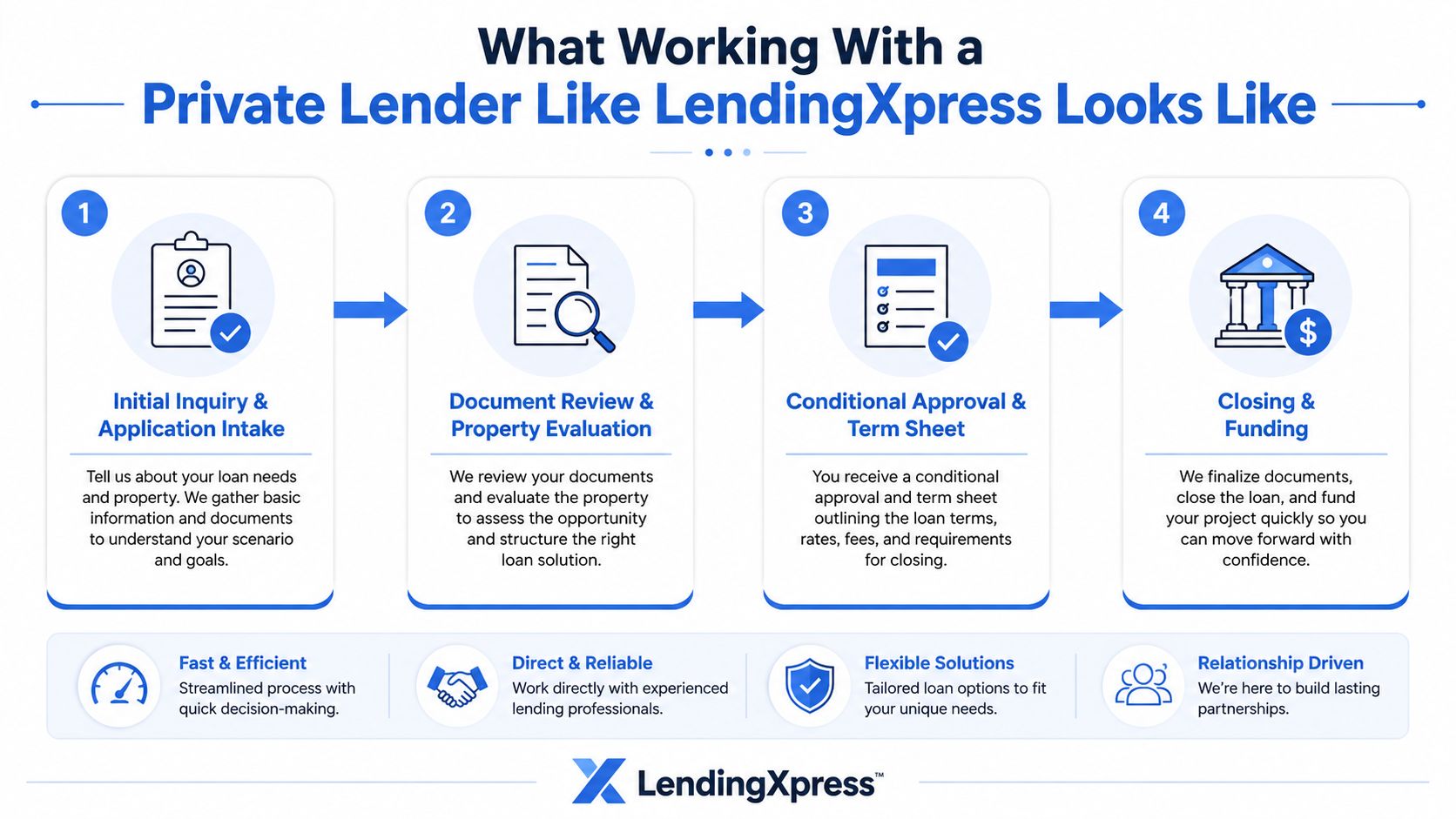
Reviewing the process before applying can expose problems early, especially a weak exit, missing insurance, or a repair budget that doesn't match the property's condition.
Putting the Numbers Together Before You Apply
A competitive note rate can still produce an expensive loan. Before applying, confirm the fee schedule, reserve requirements, and exit costs, then test the deal against its actual timeline. This 2026 bridge-rate market coverage provides market context, but your property, borrower profile, term, and exit will determine the quote.
Use this checklist:
- Review the note rate: Confirm whether it is fixed or floating, and identify the benchmark when applicable.
- Compare the all-in cost: Include points, origination charges, financed fees, reserves, extension terms, and exit fees. APR helps, but also calculate the dollars required to close and repay.
- Calculate monthly carry: Model interest on the expected outstanding balance, including financed costs and the reserve structure.
- Confirm the exit: Document whether repayment comes from a sale, refinance, stabilization, or another credible source. Stress-test delays and extension costs.
- Gather the file: Prepare the purchase contract, title information, insurance, property details, rehab budget, financial statements, and entity documents.
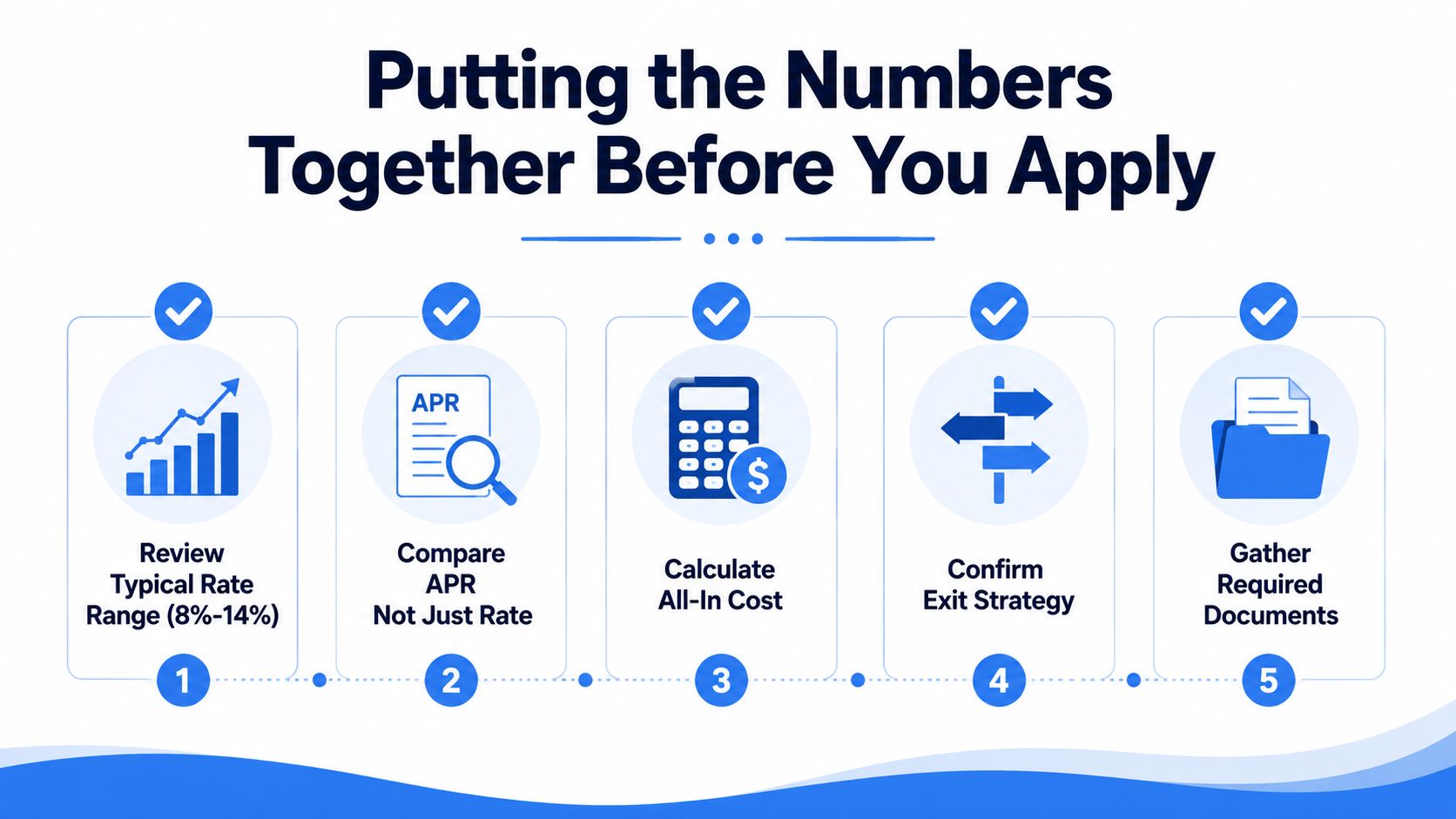
A strong application makes the risk easy to assess. Bring a defensible value, controlled scope of work, liquidity for surprises, and a payoff plan that fits the requested term. That preparation often matters more than chasing a lower headline rate.
If you are buying, refinancing, or repositioning a non-owner-occupied California property, LendingXpress can review the collateral, structure bridge financing, and clarify costs beyond the note rate. Provide the property details, requested loan-to-value, timeline, and exit plan for a practical term-sheet comparison.