
You've got a non-owner-occupied property under contract, the seller wants a fast close, and the bank is still asking for another document. Maybe the title is tied up in an estate. Maybe your income is difficult to document because you're self-employed. Maybe the building needs work before it can qualify for conventional financing. That's where the question what are private lenders becomes practical, not theoretical.
Private lenders provide real estate capital outside the traditional deposit-taking bank system. They can evaluate the property, the borrower's experience, the renovation plan, and the repayment strategy as one transaction. The tradeoff is clear: you may get speed and flexibility, but you'll usually pay more and carry a tighter deadline for repayment.
For California investors, the right lender depends on the deal. A fix-and-flip loan, a short bridge loan, an institutional private credit facility, and an asset-backed loan may all sit under the private lending umbrella, but they don't use the same underwriting or pricing. The sections below focus on non-owner-occupied properties and the four questions that matter: who lends, how the loan is built, what it costs, and when private financing is the right call.
When a Bank Says No and a Deal Says Yes
An investor in Sacramento has a $420,000 purchase contract on a probate sale. The seller requires a 14-day close, the property needs roughly $90,000 in work, and two banks have declined the loan. One is uncomfortable with the estate-related title condition. The other cannot verify the borrower's self-employed income within its underwriting rules.
A private lender reviews the same transaction through a different credit channel. The analysis centers on the property's as-is value, renovation budget, investor experience, and exit price supported by the planned sale. If title is insurable and the scope is workable, the lender may close in three business days, preserving a contract that bank timing would otherwise jeopardize.
A private lender measures a different risk profile, centered on collateral, sponsor capability, and exit strategy. Bank underwriting commonly gives greater weight to documented income, credit history, seasoning, appraisal standards, and a long repayment record. Private credit can include institutional funds, real-estate hard money lenders, and asset-backed lenders, each assigning different weight to those factors and structuring loans differently.
Start with the deal, not the rate
For a broker, begin with the constraint. What keeps the loan outside a bank program? It may be timing, property condition, incomplete income documentation, a nonstandard property, or a requested structure that does not fit the bank's matrix.
Then match the credit segment to the problem. Institutional private credit may suit a repeat sponsor seeking a larger or more customized facility. Real-estate hard money can fit a short acquisition or renovation loan where collateral and speed carry more weight. Asset-backed lending may make sense when the available collateral is stronger than the borrower's conventional income profile.
The structure still has to solve the deal without creating a larger problem. A short loan can work for a clean acquisition and realistic resale plan. It can fail when the rehab schedule is vague, projected value depends on aggressive comparables, or the borrower has no reserve for delays.
Practical rule: Private money works best when the collateral and exit are stronger than the borrower's bank file.
Before accepting a term sheet, compare the lender's segment, underwriting priorities, funding timeline, repayment deadline, and total capital cost. This guide explains how private lenders operate, how those segments differ, and what California borrowers should evaluate before signing.
What a Private Lender Is
A private lender is a non-bank, non-depository lender that originates or funds loans with private capital. The money may come from an individual investor, family office, trust deed investor, or pooled private credit fund. Depending on the platform, the lender may keep the loan, sell a participation, or place it within a broader investment structure.
The label covers several credit channels, and they should not be treated as interchangeable.
Who is lending
An individual investor may fund one deed of trust secured by a California investment property. An institutional private credit fund may deploy capital through a broker channel across many loans. Hard money lenders, bridge lenders, debt funds, and trust deed investors sit within this wider market, but they can differ sharply in loan size, process, pricing, and risk tolerance.
The New York Fed describes private credit as financing negotiated directly between a borrower and a small group of nonbank lenders, often through alternative asset managers and investment vehicles. Customized terms can serve borrowers whose projects do not fit standardized bank programs. The New York Fed's overview of private credit provides background on that broader market.
For a real estate investor, three segments matter most:
- Institutional private credit generally serves repeat sponsors and larger, more customized facilities.
- Real-estate hard money focuses on property-backed acquisition, bridge, and renovation loans where collateral and execution speed carry substantial weight.
- Asset-backed lending relies on identifiable collateral, which may include real estate or other assets, when the collateral profile is stronger than the borrower's conventional income file.
Where the money comes from
Private loans may be funded from a lender's balance sheet, investor commitments, or a fund structure rather than traditional depositor funding. That source of capital shapes return requirements, liquidity expectations, underwriting, and loan terms.
The private credit market extends well beyond small hard money shops. The Federal Reserve estimated private credit at about $1.34 trillion in the United States and nearly $2 trillion globally by 2024-Q2, with the market growing roughly fivefold since 2009. The Alternative Credit Council separately reported $3.5 trillion in global private credit assets under management and $592.8 billion in 2024 capital deployment, up 78% from 2023. Federal Reserve research on private credit size and characteristics places those figures in the context of nonbank financing.
Why the structure feels different
Private lenders can set approval procedures, documentation, and pricing around a specific asset and repayment plan. Business-purpose loans secured by residential real estate still require attention to licensing, disclosures, anti-money-laundering procedures, borrower identification, suspicious activity reporting, and state requirements. This private lender guide to usury and compliance explains why jurisdiction and compliance controls matter.
For a non-owner-occupied property, private lenders price for risk, speed, and customization. Rates and fees are generally higher, while decisions may arrive faster than through a conventional mortgage process.
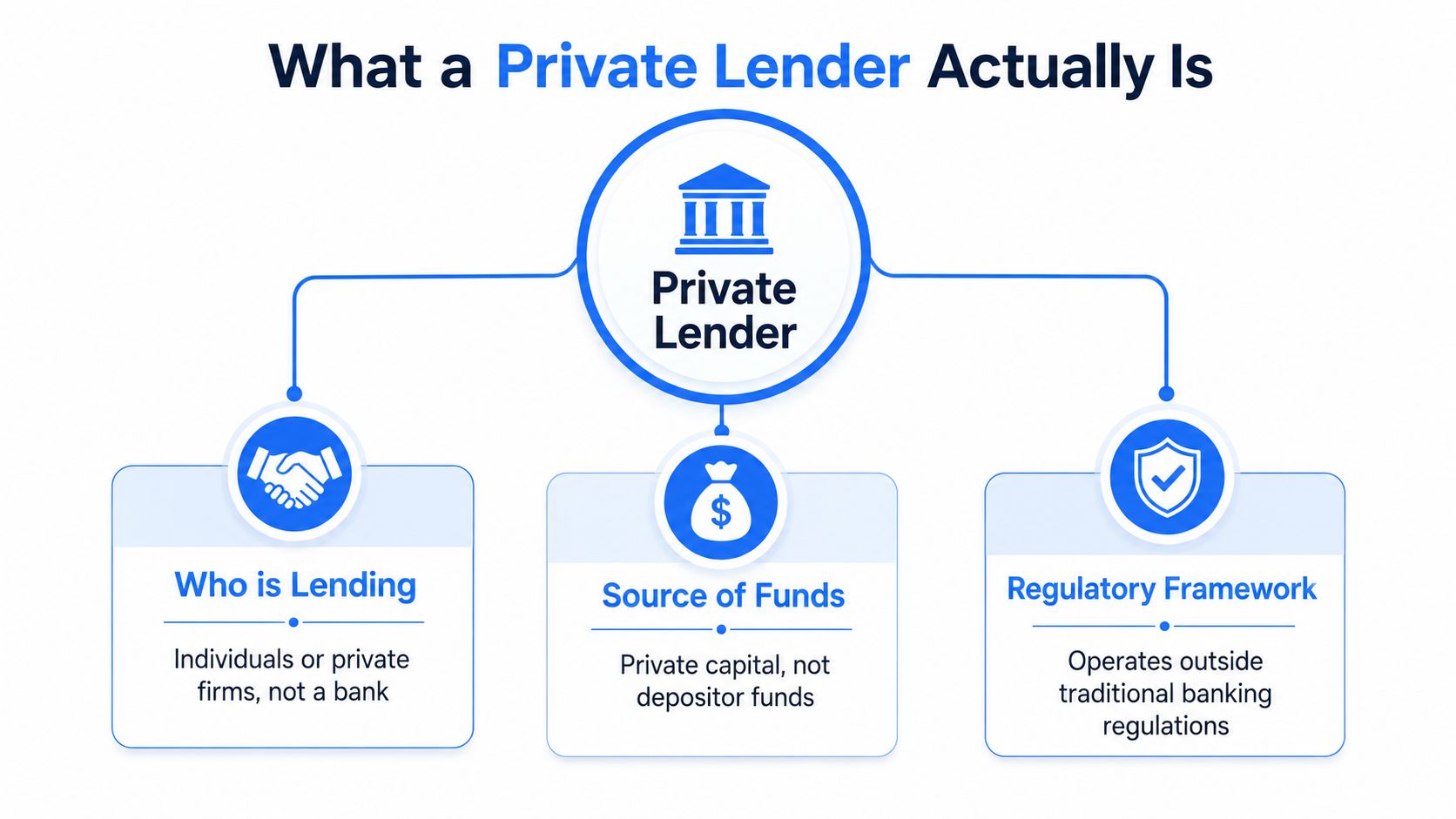
A useful working definition is a funding partner willing to underwrite a specific investment property and repayment plan outside conventional mortgage standards. Borrowers comparing private money lender options should first identify which private lending segment fits the deal.
How Private Lending Works Behind the Scenes
A California investor has a property under contract, a defined renovation plan, and a closing deadline the bank cannot meet. A private loan may solve the timing problem, but speed alone does not make it a good loan. The structure, underwriting basis, cost, and exit must fit the project. If one piece is wrong, a fast closing can create an expensive failure.
Structure comes first
Most California hard money loans are interest-only, with terms commonly running 6 to 24 months. The borrower pays monthly interest and repays the principal through a sale, refinance, or conventional take-out loan. The debt is generally secured by a recorded first- or second-position deed of trust.
A short term limits the lender's exposure to a defined project, while placing a deadline on the borrower. Delayed permits, construction overruns, or a slow sale can consume cash through interest and extension fees before the property is ready.
| Mechanic | Typical Range | What Drives It |
|---|---|---|
| Loan term | 6 to 24 months | Rehab schedule, sale plan, refinance timing |
| ARV LTV ratio | 65% to 75% LTV | Comparable sales, scope, marketability |
| As-is LTV ratio | 80% to 90% LTV | Current condition, collateral quality, liquidation risk |
| Interest rate | 9% to 12% | Property, borrower, loan size, term, exit |
| Origination points | 2 to 4 points | Loan size, complexity, execution risk |
| Legal and document preparation | $1,500 to $3,500 | Entity, title, loan structure, documentation |
The ranges come from the California private loan terms in the provided lending data. They provide market context, not a commitment for every property or borrower.
Underwriting follows the collateral
Private lenders commonly assess projected after-repair value at 65% to 75% LTV and as-is value at 80% to 90% LTV. They also review the borrower's experience, available reserves, construction plan, title, insurance, and exit strategy.
Income still matters, especially when the repayment plan depends on a refinance. For an investment loan, however, tax returns and W-2s may not be the primary approval tools. The lender is testing whether the collateral supports the proposed debt and whether the borrower can complete the plan.
The underwriting basis also depends on the credit segment. Institutional private credit may assess a larger operating business or portfolio, real-estate hard money centers on the property and project, and asset-backed lending focuses on identifiable collateral. A quote is meaningful only after the borrower identifies which segment is providing the funds.
Cost has more than one line item
The interest rate is only one part of the economics. At 9% to 12% interest with 2 to 4 points, a $400,000 loan carries roughly $12,000 to $16,000 in points, before legal and document preparation costs. California private lending guidance also describes private lending across real estate credit, special situations, and asset-backed strategies. Compare the full fee sheet, not only the headline rate.
Repayment depends on the exit
Monthly interest-only payments keep the current payment lower than an amortizing loan, but the principal remains due at maturity. A sale is often the cleanest exit for a flip. A refinance can suit a stabilized rental if the property and borrower qualify for the next lender's program.
Some private loans reduce the interest burden when repaid early. Others impose minimum-interest periods or extension conditions. Read those provisions before comparing term sheets with the same rate. A loan fits when its maturity, extension terms, and planned exit all work under a realistic timeline.
Private Lending vs Conventional Bank Financing
A California investor can have a profitable acquisition under contract and still lose it because the bank cannot close before the seller's deadline. The financing choice usually comes down to speed, documentation, borrowing capacity, pricing, and credit flexibility. A bank may cost less for a long-term rental, while private financing may protect the transaction when timing or property condition matters more.
| Metric | Conventional Bank | Private Lender |
|---|---|---|
| Closing speed | Often 45 to 75 days | Often 5 to 14 days |
| Documentation | Two years of tax returns, full appraisal, income and asset verification | Asset value, borrower experience, reserves, title, scope, and exit plan |
| Typical LTV for the outlined investment profile | Up to 75% to 80% LTV on stabilized income properties | About 65% to 70% of purchase price or 70% to 75% of after-repair value |
| Pricing format | A single mortgage rate with standard lender fees | Interest plus points and transaction-specific costs |
| Credit flexibility | Strong preference for documented income and conventional property standards | More focus on collateral, sponsor, property condition, and repayment plan |
The private lending ranges come from the provided California financing data. The conventional bank timing and documentation figures are deal-profile benchmarks, not universal guarantees. A quote also depends on the credit segment involved. Institutional private credit, real-estate hard money, and asset-backed lending may evaluate the same borrower and property differently.
When the bank is the better tool
Bank financing generally fits a long-hold rental with stable income, clean property condition, strong borrower documentation, and no immediate seller deadline. A borrower with a straightforward W-2 profile may accept the slower process in exchange for lower cost and a longer repayment structure.
The bank may require a full appraisal, title review, income verification, insurance documentation, leases, and operating information. Those requirements make sense for permanent financing, but they can delay a property that needs immediate work or a contract that demands rapid execution.
When private financing earns its place
Private financing fits a rehab, bridge acquisition, non-conforming property, or closing where the seller will not wait for conventional approval. The lender may give greater weight to collateral, the sponsor's experience, the project scope, and the repayment plan when income is irregular or the property falls outside a standardized program.
Bridge loans address a temporary timing gap. Industry guidance describes common bridge terms of 3 to 12 months and notes that conventional mortgages usually take 30 to 45 days, while clean bridge transactions may close in about 3 to 5 business days. This bridge loan timing guide explains why operational readiness matters, including complete documents, clear title, and a defined exit.
The right comparison measures whether the financing cost is lower than the cost of losing the acquisition, missing the renovation window, or being unable to act while a conventional approval remains pending.
Types of Private Lenders Real Estate Investors Use
A lender funding a Sacramento duplex rehab is solving a different problem from a fund refinancing a five-property portfolio. Private lenders are not interchangeable. Their capital base and operating model affect loan size, property type, draw procedures, underwriting, and how closely they review the exit.
Hard money lenders
Hard money lenders prioritize speed and collateral. They commonly fund fix-and-flip projects, heavy renovations, distressed acquisitions, and properties that need work before a bank will consider them.
A hard money lender may advance 70% to 75% of ARV, with renovation proceeds released through draws as work is completed. The borrower needs a credible scope of work, contractor documentation, realistic comparable sales, and enough liquidity for costs the loan does not cover.
The structure fits when the purchase price, repairs, and resale value support repayment. It becomes a poor fit when the projected ARV relies on one optimistic comparable or the borrower has no plan for cost overruns. Hard money is real-estate-specific credit, not a substitute for permanent financing.
Private bridge lenders
Bridge lenders cover a temporary financing gap. A borrower might need to acquire a rental before conventional financing is ready, refinance a maturing private loan, or buy a property that should qualify for permanent debt after stabilization.
These loans are commonly interest-only and may run 6 to 24 months, depending on the property and planned exit. The bridge lender focuses on whether the borrower can reach the next financing event, rather than structuring a long-term mortgage.
A refinance-pending close can justify bridge debt if the appraisal, leases, or seasoning requirement will be satisfied soon. It does not justify the loan when the borrower lacks a documented plan for the permanent lender. The exit must be specific, not “refinance later.”
Debt funds and trust deed investors
Debt funds and trust deed investors pool private capital into larger or more structured loans. They may serve repeat borrowers, portfolio investors, commercial borrowers, or acquisitions that need a facility rather than one simple note.
A five-property portfolio refinance or a $3 million Pasadena acquisition may fit this model better than a small hard money execution. The lender may require borrowing-base tests, property-by-property collateral, reserves, reporting, and release provisions.
Institutional private credit covers corporate lending, real estate credit, special situations, and asset-backed finance. The Alternative Credit Council reported $592.8 billion in private credit capital deployment during 2024, according to the Federal Reserve's discussion of private credit market data. That scale does not make every private loan institutional. It does show why investors should identify the credit segment funding the transaction. Asset-backed lenders, for example, may underwrite specific collateral and repayment sources rather than a conventional mortgage profile.
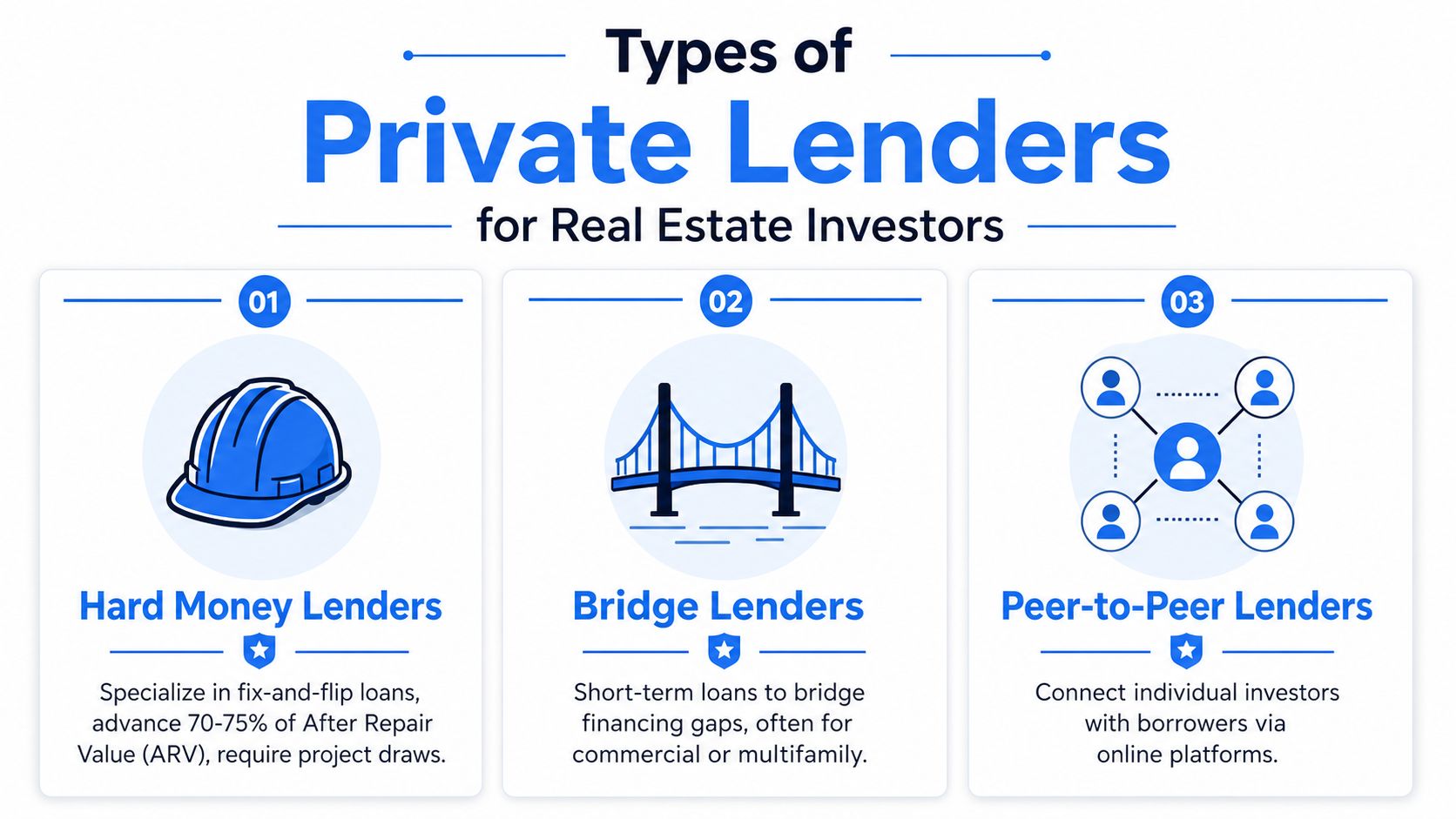
Private investor groups can also form informal lending arrangements. Before joining one, review governance, collateral control, servicing, reporting, and default procedures. Brokers and investors assessing these structures should also review private lending circles risks.
Match the lender to the job: hard money for a defined renovation, bridge debt for a temporary gap, and a debt fund, trust deed investor, or asset-backed lender for a larger or more complex capital need.
Rates, Risks, and the Rules Around California Private Lending
California private lending has two separate questions. The first is whether the loan makes economic sense. The second is whether the lender has structured and documented it correctly.
For business-purpose loans secured by residential real estate, private lenders operate within a layered compliance environment. There's no single federal usury ceiling governing private lenders in the way borrowers often assume. State rules, loan purpose, licensing, disclosures, borrower status, and property use all matter. This California private money lending overview gives borrowers a starting point for understanding the local context.
The pricing reflects that risk and structure. A private lender may quote a rate plus points because the loan requires rapid underwriting, customized documentation, construction monitoring, or a collateral-based approval that a bank wouldn't offer.
| Cost Component | Typical Range | Purpose |
|---|---|---|
| Interest rate | 10% to 13% | Compensates the lender for collateral, execution, and repayment risk |
| Origination points | 1% to 3% | Covers loan sourcing, underwriting, and funding costs |
| Minimum interest | 3 to 6 months | Protects the lender if the borrower repays immediately |
| Prepayment structure | Deal-specific | Defines whether early payoff reduces future interest |
| Legal and document preparation | $1,500 to $3,500 | Covers customized agreements, entity review, and closing work |
The ranges above come from the supplied California private lending data and are not a quote for a particular transaction.
The risks sit in the exit
A balloon payment is manageable only when the sale or refinance is realistic. If a rehab runs long, the borrower may pay interest while carrying taxes, insurance, utilities, and construction costs. If market value comes in below the projection, the next lender may not provide enough proceeds to retire the private loan.
Default remedies also matter. A recorded deed of trust gives the lender a security interest in the property, and California commonly uses non-judicial foreclosure procedures. Borrowers should understand the notice, cure, extension, and enforcement language before closing.
Borrower-side test: Calculate total interest, points, fees, carrying costs, and likely extension costs against the projected net profit. A low monthly payment doesn't make an expensive exit safe.
The strongest private loan is not the one with the most borrowing power. It's the one with enough room for the property to sell or refinance without relying on perfect timing.
How to Evaluate and Qualify With the Right Private Lender
Start by reviewing the lender, not just the term sheet. A fast approval from a lender that can't fund, won't explain fees, or changes terms at closing isn't a solution.
Use four review buckets
Credentials: Verify licensing where applicable, funding authority, track record, servicing setup, and the source of capital. Ask whether the lender funds directly or brokers the loan to another party.
Loan fit: Confirm the minimum and maximum loan size, county coverage, property types, LTV ceiling, rehab holdbacks, draw inspections, and reserve requirements. A lender may like the property but still reject the structure.
Execution: Get the expected closing timeline in writing. Ask for a complete fee sheet, appraisal and title requirements, prepayment language, extension terms, and the person responsible for decisions.
Borrower preparation: Have entity documents, purchase contract, rent or sale assumptions, comparable sales, construction bids, insurance information, reserves, and a clear exit strategy ready. Guidance on bridge loans and asset-based underwriting reinforces why property value and exit planning can matter more than personal income for this type of financing.

Before signing, ask these direct questions:
- What's your current rate range, and is it fixed or floating?
- Do you lend on my property type and in my county?
- What's your minimum and maximum loan amount?
- How long is the typical term, and is there an extension option?
- Do you allow interest reserves or construction holdbacks?
- What are your origination, underwriting, and processing fees?
- Is there a prepayment penalty, and how is it calculated?
- Who services the loan after closing?
- Can you provide recent closed loan examples and references?
- What happens if my exit slips by 30 or 60 days?
A credible lender won't avoid reasonable questions about funding, servicing, collateral, or default. Clear answers are part of the underwriting process for both sides.
Where LendingXpress Fits Into Your Financing Plan
LendingXpress fits the private lending model when a California investor needs a non-owner-occupied purchase or refinance loan and the bank process doesn't match the transaction. Its stated hard money offering covers $100,000 to $3,000,000, with LTVs up to 70% of after-repair value and up to 100% rehab financing for qualified borrowers. Those terms align with a defined fix-and-flip plan where the scope, value, and exit can be documented.
For purchase transactions with clean title, LendingXpress describes a three-day underwriting and closing process. That timing can suit a probate acquisition, a seller requiring a short close, or a bridge purchase where permanent financing is still pending. The actual timeline still depends on title, appraisal, insurance, documentation, property condition, and borrower responsiveness.
The company also offers a California Trust Deed Investment program, allowing private investors to participate in first-position notes and receive returns driven by borrower interest payments. That investor structure connects the lender-side capital source with the real estate transactions discussed above, although investors should review all program terms and risks before committing capital.
If you're a broker or investor, submit the property, purchase price, repairs, value, requested loan amount, and exit plan for review. A loan officer can then tell you quickly whether the deal fits a hard money purchase, bridge, refinance, or another private structure.
LendingXpress provides California private money financing for non-owner-occupied purchases, refinances, bridge loans, and fix-and-flip projects, including rehab funding for qualified borrowers. Visit LendingXpress to submit your scenario or speak with the loan officer team about a practical quote for your next deal.