
You find a strong off-market rental. The numbers work, the seller wants a quick close, and you already know how you'll improve the property. Then the bank conversation starts. Suddenly the deal is no longer about the asset. It's about tax returns, W-2s, debt-to-income ratios, committee timing, and whether your personal file fits a box that was built for owner-occupied borrowers.
That's where many investors lose good opportunities.
A business purpose mortgage for real estate investors solves a different problem than a standard home loan. It's built for non-owner-occupied property, for borrowers buying through an LLC, for projects that need renovation, and for investors whose income is real but doesn't show up neatly on a consumer mortgage application. If your priority is speed, flexibility, and qualification tied to the property rather than your personal paycheck, this is the lending lane worth understanding.
The Investor's Dilemma with Traditional Bank Loans
A common investor story goes like this. You identify a duplex, small apartment building, or mixed-use property at the right basis. You've already reviewed rents, repair scope, and exit options. You're ready to move.
Then the traditional lender asks for more documents, then more clarification, then more time.
Banks aren't wrong for how they lend. They're just built for a different borrower and a different type of transaction. Their process usually works better when someone is buying a primary residence, earning steady W-2 income, and willing to wait through a long approval cycle. Real estate investing rarely looks that clean.
Why the bank process stalls
Traditional underwriting often centers on your personal financial profile first. That creates friction for investors who:
- Write off legitimate business expenses and show lower taxable income than their actual cash position suggests
- Own multiple properties and have a more layered financial picture
- Buy through entities instead of in their personal name
- Need to close fast because the seller won't wait for a long committee process
- Are repositioning a property that isn't ready for conventional financing
A rental property with upside can still get rejected or delayed if the bank doesn't like how the borrower's income looks on paper.
A good investment deal can fail conventional underwriting even when the property itself makes sense.
That mismatch frustrates investors because the deal logic is often obvious. The property has rent potential. The market supports the plan. The renovation scope is manageable. But the file doesn't move because the lender is underwriting you like a homeowner, not like an investor.
The better-fit alternative
This is why many investors shift toward financing that matches the transaction instead of fighting against it. A business purpose mortgage is designed for non-owner-occupied real estate and the actual pace of investing. If you've run into delays with bank financing before, it helps to understand how to finance investment property with loan structures that are built around acquisitions, bridge scenarios, and rental cash flow.
The key difference is simple. Instead of asking whether your personal income fits a narrow consumer model, this type of loan asks whether the asset and strategy support the debt.
That's a much more useful question for an investor.
What Exactly Is a Business Purpose Mortgage
A business purpose mortgage is a loan for real estate held for investment or other business use, not for a primary residence. In practice, that means the lender is looking first at the asset, the exit plan, and the income the property can produce. Many programs also ask for less personal income documentation than a conventional mortgage, which is one reason investors use them for acquisitions, refinances, and transitional properties, as explained in Newfi's business purpose loan overview.
For an investor, that changes the conversation.
Instead of building the file around W-2s, tax returns, and consumer debt ratios, the loan is built around whether the property and the strategy support repayment. That gives investors a practical advantage in deals where speed matters, income is not neatly reflected on a tax return, or the property needs a different financing structure than a bank will offer.

What “business purpose” means in practice
The term matters because it defines the intent of the transaction. The proceeds are being used for an investment objective or business activity, not to finance a home the borrower plans to occupy.
That usually applies to borrowers who are:
- Buying rental property for cash flow or long-term appreciation
- Financing a fix-and-flip or light value-add project
- Refinancing a non-owner-occupied property to improve terms or pull out capital for the next deal
- Purchasing mixed-use or business-related real estate that falls outside standard consumer mortgage guidelines
This distinction also separates these loans from owner-occupied commercial financing, where the borrower's business generally occupies most of the property. For investors, the property is the business plan.
Why DSCR comes up so often
A large share of business purpose mortgages are structured as DSCR loans. DSCR stands for Debt Service Coverage Ratio, and the concept is straightforward. The lender compares the property's income to the proposed debt payment to see whether the asset can reasonably carry itself.
That approach works well for investors with complex tax returns, multiple entities, or income that looks inconsistent on paper even though the property performs.
In plain terms, the property has to make sense as collateral and as a source of repayment. That is what gives this loan type its edge. An investor can act on a property based on its numbers and business plan instead of waiting for a consumer underwriting model to catch up.
When this structure fits best
Business purpose financing is a strong fit when the borrower needs a loan that matches how investors operate. A rental refinance, a purchase through an LLC, a property with recent vacancy, or a deal that needs to close on a practical timeline often fits better here than in a conventional box.
There are trade-offs. Rates can be higher than agency debt, reserves may matter more, and the lender will still scrutinize the property, valuation, and exit strategy. But for many investors, that trade is worth it because the loan is built for execution. If the asset is sound and the plan is clear, a business purpose mortgage can give you access to deals that conventional financing slows down or filters out.
How Business Purpose Loans Differ from Conventional Mortgages
A conventional mortgage asks, "Does this borrower fit the bank's consumer box?" A business purpose loan asks, "Does this investment property and business plan support the debt?" That difference changes the entire process.
For investors, the practical advantage is speed and fit. A conventional lender often needs stable personal income, clean tax return analysis, and a file that looks familiar to consumer underwriting. A business purpose lender is usually more focused on the asset, the projected or in-place income, the condition of the property, and the exit plan.
The practical difference for investors
On a real deal, that means fewer conversations about explaining every write-off on a tax return and more attention on whether the property can perform as an investment.
That does not mean business purpose loans are easy money. They are built for a different use case. The lender still evaluates risk carefully, but the questions are more relevant to investors buying rentals, refinancing portfolios, or funding a property that needs work before it qualifies for long-term conventional debt.
| Feature | Business Purpose Mortgage | Conventional Residential Loan |
|---|---|---|
| Underwriting focus | Property income, collateral strength, LTV, LTC, ARV, and exit plan | Personal income, employment history, credit profile, and consumer debt ratios |
| Borrower profile | Real estate investors and business entities buying non-owner-occupied property | Individual borrowers, often in owner-occupied or standardized residential scenarios |
| Documentation | Often lighter on W-2s, pay stubs, and personal tax return analysis | Usually heavier on personal financial documentation |
| Speed and flexibility | Better suited to tight closings, distressed assets, and properties in transition | Often slower and less adaptable to unusual property or entity structures |
| Property condition | Can work for assets that need rehab or stabilization | Usually prefers properties in standard financeable condition |
Why this matters on real deals
An investor under contract on a vacant fourplex, a distressed single-family rental, or a property with deferred maintenance can lose the deal while a conventional file works through consumer-style conditions. Sellers, wholesalers, and brokers notice which buyers can close on time.
That timing edge matters. Investors who can use financing built around the asset often get better access to properties that need quick decisions, entity borrowing, or a clear repositioning plan. If you are comparing structures, this guide to real estate investor loan options helps sort out which loan matches the deal instead of forcing the deal into the wrong loan.
Tax planning matters too. Entity structure, depreciation, and how the property fits your broader investment plan can affect which financing route makes sense. Investors should review strategy with qualified advisors and practical resources such as Allied Tax property investment guidance.
What works and what creates problems
What works:
- Choosing financing based on the property's business plan
- Using asset-based underwriting for non-owner-occupied investments
- Having a clear rehab scope, rent strategy, or sale exit before application
- Knowing your cash needs for down payment, reserves, and repairs up front
What creates problems:
- Using consumer financing for a deal with investor-level complexity
- Waiting until contract deadlines are tight to solve the financing structure
- Assuming strong personal income makes up for a weak asset or unclear exit
- Ignoring how vacancy, condition, or title issues affect lender appetite
Experienced investors usually do not shop on rate alone. They look for the loan that gives them the highest probability of closing, executing the plan, and protecting margin.
Finding the Right Loan for Your Investment Strategy
Not every investment property should be financed the same way. A fast resale, a long-term rental, and a heavy renovation each need a different structure. Investors get into trouble when they choose a loan based on the rate headline instead of the actual business plan.
The right loan should support what you're trying to do with the property over the next several months, not just get you through closing day.
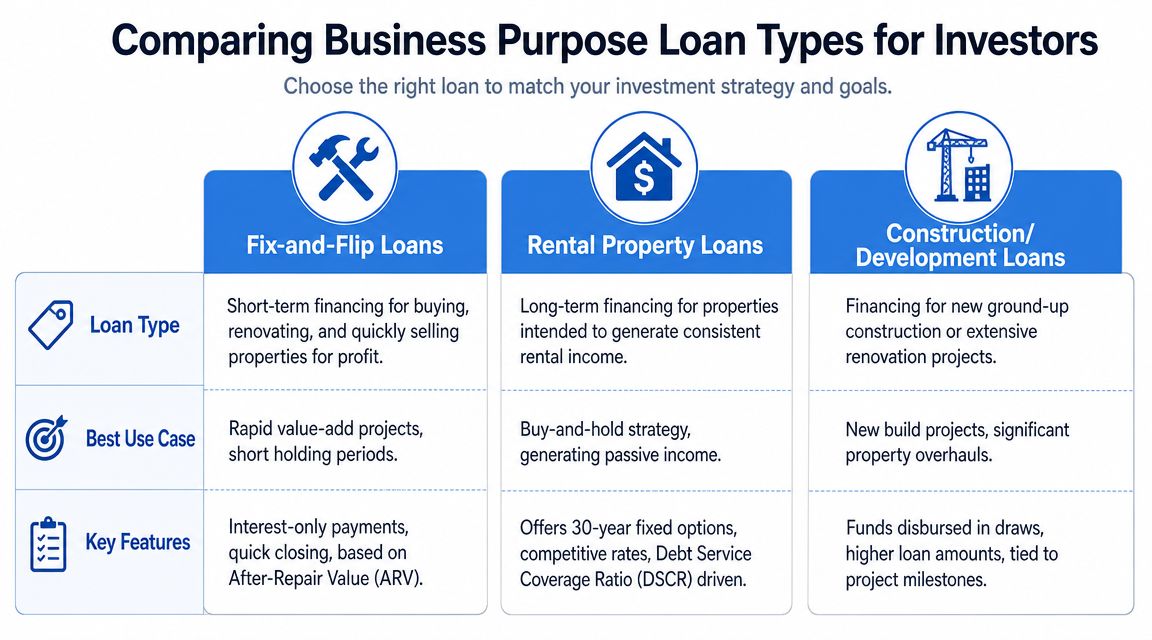
Bridge loans for speed and transition
Bridge loans fit deals where timing matters more than perfect long-term terms on day one. That often includes auction purchases, properties with title or condition issues, cash-out to solve a short-term capital need, or acquisitions where you plan to refinance later once the property is stabilized.
This structure works well when the investor already knows the next step. Maybe the plan is to renovate, raise rents, then move into rental financing. Maybe the asset will be sold after cleanup and light improvements. The point is that bridge debt works best when there's a clear transition.
Use a bridge loan when:
- The deal won't wait for conventional timing
- The property needs work before long-term financing makes sense
- You need a clean short-term exit, such as sale or refinance
It's a poor fit when the borrower doesn't have a realistic repayment plan. Short-term money is useful. Drifting without an exit is expensive.
Fix and flip loans for value-add projects
A fix and flip loan is designed around the project itself. That means purchase plus renovation, draw schedules, and underwriting tied to the property's projected value once the work is complete.
For fix-and-flip projects, specialized business purpose loans are structured to fund both the purchase and the renovation. Lenders like LendingXpress can finance up to 100% of the rehab costs, disbursing funds in draws as work is completed, which helps investors preserve capital for other opportunities, as described on the LendingXpress lending platform.
That structure is especially useful for experienced investors who'd rather keep cash available for contingency, carrying costs, or the next acquisition instead of tying everything up in one rehab.
If the project depends on renovation, your financing should account for renovation from the start.
Rental loans for long-term hold investors
Rental property loans, often structured as DSCR financing, fit investors who plan to hold the asset and rely on its income over time. This is usually the better path once the property is stabilized or close to stabilized.
These loans make sense for investors who care more about durable debt than short-term flexibility. The asset's ability to support debt service becomes central, which is often a better fit than trying to qualify through personal tax returns alone.
A simple way to think about the choice:
- Bridge if you're moving between stages
- Fix and flip if the renovation is the business plan
- Rental if the hold strategy is the end goal
For a broader look at structures investors commonly compare, review loan options for real estate investors.
One more factor investors shouldn't ignore
Loan choice also affects tax planning, entity strategy, and how profits flow back to the borrower. That part is often overlooked until late in the transaction. If you're weighing whether a property should be held for resale, retained as a rental, or acquired inside a specific ownership structure, this overview of Allied Tax property investment guidance is a useful companion to the financing discussion.
The financing should support the strategy. It shouldn't force you into the wrong one.
The Common-Sense Underwriting Process Explained
A lot of investors come into this stage expecting a maze. They assume private or business purpose lending will be opaque, inconsistent, or harder to qualify for than a bank loan. In practice, the process is usually more practical because the file is judged on the property, the business plan, and the likely payoff, not on whether personal income fits a conventional box.
That is the key advantage.
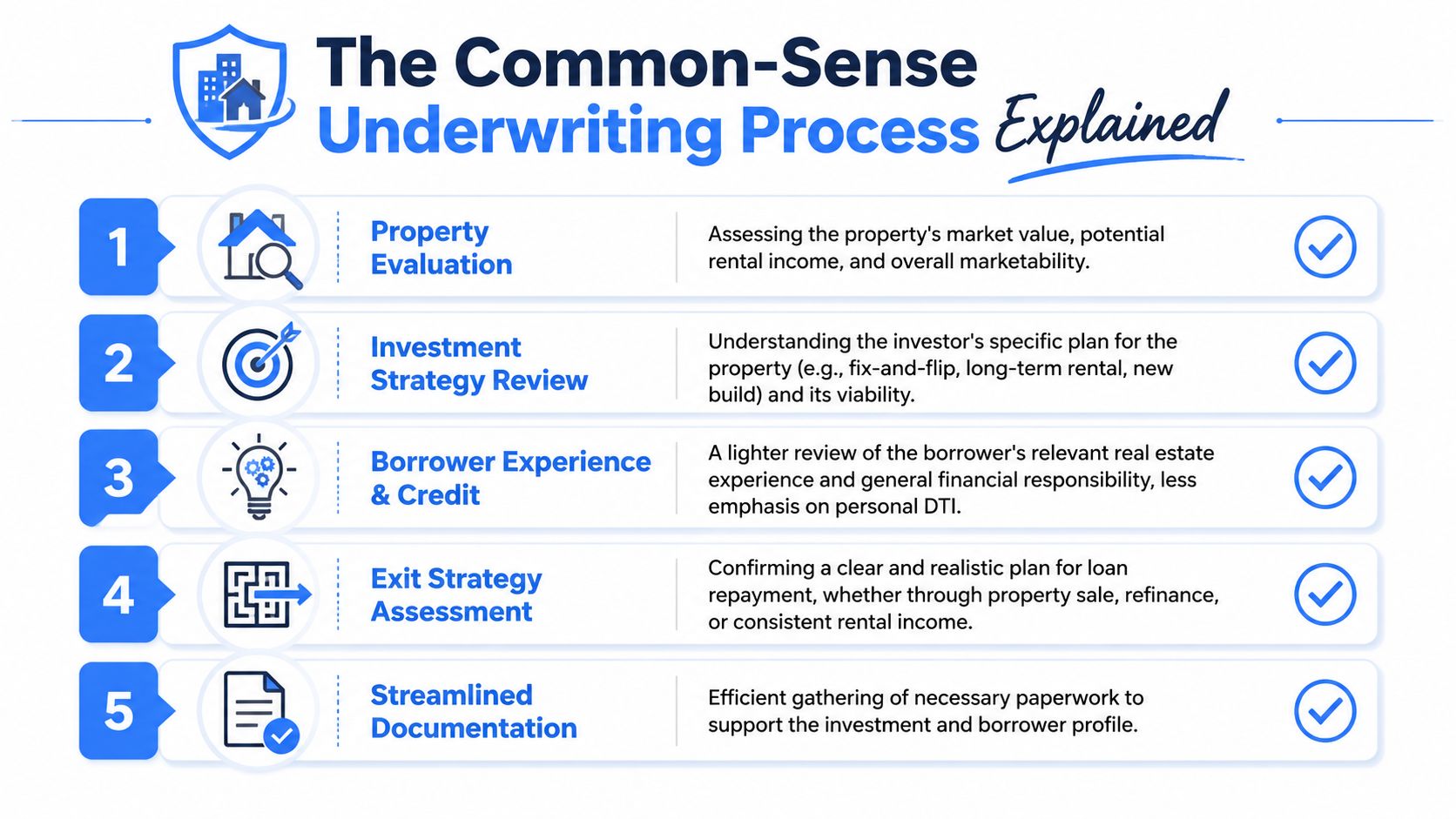
What the lender is really reviewing
A business purpose mortgage is usually underwritten around three questions. Is the asset solid? Does the plan make sense? Is there a believable way out of the loan?
That shifts the focus toward the collateral and the execution risk. Lenders are usually reviewing LTV, LTC, and ARV, along with the borrower's cash contribution, property condition, timeline, and exit path. Personal credit and experience still matter, but they are part of the file, not the entire file. For investors who are self-employed, write off heavily, or buy through entities, that difference can be the edge that gets a deal closed.
A typical review looks like this:
- Property value comes first. The lender reviews current value, purchase price, marketability, and, where applicable, the projected value after repairs.
- The plan has to fit the asset. A flip, rental hold, refinance, or sale should be realistic for that property and that submarket.
- The financing has to be reasonable. Strong properties can still become weak loans if the request leaves no room for delays, cost overruns, or a softer resale.
- The exit has to be clear. Short-term debt requires a defined payoff path, not a vague hope that conditions will improve.
- Borrower quality still counts. Experience, liquidity, credit history, and how the investor handles prior projects all affect the final risk decision.
This is why business purpose lending can move faster than a bank loan without being careless. The underwriting is narrower, but it is not lighter.
The exit strategy is not a formality
A lot of marginal files break down here.
An investor may have a good purchase, a decent budget, and enough cash to close, but if the payoff plan depends on perfect rehab timing, top-of-market resale pricing, and an easy refinance six months later, the file gets weaker fast. Lenders want to see a primary exit and, ideally, a backup if the first plan slips.
A credible exit strategy might be:
- Sale after renovation
- Refinance into long-term rental debt
- Payoff through stabilized rental income
- Disposition of another asset or planned recapitalization
The point is not to present a polished pitch. The point is to show that the numbers still work if the deal takes longer, costs more, or rents for less than expected.
Borrowers don't need a perfect story. They need a believable one.
What helps your approval odds
Clean files win time.
The strongest submissions usually include the purchase contract, rent roll if there is one, a rehab scope and budget if work is planned, entity documents, and a short summary of the strategy. A lender can make decisions much faster when the file answers the obvious questions up front. That matters in competitive acquisitions, but it also matters after closing, because a well-documented file tends to produce fewer surprises during draws, extensions, or refinance.
What slows things down is predictable:
- Messy or incomplete budgets
- No clear explanation for the exit
- Aggressive valuation assumptions with little support
- Entity or title problems discovered late
- Requests for high financing with too little borrower cash in the deal
At LendingXpress, the goal is to get to the actual credit decision quickly. If the asset is financeable and the plan holds up, the process should feel direct. Business purpose underwriting rewards preparation and clarity. It gives investors a practical way to compete when traditional income documentation would slow the deal or knock it out entirely.
Why a Reliable Lending Partner Is Your Greatest Asset
The loan structure matters. The lender matters just as much.
Investors don't just need capital. They need a lending partner who understands that timing changes outcomes. A delayed closing can cost the deal. A slow rehab draw can stall the project. A weak refinance process can trap equity when the next opportunity is already on the table.
That matters even more in a market where refinance capital remains important. Deloitte reported that new loan volume through the beginning of 2025 was up 13% from the end of 2024 and more than 90% from the same time a year earlier, while commercial mortgage loan spreads tightened by 183 basis points. The Mortgage Bankers Association also reported that 17% of the $5.0 trillion in outstanding commercial mortgages was scheduled to mature in 2026, equal to roughly $875 billion of loans, which shows why access to dependable refinance execution remains important in commercial and investor lending, according to Deloitte's commercial real estate outlook.
What reliability looks like on real transactions
Consider three common scenarios.
An investor wins a property where the seller wants certainty and speed. A lender that drifts, asks the same questions repeatedly, or changes direction late creates risk even if the initial quote looked attractive.
A flipper needs a lender that understands renovation budgets and draw timing. If the capital side doesn't keep pace with the construction side, the project suffers.
A rental owner needs to refinance out of short-term debt before the hold becomes uncomfortable. In that situation, responsiveness is not a bonus. It's part of the investment plan.
What to look for before you commit
Choose a lender that can answer basic questions directly:
- What property types fit the program
- How they view debt funding and cash contribution
- What documents they need upfront
- How they handle draws or refinance timing
- Who will manage the loan from quote to closing
The right lender reduces friction. The wrong lender creates it at every stage.
A business purpose mortgage for real estate investors is more than an alternative to a bank loan. Used correctly, it's a tool for moving faster, qualifying on the strength of the asset, and keeping your strategy intact when conventional financing doesn't fit.
If you're evaluating a purchase, refinance, or rehab on a non-owner-occupied property, LendingXpress is one place to discuss the deal structure, timeline, and exit strategy before you lose time chasing the wrong financing path.