
You've built a few rentals. The leases are in place, the rent rolls look healthy, and the properties are doing their job. Then you go back to a bank for the next acquisition or refinance, and the conversation shifts away from the assets. The banker starts drilling into your personal debt-to-income ratio, tax returns, and how many mortgages already sit under your name.
That's where a lot of capable investors get stuck.
DSCR loans for rental portfolios were built for this exact point in the growth cycle. Instead of forcing a rental business into owner-occupant bank rules, they look at whether the portfolio can carry its own debt. For investors trying to buy multiple rentals, refinance several properties together, or keep growing after conventional financing tightens up, that shift matters.
Scaling Your Rentals Beyond Traditional Bank Limits
Traditional banks tend to reward simple files. One borrower. One property. Clean W-2 income. Low personal debt. That works fine at the beginning. It gets harder once you own several non-owner-occupied properties, especially if your tax returns show write-offs or your debt load looks heavy on paper even while the rentals perform well.
A portfolio investor thinks differently. You're not just buying houses. You're building an income-producing operation. The financing should reflect that.
Why investors hit the wall
The usual problem isn't always weak properties. It's mismatch. The bank underwrites you like a consumer borrower while you're operating like a business owner. The more rentals you add, the more likely that mismatch becomes.
Common friction points include:
- Personal income scrutiny: Tax returns and debt ratios can look weaker than the actual portfolio.
- Mortgage count issues: More financed properties often means more resistance from conventional channels.
- Entity ownership complications: Many investors hold rentals in an LLC or another entity, which can create extra hurdles with bank programs.
- Slow decision-making: By the time the file moves, the opportunity may already be gone.
Practical rule: If your rentals are stable but your personal profile is what keeps getting flagged, you need a loan program that underwrites the assets first.
Where DSCR portfolio lending fits
A DSCR portfolio loan changes the conversation. The lender focuses on cash flow from the properties rather than your W-2 income. That doesn't mean the process is loose. It means the process is aligned with the asset class.
This is especially useful when you want to refinance several rentals into one structure, buy a package of properties, or keep liquidity available instead of tying up all your capital in separate loans. Good investors don't just chase approval. They protect flexibility. That's why portfolio-level DSCR lending has become such a practical option when banks say no for reasons that have little to do with the actual rental performance.
What Are DSCR Loans for Rental Portfolios
A DSCR loan asks a simple business question. Does the rental income cover the debt tied to the property or portfolio?
DSCR stands for Debt Service Coverage Ratio. For a single asset, it measures whether that property's income can support its payment obligations. For a portfolio, the same idea gets applied across multiple rentals under one structure.

Think of the portfolio as a rental business
The cleanest way to understand this is to treat the portfolio like a small operating company. The properties produce rent. The portfolio has expenses and debt service. The lender wants to know whether the operation supports the loan.
That's the part many guides miss. They stop at the single-property formula. Portfolio borrowers care about something else. They want to know whether a lender will look at each property on its own, whether strong assets can offset weaker ones, and how the file gets handled when several rentals are refinanced together.
Public guidance on DSCR loans often says they rely on property cash flow, usually avoid personal income documentation, and commonly require 20%–30% down with 3–6 months of reserves, but it rarely explains how those rules behave once multiple rentals sit in the same deal, as noted in this discussion of DSCR underwriting gaps for portfolio borrowers.
What changes at the portfolio level
When multiple rentals are grouped, the underwriting focus moves from one address to the aggregate performance of the portfolio. That can help if one asset is temporarily weak while the rest are stable. It can also hurt if the portfolio looks fine on paper but reserves are thin or one property introduces too much volatility.
Here's the practical takeaway:
| Underwriting question | Single-property view | Portfolio view |
|---|---|---|
| Income review | One rent stream | Combined rent across rentals |
| Debt review | One property payment | Combined debt obligations |
| Weak property impact | Can derail the file alone | May be absorbed by stronger assets |
| Reserve discussion | Property-specific | Often reviewed with a broader liquidity lens |
| Strategy focus | Asset approval | Portfolio durability |
A high DSCR on one rental doesn't automatically fix a weak portfolio. Lenders still want to see a structure that holds together if one unit turns over or one asset underperforms.
That's why DSCR loans for rental portfolios work best when the investor is thinking two moves ahead. Approval matters. So does how the portfolio behaves after closing.
How to Calculate Your Portfolio DSCR
The math is straightforward once you separate the process into pieces.
At the property level, the basic idea is net operating income divided by total debt service. At the portfolio level, you apply the same logic using combined figures from all included rentals. You're measuring whether the group of properties produces enough income to support the group's debt.

Start with one property
Before you calculate a full portfolio, run the numbers on each rental individually.
Use this workflow:
- Gather gross rent: Start with current lease income or market rent if the property is being underwritten that way.
- List operating expenses: Include the property costs that affect operating income.
- Find NOI: Subtract operating expenses from gross rental income.
- Determine debt service: Use the loan payment obligations tied to that property.
- Calculate DSCR: Divide NOI by debt service.
This won't replace a lender's worksheet, but it will tell you quickly whether a property is pulling its weight.
A practical way to organize this is with an investor income tracking spreadsheet. If your rents, lease dates, and property-level expenses are messy, your DSCR estimate will be messy too.
Then combine the portfolio
For a portfolio loan, aggregate the same categories across all included properties. Add total rent. Add total operating expenses. Add total debt service. Then divide combined NOI by combined debt service.
A portfolio often has mixed performers, a factor that influences lender assessment. One long-held rental may be very strong. Another may be recently renovated and not fully seasoned. Another may have just turned over. The lender is trying to decide whether the whole pool is dependable enough to support the note.
Here's a simple framework for reviewing a three-property portfolio without assigning made-up numbers:
| Property | Rent strength | Expense load | Debt load | Likely role in portfolio |
|---|---|---|---|---|
| Property A | Strong | Stable | Moderate | Supports aggregate cash flow |
| Property B | Average | Stable | Average | Neutral contributor |
| Property C | Weak or transitional | Elevated | Higher | Drag on overall DSCR |
If Property A throws off solid cash flow and Property B is steady, they may offset a softer Property C in a combined review. That's one reason portfolio underwriting can open doors that a property-by-property approval model would close.
Later in your prep, it helps to see a visual walkthrough of the sequence:
What investors often miss
The formula is simple. The judgment call is not.
Three issues tend to distort a borrower's own estimate:
- Vacancy blind spots: Investors sometimes understate the effect of a recent turnover.
- Expense smoothing: A property with irregular repairs can look stronger on a quick spreadsheet than it will in underwriting.
- Portfolio optimism: Borrowers often assume the strongest asset will carry the whole file. Sometimes it can. Sometimes the weak link still dominates the conversation.
If you want to know where your deal stands, don't just calculate the portfolio once. Run it three ways. Current performance, stabilized performance, and conservative performance. That gives you a much clearer view of whether the file is financeable.
The Lender Underwriting Playbook
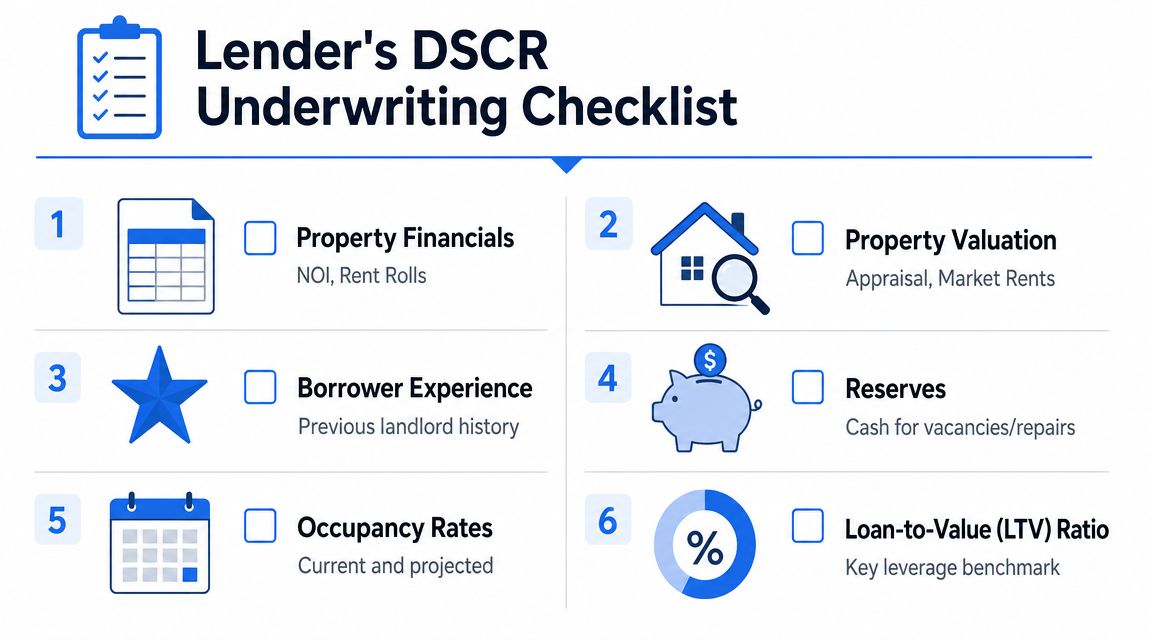
A lender's review is usually less mysterious than borrowers think. For a DSCR portfolio loan, the file rises or falls on a handful of core items. If those line up, the deal moves. If they don't, no amount of explanation fixes it.
The key benchmarks are fairly consistent. A common qualification benchmark is 1.0, which means breakeven, while many lenders prefer 1.0–1.25 or higher. A 1.25 DSCR stands out because it shows the property or portfolio generates 25% more income than needed to cover annual debt obligations. Lenders also often look for 20%–25% down, 3–6 months of cash reserves, and a borrower credit score in the 620–680+ range, based on RCN Capital's overview of DSCR portfolio lending benchmarks.
The four numbers that matter most
Borrowers often focus only on DSCR. Lenders don't. They look at the file as a risk stack.
- DSCR: At 1.0, the portfolio is roughly covering its debt. At 1.25, there's a meaningful cushion.
- Down payment or LTV: The borrower usually needs enough equity in the deal to show commitment and reduce lender risk.
- Credit profile: Stronger credit doesn't replace weak cash flow, but weak credit can tighten the box fast.
- Reserves: Liquidity matters because even good portfolios hit repairs, vacancies, and leasing gaps.
Underwriting mindset: A lender isn't asking whether the portfolio works in a perfect month. The lender is asking whether it still works when one property has a bad month.
What gets reviewed beyond the headline ratio
Real files take precedence over online summaries. The lender wants organized property financials, lease support, valuation support, and entity documents if the borrower is using an LLC or similar structure.
Expect review of items such as:
- Rent rolls and leases: To verify occupied income and consistency across the portfolio.
- Appraisal and market rent support: To test whether the stated rents line up with the market.
- Entity paperwork: If title or borrowing sits in a business entity.
- Liquidity documentation: To confirm available reserves.
- Borrower experience: Not always decisive, but it can help frame the file.
A practical reference point for preparing the file is the DSCR loan requirements page from LendingXpress. It helps borrowers see the kinds of items lenders typically want before they issue terms or move to final approval.
What usually causes friction
The hardest files are not always the risky ones. They're the ones with conflicting information.
A few examples:
| File issue | Why it slows approval |
|---|---|
| Leases don't match rent roll | The income picture looks unreliable |
| One asset is unstable | The portfolio may look weaker than the summary suggests |
| Reserve funds are unclear | Liquidity strength can't be confirmed |
| Entity documents are incomplete | Closing structure becomes harder to finalize |
If you want a faster answer, hand the lender a file that tells one clean story.
DSCR Loans vs Other Investment Financing
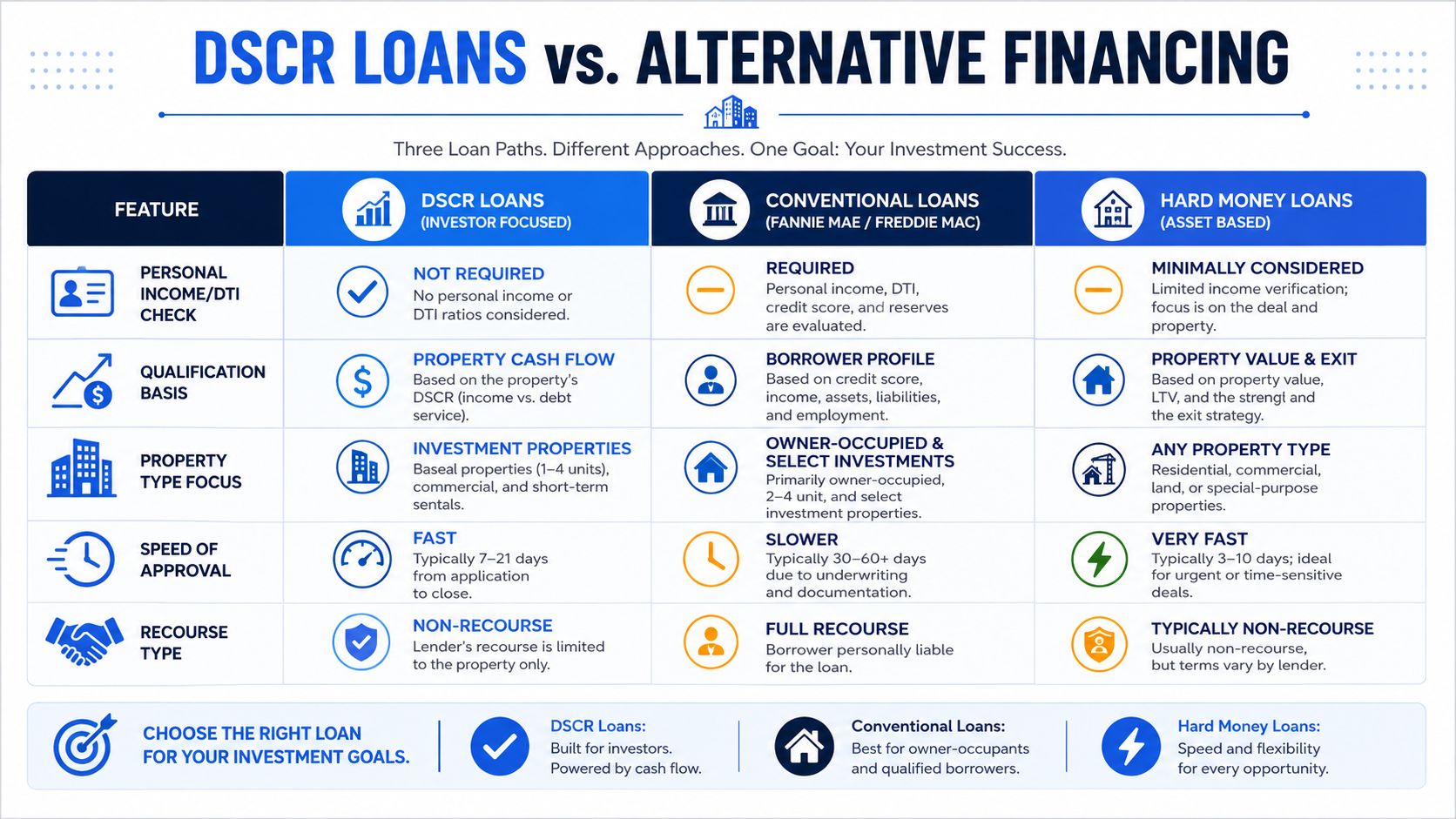
A DSCR portfolio loan is useful, but it isn't always the right tool. Investors make better financing decisions when they match the loan to the strategy instead of forcing every deal into the same box.
The key comparison isn't “good loan versus bad loan.” It's which loan solves the exact problem in front of you.
Where DSCR fits best
DSCR financing makes the most sense when the property or portfolio is the strongest part of the file. If your rentals are stable but your personal tax returns are messy, this is often the cleanest path.
Conventional financing tends to work better when the borrower has strong documented income and doesn't mind a more traditional review. Blanket or cross-collateral portfolio structures can be useful when several assets need to sit under one note. Hard money or bridge debt fits when speed matters more than long-term carry.
Side-by-side decision view
| Loan type | Best qualification basis | Speed | Documentation burden | Best use case |
|---|---|---|---|---|
| DSCR loan | Property or portfolio cash flow | Often faster than bank financing | Lighter than full conventional | Stabilized rentals and portfolio growth |
| Conventional mortgage | Personal income and debt profile | Usually slower | Heavy | Borrowers with strong W-2 or tax return support |
| Blanket or portfolio loan | Combined asset strategy | Varies by lender | Moderate to heavy | Consolidating several rentals |
| Hard money or bridge | Asset value and exit plan | Fast | Light to moderate | Acquisition, repositioning, short-term financing |
If you're sorting through options for a non-owner-occupied property, this broader guide to how to finance investment property gives a useful high-level framework.
A DSCR loan is strongest when the property is already acting like a business. A bridge loan is stronger when the property still needs work before it can perform like one.
The trade-offs that matter in practice
Investors sometimes hear “fast and flexible” and stop there. That's incomplete. DSCR lending can be faster and less document-heavy than a bank loan, but it also asks for stronger asset performance and a more disciplined reserve position than some borrowers expect.
Conventional loans can be cheaper in the right file, but they're often less forgiving if your personal debt load is already stretched. Hard money can get you to closing quickly, but it usually works best as a short-term tool, not as permanent rental debt. Blanket structures simplify payments, but they can reduce flexibility when you want to sell or refinance one property later.
The right move depends on what you're trying to optimize. Speed. Funding power. Simplicity. Liquidity. No single loan wins every category.
Actionable Strategies to Improve Your Portfolio DSCR
If your portfolio is close but not quite there, don't assume the answer is no. In many files, the ratio improves when the investor fixes a few operational issues before applying.
Strong operators distinguish themselves from hopeful borrowers. They don't argue with the numbers. They improve them.
Raise income where the market supports it
A lot of portfolios carry legacy rents. If a property has been stable for years, that can be great for occupancy, but it can also leave income below current market support. Review each lease against real local comparables and decide whether increases are justified at renewal.
Be disciplined here. Pushing rents without understanding the tenant profile can create vacancy that hurts the file more than the increase helps. The goal is durable income, not a temporary headline number.
Cut the expenses that don't need to be there
Some expense drag is operational, not structural. Investors often accept old insurance pricing, outdated service contracts, or tax assessments they've never reviewed.
Focus first on the costs you can control:
- Insurance review: Shop coverage and confirm you're not overpaying for the current risk profile.
- Tax review: If an assessment looks inflated, challenge it through the proper local process.
- Maintenance discipline: Recurring small repairs often signal a larger deferred issue that should be fixed once instead of patched repeatedly.
- Vendor cleanup: Remove duplicate or low-value service costs across the portfolio.
Restructure the weakest point in the pool
Sometimes the fastest improvement doesn't come from boosting the strongest asset. It comes from fixing the property that's pulling the portfolio down.
That might mean paying down debt on one rental, stabilizing a vacancy before applying, or separating a problem property from the refinance request. Not every asset belongs in the same loan application.
The cleanest approval path is often subtraction. One inconsistent property can create more drag than two strong properties can overcome.
Sell the chronic underperformer
This isn't always the answer, but sometimes it is. If one property consistently produces weak rent relative to its debt load, absorbs management time, and raises questions in every lender review, selling it may strengthen the portfolio more than trying to finance around it.
A better portfolio is not always the bigger portfolio. It's the one that gives you options.
Secure Your Portfolio Loan with LendingXpress
Once your numbers are organized and your strategy is clear, the financing process should feel straightforward. Most delays happen because the borrower submits a file that hasn't been cleaned up first. Missing leases, unclear entity documents, and inconsistent property data create slowdowns long before underwriting reaches a real decision.
What a clean application looks like
Start with the basics. Gather your rent roll, current leases, property-level expense information, entity documents if you're borrowing through an LLC, and clear information about which properties belong in the portfolio request.
Then pressure-test the story before you send it out:
- Make the property list final: Don't keep swapping assets in and out midstream.
- Reconcile income documents: Lease amounts, deposit history, and rent roll figures should line up.
- Show reserve strength clearly: If liquidity is spread across accounts, present it in a way that's easy to verify.
- Flag unusual situations early: Vacancy, recent rehab, or a tenant issue is easier to discuss upfront than late in underwriting.
Why lender fit matters
Not every lender handles investor files with the same mindset. Some lenders are comfortable with straightforward stabilized portfolios. Others are better with transition assets or more complex entity structures. The right fit depends on your portfolio, your timeline, and whether the lender knows how to look at a file built around rental income rather than personal employment income.
For borrowers exploring options, LendingXpress is one lender that offers financing for non-owner-occupied investment properties and works with investors who need a practical alternative when conventional financing falls short.
Keep the conversation focused
When you talk to a lender, don't lead with a life story. Lead with the deal.
Summarize the portfolio, explain the financing goal, identify any weak spots, and show how the numbers support the request. That usually gets you to a real answer faster. Good lenders don't need a polished pitch. They need a coherent file.
If you're ready to review your rental portfolio and see whether a DSCR structure fits, talk with LendingXpress. A focused review of your rent roll, reserves, and property mix can tell you quickly whether the path is a portfolio refinance, a new acquisition loan, or a different financing structure that better matches your next move.