
You find a strong commercial deal on Monday, get a signed contract on Tuesday, and by Wednesday the main problem appears. The property needs work, the rent roll is uneven, and the seller won't wait for a slow bank process.
That's where most investors get stuck. They don't need a generic explanation of loan types. They need to know which financing tool fits the actual deal in front of them.
Commercial property investment loans are really about matching capital to strategy. A fully leased neighborhood retail center, a half-vacant office building, and a warehouse in lease-up may all be “commercial real estate,” but they don't belong in the same lending bucket. The wrong loan can kill a good acquisition. The right one can buy you time, flexibility, and a clean path to stabilization.
This is especially true for non-owner-occupied properties, where lenders care less about your plans and more about whether the asset, the borrower, and the exit all line up. If your deal is straightforward, long-term bank debt may work. If the property is in transition, private capital often makes more sense because the lender is underwriting the story of what the asset can become, not just what it is today.
Your Guide to Commercial Property Investment Loans
If you're comparing options, start with the idea that a commercial loan isn't just money. It's a tool that either supports your business plan or gets in its way.
For a broad market view, this global guide to investment property financing is useful because it helps frame how different financing structures fit different investment goals. Once you narrow that down to commercial assets, the question becomes much more practical. How fast do you need to close, how stable is the property, and what does the exit look like?
A lot of borrowers begin by searching rates. That's understandable, but it's usually the wrong first step. Before you focus on price, focus on fit.
Start with the deal, not the loan menu
Ask three things first:
Is the property stabilized or transitional
If tenants are in place, income is predictable, and the building needs little operational change, traditional financing is usually the first lane to check.How much time do you have
A bank process can work when the seller is patient and the file is clean. If the deal is time-sensitive, you need a lender that can move on the asset, not just the paperwork.What has to happen before permanent financing makes sense
Sometimes you need repairs, lease-up, tenant rollover, or a repositioning plan before long-term debt becomes realistic.
The best loan is the one that matches the property's current condition and your next move.
If you want a practical overview of structures available for investment real estate, LendingXpress has a solid commercial real estate financing options guide that covers where different products fit.
Most investors don't lose deals because they picked the wrong interest rate. They lose them because they picked the wrong lending path.
The Two Worlds of Commercial Lending
Commercial lending makes more sense when you divide it into two worlds. One is built around the borrower relationship and historical performance. The other is built around the asset and the transition plan.
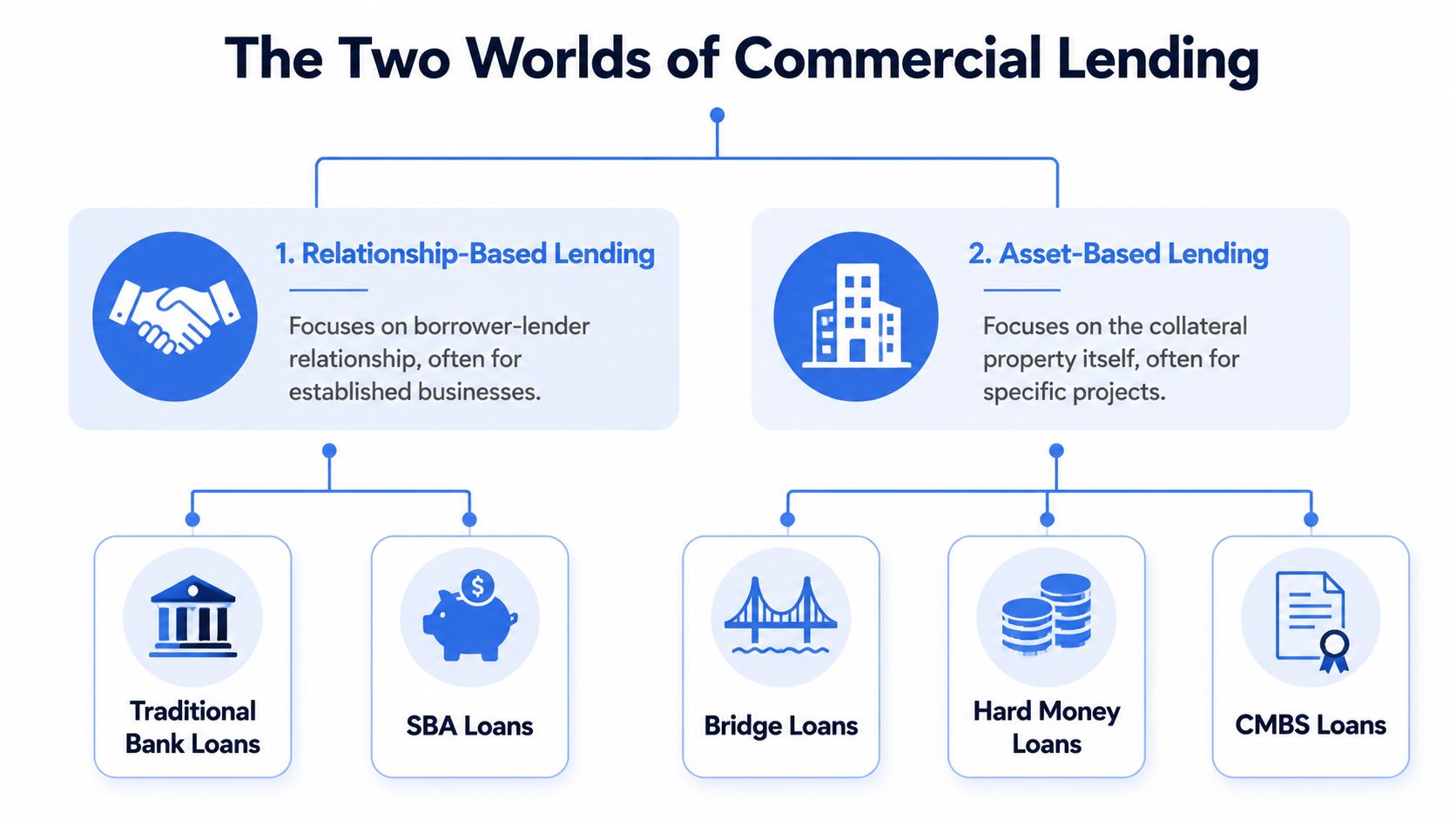
Relationship-based lending
This is the traditional path. Banks and credit unions usually live here. They want a clean file, stable property income, strong borrower financials, and a transaction that fits their credit box.
The core products in this world are:
Traditional bank loans
These fit stabilized commercial properties held for income over time. The lender leans heavily on existing cash flow, borrower strength, and documentation.SBA loans
These are more common when the property supports a business operation, though many investors mention them while comparing structures. They can offer longer-term financing, but they aren't a cure for a weak deal.
In relationship-based lending, a good borrower can improve a good file. A messy asset usually cannot.
Asset-based lending
Bridge lenders, hard money lenders, and some institutional executions operate in such environments. The focus shifts from “Does this file look perfect today?” to “Is this a financeable plan with acceptable risk?”
The most common products are:
Bridge loans
Used when the property is in transition. That can mean vacancy, renovation, deferred maintenance, lease-up, or a repositioning strategy.Hard money loans
Similar in spirit, but often even more focused on speed, collateral, and short-term execution.CMBS loans
These sit in a different lane. They are generally better suited to larger, stabilized assets where institutional structure and securitized execution make sense.
Why this split matters
A lot of confusion comes from borrowers comparing products that solve different problems. A bank loan is trying to protect long-term repayment against current conditions. A private bridge lender is often trying to finance a short-term transition to a stronger future condition.
That's why these products are priced and structured differently. Conventional commercial mortgage terms commonly run 5 to 25 years with interest rates roughly 5% to 15%, while transitional or bridge loans are short-term, often floating-rate, and priced higher because the lender is taking on execution risk and refinance risk rather than just current income, as outlined in NerdWallet's summary of small-business real estate loan structures.
If the property already works, long-term debt is usually the cleaner answer. If the property has to become workable, short-term private debt may be the only realistic answer.
A quick mental model
| Lending world | Best fit | Main focus | Common weakness |
|---|---|---|---|
| Relationship-based | Stabilized assets | Historical cash flow and borrower profile | Slow when the deal is urgent |
| Asset-based | Transitional assets | Collateral, business plan, and exit | More expensive if used too long |
Borrowers get in trouble when they ask a bank to fund a transition it doesn't want, or when they use expensive bridge debt on a property that should have gone straight to permanent financing.
Decoding Underwriting What Lenders Really Want
Underwriting isn't mysterious once you know what the lender is trying to protect. Every commercial lender is asking some version of the same question. Can this property support the debt, and if something goes wrong, how much room is left?

DSCR and LTV drive the file
A core benchmark is debt service coverage ratio, or DSCR. It compares net operating income to annual debt service and tests whether the property can generate enough cash flow to cover its payments. Lenders also look closely at loan-to-value, or LTV, and industry guidance notes that typical mortgage LTVs are around 60% to 65%, because a higher LTV increases lender loss severity if value drops or income weakens, according to the NAIC's commercial mortgage loan primer.
Those two measurements matter for different reasons. DSCR answers, “Can this property carry itself?” LTV answers, “How much cushion exists if the plan slips?”
Banks and private lenders read risk differently
A bank usually starts with trailing performance. It wants rent rolls, operating statements, lease terms, borrower financials, and a property that already behaves like stabilized collateral.
A private lender still reviews those items, but the weighting changes. If the property is half leased and the business plan is to renovate vacant suites and bring rents to market, current income tells only part of the story. The lender also studies:
The sponsor's plan
What work will get done, in what order, and how quickly?The path to payoff
Will the exit be refinance, sale, or a longer hold after stabilization?The sponsor's operating ability
Experience matters most when the property needs active management, not passive ownership.
That's one reason some borrowers explore stated income commercial real estate loans when traditional documentation standards create friction. The key isn't less scrutiny. It's different scrutiny.
What weak files usually miss
The common mistake isn't low occupancy by itself. It's low occupancy with no credible recovery plan.
A lender gets uncomfortable when the borrower can't explain:
- Why the property is underperforming
- What specific actions will fix it
- How the loan gets repaid if leasing takes longer than expected
Here's a useful walkthrough on how lenders think through commercial debt and property performance:
Practical rule: Underwriting gets easier when your story is simple. “We will repair these units, sign these tenants, and refinance once the property stabilizes” is financeable. “We'll figure it out after closing” isn't.
Strong borrowers don't just submit documents. They reduce uncertainty.
Choosing Your Loan A Practical Decision Framework
Most investors don't need more loan definitions. They need a way to decide when a higher-cost loan is smart and when it's a warning sign.
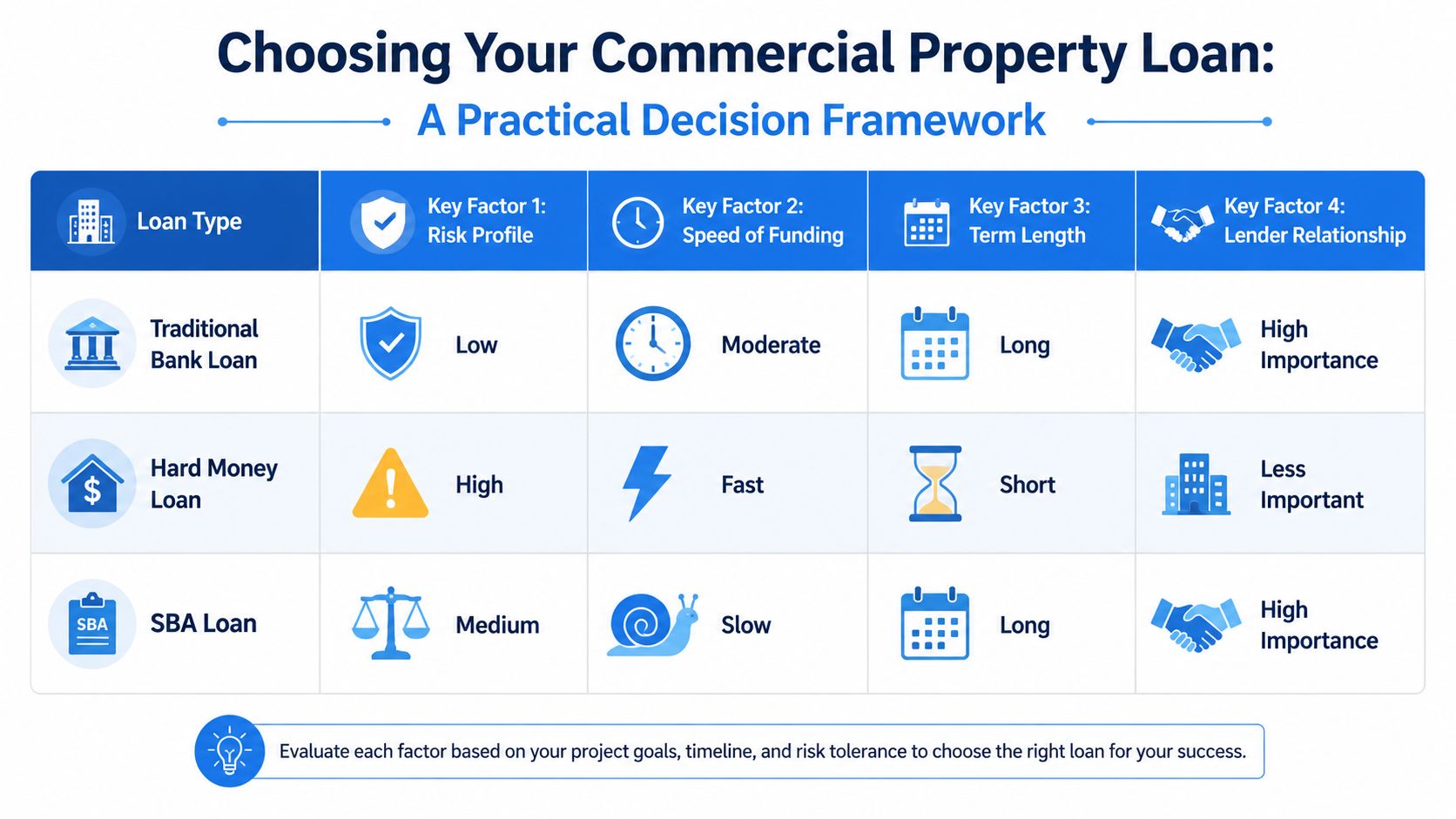
Use the property's condition as your first filter
If the asset is fully leased, operating normally, and your closing timeline is reasonable, start with conventional financing. You're buying durable cash flow, not a turnaround project.
If the property needs leasing, renovation, cleanup, tenant rollover, or a fast close, stop trying to force it into a permanent loan request. That usually creates delay, retrades, or a declined file after weeks of effort.
Bridge loans are commonly used for value-add, renovation, or properties that don't qualify for permanent financing. Lenders underwrite them around execution risk, refinance risk, and lease-up risk, not just current NOI, as noted in Verada Retail's discussion of commercial real estate loan types.
Ask four decision questions
How soon do you need to close
Speed changes the loan choice fast. If a seller wants certainty and your due diligence is moving faster than a bank committee, private debt can protect the acquisition. Paying more for speed can make sense when losing the deal costs more than the additional financing expense.
What has to change after closing
If your plan depends on rehab, re-tenanting, or operational cleanup, your real financing need is time plus flexibility. That points toward bridge or hard money. Long-term debt works better after the work is done.
Is the asset temporarily weak or fundamentally weak
This is the question many borrowers avoid. Temporary weakness can be financed. Fundamental weakness usually shouldn't be.
A vacant building in a good submarket with a real leasing plan is one thing. A property with chronic location problems, obsolete layout, and no clear tenant demand is another. Debt doesn't fix a broken premise.
What is your exit if debt markets tighten
Too many investors assume the refinance will be there on schedule. Smarter borrowers build a backup plan. If long-term takeout comes in light, do you have more equity, another lender path, or enough reserves to extend the hold?
A bridge loan is a tool for crossing a gap. If there's no visible ground on the other side, it's not a bridge strategy. It's wishful thinking.
A simple side-by-side view
| Situation | Better fit | Why |
|---|---|---|
| Stable property, clean rent roll, normal timeline | Traditional bank loan | Lower-cost capital fits a long hold |
| Vacant or partially vacant asset | Bridge loan | The property needs time to become financeable |
| Seller demands fast close | Hard money or bridge | Certainty and speed matter more than polished paperwork |
| Complex borrower income but solid collateral | Private loan | The lender can focus more on asset quality and exit |
| No clear exit after improvement period | Wait or restructure | Debt won't solve an unclear business plan |
When the expensive loan is the smart loan
A lot of investors use “expensive” too broadly. Cost matters, but sequence matters more.
A short-term private loan can be the right move when it helps you:
- Secure the asset before competing buyers do
- Fund improvements that facilitate future financing
- Stabilize rents before locking into permanent debt
- Avoid losing months in a bank process that was never a fit
Used correctly, higher-cost debt buys control. Used carelessly, it magnifies mistakes.
Real-World Scenarios With Numbers
The easiest way to understand commercial property investment loans is to look at two very different deals.
1. Stabilized retail center with conventional debt
An investor contracts to buy a small retail center that is fully leased with clean tenant history and steady collections. The building needs only routine maintenance. The business plan is simple: buy, hold, and collect income.
This is a conventional loan deal.
A stabilized asset like this fits long-term financing because the lender can rely on in-place leases, operating history, and current property performance. Typical conventional commercial mortgage terms commonly run 5 to 25 years, with interest rates roughly 5% to 15% for stabilized assets, based on NerdWallet's overview cited earlier in this article.
The approval process still requires real work. The lender will review the purchase contract, rent roll, leases, property operating statements, borrower financials, and appraisal. But the story is easy to underwrite because the property already works.
This type of borrower should usually avoid short-term private debt unless timing creates a special problem. If the deal is stable and the closing window allows it, permanent financing is often the cleaner fit.
2. Vacant commercial building with a bridge strategy
A second investor targets a vacant commercial property that sits in a strong corridor but has been neglected. The building needs renovation, updated leasing materials, and a focused tenanting plan before a bank will treat it as stabilized collateral.
In such cases, a bridge loan earns its place.
The lender isn't looking only at current income because current income is weak or nonexistent. The file turns on a different set of questions:
- Can the borrower close quickly enough to secure the property?
- Is the renovation scope realistic?
- Does the market support lease-up after improvements?
- Is there a believable refinance or sale path once the building stabilizes?
If those answers are solid, a short-term private lender may finance the acquisition and, depending on the structure, the rehab plan as well. The higher rate is not the point. The point is getting control of the asset, executing the plan, and moving into cheaper long-term debt later.
Strong bridge deals don't start with “the property is ugly.” They start with “the problem is fixable, and the exit is visible.”
What these examples really show
The first deal rewards patience and documentation. The second rewards speed, asset judgment, and execution.
Neither loan is “better” in the abstract. Each one is right only because it matches the property's current reality.
Your Commercial Loan Application Checklist
Good borrowers make a lender's job easier. That starts with a complete file.
If you walk into a loan request with missing leases, unclear ownership documents, and no operating history, the process slows down no matter who the lender is. Banks tend to ask for a deeper paper trail. Private lenders usually streamline the process, but they still need enough to judge the asset and the exit.
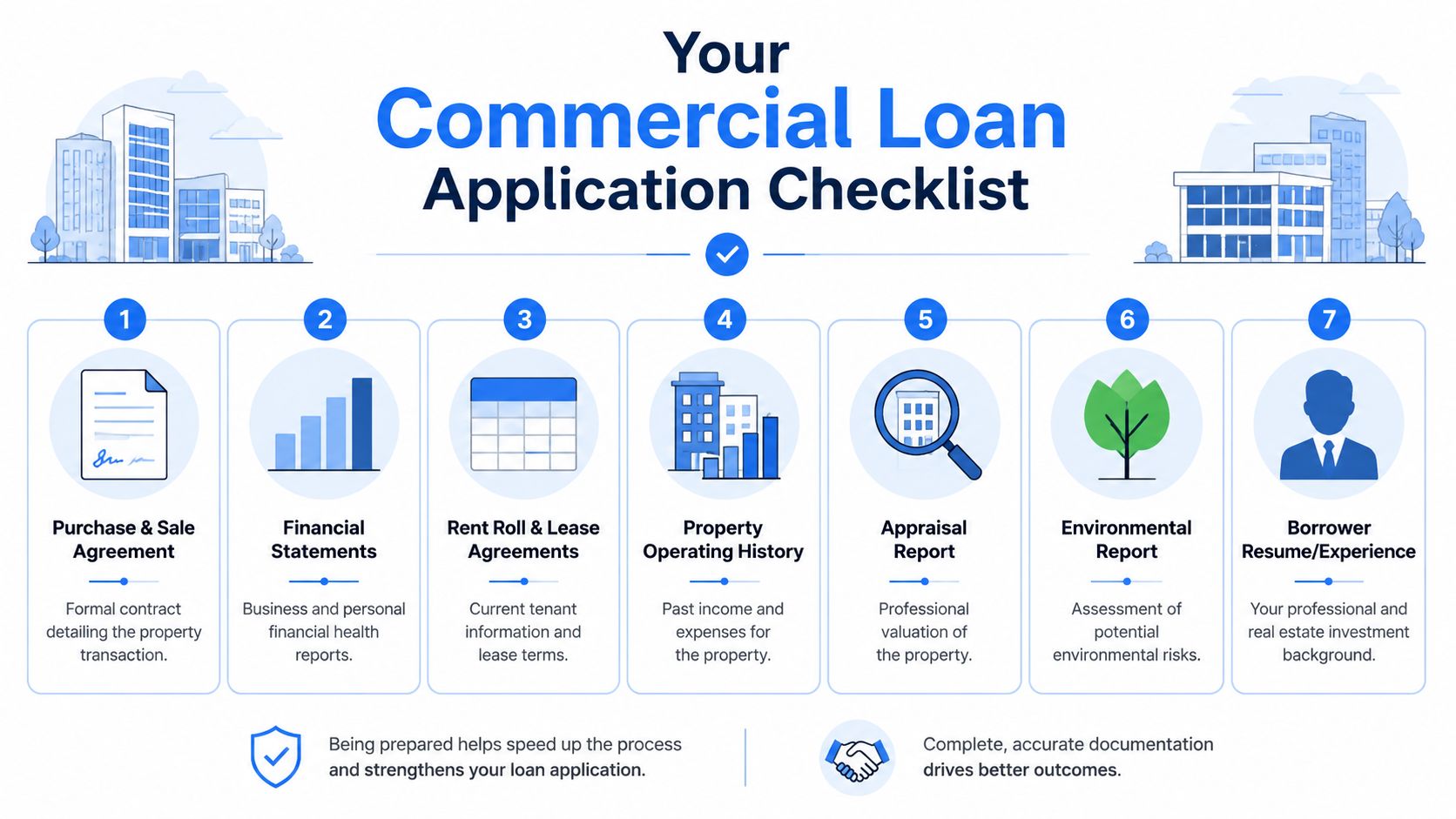
What to gather before you apply
Purchase and sale agreement
This tells the lender what you're buying, on what terms, and how quickly the deal must close.Rent roll and lease agreements
These show who occupies the property, how much rent is due, when leases expire, and where rollover risk may sit.Property operating history
Recent income and expense records help the lender understand how the asset has performed.Borrower financial statements
Even asset-focused lenders want to know whether you have the liquidity and stability to handle a rough patch.Entity documents
If you're buying through an LLC or other entity, have formation documents ready.Appraisal and environmental materials
Depending on the deal, the lender may order these, review existing reports, or require updated versions.Borrower resume or experience summary
Transitional properties get easier to finance when you can show you've handled leasing, rehab, or repositioning before.
What borrowers often forget
Three items are commonly overlooked:
- A clear scope of work for transitional properties
- A realistic timeline for repairs or lease-up
- An exit summary explaining refinance, sale, or hold strategy
A lender can work with a complicated deal. It's much harder to work with an unclear one.
Finding the Right Lending Partner for Your Strategy
Choosing among commercial property investment loans comes down to one thing. Match the debt to the business plan.
If the property is stable, tenant income is reliable, and your timeline is normal, conventional financing usually deserves the first look. Those loans are built for long holds, and conventional commercial mortgages commonly run 5 to 25 years with rates roughly 5% to 15% for stabilized assets, while transitional loans are shorter-term, often floating-rate, and priced higher because the lender is taking on repositioning risk, as summarized in NerdWallet's loan guide noted earlier.
If the property is in transition, speed and flexibility matter more than headline pricing. That's where private lending can make sense, especially when the opportunity depends on a fast close, rehab funding, lease-up time, or a structure that doesn't fit a bank template.
For California investors working through those situations, LendingXpress is one example of a private lender that offers bridge, fix and flip, and rental property financing for investment real estate, with an efficient application and asset-focused underwriting. That type of lender is worth considering when a traditional bank can't move quickly enough or won't finance the asset in its current condition.
The right partner should do more than quote terms. They should pressure-test your exit, flag weak assumptions, and help you avoid using the wrong product for the wrong stage of the deal.
A good lending relationship saves time. A disciplined one can also save the project.
If you've got a time-sensitive acquisition, a value-add commercial property, or a deal that doesn't fit the bank box, talk with LendingXpress about the financing structure that matches your strategy.