
You close on a dated rental or flip. The contractor wants to start demo, the plumber wants money for materials, and the electrician has a slot open now, not next month. If your rehab funds hit the project all at once, you risk overpaying too early. If the money moves too slowly, the job stalls.
That's why a construction loan draw schedule matters so much to investors. It's the working payment plan behind the project. It tells everyone when money gets released, what work has to be finished first, and what paperwork has to be in before the next disbursement goes out.
Used well, it does more than satisfy a lender. It protects your cash flow, keeps your contractor accountable, and gives you a cleaner path through the project from first hammer swing to final sign-off.
Your Project's Financial Roadmap
A lot of investors learn the value of a draw schedule the hard way. A property looks straightforward on day one. Then demo opens up hidden repairs, one trade finishes before another is ready, and subcontractors start asking when they'll get paid. Without a clear funding map, the rehab budget turns into a string of urgent phone calls.
A solid draw schedule fixes that. It creates a sequence for releasing capital that matches how the job progresses. Instead of reacting to every payment request, you already know what gets funded first, what gets funded later, and what proof is needed before money is released.
What that looks like on a live project
Take a typical investor rehab. The first money might need to cover cleanup, selective demolition, and the materials that let framing or rough work begin. Later draws support the stages that add visible value to the property. Final funds stay tied to completed finishes, corrections, and closeout items.
That structure provides advantages to both sides. Your contractor knows payment is coming through a defined process, and you know funds won't get too far ahead of verified work.
A draw schedule works best when it's treated like a project control tool, not a loan form.
It also helps to build the schedule off a real scope, not a rough guess scribbled into a spreadsheet. If you're trying to sharpen line items before funding starts, tools like Exayard construction estimating software can help organize cost assumptions and scope detail so your draw plan reflects the job you're constructing.
Why investors should care early
Most funding delays don't start with the lender. They start earlier, when the borrower and contractor never align on scope, payment timing, or documentation. Then the first draw request arrives with missing invoices, vague descriptions, and photos that don't show enough.
Investors who plan the draw schedule before work starts usually keep projects moving better. They know when cash should be available, they prepare paperwork in advance, and they don't let one trade's billing request dictate the whole project rhythm.
What Is a Construction Loan Draw Schedule
A construction loan draw schedule is a staged disbursement system, not a lump-sum payout. Funds are released only after agreed milestones are completed, and the schedule is typically set by the borrower, contractor, and lender together. Industry examples also show that timing may be milestone-based or calendar-based, some projects request draws monthly or even twice per month, and retainage is often built in at around 10% to protect completion quality, according to Buildertrend's construction draw process overview.
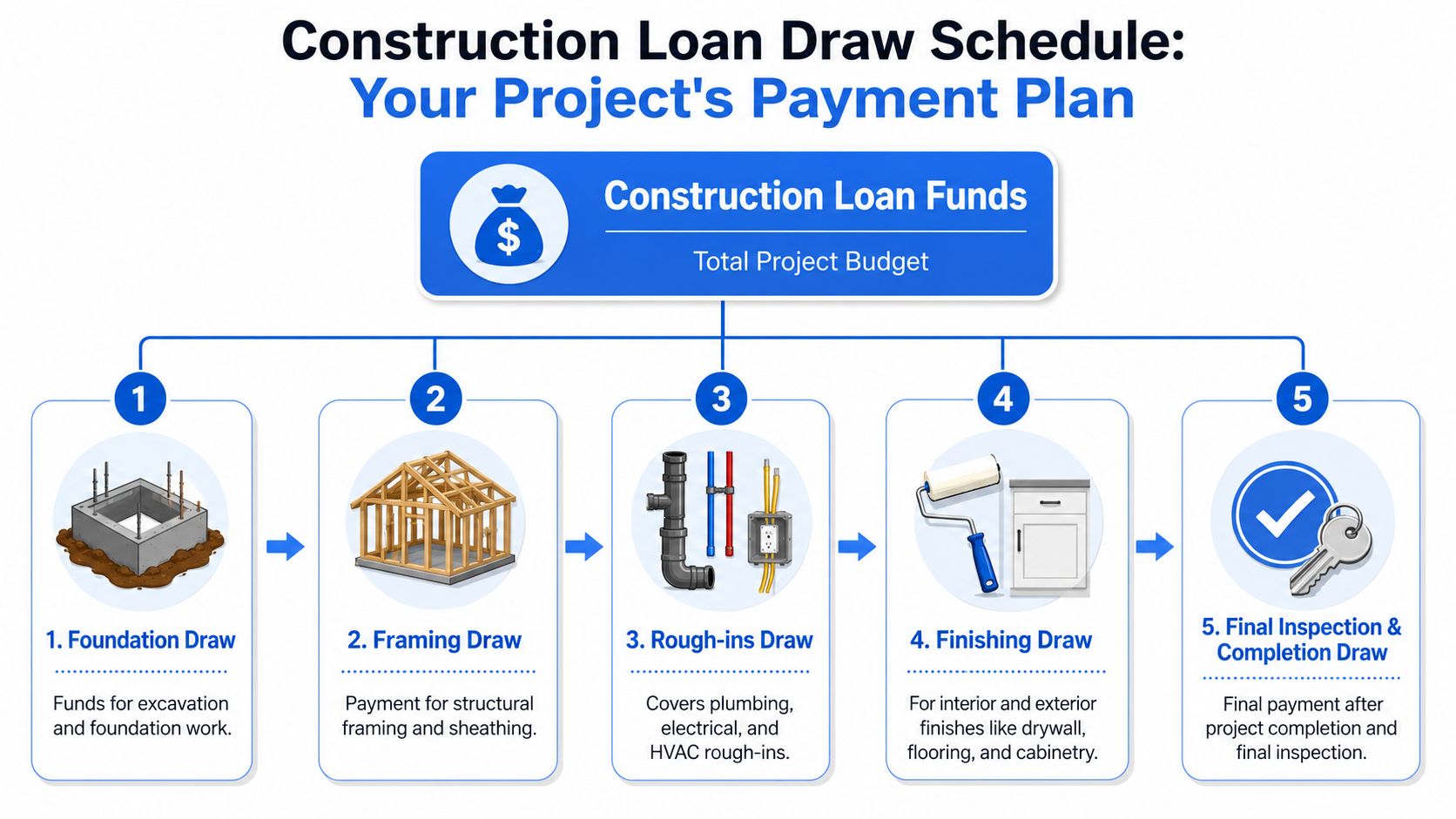
It operates as a controlled release valve for your project budget. The full rehab or construction allocation exists, but it doesn't all hit the job at once. Money moves out in pieces as work gets done and verified.
Why lenders use this structure
The lender wants to see that capital is turning into real improvements on the property. Releasing money in stages reduces the chance that funds disappear into unfinished work, disputed invoices, or a contractor who got paid too far ahead.
From an investor's side, that same structure is useful. It keeps contractor billing tied to completed scope. It also gives you regular checkpoints to compare budget, quality, and schedule before the next draw goes out.
Why investors should like it too
A good draw schedule creates discipline. If the framing isn't done, the framing draw doesn't release. If rough plumbing and electrical aren't ready for review, that draw waits. That may sound restrictive at first, but it prevents a common investor problem. Too much money goes out early, then the project limps through the finish line short on cash.
Here's the practical benefit:
- Better payment control keeps labor and material spending aligned with actual progress.
- Cleaner oversight gives you a recurring reason to review photos, invoices, and site conditions.
- Less conflict because the payment plan was agreed before the project got messy.
For investors comparing rehab financing structures, it also helps to understand how construction funding differs from permanent financing. This overview of one-time close construction loans gives useful context on how construction-related disbursement frameworks can be structured.
If you're new to construction financing, don't think of draws as slowdowns. Think of them as checkpoints that keep a project financeable all the way to completion.
The Key Components of Your Draw Schedule
Most draw schedules look complicated until you break them into parts. In practice, the structure is straightforward. You're setting milestones, tying money to those milestones, and defining what has to be submitted before each release.

One common pattern in construction lending is to tie payments to percentage completion rather than funding the full loan amount upfront. Industry guidance includes examples such as releasing 25% of the loan at foundation completion and 50% at framing completion. Broader references also describe milestone bands like 20%, 40%, and 60%, or a detailed schedule of values that allocates the total contract amount across the job timeline. That milestone model has become standard because it creates verifiable checkpoints for inspections and documentation, including invoices, receipts, updated cost breakdowns, and lien waivers, before funds are disbursed, as described by Bankstride's construction loan monitoring guide.
Milestones and payment triggers
The first building block is the milestone. This is the stage of work that must be completed before a draw is available. On a rehab, that could be demolition and framing stabilization, rough mechanicals, drywall, or finish work. On new construction, it might be foundation, framing, rough-ins, and completion.
The second building block is the trigger. That's the proof point. It defines what “complete” means for that phase. If the schedule is vague, disputes show up fast.
A clean draw schedule should answer questions like:
- What work is included in this draw
- What has to be finished before the request is submitted
- Who verifies completion before funds are released
Inspections and paperwork
Most lenders won't fund off a text message saying the work is done. They want support. That usually means some combination of invoices, receipts, updated budget detail, photos, and signed lien waivers.
Inspection is where many investors either gain speed or lose time. If the site is only partially ready, the inspector notes incomplete work, and the draw gets delayed. If the request package is organized, approval tends to move much more smoothly.
This visual walkthrough is useful if you want to see the moving parts in context:
Retainage and final holdbacks
Retainage is the part borrowers usually resist early, then appreciate later. A small holdback at the end helps make sure punch-list items, corrections, and final cleanup get done. Without it, you may find yourself chasing the last details after most of the money is already out.
Practical rule: The more detailed your scope of work is before closing, the fewer arguments you'll have when a draw is under review.
If you're financing an acquisition with renovation scope together, this matters even more because purchase and rehab funds need to work on the same timeline. Investor borrowers often review purchase and renovation loan options for non-owner-occupied properties before finalizing how their scope, budget, and draw schedule should line up.
Sample Draw Schedules for Real Estate Investors
Examples make this easier to understand than theory does. Most investor projects don't need a complicated funding map. They need a realistic one. The schedule should match how the work actually gets built, not how someone wishes it would get built.
A technically sound draw schedule is usually milestone-based rather than calendar-based. Funds are released after a third-party inspector verifies completed work, which reduces advance-rate risk by matching disbursements to observable value creation. Industry guidance commonly cites 4 to 6 draws, with each draw representing about 15% to 25% of the total loan amount, and lenders often require invoices, progress photos, and inspection reports before funding the next tranche, according to Groundfloor's guide to draw schedules in new construction loans.
Example one for a fix and flip
Here's a simple sample structure for a rehab with a $50,000 renovation budget. This is only a model. Actual scopes vary by property, contractor, and lender requirements.
| Draw # | Milestone / Scope of Work | Draw Amount | Total % Complete |
|---|---|---|---|
| 1 | Demolition, debris removal, initial framing or site prep | $10,000 | 20% |
| 2 | Rough plumbing, rough electrical, HVAC rough-in, window or roof progress if applicable | $10,000 | 40% |
| 3 | Insulation, drywall, texture, interior paint prep | $10,000 | 60% |
| 4 | Flooring, cabinets, fixtures, trim, finish mechanical items | $10,000 | 80% |
| 5 | Final paint, punch list, cleaning, completion items | $10,000 | 100% |
That kind of schedule works when the scope is clearly grouped. Each draw covers a meaningful chunk of work, and the contractor knows what has to be complete before requesting payment.
Typical backup for each request might include:
- Invoices and receipts showing labor and material costs tied to that stage
- Progress photos that clearly show the completed work
- Inspection confirmation if the lender requires third-party review
- Lien waivers from the parties who were paid in that phase
Example two for a small new construction project
A small ground-up project, such as an ADU or infill build, usually follows more traditional construction milestones. The schedule often tracks visible stages like foundation, framing, rough-ins, finishes, and final completion.
A practical sequence might look like this in plain terms:
- First draw after site work and foundation completion
- Second draw once framing and exterior shell are substantially complete
- Third draw after plumbing, electrical, and HVAC rough-ins are installed
- Fourth draw when interior finishes are in place
- Final draw after final inspection items are complete
The best sample draw schedule is the one your contractor can actually build to and your lender can verify without guessing.
The investor mistake is copying a generic template without checking the specific labor sequence. If your cabinet package arrives late, for example, your finish draw may need to be structured around what can be inspected and documented at that point.
How to Create and Manage Your Draw Schedule
A workable draw schedule starts before the first draw request. It starts with your scope of work. If the scope is thin, the budget will be soft. If the budget is soft, the draw schedule will turn into a series of exceptions and revisions.
Start with scope, bids, and sequencing
Break the project into actual scopes that can be inspected. Don't use vague buckets like “rehab” or “finishes” unless they're further defined somewhere else. The lender, contractor, and borrower should all understand what sits inside each phase.
Then get itemized contractor pricing. That's what gives the schedule shape. If a bid combines too many unrelated tasks into one line, it becomes harder to decide when that portion of work is complete.
A strong setup usually includes:
- A detailed scope of work with line items that match the property plan.
- Itemized bids from the general contractor and key trades.
- A sequence of work that reflects how the job will move.
Align the schedule with lender process
Once the scope and budget are real, match them to the lender's draw mechanics. Some lenders want more frequent requests. Others prefer larger milestone-based draws. What matters is that the payment structure fits the project rhythm and the inspection process.
This is also where investors save time by asking the right questions up front:
- How is a draw requested
- What documents are required each time
- Who orders the inspection
- What causes a draw to be paused
If you're working on a rehab-oriented investment property, it helps to review how fix and flip financing is typically structured so your purchase timeline, rehab budget, and draw cadence fit together.
Manage the job week to week
A draw schedule doesn't manage itself. Investors who stay ahead of it usually do a few things consistently.
- Track progress in real time so you know when a milestone is close, not after cash is already needed.
- Collect backup continuously instead of hunting for invoices and waivers at the last minute.
- Confirm site readiness before inspection is scheduled.
- Communicate early if a change order will affect the original draw logic.
Here's the operational mindset that works best. Don't wait until contractors are pressing for payment to start assembling a draw package. Build the request while the work is happening.
Submit a draw request when the milestone is genuinely complete and the file is clean. Speed usually follows preparation.
A lot of friction disappears when the borrower treats the draw schedule like part accounting system, part project calendar. It keeps the funding side from lagging behind the construction side.
Common Pitfalls and Pro Negotiation Tips
Most draw problems aren't dramatic. They're procedural. A phase is only partially complete, a change order wasn't documented, a contractor bill doesn't match the original scope, or the borrower assumes a draw will release before the inspection package is ready.
The mistakes that slow projects down
The first pitfall is underdefined scope. If a milestone says “rough-in complete” but the lender and contractor define that differently, the draw can get stuck in review.
The second is poor change-order discipline. Surprises happen on rehab jobs. Hidden damage, code issues, product substitutions, and sequencing changes all routinely appear. The problem isn't the change itself. The problem is when nobody updates the budget and draw expectations before asking for more money.
Another common issue is bad document hygiene. Missing waivers, unclear invoices, and weak photos create preventable delays.
How experienced investors negotiate better terms
Strong borrowers negotiate draw logic before closing, not in the middle of the job. If the first phase is material-heavy, they make sure the initial draw structure reflects that reality. If the finish stage tends to generate many small invoices, they plan for better documentation and tighter closeout review.
Useful negotiation points include:
- Define milestones clearly so “complete” has a shared meaning.
- Build in a contingency mindset in the overall budget so expected surprises don't derail the sequence.
- Discuss change-order handling early so everyone knows how revisions get reviewed.
- Ask about turnaround expectations for inspections and disbursements before the loan is finalized.
A practical habit also helps. Keep a current budget snapshot with original line items, approved changes, paid amounts, and remaining balances. When a question comes up, you want one version of the truth.
If a draw is denied or delayed, don't argue in generalities. Ask exactly what's missing, fix that item, and resubmit a clean package.
Borrowers who approach draws as a documentation process, not just a funding request, usually get through construction with fewer stoppages.
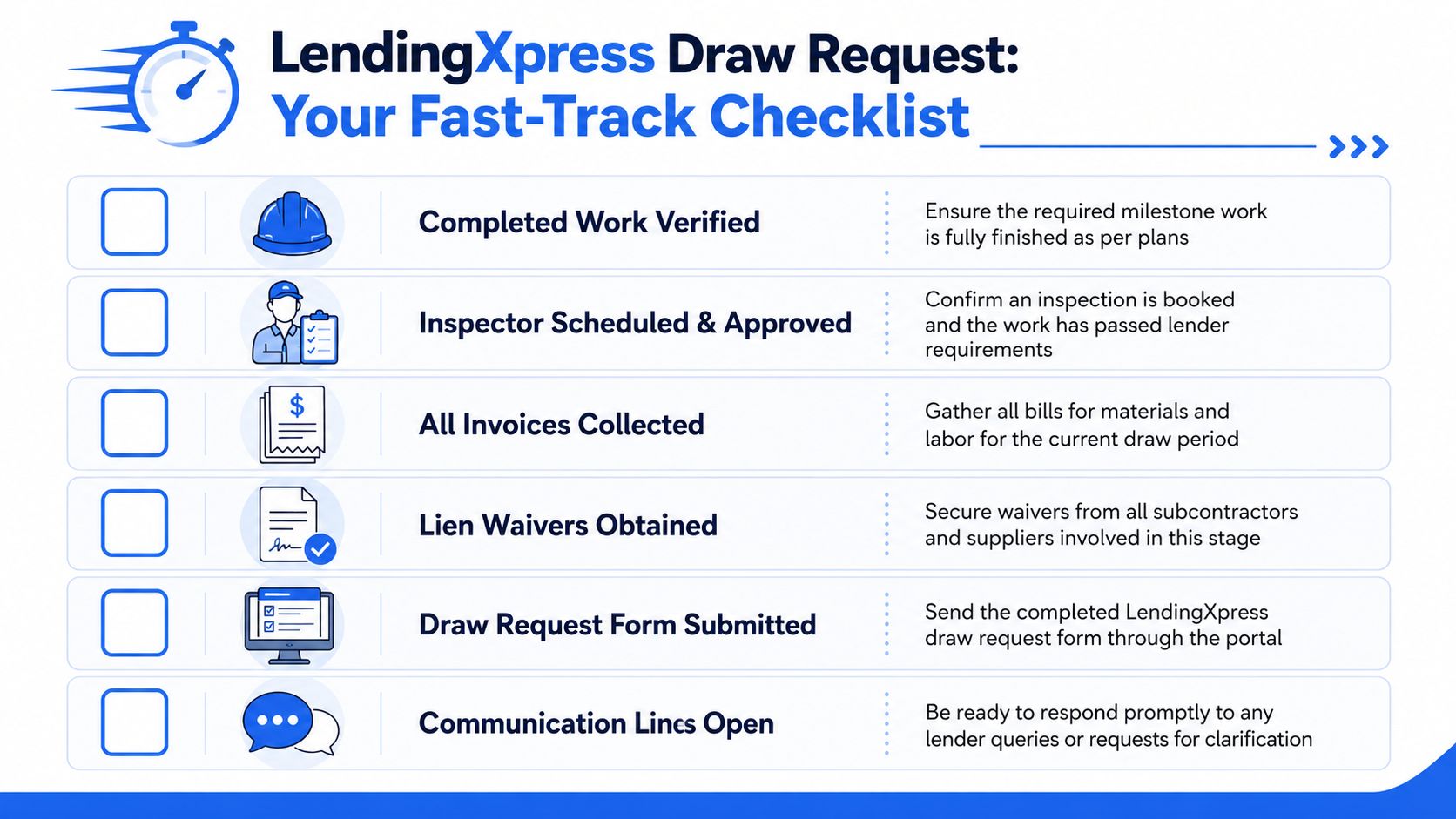
The LendingXpress Draw Request Checklist
When a draw request is clean, funding moves faster. When it's incomplete, the project waits. Most delays come from missing support, not from the milestone itself.
Use a simple checklist every time before you submit:
- Confirm the work is complete for the milestone you're billing.
- Make sure inspection is scheduled or approved based on the lender's process.
- Gather invoices and receipts for labor and materials tied to that draw.
- Collect signed lien waivers from contractors, subcontractors, and suppliers where required.
- Prepare clear photos or video that show the completed scope.
- Submit the draw request form accurately so there's no confusion about what you're asking to fund.
Good draw management is simple, but it isn't casual. If you organize the file before the request goes in, your contractor gets paid sooner, your project keeps moving, and your financing stays aligned with progress on site.
If you're financing a non-owner-occupied purchase, rehab, bridge, or construction-heavy investment deal, LendingXpress offers private lending built for speed, practical underwriting, and staged draw funding that fits real project timelines. Reach out to discuss your next deal and structure a loan that keeps your project moving instead of waiting on bank bureaucracy.