
You found a deal that makes sense on paper. The property is ugly, the seller wants speed, and the spread is there if you can close and fix it fast. Then the bank steps in and kills the momentum. Maybe the property condition doesn't fit agency rules. Maybe your debt-to-income ratio doesn't look clean enough on paper. Maybe the loan committee can't move before another buyer takes the deal.
That's the point where many investors assume the deal is dead. It usually isn't. The problem often isn't the property. It's the financing structure.
For non-owner-occupied properties, creative financing for real estate gives investors, brokers, and agents a way to keep moving when conventional lending doesn't fit the deal.
The Investor's Dilemma When Banks Say No
A common situation looks like this. An investor spots a distressed rental with strong upside. The seller is motivated, the numbers work, and the exit is clear. But the bank won't fund it because the property needs repairs before closing, or because the timeline is too tight for a standard underwriting process.
That problem is more common than most newer investors realize. Approximately 33% of U.S. real estate investors used non-traditional financing for their most recent acquisition in 2022, which represented a 37% growth in reliance on these strategies since 2019, according to the National Association of Realtors.
That matters because it tells you something important. Creative financing isn't a fringe tactic used by a handful of operators. A large share of active investors already use it when the deal calls for speed, flexibility, or a property that doesn't fit a bank box.
If you've only worked through conventional lenders, it helps to understand the normal bank process so you can see where delays get introduced. This mortgage loan application guide is useful for that. It lays out why traditional approvals can drag even when the borrower is qualified.
Practical rule: If the deal depends on a fast close, light documentation, or funding for a rough property, don't wait for a bank to become flexible. Build a financing plan that matches the asset and the timeline.
The investors who keep closing deals aren't always the ones with the cheapest money. They're the ones who know when to switch tools.
What Is Creative Real Estate Financing
Creative financing means using a funding structure outside traditional bank channels to buy or control an investment property. It's used for non-owner-occupied properties, not primary residences, when standard underwriting doesn't line up with the specifics of the deal. That definition aligns with Investopedia's explanation of creative financing.

It's a problem-solving mindset
A bank loan is built for uniformity. The bank wants stable income, predictable property condition, standard appraisal support, and plenty of time to review the file.
Creative financing works differently. It asks a practical question first: What is stopping this deal from closing, and what structure solves that problem?
Sometimes the issue is time. Sometimes it's property condition. Sometimes the borrower has solid experience and a good asset but doesn't present well under traditional income documentation. In those cases, the financing needs to adapt.
What creative financing often looks like
For investment property deals, that can include:
- Seller financing: The seller carries part or all of the note instead of requiring full cash from a new bank loan.
- Subject-to transactions: The buyer takes title and makes payments on the seller's existing mortgage.
- Lease options: The investor controls the property now and locks in a later purchase right.
- Private or hard money: A non-bank lender funds the purchase, rehab, refinance, or bridge period based largely on the asset.
Creative financing works best when the standard mortgage isn't wrong, just mismatched to the deal.
What it is not
It isn't magic. It doesn't fix a bad buy. It doesn't make title issues disappear. It doesn't excuse sloppy legal documents or weak exit planning.
Used properly, it gives you options. That's the core value. If a seller cares more about monthly income than a cash-out at closing, seller terms may work. If a property needs heavy rehab before it can qualify for conventional debt, private capital may be the right bridge. If the existing financing is attractive, a subject-to structure may create room that a fresh market-rate loan would destroy.
That's why experienced investors don't treat financing as an afterthought. They treat it like part of the acquisition strategy.
Common Creative Financing Strategies Explained
Some creative structures depend on the seller's cooperation. These can work well when the seller has a specific pain point and is willing to trade price, timing, or terms to get the deal done.

Seller financing
With seller financing, the seller acts as the lender. Instead of you bringing in a bank to fund the whole purchase, the seller accepts a down payment and monthly payments under agreed terms.
This tends to work when the seller owns the property free and clear, or has enough flexibility to carry paper. It can also work when the property won't qualify for a conventional loan in its current condition.
Best use cases include:
- Motivated sellers: They want income over time instead of a full lump sum now.
- Unusual properties: The asset doesn't fit cleanly into standard lending guidelines.
- Investors needing flexibility: The buyer wants room to improve, refinance, or resell before a balloon comes due.
The main upside is flexibility. The main risk is document quality. If the note, deed of trust, payment terms, and default remedies aren't drafted correctly, disputes show up later.
Subject-to deals
A subject-to transaction means the buyer takes title to the property while the existing mortgage stays in the seller's name. The buyer makes the seller's mortgage payments instead of getting a new loan.
The attraction is obvious. The buyer may step into a lower historical rate and avoid the cost and delay of new financing. But newer investors often become careless.
About 85% of conventional loans contain a due-on-sale clause, and the lender may legally accelerate the debt if it discovers the transfer of equity. At the same time, the buyer may benefit from the seller's older interest rate, which is often 3 to 4% lower than current market rates, according to SmartAsset's discussion of creative real estate financing.
Don't treat subject-to like a shortcut. Treat it like a legal structure that needs serious review before you record anything.
Subject-to tends to make the most sense when the seller has little equity, the loan terms are strong, and the investor has a clear servicing and exit plan.
Lease options
A lease option gives the investor control now and the right to buy later at a predetermined price. You lease the property for a set term, then exercise the purchase option if the deal still makes sense.
This can help when an investor needs time to stabilize the asset, line up financing, or test a location before taking full ownership. It can also help a seller who isn't ready for a clean sale today but wants a path to one.
The benefit is low upfront commitment compared with a full acquisition. The risk is loose drafting. If the lease, option fee treatment, maintenance obligations, and purchase rights aren't crystal clear, the structure can get messy fast.
Creative Financing Methods at a Glance
| Strategy | Best For… | Key Benefit | Primary Risk |
|---|---|---|---|
| Seller Financing | Sellers willing to carry terms on an investment property | Flexible structure without bank underwriting | Poor documentation and future payment disputes |
| Subject-To Deals | Low-equity properties with attractive existing financing | Access to existing loan terms and lower rate environment | Due-on-sale acceleration risk |
| Lease Options | Investors who need control before full purchase | Time to improve operations or arrange takeout financing | Unclear option language and ownership confusion |
No one strategy wins every time. The right choice depends on seller motivation, title condition, existing debt, and your exit.
A Creative Financing Deal In Action
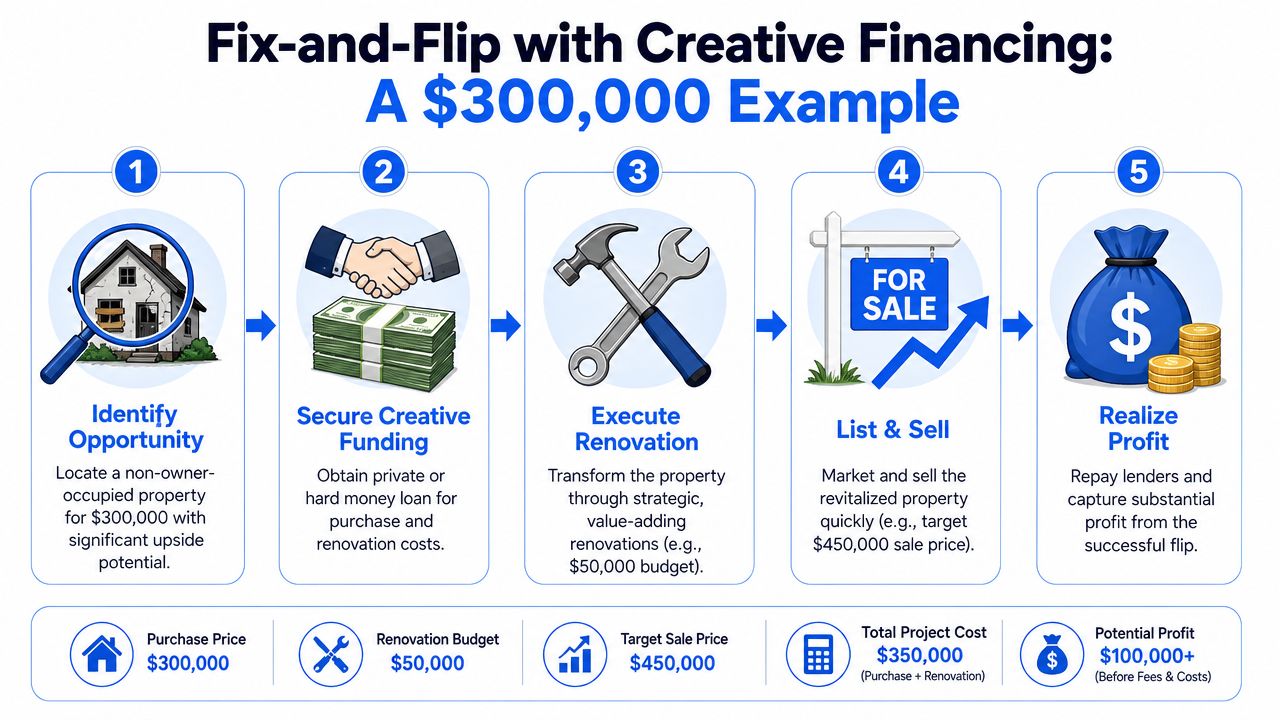
A simple deal example makes this easier to evaluate. Say you find a distressed non-owner-occupied property for $300,000. It needs $50,000 in repairs, and after renovation you believe it can sell for $450,000.
How the structure can work
Let's say the seller wants out quickly but also wants a higher price than a cash buyer is offering. Instead of trying to force a bank loan into the deal, you negotiate a structure that fits the seller's priorities.
One workable approach is a small upfront payment combined with seller financing and a short balloon. That gives the seller scheduled payments and a defined payoff date. It gives you time to complete the rehab and exit.
The rough sequence looks like this:
- Acquire the property at $300,000
- Fund the $50,000 renovation
- Complete the work and list the property
- Sell near the $450,000 target
- Pay off the seller-financed balance and keep the spread after expenses
This is the point where investors need discipline. The deal isn't profitable because the purchase was creative. It's profitable only if the rehab scope is accurate, the resale assumption is realistic, and the timeline stays under control.
A visual walkthrough helps if you want to see how this type of project flows from acquisition to exit:
What makes the deal work
Three factors usually decide whether a deal like this closes cleanly or blows up:
- The purchase discount: You need enough margin between acquisition basis and realistic resale value.
- The rehab plan: Contractors, scope, and timeline have to be written down, not guessed.
- The exit path: Know whether you'll sell, refinance, or extend before the balloon date becomes a problem.
A clean exit fixes a lot of sins. A weak exit turns even a creative structure into stress.
New investors often obsess over the financing and ignore the project management. Experienced operators do the opposite. They assume money is only one piece of the job.
Navigating Legal and Tax Considerations
This part isn't optional. Creative structures can solve financing problems, but they also create legal and tax questions that shouldn't be handled from a template pulled off the internet.
Get the documents right
Every deal needs proper documentation around title, payment terms, default rights, insurance, servicing, and transfer mechanics. That matters even more with seller-carried paper, wrap structures, lease options, and subject-to transactions.
If a contract dispute shows up later, the quality of the paperwork will determine how painful the outcome gets. For a practical look at how real estate contract problems can escalate, this guidance on property contract issues is worth reviewing.
Watch the pressure points
The legal risks aren't abstract. They're usually tied to a few recurring mistakes:
- Title confusion: The parties think they agreed on ownership timing, but the deed and contract say something else.
- Servicing gaps: Nobody clearly handles payment collection, tax escrows, or insurance verification.
- State-specific rules: A structure that's common in one market may need different language or procedures in another.
- Tax treatment mistakes: Payment allocation, installment treatment, and equity-for-services arrangements can carry consequences if they're not reviewed properly.
A tax professional is especially important when the structure departs from a plain purchase loan. If labor, credits, deferred payments, or unusual hold periods are involved, get advice before closing, not after.
If the deal only works when you skip legal review or tax review, the deal doesn't work.
Good operators spend money on attorneys and tax advisors because they know what a bad closing file costs later.
When to Use Private and Hard Money Lenders
Sometimes the seller won't carry paper. Sometimes there's an existing loan that makes a subject-to deal too risky. Sometimes you need cash, speed, and certainty so you can compete with experienced buyers.
That's where private money and hard money come in.

When these loans make sense
Private and hard money are usually the right fit when the property is distressed, the timeline is short, or the borrower's file doesn't present well to a bank even though the asset itself is solid.
These loans are commonly used for:
- Fix-and-flip acquisitions: You need to buy fast and fund rehab.
- Bridge situations: You're buying before permanent financing is available.
- Cash-out on stabilized equity: You need capital for the next project.
- Commercial or mixed scenarios: The property and business plan are workable, but conventional underwriting is too rigid.
Private money often comes from individuals or smaller groups. Hard money usually comes from professional lending shops. In practice, borrowers care less about the label and more about whether the lender can evaluate the asset quickly, issue terms clearly, and close on time.
Credit matters, but the asset often matters more
A lot of borrowers disqualify themselves too early because they assume bad credit ends the conversation. In asset-based lending, that isn't always true.
A strong LTV can override a low credit score in many hard money scenarios. For example, a 70% LTV can often secure approval even with a 550 credit score, because the loan is primarily secured by the asset rather than the borrower's credit history, as noted by the Urban Institute.
That doesn't mean credit never matters. It does. It affects risk, credibility, and sometimes pricing. But for non-owner-occupied deals, experienced private lenders spend a lot of time looking at the property, the exit, the lien position, and the investor's plan.
What to ask a lender before you move forward
Not all private lenders operate the same way. Ask direct questions:
- How fast can they close? Speed only matters if they can perform.
- Do they fund rehab? Many investors need one capital source for both purchase and improvements.
- How do they underwrite? You want to know whether they're asset-driven, paperwork-heavy, or somewhere in between.
- What property types do they like? A lender that understands your asset class usually spots issues earlier.
For investors comparing options, this overview of private money lenders for investment property deals is a practical place to start. It gives context on how these loans are commonly used in real transactions. LendingXpress is one California-based option in this space, providing private and hard money loans for residential and commercial investment properties, including bridge and rehab scenarios.
Your Next Steps to Secure Investment Capital
If banks have already said no, don't assume the answer is no from everyone. It usually means the deal needs a different structure.
Start with the deal, not the loan product
Before you shop for money, get clear on four things:
- Property type: Is it a fix-and-flip, rental, or bridge scenario?
- Condition: Does it need work before it can qualify for conventional debt?
- Timeline: How quickly do you need to close?
- Exit: Will you sell, refinance, or hold?
Once those answers are clear, the financing path gets easier to narrow down. Seller terms may work if the owner is flexible. Private capital may be cleaner if you need certainty and speed.
Move quickly, but don't move loose
Hard money and private money loans average a 14-day closing time compared with 45 days for traditional bank mortgages, and these short-term bridge loans can often finance up to 100% of rehab costs with loan sizes ranging from $100,000 to over $18 million, according to the Federal Housing Finance Agency.
That speed is useful only if your file is ready. Have your purchase contract, scope of work, title information, insurance plan, and exit strategy organized before you submit.
If you're evaluating options for a current or upcoming deal, this guide on how to finance investment property is a good next read. It helps connect the property type and business plan to the right capital structure.
The main takeaway is simple. Creative financing for real estate isn't about forcing exotic terms into every deal. It's about choosing the right tool for the asset, the seller, and the timeline so you can keep buying when conventional lending falls short.
If you're working on a non-owner-occupied purchase, refinance, bridge, or rehab deal and need a practical review of the financing options, LendingXpress can help you evaluate the structure and next steps without overcomplicating the process.