
Distressed debt investing has grown into a substantial private-markets niche. UBS reported that distressed debt and special situations funds represented more than USD 550 billion, or about 3% of total private-markets assets under management, while Cambridge Associates recorded a 9.7% historical median vintage-year IRR for distressed debt funds from 1999 through 2019. UBS's distressed-debt overview makes the point clearly: this isn't only a bankruptcy trade. For real estate investors, it can mean buying a nonperforming loan, funding a workout, or acquiring control of an income-producing property when conventional lenders have stepped away.
The opportunity is real, but the work is legal, operational, and intensely local. A cheap note secured by a California rental can still produce a poor outcome if title is defective, rents are overstated, a junior lien is missed, or the property takes longer to sell than the underwriting assumes.
What Distressed Debt Investing Means
Distressed debt investing means buying a troubled loan or debt claim below its face value and creating a path to repayment, recovery, or control.
Consider a rental owner with a $480,000 refinance loan. Tenant turnover disrupts cash flow, the borrower stops paying, and the loan reaches 90 days delinquent. A private investor buys the note for $260,000, or roughly 54 cents on the dollar, then chooses among foreclosure, a discounted payoff, a loan modification, or a deed-in-lieu.
The investor does not begin by buying the house. The purchase is the lender's legal position, which can include the promissory note, deed of trust, payment history, servicing file, assignments, title rights, and the ability to enforce the obligation if the borrower fails to cure the default.
The debt categories that matter
A nonperforming loan, or NPL, has stopped producing the payments required by its contract. The borrower may be behind because the property lost a tenant, insurance and taxes consumed reserves, construction stalled, or the loan matured before refinancing became available.
A re-performing loan, or RPL, previously fell behind but has resumed payments under the original terms or a workout agreement. RPLs often trade at less dramatic discounts than delinquent paper, but the servicing history can make expected cash flow easier to assess.
Special situations cover transactions that do not fit a simple default label. The borrower may still be current but unable to refinance, the lender may need to sell before maturity, or the parties may be negotiating a liability-management arrangement. For a real estate lender, the practical question is whether the borrower can pay, refinance, sell, or contribute new equity before enforcement becomes necessary.
The collateral and the loan file must be underwritten separately.
Banks, mortgage servicers, CMBS special servicers, private lenders, and loan-sale brokers can all supply distressed paper. The position is usually illiquid and document-heavy. A market quote rarely provides the easy exit available in a short trade, so the investor must understand the property, borrower, lien position, and enforcement process before setting a purchase price.
Practical rule: Underwrite the legal claim and the collateral separately. A strong property does not fix a weak note, and a perfectly documented note does not create value where the property cannot support repayment.
Why Distressed Debt Belongs in a Real Estate Portfolio
Distressed debt fits best as a long-duration private credit allocation, not as a short-term call on the next crisis. As noted earlier, UBS found that distressed debt returns tend to peak in stressed vintage years, including 2001 and 2008, while the more stable credit conditions from 2011 through 2018 produced more moderate outcomes. The broader point is that the strategy has a repeatable capital base, but results remain tied to the credit cycle.
For a real estate investor, the return comes from a specific set of actions: buying a claim below its unpaid balance, collecting contractual interest or negotiated payments, and resolving the collateral above the purchase basis. The investor does not need to identify the exact bottom of a housing market. The practical edge is finding a payment problem that can be solved for less than the collateral can reasonably recover.
The collateral changes the analysis
Corporate distressed debt may depend on future earnings, a restructuring plan, and competing creditor claims. A real estate loan offers a more tangible recovery framework. The property may produce rent, support a refinance, or be sold. Underwriting can also address title, physical condition, zoning, insurance, taxes, and recent comparable sales.
Seniority provides another layer of protection. A first-position deed of trust generally receives payment before junior debt and equity, although foreclosure costs, taxes, legal disputes, falling values, and delay can reduce that advantage. Equity absorbs losses first, yet a senior lender can still lose money if the property was overvalued or enforcement takes too long.
| Return Source | Typical IRR | Volatility | Correlation to Public Markets | Typical Hold |
|---|---|---|---|---|
| Distressed debt | 9.7% historical median vintage-year IRR | Credit-cycle sensitive | Qualitatively lower than public equity exposure | Long-duration |
| Real estate equity | Not specified | Property and market sensitive | Qualitatively tied to real estate and economic cycles | Long-duration |
| Contractual private debt | Not specified | Payment and collateral sensitive | Qualitatively less market-priced day to day | Defined by loan term |
| Public equity | Not specified | Market-priced and liquid | Direct public-market exposure | Flexible |
The historical 9.7% median IRR is a reference point, not a forecast for a California trust deed or an individual NPL. A loan's result depends on its basis, lien priority, property quality, borrower cooperation, servicing, and legal execution. In practice, a well-located income property can still produce a poor investment when the loan basis is too high, while a difficult workout can work when the purchase price leaves room for legal costs, carrying expenses, and time.
Main Instruments You Can Buy
Real estate investors usually encounter distressed exposure through four instruments. They don't carry the same position in the capital stack, and the highest stated yield often comes with the least reliable recovery.

First-position NPLs
A first-position nonperforming loan is senior-secured paper tied to a specific property. The investor buys at a discount to the unpaid principal balance and controls the main enforcement lever, usually a foreclosure or negotiated resolution.
This fits an investor who can review title, manage a servicer, fund legal expenses, and wait for a workout. Recovery can be attractive when the collateral has usable value, but the investor still faces taxes, insurance, repairs, borrower defenses, and sale friction.
Trust deeds and trust-deed funds
A trust deed is a loan secured by real property. A trust-deed fund pools loans so investors don't carry the entire outcome of one borrower or one address. Depending on the structure, the fund may hold performing, sub-performing, or distressed notes and may distribute current income while retaining workout flexibility.
Investors considering secured debt investment structures from LendingXpress should review lien position, property type, maturity, servicing authority, distribution terms, and how losses are allocated. A pooled structure reduces single-loan concentration, but it doesn't remove real estate or manager risk.
Mezzanine debt
Mezzanine debt sits behind the senior mortgage. It may be secured by a pledge of the borrower's ownership interests rather than a direct first lien on the property. That can give the lender control rights without the same foreclosure path as a first-position deed of trust.
The trade-off is straightforward. Mezzanine debt can bridge a capital gap or support a workout, but an underwater senior loan can consume the collateral value before the mezzanine lender recovers anything. This instrument suits investors comfortable with intercreditor agreements and sponsor-level enforcement.
Workout loans and rescue capital
Rescue capital is new money advanced to cure arrears, stabilize a property, fund repairs, take out an existing lender, or create time for a sale. The lender may receive a new senior lien, an amended loan, default interest, or an equity participation.
The borrower gets a solution when a bank won't move quickly. The lender gets a negotiated basis and potentially better control, but only if the new-money documents, budget, draw process, and exit plan are precise. A rescue loan made without a verified payoff and realistic refinance path adds fresh capital to an old problem.
How to Source and Underwrite a Deal
Distressed paper rarely arrives in a clean online listing. The strongest opportunities often come through relationships with loan-sale desks, mortgage brokers, special servicers, REO managers, bankruptcy attorneys, and private lenders who don't want to handle another workout.
The first step is sourcing. Banks and servicers such as Mr. Cooper and PHH may have loan-sale channels, while specialized NPL traders and REO brokers can surface smaller pools or individual assets. Direct outreach to special servicers and referrals from bankruptcy counsel can uncover situations before a broad bid process begins.

Build the file before building the bid
Request the documents that reveal both payment behavior and enforceability:
- Loan documents: Obtain the original note, deed of trust or mortgage, assignments, endorsements, guaranties, and modification agreements.
- Payment history: Review the payment tape, servicing notes, default notices, escrow records, and borrower communications.
- Collateral records: Collect the existing appraisal or BPO, rent roll, leases, operating statements, tax status, insurance declarations, photographs, and repair estimates.
- Underwriting history: Compare the original underwriting file with current income, debt service, occupancy, and property condition.
The model should start with a recovery waterfall, not the asking price. Estimate the foreclosure-sale value, subtract senior debt, unpaid taxes, insurance, legal expenses, servicing costs, repairs, and selling costs, then compare the net result with the loan balance.
Stress the exit, not just the entry
A current BPO is a starting point, not a liquidation value. Underwrite the borrower equity position under both a discounted payoff and a foreclosure reversion. The discount-to-current-value stress should be severe enough to test whether the purchase basis survives a weaker sale outcome, with a 65% to 75% discount stress range used in the deal review process described here.
The deal should also pass a liquidity test. A property that won't attract a third-party buyer within 120 days under the assumed sale conditions deserves a lower bid or a pass. Missing note endorsements, unresolved junior liens, unclear servicing authority, and unverified insurance are not paperwork inconveniences. They can become the reason a seemingly profitable recovery stalls.
Valuing Distressed Real Estate Debt
The valuation exercise is simple to describe and difficult to execute. Estimate what the property can clear in a foreclosure or negotiated sale, deduct everything that gets paid ahead of the investor, and compare the result with the debt being purchased.
For a single-family rental, I want three value lenses. As-is retail value reflects what the property might achieve with ordinary market exposure in its current condition. Quick-sale value recognizes the discount required for speed, limited repairs, or a buyer who must solve a title or occupancy issue. Reversion value assumes the lender takes control, completes light work, stabilizes the asset, and sells or refinances it.
Seniority determines whether the math works
A first trust deed with a low basis against a functional rental has a different recovery profile from a second lien behind an underwater first. The first lender may capture most of the collateral value after costs, while the second lender may receive little despite holding a valid claim.
Moody's historical benchmarks cited by CFO show average recoveries of about 87% for first-lien senior secured bank loans, roughly 40% for senior unsecured bonds, and 28% for subordinated bonds. Its forward-looking estimates were lower, at 68%, 32%, and 18%, respectively, which reinforces the central underwriting lesson that structure materially changes downside protection. The CFO discussion of Moody's recovery benchmarks provides useful context, although real estate loans still require property-specific analysis.
| Lien Position | Avg. Recovery Rate | Typical Purchase Price (% of UPB) | Implied Gross Yield | Risk Profile |
|---|---|---|---|---|
| First-position senior secured | 87% historical benchmark | Deal-specific | Depends on purchase basis and resolution time | Lower structural risk, still exposed to collateral and legal costs |
| Senior unsecured | 40% historical benchmark | Deal-specific | Depends on claim price and recovery | No direct collateral priority |
| Subordinated debt | 28% historical benchmark | Deal-specific | Depends on basis and residual value | High impairment risk |
| Forward-looking senior secured estimate | 68% benchmark | Deal-specific | Depends on timing and price | Greater downside sensitivity |
A discount to par creates potential yield only when the recovery arrives on schedule. Buying a note at a low price can still produce a weak annualized result if foreclosure, bankruptcy, repairs, or resale delays consume years of capital. Model time, legal expense, and carrying costs alongside the recovery percentage.
Risk Mitigation and Legal Mechanics
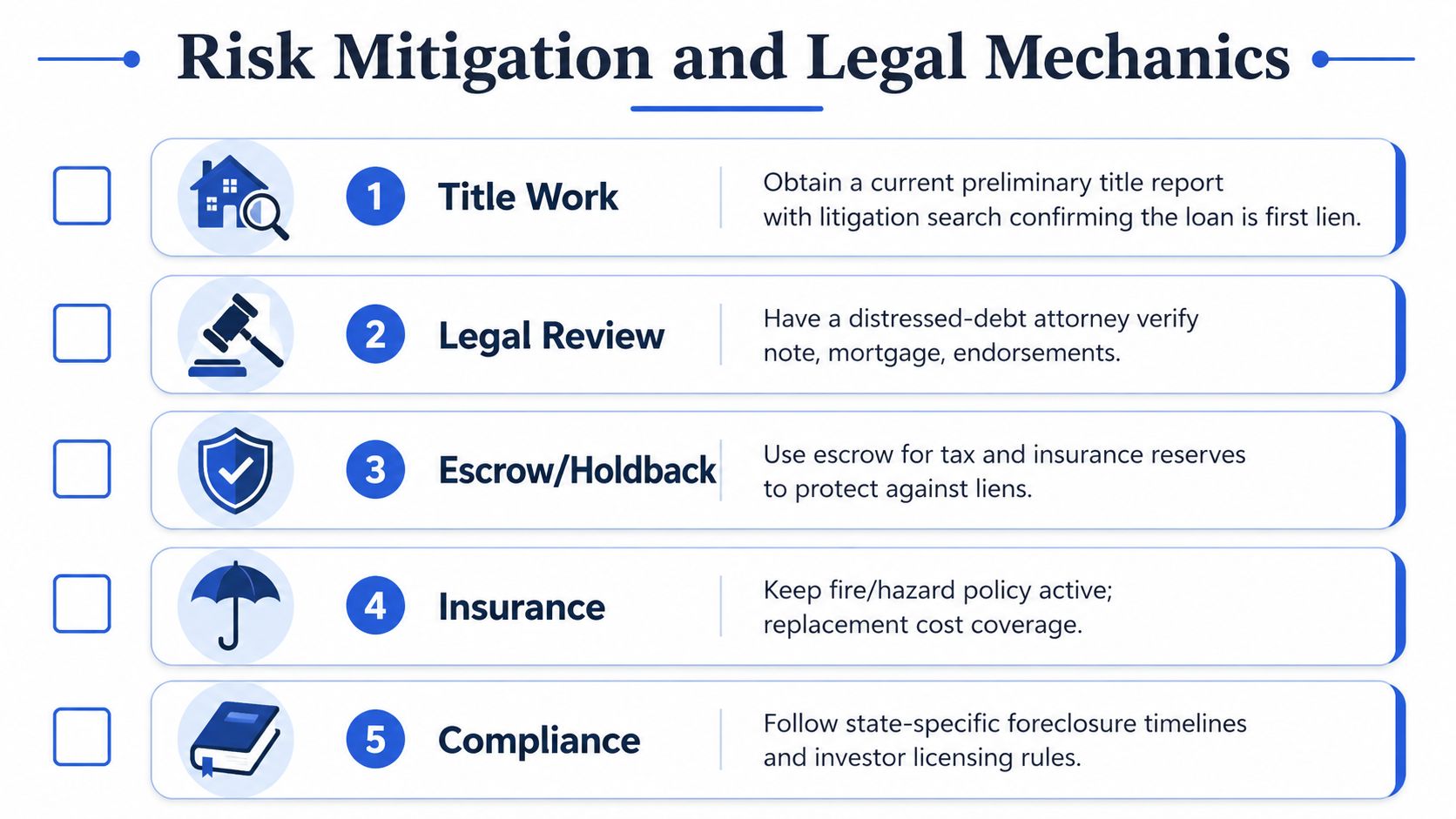
The legal file protects your position before a workout turns adversarial. Order a current preliminary title report and litigation search. Confirm that the note is enforceable, the assignment chain is complete, the deed of trust was recorded correctly, and junior liens are identified.
The search should also surface unpaid taxes, judgments, code-enforcement actions, pending litigation, and ownership complications. An old appraisal or seller summary cannot establish what you are buying. For income-producing California property, verify leases, rent collections, insurance, property taxes, and physical condition against the collateral file.
California enforcement requires planning
For a California nonjudicial foreclosure, the lender generally proceeds through a notice of default, a 90-day cure period, a notice of sale, and 21 days of posting and publication before the sale. The actual sequence depends on the loan documents, property, borrower, statutory requirements, and counsel's advice. Treat the timeline as a planning framework, not a guaranteed closing schedule.
Judicial foreclosure follows a court process and may take a different course. A receiver can be appropriate when rents are being diverted, the property is deteriorating, or an independent party must preserve income and protect the collateral during the dispute.
Documentation beats memory. Keep every demand, inspection report, payment proposal, forbearance agreement, modification, draw request, and borrower response in the servicing file.
Junior-position debt needs a wider margin of safety. A senior default can consume time and collateral value before the junior lender gains control. Before approving a workout, execute a written subordination or consent agreement naming each signing party, defining released claims, setting payment and notice requirements, and stating the consequences of another default. Retain signed copies in the loan file.
A borrower facing an imminent sale may also benefit from how to avoid Arizona foreclosure. It is not California legal advice, but it shows why early communication and a written resolution plan matter before enforcement costs rise.
Practical Ways to Get Exposure Today
Investors have three practical entry routes, and each demands a different level of involvement. Direct ownership offers the most control, pooled debt offers operational delegation, and a partnership lets an experienced private lender handle the work while the capital provider learns the process.
Direct NPL purchases
Buying a single NPL through a loan-sale platform, mortgage broker, or bank REO desk gives you direct exposure to a specific borrower and property. You'll need a servicing arrangement, legal counsel, title review, field inspections, insurance verification, and enough liquidity for a workout or foreclosure.
This route suits an investor who understands the capital stack and can make decisions quickly. It doesn't suit someone expecting a passive coupon or a clean resale market.
Trust-deed fund participation
A trust-deed fund pools loans and can provide exposure across several properties, borrowers, and maturities. The investor should review the fund agreement, lien standards, valuation policy, reserve treatment, distribution mechanics, related-party fees, and the manager's authority to extend, modify, or foreclose.
The fund structure can reduce the operational burden, but investors still need to understand what happens when a loan becomes delinquent. A fund's stated target or current distribution isn't a substitute for reviewing collateral quality and loss allocation.
Partnering with a private lender
A partnership can be the most practical first step. You contribute capital while the lender sources the opportunity, orders title, manages servicing, negotiates with the borrower, and coordinates foreclosure or resale. The economic arrangement may use a split, a participation, or a note structure, but the documents must define control, reporting, fees, reserves, and loss sharing.
For borrowers seeking a separate financing solution on a non-owner-occupied property, LendingXpress real estate debt investments reflect the kind of secured-debt framework investors should examine closely, including lien position and collateral terms.
| Path | Typical Minimum | Time Commitment | Expertise Needed |
|---|---|---|---|
| Direct NPL purchase | $100,000+ per loan | High | Servicing, title, valuation, foreclosure |
| Trust-deed fund | $50,000 to $250,000 | Moderate | Fund documents, collateral review, manager oversight |
| Private-lender partnership | Deal-specific | Low to moderate | Manager selection, agreement review, reporting |
The figures above come from the financing structures described for these investor paths, including direct NPL and trust-deed participation guidance. Treat them as screening points, not universal market rules.
A Realistic Path Forward for Investors
Headline IRR is the wrong starting point. Capital preservation comes first, especially on non-owner-occupied rentals where vacancy, repairs, insurance, and refinancing conditions can change the recovery path.
A conservative 60% to 65% LTV on a rental in a stable submarket can leave meaningful collateral room, while an aggressive basis on a marginal property can turn a high quoted return into a prolonged workout. That LTV range is a risk-management target, not a guarantee. The LendingXpress investment-property financing discussion also shows why down payment and LTV requirements vary by property type and occupancy.

Build experience before scale
Start by co-investing with a private lender who has completed workouts in the market where you plan to invest. Review the title report, inspect the property, read the servicing notes, attend borrower calls, and follow the resolution through payoff, foreclosure, or resale.
Diversify across property types, geographies, borrowers, and sponsors. A portfolio concentrated in one apartment building, one submarket, or one manager can fail for reasons that have nothing to do with the original purchase price.
Relationships matter because distressed deals often require fast, practical execution. A lender who knows the trustee, title officer, inspector, servicer, and local contractors can resolve problems more effectively than a first-time buyer relying only on a bid screen.
For borrowers who own or are acquiring non-owner-occupied property, conventional financing may not move at the pace a workout or time-sensitive purchase requires. Private lenders can consider collateral, exit strategy, and the specific condition of the asset when a traditional bank declines the file.
LendingXpress structures bridge, rental, fix-and-flip, and other private loans secured by non-owner-occupied residential and commercial real estate, including situations where traditional financing falls short. If you need a responsive capital partner for an acquisition, refinance, rehab, or workout, visit LendingXpress to discuss the property, collateral, and exit plan with its lending team.