
You've found a non-owner-occupied property with a workable spread, but the bank wants tax returns, stable income documentation, and a property that fits its standard box. Your closing date won't wait, the renovation scope may be too involved for conventional underwriting, or the projected rental income doesn't satisfy the bank's DSCR requirements. That's when the conversation usually turns to private money vs hard money.
The terms often get used interchangeably, but they describe different parts of the lending market. Understanding that difference can affect your approval odds, borrowing cost, draw process, exit plan, and the way a broker presents your deal.
Understanding Private Money vs Hard Money
The call with the conventional lender usually ends the same way. The property may be sound, but the bank doesn't like the condition, the borrower's income is irregular, or the timeline is too short. A fix-and-flip investor may have a strong resale plan but limited personal income documentation. A rental investor may own several properties and still fall short of a bank's DSCR requirements. A buyer bridging one acquisition into the next may need an answer faster than a traditional lender can provide.
That denial doesn't necessarily mean the deal is weak. It may mean the financing product is wrong for the asset and the business plan.
Private money is the broad category. It covers capital from non-bank sources, including individual investors, family offices, private lending companies, and other nontraditional lenders. Hard money is a narrower product within that category. It developed as shorter-term, asset-based financing secured primarily by property value rather than the borrower's credit profile. The National Real Estate Licensing Association history of private real estate lending describes hard money as an earlier form of private lending and notes that the modern U.S. market expanded after banks pulled back from non-owner-occupied and non-conforming loans following the housing crash.
The distinction is similar to choosing between a handyman and a contractor. The right choice depends on the job's scope, documentation, and execution risk, much like deciding whether to choose between handyman and contractor depends on the work required rather than the label alone.
The category and the product
A relationship-based private lender may customize payment timing, collateral structure, or maturity around a borrower's circumstances. A hard money lender usually offers a more repeatable structure for speed-sensitive investment transactions, with defined loan-to-value limits, points, terms, and draw controls.
That doesn't mean private money is always cheaper or hard money is always faster. It means the lender's operating model matters more than the name on the term sheet. For investors seeking a non-bank option, reviewing private money lenders means asking how the lender evaluates the asset, borrower, and exit.
Practical rule: Ask what changes because the loan is being called private money or hard money. If the answer is nothing, focus on the written economics and execution process instead.
How Lenders Evaluate Risk Differently
Underwriting reveals the difference between these loan types. A hard money lender usually starts with the property, not the borrower's employment history. The lender studies the current value, purchase basis, renovation scope, projected after-repair value, marketability, title, and the plan to repay the loan.
A conventional lender may place heavy weight on income, debt-to-income ratios, and standardized credit requirements. Hard money underwriting is more concerned with whether the collateral supports the loan and whether the proposed exit is realistic. Credit and liquidity can still matter, but a borrower with irregular income or blemished credit may have a better chance when the property and exit carry the decision.
Private money can be more relationship-driven. An individual or family lender might weigh the borrower's experience, communication style, reputation, and broader financial picture alongside the property. Another private lender may evaluate the deal almost exactly like a hard money company. That variation is why investors should never assume that “private” means informal or that “hard” means impersonal.

What strengthens an approval
Professionalization has raised expectations across the market. Trade-press history records that Kiavi began scaled private-lending originations in 2013, was originating more than $100 million per month by 2017, and that Anchor Loans exceeded $1 billion in annual originations in 2016 (Scotsman Guide). The same source references an independent estimate of roughly 8,300 hard money and related private money lenders in the U.S., almost 40% higher than in 2016.
Those figures describe a market that has become more structured, not a place where lenders ignore the details. A strong submission should include:
- A clear property summary: Include the address, purchase price, current condition, estimated value, and intended use.
- A credible renovation budget: Provide contractor bids, a defined scope, and enough detail for the lender to test the assumptions.
- A defensible exit: Explain whether repayment comes from sale, refinance, rental stabilization, or another source.
- Borrower context: Show relevant experience, available liquidity, and how you'll handle costs the loan doesn't cover.
- Clean documentation: Purchase contracts, title information, insurance details, entity documents, and supporting property materials reduce avoidable delays.
A lender may accept weaker personal income documentation when the collateral and exit are strong. That flexibility disappears when the ARV is speculative, the budget is thin, or the borrower has no plan for delays.
Comparing Rates, LTVs, Points, and Terms
A private lender may quote a lower rate, while a hard money lender may offer a clearer process and faster execution. The difference affects more than the interest line. It can change how much cash you bring, how much profit remains, and whether your sale or refinance occurs before maturity.
Hard money loans generally cost more than conventional mortgages because the lender is taking property, timing, condition, and execution risk. Annual rates commonly fall between 8% and 15%, while private money is generally reported around 6% to 12%, often with fewer or no origination points, according to Rocket Mortgage's hard money loan overview. A lower rate does not guarantee a lower total cost. Points paid at closing can matter more on a short-term loan that is repaid quickly.
| Loan feature | Hard money | Private money |
|---|---|---|
| Pricing | Commonly 8% to 15% annually | Generally reported around 6% to 12% |
| Origination points | Often 1 to 4 points for short-duration investment loans | Often fewer or no points, though terms vary |
| Leverage | Commonly around 60% to 75% of current value or ARV | Negotiated more broadly based on collateral and relationship |
| Term | Commonly 6 to 24 months | Can be customized around the investment plan |
| Best fit | Flips, bridge purchases, and speed-sensitive projects | Flexible structures and relationship-based transactions |
The hard money and term ranges above are summarized by REI Prime's hard money terms glossary. As noted earlier, a separate lending glossary describes common value-based limits around 65% to 75% of as-is value, 85% to 90% of total cost, and 70% to 75% of ARV. ARV often becomes the binding constraint.
Read the quote as a complete package
Suppose you compare a lower-rate private loan with a higher-rate hard money loan. The private option may reduce interest expense, but a slower approval process or less predictable funding can cost you the acquisition. The hard money option may close sooner, yet points, inspection fees, extension costs, and a short maturity can reduce the project's profit.
The right comparison is the loan's effect on the planned exit. A flip that sells on schedule may absorb higher upfront pricing in exchange for certainty. A delayed sale can make extension charges and additional interest more important than the initial rate difference. A refinance can face the same risk if the property does not stabilize as planned or the lender applies a lower value than your underwriting assumed.
Review these items before accepting either structure:
- Interest calculation: Confirm whether interest accrues on the full commitment or only on funded amounts.
- Points: Ask how many points apply and whether they are paid at closing or added to the balance.
- Lending basis: Determine whether the lender uses as-is value, total cost, or ARV.
- Term and extension language: Know what happens if the sale or refinance takes longer than planned.
- Draw and inspection charges: Include every fee in the project budget.
The best loan is not necessarily the one with the lowest headline rate. It is the structure whose total cost, funding conditions, and maturity leave enough room for the actual exit.
Speed, Draw Schedules, and Funding Flexibility
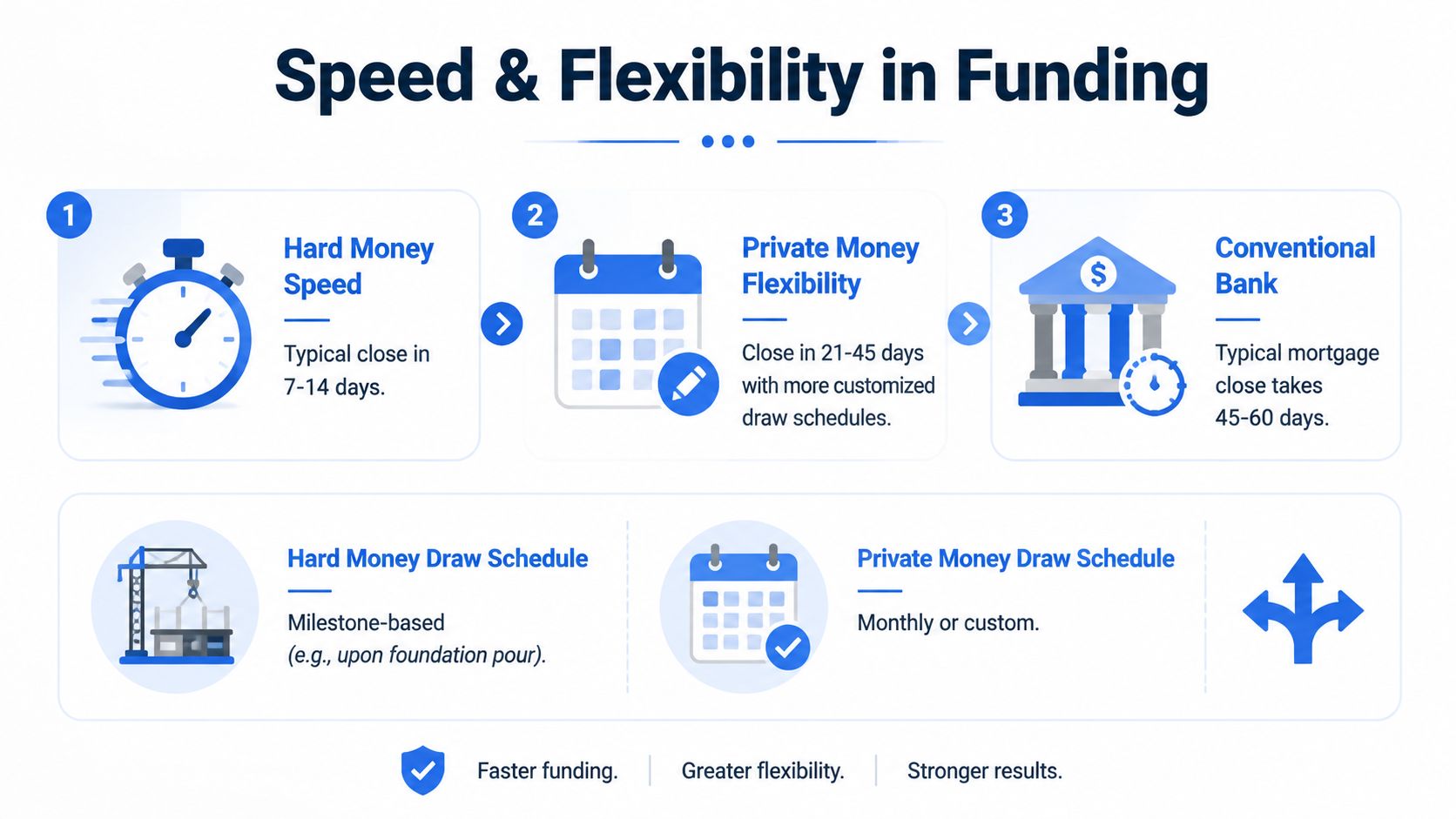
A seller may accept the offer that can close first, but closing speed is only one part of execution. A private lender may close an investment property loan in 7 to 14 days, compared with 45 to 60 days for a conventional mortgage, according to Fidelity California's private money loan guide. Construction and renovation loans can also release draws in 2 to 4 business days after the required inspection process.
Those timelines depend on a complete file. The lender still needs enough information to verify the property, title, scope of work, borrower structure, and exit. Missing contractor bids or unclear ownership documents can turn a fast loan into a delayed transaction, which may weaken the borrower's position with the seller or contractor.
The first draw matters as much as closing
A fix-and-flip borrower can close quickly and still face a cash shortfall if renovation funds are unavailable when the contractor needs payment. Hard money lenders commonly hold back rehab proceeds and release them in stages after inspecting completed work. Depending on the loan structure, draws may be released in 3 to 6 stages. As noted earlier, hard money underwriting typically places more control around property progress and the planned exit.
That control helps the lender manage construction risk, but it creates a funding obligation for the borrower. Early work may need to be paid before reimbursement, so confirm the borrower's available liquidity and the time required to process each request. A delayed draw can slow the project, push back the sale, and make a short exit window harder to meet.
Private money may allow a monthly or custom draw schedule, though the result depends on the individual lender. Informal terms become costly when the parties disagree about inspections, receipts, completion standards, or release timing.
Write every milestone into the loan documents. Foundation work, framing, mechanical systems, and final completion can each be tied to documentation and inspection instead of verbal assurances.
For borrowers comparing execution processes, a hard money lender for real estate loans should explain both the expected closing timeline and the conditions for the first draw. That answer often reveals more about practical deal fit than the loan label alone.
When to Choose Private Money vs Hard Money
The right choice depends on what the deal needs from the lender. A distressed property with a short acquisition window, a defined renovation plan, and a sale or refinance exit usually fits hard money well. The lender's asset-focused process, standardized documents, and milestone-based draws match a project where speed and execution control matter.
Private money can be a better fit when the transaction needs customization. An investor may need a longer hold, an unusual collateral arrangement, flexible payment timing, or terms shaped around a trusted relationship. A private lender may also be willing to understand a borrower's broader portfolio rather than evaluate one property in isolation.
Match the structure to the scenario
Use hard money when:
- The seller needs a fast close: The loan is designed for speed-sensitive acquisitions.
- The property needs work: The lender can evaluate the current asset and planned ARV rather than requiring a conventional-ready property.
- The exit is defined: A sale or refinance is supported by realistic assumptions.
- Rehab funds need controls: Staged draws help match funding to completed work.
- The borrower doesn't fit bank underwriting: Asset strength can carry more weight than conventional income documentation.
Consider private money when:
- The hold period is less predictable: A relationship-based lender may be more open to customized maturity or extension terms.
- The deal is unconventional: Unique property, entity, or collateral details may require negotiated underwriting.
- The borrower values communication: Some investors prefer a direct relationship with one capital source.
- The transaction is smaller or specialized: A private arrangement may be more practical than a standardized program.
The difficult question is the exit. A bridge loan may look attractive when the plan assumes a quick refinance, but that refinance may not be available on the original timeline. The McKinsey Global Private Markets Report reports that private debt fundraising fell 22% to $166 billion, while global closed-end fundraising declined 28% to $104 billion, the lowest level since 2012. Those figures point to tighter capital formation, even while investors continue seeking non-bank financing.
That doesn't make private or hard money unusable. It makes conservative planning more important. If a property takes longer to sell, the borrower may face additional interest, extension costs, taxes, insurance, and contractor expenses. If refinancing is delayed, the borrower may need reserves or a backup exit instead of assuming another lender will step in.
Exit discipline beats rate shopping: A loan that costs less on day one can become the expensive option if its maturity doesn't match the project's realistic timeline.
Run the deal through a slower-sale scenario and a delayed-refinance scenario. If the numbers fail under modest pressure, reduce the loan-to-value, increase reserves, revise the scope, or walk away.
Your Decision Checklist for Choosing the Right Loan
Start with the transaction, not the label. A non-owner-occupied property has to support the financing after purchase costs, renovation, carrying expenses, and lender charges. The loan should serve the exit, not force the exit to happen on an optimistic schedule.
First, identify the pressure point
If the seller demands speed or the property needs immediate renovation, hard money may be the cleaner operational fit. If the transaction needs customized timing or a more thorough review of the borrower and portfolio, private money may deserve closer attention.
Ask yourself:
- Is the closing date fixed? If losing the property is the main risk, prioritize a lender with a demonstrated process for fast approvals and closings.
- Does the property need substantial work? Confirm how the lender calculates value and whether rehab proceeds are held back.
- Does your income profile fit a bank? If not, prepare a strong collateral and exit package rather than relying on personal income alone.
- Do you need customized terms? Put every requested accommodation in writing before comparing offers.
Second, test the asset and the exit
Review the as-is value, purchase basis, renovation budget, and ARV with conservative assumptions. Then model both a sale and a refinance. A rental investor should verify that the stabilized property can support the intended long-term debt, while a flipper should test whether the resale price and timeline remain realistic if the market moves slowly.
A conservative LTV and staged draw structure can reduce exposure regardless of whether the lender calls the product private money or hard money. Ask who inspects the work, how draw requests are submitted, whether inspection fees apply, and how quickly approved funds are released.
Third, calculate all-in cost
Compare more than the interest rate. Include points, closing charges, draw fees, extension fees, legal costs, and any other amount listed in the term sheet. A lower rate with a delayed close or restrictive draw process may not outperform a faster loan that lets you acquire and renovate on schedule.
Before signing, request clear answers to these questions:
- What is the maximum loan amount and what value metric controls it?
- How many draws are available, and what triggers each release?
- What happens if the project runs beyond the stated term?
- Is interest charged on funded capital or the full commitment?
- What cash must remain available for overruns and carrying costs?
- What is the documented repayment plan if the primary exit fails?

LendingXpress works with California investors seeking private and hard money financing for non-owner-occupied bridge, fix-and-flip, rental, and commercial properties. For eligible deals, its process can support closings in as little as three days, with common-sense underwriting, conservative LTVs, and staged renovation draws. Review your numbers with a responsive lending partner before you commit to the wrong structure.
If your deal needs fast, property-focused financing when a conventional bank doesn't fit, visit LendingXpress to discuss the property, budget, and exit strategy with a lending team. Bring your purchase details and renovation plan, and ask for terms that show the complete cost from closing through payoff.