
You found a three-bedroom that might sell for $400,000 after the work. The seller will take $260,000. On a napkin, that's $140,000 of spread, and it feels like the deal that finally makes it worth it to flip a house.
It isn't, not yet. Rehab, interest, points, taxes, insurance, utilities, and the selling commission can eat almost all of that spread. Run the full stack and you're left near $9,900.
That's the spot a lot of investors are in this week. The listing looks cheap against the finished value. The offer deadline is close. Nobody has priced the months in between, and the loan still has to fit a house you won't live in.
Flip Profit Math at a Glance
Start with a conservative after-repair value (ARV) from several sold homes that really match, then build every dollar in and out. This sample is a $400,000 ARV, three-bedroom single-family flip. The offer on the table is $260,000. Rehab is $60,000, with a $6,000 contingency on top. You hold six months. Interest is figured on an average drawn balance near $290,000. The lender charges two points on a $320,000 loan. Carrying costs run about $750 a month. Selling costs are 8% of ARV.
| Line item | How it is estimated |
|---|---|
| Purchase price | $260,000 offer price used in this example |
| Buy-side closing costs | $5,200, about 2% of the purchase price |
| Rehab budget | $60,000 from room-by-room bids, about 15% of ARV |
| Rehab contingency | $6,000, 10% of the rehab budget |
| Interest, six months | $16,000 on an average drawn balance near $290,000 |
| Lender points | $6,400, two points on a $320,000 loan |
| Taxes, insurance and utilities | $4,500, about $750 a month for six months |
| Selling costs | $32,000, 8% of the $400,000 ARV |
| Total cost | $390,100 |
| Net profit | $9,900 |
| Cash invested | $71,000 for the down payment, buy-side closing costs, and points paid up front |
| Return on cash | 13.9%, net profit divided by cash invested |
Where the $140,000 goes
The purchase is the easy line. Buy-side closing adds $5,200. Rehab plus contingency is $66,000 before you find a rotten subfloor. Six months of interest is $16,000. Points take $6,400 on day one. Carrying costs add $4,500. The exit takes $32,000.
Add those lines and total cost is $390,100. Subtract that from a $400,000 sale and net profit is $9,900. On $71,000 of cash, that's a 13.9% return. You tied up that cash, took construction risk, and might have earned less than a calm year in a savings account if the sale slips.
A flip is worth pursuing only when the full pro forma, not the purchase price, clears your target return.
Experienced flippers often budget rehab and other non-purchase costs at roughly 20% to 33% of ARV, then work the offer backward from resale. In this sample, non-purchase costs are about $130,100, or 33% of ARV, right at the top of that band. The ATTOM 2025 year-end flipping report put the typical U.S. flip's gross spread at $65,981, a 25.5% gross return before rehabilitation, financing, and selling expenses, the weakest annual level since 2008. A fat spread on paper can be a thin deal after costs.
Finding and Screening Flip Deals
A cheap price from the wrong channel is still a bad buy. Match the source to how fast you can offer and what can blow up after you sign.
| Sourcing channel | Typical entry price | Speed to offer | Main risk |
|---|---|---|---|
| MLS listings | Asking price, sometimes reduced | Fast to view, often competitive | Bidding wars and inflated comparables |
| Off-market leads from direct mail or driving for dollars | Often below market | Slow, often months | Owner pricing and title issues |
| Wholesaler contracts | Wholesale fee added to the price | Quick to sign | Inflated price and thin disclosure |
| County tax or foreclosure auctions | Discounted, often cash only | Fixed deadlines | Unseen interior and lien surprises |
| Agent pocket listings and referrals | Negotiated | Moderate | Limited inventory and relationship dependence |
MLS deals move fast and get bid up. Direct mail and driving for dollars can beat the asking-price crowd, but owners take months and titles get messy. A wholesaler can put a contract in your hands this afternoon, then bury the fee inside a number that no longer works. Auctions force cash and a hard deadline before you've seen the attic. Pocket listings depend on the agent, not on a portal refresh.
A one-hour screen
Run this on any lead before you fall in love with the photos. A tighter version of the same habit sits in this guide on how to find houses to flip.
- Price trend: Check the block's sale prices over the past six to twelve months. Falling prices eat the spread you think you bought.
- Sold comps: Pull three to six sold homes within about half a mile from the last six months. Match beds, size, and lot before you trust the ARV.
- Absorption: Look at days on market and recent price cuts. If listings sit, your six-month hold is a wish.
- Block check: Look up crime trends with the local police department and confirm nearby schools are at least above average. Buyers price both, even when your rehab is clean.
- Walk it: Tour with a contractor and get a rough scope before any offer. A pretty kitchen bid means nothing if the sewer is collapsed.
The sourcing mistake I would not repeat is chasing a steep discount on a declining block. The discount is real on the buy. The ARV you used never shows up when you list. If the screen fails on trend, comps, or condition, stop. Pinnacle Property Media's note on signs you should walk away from a prospective flip is a useful second pass when a deal feels rushed. Screening is a habit that kills most leads early so your time goes to the few that pass.
Permits, Code Upgrades and Insurance Checks
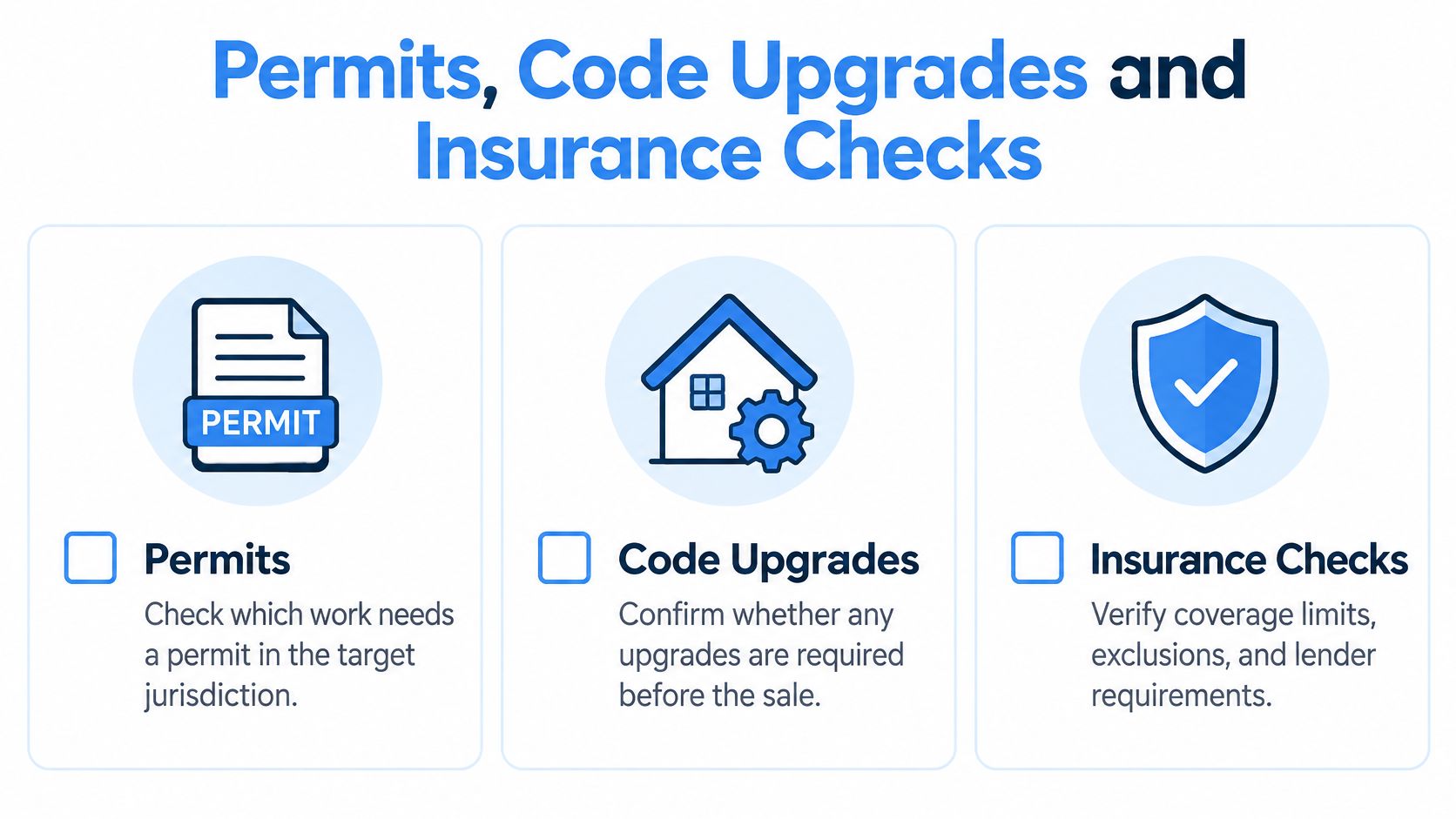
A new kitchen can hide a garage conversion that never had a permit. That file matters more than tile choice. An unpermitted kitchen, garage conversion, or electrical upgrade can stall the schedule, kill a buyer's loan, and leave the finished house uninsurable.
Price the delay before you price the tile
Ask the building department which work needs a permit in that city. Ask whether an older addition can be legalized before you close. Open permits and failed inspections push every later date.
Put that delay in dollars on the sample deal. Interest plus about $750 of monthly holding costs comes to roughly $3,400 a month. A 23-day permit delay is a planning assumption, not a national average, and it adds about $2,600 before a hammer swings. That delay can shove the listing into a slower season or past the loan's planned end date. On a flip with a thin spread, that is real profit leaving the deal.
Energy code is the quiet add-on. A major renovation can trigger retrofits that were never in the contractor's bid. Those retrofits can add meaningful cost, so ask the building department before you lock scope. A 2025 Santa Cruz County grand jury report warned that insurers may deny coverage for illegal construction, which turns a cheaper rehab into a financing, resale, and liability problem, as the Santa Cruz County permitting report lays out.
Pre-offer checklist
- Permit history: Pull the city's file. Note open permits, expired permits, and any addition you can't document.
- Code triggers: Mark the scope list for electrical, plumbing, HVAC, structural, and energy items the department says will be pulled in.
- Insurance quote: Get a quote on the finished home before you buy, including exclusions a buyer's insurer might reject.
- Inspection calendar: List lead times for rough-in and final inspections so the schedule isn't a guess.
- Extension reserve: Hold at least one month of carrying costs so a late inspection doesn't force a fire sale.
Skipping final inspections is the other common miss. The buyer's lender or appraiser will ask for them. If you treated paint as low risk and left an illegal circuit behind the new backsplash, the sale is the moment you pay for it. The permit file belongs in underwriting, before you celebrate the ARV.
Underwriting the Deal Backward From ARV
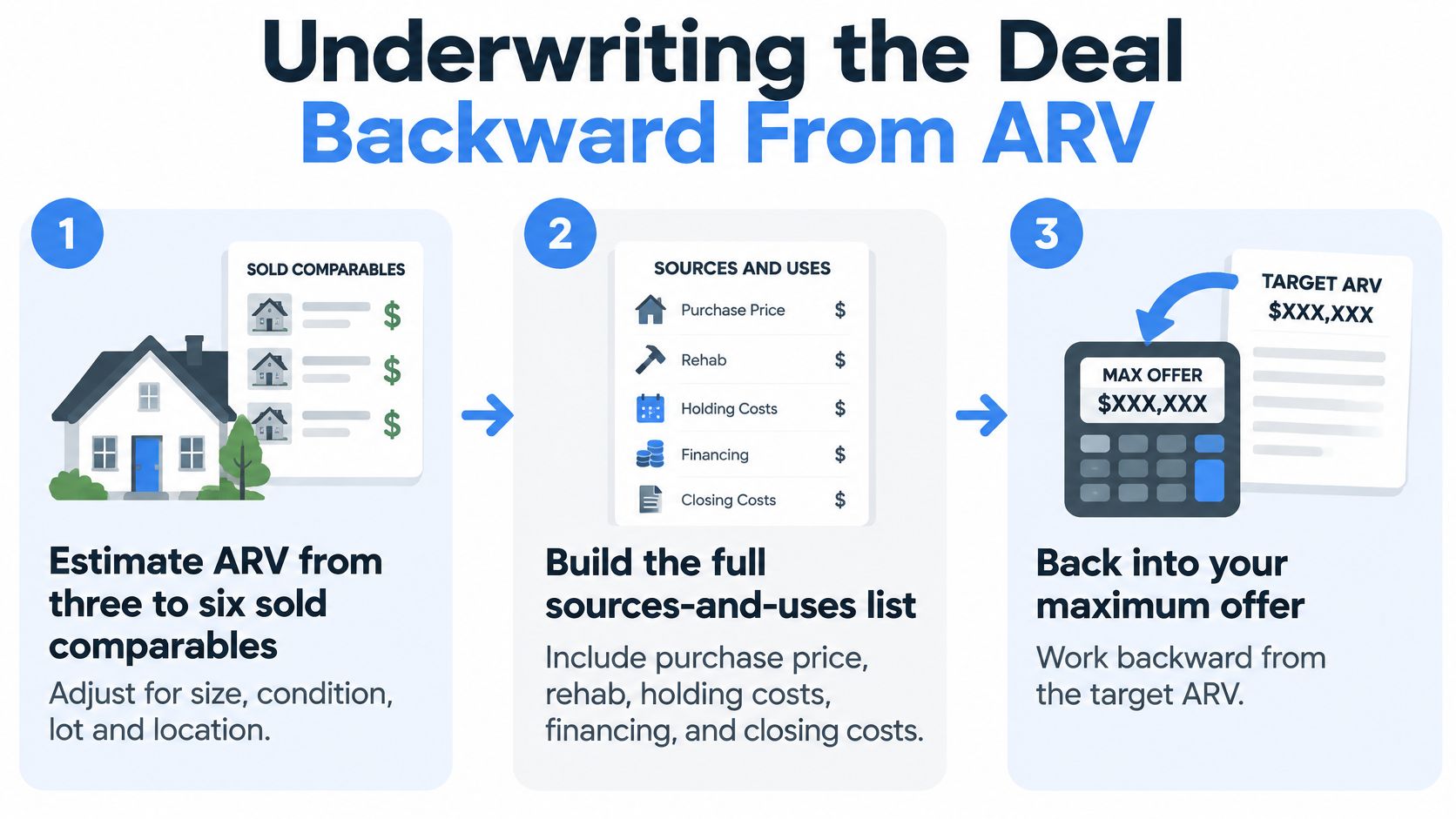
Price the house from the sale backward. The $260,000 number in the sample only nets $9,900 because it was chosen from the seller's ask, not from the finished value.
Four steps to a max offer
- Set ARV from sold homes. Use three to six real comps. Adjust for size, condition, lot, and location. If you need a comp from another neighborhood, cut the value, don't stretch it.
- List every use of cash. Rehab with contingency, both sets of closing costs, interest, points, taxes, insurance, utilities, and commissions. Separate cosmetic work from structural, electrical, plumbing, HVAC, and code items, and get room-by-room bids before you close.
- Back into the ceiling. Subtract those costs and a target profit of 10% to 15% of ARV. On a $400,000 ARV, non-purchase costs near $130,000 and a $40,000 to $60,000 profit target put the max purchase around $210,000 to $230,000.
- Cut again for risk. Take a safety discount for a low appraisal, a slower sale, and scope changes. If the seller won't meet that number, you don't have a deal. You have a hope.
A $225,000 offer, inside that ceiling, lifts profit from $9,900 to roughly $45,000 on the same budget and the same sale price. Same house. Different buy. That's the whole game.
Margin compression is why the cushion matters. The ATTOM third-quarter 2025 flipping report reported a median gross profit of $60,000 and a 23.1% gross return, down from 29.8% a year earlier, and that gross figure excludes rehab and other expenses.
| Case | Assumption | Net profit |
|---|---|---|
| Base case | Six-month sale at $400,000 with the sample budget | $9,900 |
| Delayed sale | Sale closes 60 days late, adding about $6,800 of interest and carrying costs | About $3,100 |
| Downside | Resale falls 5% to $380,000 and rehab plus contingency rises 15% | About −$20,000 |
I would walk away from any deal that goes negative in the downside case unless you can write that loss check without touching the next project. Watch cost-to-complete, days on market, and remaining interest every week. Release rehab money only against dated invoices, lien waivers, photos, and a site visit so a pretty ARV doesn't hide unfinished work.
Finishes still matter once the bones are safe. A clear look at flooring upgrades that increase home value helps you spend on the floors buyers pay for, instead of a custom pattern that doesn't move the comp.
Choosing Financing for a Non-Owner-Occupied Flip
The loan has to match the hold, the cash, and a property you won't live in. A cheap rate that traps your reserves loses to a faster loan with a clean exit. Model both before you sign anything.
| Financing option | Best fit | What lenders check | Typical speed |
|---|---|---|---|
| Conventional investment mortgage | Long holds and rentals | Several months of reserves, debt-to-income, credit | Several weeks |
| Bank construction or CRE loan | Investors with strong track records | Tighter LTV and DSCR tests, documented income | Several weeks to months |
| Hard money loan | Quick purchase on a short term | Exit plan, equity, cash for interest payments | About a week |
| Fix and flip or bridge loan | Purchase plus rehab in one loan | Scope, budget, after-repair value, exit | Days to a few weeks |
| Private money loan | Deals banks decline | Collateral strength, written repayment plan | Often days to a few weeks, set by that lender |
The reserve trap
A conventional investment-property mortgage is built for a hold, not a six-month resale. Conventional investment programs typically want several months of reserves on an investment-property transaction, and reserves are measured against the full qualifying payment: principal, interest, taxes, insurance, and assessments, paid out of liquid assets.
Say the monthly PITIA is $3,000. Six months is $18,000, and that cash sits apart from the down payment, closing costs, and rehab budget. On the sample deal you already needed about $71,000 up front. Add $18,000 of idle reserves and the thin $9,900 profit shrinks further. If you can't park that liquidity, a loan that underwrites the property, the project, and the exit fits better than a guideline written for long-term landlords.
Banks have tightened too. The Federal Reserve's Senior Loan Officer Opinion Survey has recorded tighter policies on commercial real estate loans, including loan-to-value and debt-service coverage, and some lenders shortened interest-only periods. Less borrowing and principal payments that start sooner both eat into the sale proceeds you were counting on.
Hard money, fix and flip, bridge, and private loans underwrite repayment first. Terms often run well under five years, so you need a sale, refinance, or payoff you can explain, plus cash for the monthly interest. Lenders in that set want the exit spelled out before they look hard at the house. LendingXpress is one lender in that group, offering hard money, fix and flip loans, construction, bridge, and private money financing for borrowers whose files miss a bank's reserve, geography, or timing tests.
Pricing decides it, not the rate sheet alone. A loan that closes in a week at a higher rate can beat a cheaper one that costs you the house. Run the full loan cost against your hold and your worst-case sale before you commit.
Three questions before you sign
- Draws: How is each dollar released, and what has to be installed before you get paid?
- Extensions: What does an extra 30 or 60 days cost in fees and rate?
- Points: Are points charged on the full loan amount at closing, or only on what you've drawn?
The payoff date should land after your planned sale, with room for a slow buyer.
If the note matures the same week you hope to list, the loan is the risk, not the house.
Building the Rehab Budget and Draw Schedule
A single rehab number hides the lines that blow up. Build the budget in buckets, then match cash to finished work. On a thin flip, one unplanned line item is the profit.

Budget by what can fail
Structural work covers foundation repair, roof framing, and sewer lines. Price these from a licensed contractor, not from a per-square-foot guess. On the roof, learn to recognize granule loss on shingles before you assume a coating will pass a buyer's inspection.
Systems are the electrical panel, the plumbing stack, and an HVAC replacement. These trigger inspections and long lead times on equipment. Code items are whatever the scope pulls in, from smoke and carbon alarms to energy upgrades you didn't draw on the plan.
Cosmetic finishes are paint, flooring, and the kitchen and bath. They photograph well and they are not where most overruns start.
Soft costs include design, permit fees, dumpsters, utilities, and builder's risk insurance. Leave them out and the contingency is already spent.
I would hold a 10% contingency on mostly cosmetic work. On homes built before 1970, use 15% or more. Hidden plumbing and framing show up once the drywall is gone, so treat both figures as a floor. In a 2025 homeowner renovation report, 37% of respondents exceeded their original budgets. Materials were cited by 58% and labor by 40% as major causes, according to the 2025 How America Renovates report.
Draws follow installed work
Don't fund the project in one wire. The model to copy is HUD's Section 203(k) rehab procedure, even though that program isn't a general investor loan: money follows inspection, a holdback waits until the end, and the draw count is capped. A draw has to reflect real cost for materials, labor, overhead, and profit, and materials sitting in the garage are not payable until they are installed. Get count, timing, and holdback in writing before you sign.
Some private lenders, LendingXpress included, finance up to 100% of rehab costs. That cuts the cash you bring to closing, and it makes the draw terms the difference between paying the crew and stalling mid-rough-in. If the draw count is smaller than your milestone list, the schedule is already at risk.
A six-month rhythm
Weeks one to four are closing, permits, and orders for long-lead gear. Weeks four to ten are demolition and structural work. Rough-ins and inspections come next. Finishes and listing prep close the back half.
If a draw only pays for what's installed, order the panel and the furnace before you need the inspection slot, not after. Tie each draw request to a milestone you can photograph. That discipline keeps the rehab budget honest when the first surprise shows up behind the drywall.
Pick Your Exit Before You Buy
The exit picks the loan, the finishes, and how much delay you can afford. Choose it before the offer, not after the paint dries.
Retail sale. Price at the comps, not at your cost plus sweat. Overpricing is the usual reason a flip sits and burns interest. Deep clean, fresh neutral paint, working lights in every room, and a pre-listing inspection so the buyer's report doesn't restart the negotiation. Skip trendy finishes that the last three sales didn't pay for.
Sale after a refinance into a rental. This fits when the retail spread is thin but a tenant would cover the new payment. You still need the rehab done to a rentable standard, a refinance that qualifies, and enough time on the first loan to reach that closing. If the refi is the only way the first loan gets paid off, you've stacked two approvals on one timeline.
Hold, then cash-out later. You keep the house, collect rent, and pull equity when the value and the lender both agree. It can beat a weak sale. It also means you're a landlord, with vacancies, repairs, and a payment that doesn't care that you meant to flip. Don't pick this on listing day because the first offer disappointed you.
What to confirm this week
Match the term sheet to the offer you already underwrote. The payoff date should sit after the planned sale with weeks to spare, not days. If the sample only works at $260,000, it doesn't work. Use the backward price, nearer $225,000 in that example, and check that your target return still survives the delayed-sale case.
A fix and flip or bridge loan can fund the purchase and the rehab on a non-owner-occupied house when a bank reserve rule won't. Fix and flip loans can cover up to 100% of rehab costs. Bridge loans can fund a fast acquisition or a refinance, secured by residential or commercial property. Borrowers finish the paperwork and can receive funds in days, not weeks. Put that term sheet next to the other options and see which payoff date fits the sale. Then make the offer this week, or pass.
LendingXpress lends to investors buying and renovating non-owner-occupied property when a traditional bank timeline or reserve rule doesn't fit the flip. We structure hard money, fix and flip, and bridge loans around the project and a clear sale or refinance, including rehab funding on qualifying deals. If you're pricing an offer now, visit LendingXpress and compare a term sheet with the full pro forma before you write the number.