
Loan-to-value ratio is a lender's risk gauge. It's calculated as Loan Amount ÷ Property Value × 100, and in conventional residential lending, 80% is the standard maximum LTV without PMI.
If you're trying to buy a rental, close on a bridge loan, or fund a fix-and-flip, that number can decide whether your deal moves forward or stalls. Most new investors focus on rate first. Experienced investors look at the debt financing, cash in, exit plan, and whether the property will qualify for the amount they want to borrow.
For non-owner-occupied properties, LTV matters even more because lenders aren't looking at your future residence. They're looking at an investment asset, your equity cushion, and how protected they are if the deal doesn't go as planned. That's why understanding what is loan to value ratio isn't just basic finance vocabulary. It's deal survival.
Why LTV Is the Most Important Number in Your Next Deal
You find a property with upside. The seller wants a quick close. The numbers work on paper. Then the financing side gets messy.
A bank asks for more documentation, takes too long, or pushes back on the property type because it's non-owner-occupied. In that moment, the question usually isn't whether the property looks promising. The question is how much of the property's value a lender is willing to finance.
That's where LTV becomes the center of the conversation.
Why investors run into this wall
For a lender, LTV shows how much equity sits between the loan and the property's value. A lower ratio gives the lender more room if the market shifts, the appraisal comes in soft, or the borrower needs more time to execute the plan.
For an investor, that same ratio affects three things right away:
- Whether you get approved: If the borrowing is too extensive, many lenders will pass.
- How much cash you need in the deal: A lower loan amount means more money from you or a partner.
- How profitable the deal feels after closing: Increased borrowing can preserve cash, but it can also bring tighter terms and more pressure on the exit.
Practical rule: Investors who understand LTV early make cleaner offers, structure financing faster, and avoid chasing deals they can't actually close.
What new investors often miss
A lot of online explanations of what is loan to value ratio are written for homebuyers. That advice only gets you part of the way. Investment lending is different.
A rental purchase, bridge refinance, or distressed acquisition gets underwritten with a different mindset. Lenders care about property condition, lease strategy, rehab scope, and resale or refinance options. The property itself has to make sense as collateral.
Here's the practical takeaway. If you know the likely LTV range before you make the offer, you can back into your real down payment, your financing gap, and your likely return. If you don't, you're negotiating blind.
Calculating Loan to Value Ratio The Simple Formula
LTV is simple to calculate, but investors get in trouble when they use the wrong value in the formula.
Loan-to-value ratio is the loan amount divided by the property value the lender is willing to recognize, multiplied by 100. Bankrate's explanation of the LTV formula shows the basic math clearly: a $150,000 loan on a $200,000 property equals 75% LTV.
The formula in plain English
Use this:
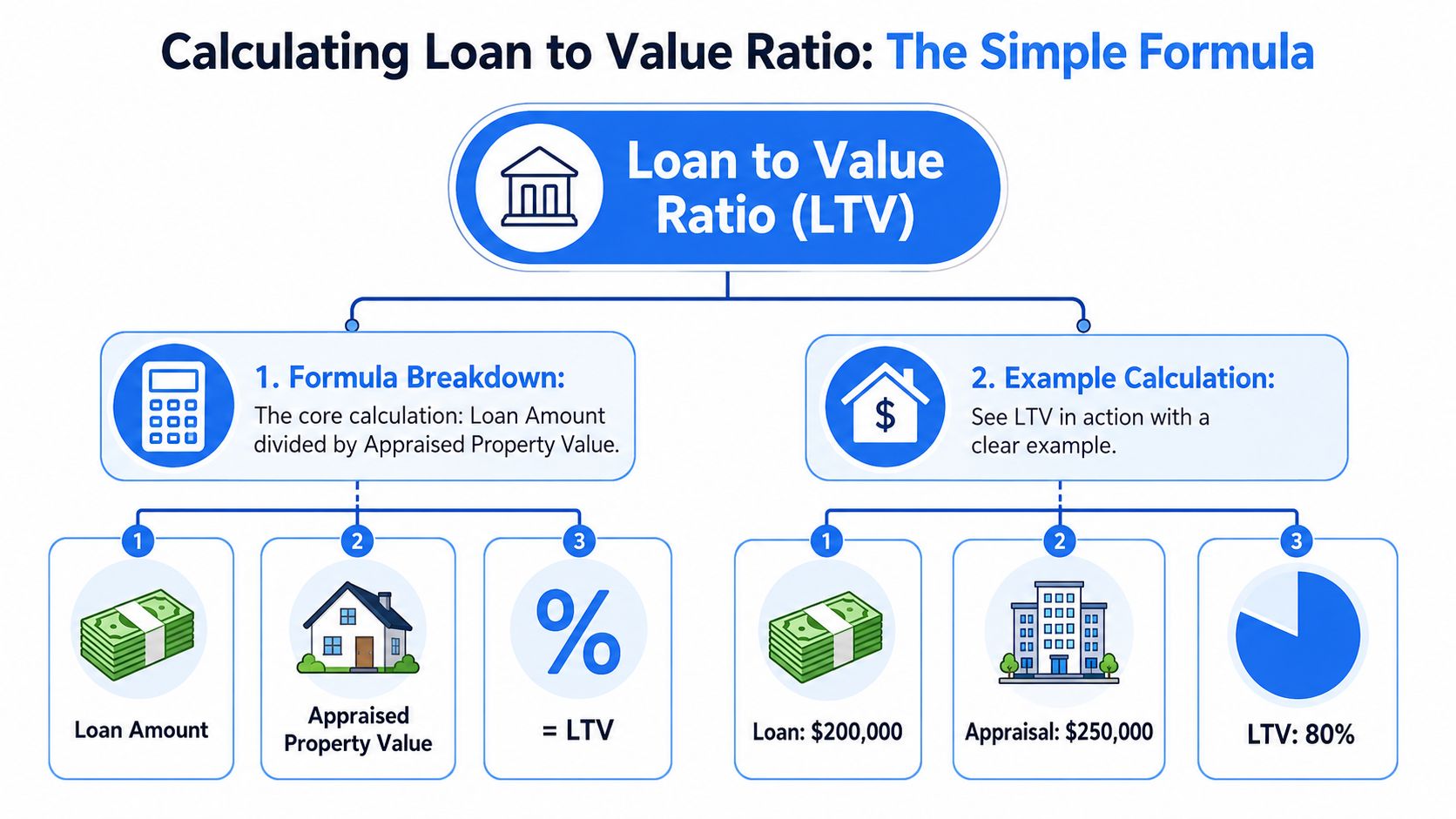
Loan Amount ÷ Property Value × 100 = LTV
The key question is what counts as “property value.” On an investor deal, lenders often use the lower of the purchase price or appraised value for an as-is transaction. If you contract to buy at $220,000 but the appraisal comes in at $205,000, many lenders will base the LTV on $205,000, not your contract price.
That single adjustment can change how much cash you need to close.
This visual makes the formula easy to remember:
A simple investor example
Here's a cleaner real estate example than the generic mortgage explanation.
| Deal piece | Amount |
|---|---|
| Purchase price | $100,000 |
| Loan amount | $50,000 |
| LTV | 50% |
The math is straightforward. $50,000 ÷ $100,000 × 100 = 50% LTV.
At 50% LTV, the lender has a large equity cushion. For an investor, that usually means an easier conversation because the deal has more room for appraisal issues, rehab surprises, and selling costs.
Now change one input. If that same property supports a $75,000 loan, the LTV becomes 75%. Nothing about the property changed. The risk to the lender did, and that usually affects structure, reserves, and required cash from the borrower.
For rental deals, this is one of the first numbers to estimate before you apply. If you want to understand how lenders evaluate those files, review common rental property loan requirements for investors alongside the LTV calculation.
Where new investors misread the formula
New investors often assume LTV answers every financing question. It does not.
LTV tells you how the loan compares to value. It does not tell you whether the lender will fund rehab, whether they underwrite off as-is value or stabilized value, or whether the property qualifies in its current condition. In private and hard money lending, those details matter a lot more on non-owner-occupied properties than they do on a standard home purchase.
That's why experienced investors calculate LTV early, then pressure-test the number against the actual deal. Which value is the lender using? Is the property distressed? Is the plan a rental hold, a bridge refinance, or a flip? The formula stays the same. The underwriting does not.
How LTV Affects Your Loan Approval and Terms
A borrower walks in with a strong-looking rental deal and expects a quick yes. Then the lender sees the requested loan amount pushes the file near the top of its LTV limit. The deal does not die on the spot, but the terms usually change.
That is how LTV works in practice on investment property loans. It affects whether the lender says yes, how much the lender will fund, what interest rate gets offered, how much cash the borrower must bring in, and how hard the exit plan gets reviewed.
The benchmark matters, even if you are not getting a conventional mortgage
Conventional lending trained the market to treat 80% LTV as an important line. Above that level, borrowers often face added cost or tighter structure. Private lenders are not pricing mortgage insurance on a rental the way an owner-occupied bank loan might, but the risk logic is similar.
Using more borrowed funds gives the investor more buying power. It also leaves less room for the lender if the appraisal comes in light, the rehab runs long, or the property sells below plan.

What higher LTV usually changes on an investor file
On non-owner-occupied deals, a higher LTV rarely stands alone. It tends to pull other underwriting questions with it.
A lender may ask for more borrower liquidity, more experience, tighter rehab controls, or a clearer exit. On a bridge or hard money loan, a high level of debt can also affect points, rate, holdbacks, extension terms, or whether interest reserves are required. In plain English, the lender is deciding how much protection is left if the deal underperforms.
Lower LTV usually gives the file more flexibility. There is more room to solve appraisal issues, title problems, delayed leasing, and resale discounts without the whole structure breaking.
A broad commercial benchmark helps frame that risk. Re-Leased's commercial LTV guide explains the concept using stabilized property lending, where a smaller loan amount generally supports better terms because the lender has more collateral coverage.
What investors should watch beyond the headline rate
New investors often focus on the note rate and miss the true cost of a high-LTV structure. A loan can look attractive on paper and still be expensive if it comes with heavy reserves, short maturities, strict draw controls, or limited extension options.
That is why I tell borrowers to read terms as a package, not as a single number. LTV affects the whole package.
For a clearer view of how lenders screen non-owner-occupied properties, review these rental property loan requirements for investment real estate. If you want a broader framework for measuring business performance alongside deal metrics, see mastering accounting ratios for performance.
Where deals get stuck
High-LTV deals can still close. They close when the rest of the file is strong enough to offset the increased risk.
That usually means the property has a believable value, the borrower has cash reserves, the scope of work is realistic, and the exit makes sense for the market. If any of those pieces are weak, LTV stops being a number on a spreadsheet and becomes the reason terms get tighter or the approval gets pulled.
Going Beyond LTV Investor Ratios You Need to Know
Basic LTV works fine for a clean purchase of a stable rental. It doesn't tell the full story on a heavy value-add deal.
When an investor is buying a distressed property, renovating units, or planning a fast resale, lenders often look beyond current value. That's where investor-specific ratios matter.

LTC matters on rehab deals
Hard money lenders often use Loan-to-Cost (LTC) instead of market-value-based LTV during renovations. Academy Bank's explanation of LTC in renovation lending notes that while conventional mortgages cap at 80% LTV to avoid PMI, investment loans may finance up to 100% of rehab costs, which makes LTC more relevant on value-add projects.
That matters because a fixer isn't just a property purchase. It's a project.
LTC asks a different question: how much of the total project cost is the lender funding?
If you're buying a worn rental and planning upgrades, LTC often gives a truer picture of the capital stack than simple LTV. Investors who track both ratios usually underwrite more accurately and avoid underestimating their cash need.
ARV changes how flippers think
Another common metric is ARV, or after-repair value. That's the lender's view of what the property may be worth once the renovation is complete.
Private lenders often discuss financing potential in relation to ARV because a distressed property may not support enough financing based only on current condition. ARV-based lending can create room for the business plan when the scope, budget, and comps are credible.
What works here is discipline. Investors should treat ARV as a working underwriting number, not a wish list. If projected value depends on a perfect renovation, zero delays, and a hot resale window, the deal is already too fragile.
On a rehab deal, the right question isn't “How much can I borrow?” It's “Which ratio matches the way this project actually makes money?”
Don't ignore CLTV
If a property has more than one lien, lenders may also look at CLTV, or combined loan-to-value. That's the ratio created by all secured balances against the property, not just the first loan.
This comes up on refinances, second-position debt, and properties with existing debt. A deal that looks reasonable on first-position LTV can become much less attractive once the total debt load is included.
For investors who want a better handle on how ratios interact across the full financial picture, this guide on mastering accounting ratios for performance is a useful companion read.
If you're planning a bridge, rental, or rehab structure, it helps to compare options built for financing investment property rather than trying to force a bank-style mortgage framework onto an investor deal.
Practical Strategies to Improve Your LTV and Secure Funding
A lot of investors treat LTV like a lender rule they have to live with. That's the wrong approach.
In practice, LTV is one of the most adjustable parts of a deal. You can improve it before you apply, during negotiations, and sometimes even after the first lender conversation if you restructure the file correctly.
For non-owner-occupied investment properties, conventional lenders typically want a down payment between 15% and 30%, which corresponds to a maximum LTV of 70% to 85%, according to Rocket Mortgage's overview of non-owner-occupied financing. If your deal falls outside that range, you usually need a better structure, more cash, or a more flexible lender.

Put more money into the deal
The most direct fix is the least glamorous one. Reduce the loan amount.
That can mean a larger down payment, paying certain costs outside the loan, or bringing in a partner who fills the gap. Yes, it reduces your reliance on borrowed funds. It also gives you a cleaner file, broader lender options, and more room if the appraisal doesn't hit exactly where you expected.
Attack the purchase price
Many investors spend hours modeling upside and very little time negotiating basis. But basis drives the level of debt utilization.
If you negotiate the acquisition lower, you may improve your LTV without changing the loan amount much. On a rental hold, that can improve financing and future cash flow at the same time. On a flip, it may widen your margin before construction even begins.
Improve the value side honestly
Some investors improve the file by improving the property itself before a refinance. Others tighten the scope, finish deferred work, stabilize occupancy, or clean up operational issues that affect valuation.
What doesn't work is trying to force value with weak comps or aggressive assumptions. Lenders see that immediately. Better appraisals usually come from better assets, not better spin.
Field note: If your strategy for “fixing” LTV depends on talking the lender into your number, the deal probably needs a stronger basis or a better plan.
Rework the structure instead of forcing one loan
Sometimes the answer isn't reducing the loan burden. It's splitting the problem into phases.
A bridge loan can solve timing. A rehab structure can solve scope. A refinance after stabilization can solve cost of capital. Investors who think in stages often get funded more smoothly than investors who insist on one perfect loan from day one.
Here are practical levers that often help:
- Bring in equity early: A capital partner can reduce the senior loan need and make the deal more financeable.
- Challenge weak assumptions: If your contractor budget, rent plan, or resale timeline is thin, fix that before the lender does.
- Use local market support: Leases, repair bids, and clean comps help the lender get comfortable faster.
- Plan your exit before closing: Refinance, sale, or hold should be clear from the start.
If you work with agents on investment deals, this actionable video playbook for agents offers useful ways to communicate financing realities to buyers before a deal gets shaky.
Partnering with a Lender Who Sees the Whole Picture
By the time most investors ask what is loan to value ratio, they're usually trying to solve a real problem. They need to close quickly, protect cash, or make a deal fit inside a lender's box.
The deeper lesson is that LTV matters a lot, but it's never the whole story on an investment property.
Good underwriting goes past one ratio
A strong lender looks at the asset, the financing structure, and the execution plan together. On a rental, that means condition, rents, and exit options. On a bridge deal, it means timing, collateral quality, and refinance path. On a rehab, it means scope, budget control, and whether the projected value is credible.
That's why experienced investors don't ask only, “What's the max LTV?” They ask better questions.
- Is the property financeable in its current state?
- Does the financing structure leave room for delays or surprises?
- Will this structure still work if the exit takes longer than expected?
- Am I solving the immediate closing problem while creating a future refinance problem?
What usually works best
Deals move better when the borrower is realistic about their borrowing, clear about the plan, and prepared with clean numbers. Lenders respond well when the file makes sense without a long story attached to it.
The opposite is also true. If the deal only works at the limit of borrowed capital, with thin reserves and a perfect exit, approval gets harder and terms usually get less attractive.
The best investor loans aren't built on maximum leverage. They're built on workable leverage.
That's especially true for non-owner-occupied properties, where flexibility can matter more than fitting a conventional checklist. If your deal is time-sensitive, needs rehab funds, or doesn't fit a bank template, the right lending partner can make a meaningful difference by focusing on collateral strength and execution, not just a rigid underwriting formula.
If you're working through a non-owner-occupied purchase, bridge refinance, rental loan, or fix-and-flip and need a lender that understands investor deals, LendingXpress is worth a look. Their team focuses on fast closings, common-sense underwriting, and flexible structures for borrowers who don't fit the traditional bank model.