
You've found a Los Angeles property with enough upside to attract multiple offers. The seller wants a quick close, your contractor can start soon, and the spreadsheet looks profitable at first glance. Then the questions arrive: How much cash must you bring, when will rehab funds become available, and how many extra weeks can the deal survive before the profit disappears?
A Hard Money Loan Los Angeles investors use for a flip isn't just a way to borrow more quickly. It's part of the project's profit equation. Interest, origination charges, draw timing, financing, resale costs, and the length of the hold all affect the final result. A property that works with a fast acquisition and controlled renovation can become a weak investment when delays force you to carry the loan longer.
Los Angeles investors also operate in a substantial private-finance market. In Q1 2026, the average Los Angeles hard money loan carried a 10.70% interest rate, had an average amount of $870,485, and the regional tracker recorded 675 loans. In Q2 2026, the average Los Angeles bridge-loan rate was 10.38%, the average loan amount reached $1,018,098, and the tracker recorded 799 loans. Regional Los Angeles hard money and bridge lending data shows why this financing deserves careful analysis rather than casual optimism.
The encouraging part is that you don't need complicated modeling to make better decisions. You need a realistic resale value, a complete cost list, a timeline that reflects Los Angeles execution, and a lender who understands that a time-sensitive acquisition can't wait for a conventional process. This guide walks through that math for non-owner-occupied investment properties, including where LendingXpress may fit when traditional financing falls short.
Introduction Is House Flipping Still Profitable in Los Angeles
You find a Los Angeles property with an apparent value gap. The seller accepts your offer because you can close quickly, but the loan costs more than a bank mortgage. The deal can still work, provided the time saved protects more profit than the added financing expense consumes.
A completed home may command a strong resale price, yet that price alone does not create profit. A flip is an unfinished business project. From acquisition through sale, each day can add interest, property expenses, contractor delays, permit problems, market changes, and other holding costs.
Speed can also affect whether you win the property. One investor may offer less but request a longer closing. Another may offer more while relying on a financing process that creates uncertainty. A private bridge lender may help a buyer compete by focusing underwriting on the property, the exit plan, and available equity, rather than using the same income-documentation process as a conventional mortgage.
The useful question is therefore practical: does faster control of the property protect enough margin to justify the loan's interest and fees? That answer depends on the value gap, renovation schedule, draw timing, resale plan, and expected holding period.
The Los Angeles investor equation
Los Angeles has a substantial investor base. One California market estimate counted 52,547 real estate investors in the Los Angeles-Long Beach-Anaheim metro area. California investor-market data also estimated California short-term investment-property lending at about $3.5 billion across 1,882 loans in Q2 2026, following $3.9 billion across 2,583 loans in Q1 2026.
Those figures do not prove that a particular flip will succeed. They indicate that short-term financing supports an established market for acquisitions, renovations, and refinances. California's long-term rental lending was larger, at $14.1 billion across 13,473 loans in Q2 2026, which helps clarify hard money's role. It generally provides interim capital rather than replacing permanent rental or conventional financing.
Practical rule: A flip is profitable only after you account for the cost of controlling the property, improving it, and selling it.
Start by testing whether the projected margin remains healthy after financing and time-sensitive expenses. Then confirm that the lender can fund the project in the form it requires, including staged renovation draws when applicable. LendingXpress may fit when traditional financing cannot match the transaction's timing or structure.
Understanding How Flip Profit Really Works
Start with the finished value, then work backward. After-repair value, or ARV, is your estimate of what the property should sell for after the renovation is complete. Think of ARV as the destination on a map. It doesn't tell you how much fuel the trip requires, but every other decision depends on reaching the right destination.
Gross profit is the resale price minus the purchase price, renovation, carrying, closing, and selling costs. ROI then compares the profit with the cash you invested, including down payment, closing funds, reserves, and other capital that stays tied up during the project.
Gross profit = resale price minus total project costs
ROI = net profit divided by invested cash
Build the deal from the exit backward
Use comparable properties that resemble the finished project in location, size, condition, and design. Don't justify an aggressive ARV by pointing to a renovated home in a stronger micro-market. In Los Angeles, a few blocks can change buyer demand, parking expectations, school preferences, and resale timing.
Next, estimate the purchase and renovation costs. Then add financing charges and carrying expenses. Carrying costs include loan interest, property taxes, insurance, utilities, security, maintenance, and any association obligations. They behave like a meter running in the background. A short delay may seem harmless, but multiple delays can consume the margin you expected to earn.
The funding structure also changes the calculation. A loan may charge interest on the full balance or on amounts advanced, depending on the terms. Rehab money may be released through inspections and approved draws rather than delivered in one lump sum. Ask how interest accrues, whether unused funds carry a charge, and what documentation is needed for each draw before you finalize the budget.

Use a conservative reading of the spreadsheet
A promising deal should still work if the resale takes longer than planned or one part of the renovation costs more than expected. You don't need to predict every surprise. You do need to identify which assumptions are doing most of the work.
If the profit exists only because the ARV is optimistic, the rehab estimate has no contingency, or the loan is repaid on an unrealistic date, the deal isn't ready. Separate confirmed costs from estimates, identify who supplied each estimate, and update the model when inspection or contractor information changes.
Breaking Down the True Costs of a Los Angeles Flip
Most budget mistakes happen because investors focus on the purchase price and rehab while treating every other expense as a footnote. A complete Los Angeles flip budget needs four main buckets, plus a reserve for uncertainty.
Acquisition costs include the purchase price, escrow charges, title work, inspections, lender-related fees, recording expenses, and any required insurance setup. Some costs are known before closing. Others depend on the loan structure, property condition, and transaction documents. Request a written settlement estimate so your cash-to-close figure isn't based on a rough conversation.
Rehab costs cover labor, materials, design, permits, architectural or engineering work, demolition, waste removal, inspections, and changes required after work begins. Cosmetic work is easier to estimate than structural, electrical, plumbing, roofing, or foundation issues. A contractor's low bid may exclude permits, finish upgrades, or repairs discovered after demolition.
For a practical renovation planning reference, use this guide to estimating renovation costs while building a line-item scope. The useful question isn't just “What will the kitchen cost?” It's “What must be completed for the finished property to support the resale assumption?”

Track the costs that grow with time
Carrying costs are the expenses that continue while the property sits unfinished or listed. Interest is often the most visible item, but taxes, insurance, utilities, lawn care, security, maintenance, and association charges can also continue. A longer hold may also require additional property management or contractor oversight.
Closing and selling expenses can include agent compensation, seller-side escrow and title charges, transfer-related costs, staging, photography, cleaning, repairs requested during escrow, and buyer credits. Don't subtract only the expected sale price from your total investment. The property must generate enough proceeds after the complete disposition process.
Protect the margin before work starts
Build a reserve for uncertain work and time. The exact reserve depends on property condition, scope quality, contractor reliability, and local approval requirements. Keep the reserve visible in the model rather than hiding it inside a vague “miscellaneous” line.
A useful budget separates fixed costs, scope-sensitive costs, and time-sensitive costs. Purchase-related charges may be relatively stable. Rehab changes with discoveries and design choices. Interest and utilities continue every day the project remains open. That classification tells you where better planning can protect profit and where faster execution has the greatest value.
How Financing Choice Changes Your Profit Math
A Los Angeles flip can look profitable until the financing clock starts. Suppose a renovation takes longer than planned. Interest continues, draws may arrive only after inspections, and every extra day pushes the break-even sale price higher. Financing speed and structure therefore belong in the profit equation, alongside purchase price, repairs, and resale value.
A conventional loan may offer a lower stated rate, but approval also depends on property eligibility, borrower documentation, renovation limits, and the planned exit. Hard money generally costs more, yet it can be structured for a non-owner-occupied investment property and a short-term business purpose. The right comparison is the completed project, not the rate shown at the top of the term sheet.
California business-purpose loan examples include 1- to 5-year terms, while short-term first and second mortgages may use 1- to 3-year terms. California business-purpose loan examples illustrate why the term should cover the expected renovation and resale period, with room for a realistic delay.
| Feature | Hard Money Bridge Loan | Conventional Loan |
|---|---|---|
| Approval focus | Property, equity, project, and exit | Borrower income, credit, debt, and property |
| Closing approach | Designed for time-sensitive acquisitions | Usually more documentation and conditions |
| Renovation flexibility | Can support project-specific structures and draws | Often less suited to active construction or major rehab |
| Pricing | Commonly higher than bank debt | Commonly lower headline pricing |
| Best fit | Non-owner-occupied flips, bridge acquisitions, and refinance exits | Stabilized properties and borrowers who can wait for conventional underwriting |
| Main risk | Interest and fees can rise with the hold period | Delays or rigid criteria can cause a missed acquisition |
Compare total cost, not just the rate
Los Angeles market figures provide context for hard-money and bridge-loan pricing, but actual terms depend on the property, borrower profile, renovation scope, and exit. The Los Angeles private lending market figures should not replace a written quote for the specific project.
A lower rate has little value if the loan closes after another buyer wins the property. A fast closing also fails if the structure leaves insufficient cash for construction, reserves, or scheduled draws. Add interest, points, legal and escrow charges, draw procedures, inspection timing, and extension terms to the same model.
Roof work can create a similar timing issue. For a property requiring major repairs, reviewing roof replacement cost solutions can help place that expense in the overall capital plan rather than treating it as an afterthought.
For a wider comparison of ways to finance an investment property, examine how each option affects closing speed, cash required, and the resale or refinance exit. Ask every lender for a written term sheet that explains funding conditions, draw rules, fees, and extension costs.
What Happens When the Numbers Change
A flip spreadsheet is a forecast, not a promise. Your job is to test the deal against the changes most likely to damage it. In Los Angeles, those changes often involve resale timing, contractor scope, approval delays, buyer negotiations, and financing extensions.
Start with a base case. Use the purchase price, conservative ARV, complete rehab budget, expected selling expenses, and the loan's actual interest and fee structure. Calculate the amount of cash required and the profit remaining after repayment.
Three simple pressure tests
Base case: The acquisition closes on schedule, the contractor completes the approved scope, the property reaches the expected finished condition, and the sale closes within the planned hold. This case tells you what happens when execution is competent but not perfect.
Cost-overrun case: A major system requires additional work, or finish selections exceed the original scope. Increase the rehab expense in your model and identify whether you can fund the difference without delaying the project. If the answer is no, the deal may be undercapitalized before the first draw.
Extended-hold case: The renovation finishes later than expected, or the listing takes longer to attract an acceptable offer. Add the extra interest and property expenses to the model. Then consider price concessions, repairs requested by the buyer, and another period of insurance and utilities.
Stress-test question: If the sale takes longer and the renovation costs more, can the project still repay the loan without emergency capital?

Find the expensive variable
Time affects more than interest. A delay can postpone listing, extend insurance and utilities, keep contractor deposits tied up, and push the sale into a less favorable marketing window. A private loan may reduce the time needed to acquire the property, but it can't repair a weak scope or replace disciplined project management.
Run the sensitivity analysis before you submit an offer. If the deal fails under modest pressure, lower the purchase price, increase available reserves, adjust the scope, or choose a different exit. Optimism belongs in the marketing plan. Conservatism belongs in the financing decision.
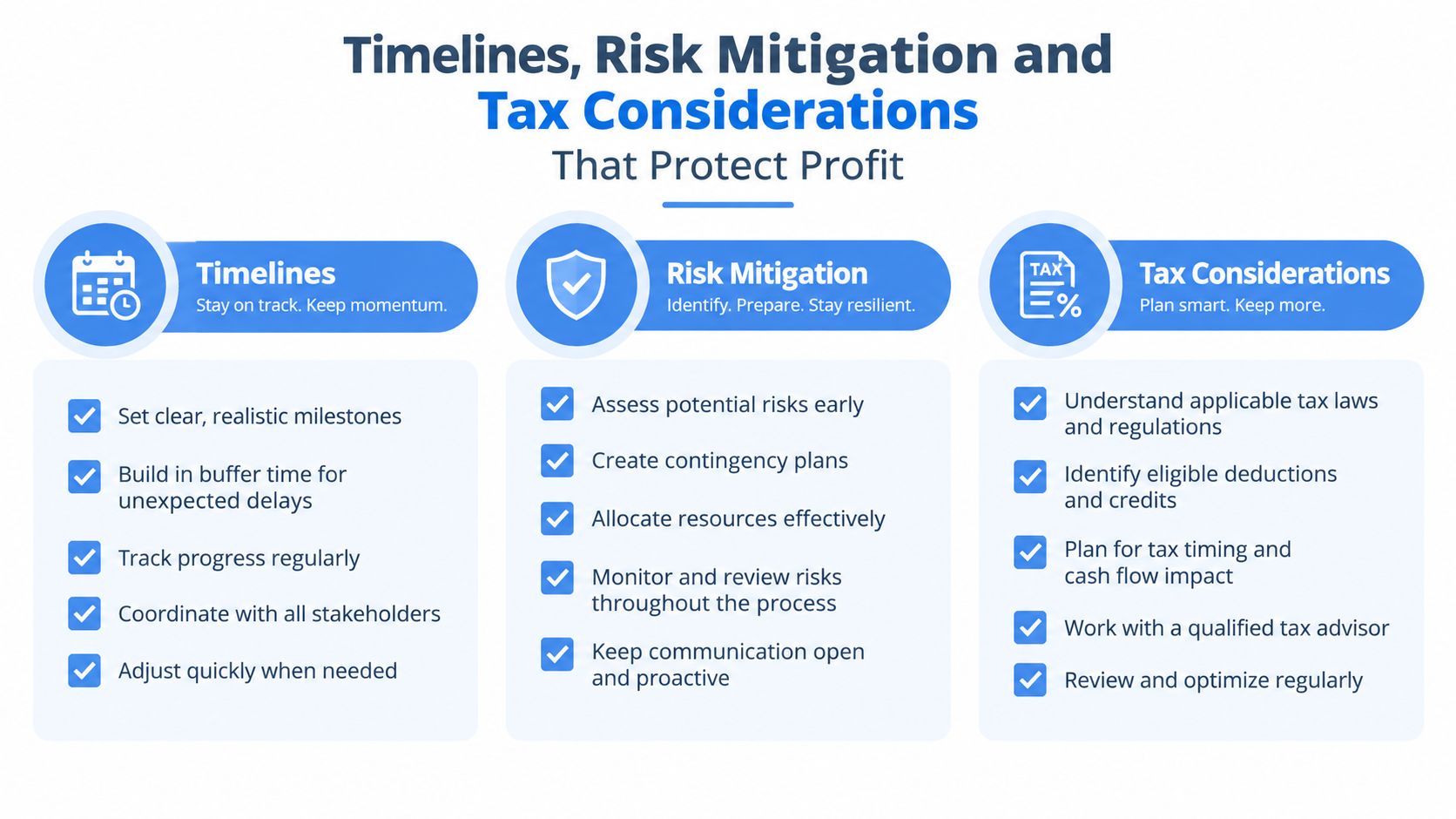
Timelines Risk Mitigation and Tax Considerations That Protect Profit
Profit protection begins before closing. Confirm the purchase contract, inspection access, contractor availability, permit path, insurance, draw process, and resale strategy while you still have the ability to renegotiate or walk away. A fast loan doesn't eliminate due diligence. It gives you a way to act once the due diligence supports the decision.
Set a timeline with separate phases. Acquisition requires coordination among the seller, escrow, title company, lender, insurance provider, and any entity signing the documents. Rehab requires a written scope, material decisions, inspection planning, and draw requests. Listing and sale require completed work, cleaning, staging, photography, marketing, buyer access, negotiations, and escrow.
Control construction before construction controls you
Get more than one contractor view of difficult work, and compare scopes rather than looking only at the bottom-line bid. Require written change orders. Keep a record of invoices, permits, inspections, and draw approvals. If your lender releases rehab money in stages, your contractor's payment expectations must match that schedule.
Ask these questions before accepting a term sheet:
- Draw requirements: What inspection or documentation supports each release?
- Interest calculation: Does interest apply to the full commitment or funded balance?
- Extension terms: What happens if the sale or refinance takes longer?
- Exit evidence: What sale, refinance, or repayment documentation will the lender require?
- Entity documents: What must your LLC, corporation, trust, or other borrowing entity provide?
Treat compliance as part of underwriting
California licensing status can affect pricing, fees, and the application of usury restrictions. Legal guidance explains that loans made or arranged by a California-licensed real estate broker and secured by real property can be exempt from state usury restrictions, while loans made by licensed California finance lenders can also be exempt. California lending and usury guidance explains why you should verify who originates or arranges the loan before relying on an assumed rate limit.
A separate California private-lending compliance guide states that the general 10% usury cap applies to unlicensed lenders, while DRE-licensed brokers, DFPI-licensed finance lenders, banks, credit unions, and insurance companies are exempt. It also identifies common documents such as a promissory note, deed of trust, loan agreement, personal guaranty for entity borrowers, Mortgage Loan Disclosure Statement, and, in some rehab transactions, draw agreements. California private-lending compliance information is a useful reminder to review documents with qualified legal counsel.
These loans are generally structured for investment or business use, not personal spending. A California lender source states that its programs are for business or investment purposes only, and that owner occupancy may be permitted only when proceeds are used for business purposes rather than personal expenses. California business-purpose loan guidance supports treating the occupancy and use-of-proceeds review seriously.
Tax treatment also deserves professional advice. Keep improvement invoices and closing records, distinguish project costs from personal expenses, and ask your tax adviser how the property's purpose and resale activity affect reporting. Don't assume a flip receives the same treatment as a long-term rental or that a tax strategy automatically fits your transaction.
Real World Examples and When Flipping Makes Sense
Use three decision examples, not because every Los Angeles property follows the same pattern, but because each one exposes a different underwriting mistake.
The first deal has a conservative ARV, a documented scope, enough cash for the purchase and required reserves, and a lender whose draw process matches the contractor's schedule. The margin remains positive after interest, selling costs, and a delayed exit. A hard money bridge loan may make sense because the investor values control of the property and expects to repay the loan through a sale or refinance.
The second deal reaches break-even. The purchase price is attractive, but the renovation estimate excludes several necessary repairs. The investor also assumes a rapid sale and has no clear plan for additional carrying expenses. Even if the property eventually sells, the financing cost and missing scope reduce the return to a level that may not justify the execution risk.
The third deal should be rejected. The ARV depends on an optimistic comparable, the contractor bid is incomplete, the investor needs every dollar of the loan to fund construction, and a modest delay would require outside cash. A lender's willingness to consider the property doesn't make the investment sound. Walking away can be the most profitable decision available.
Choose the strategy that matches the asset
Flipping may fit when the property has a visible improvement opportunity, the resale market supports the finished product, and you can manage the work and exit. Buy-and-hold may fit better when rental income and long-term appreciation matter more than a rapid resale. Wholesaling may fit when you can source a contract but don't want to fund or manage renovation.
For a non-owner-occupied property, compare the complete capital plan before making an offer. Confirm the loan amount, financing structure, draws, interest, fees, reserves, contractor scope, resale costs, and repayment path. LendingXpress offers California investors bridge, fix-and-flip, and rental-property financing secured by residential and commercial assets, with underwriting structured around the property and transaction.
LendingXpress can help investors evaluate fast bridge and fix-and-flip financing for non-owner-occupied Los Angeles properties, including renovation structures with staged draws. Visit LendingXpress with your purchase details, scope of work, estimated ARV, and exit plan to start a practical financing conversation.