
You've found a Sacramento property with strong potential, but the seller wants certainty now. Your bank is still reviewing income documents, requesting another statement, and waiting for an appraisal while another buyer prepares to close. The problem isn't always the property or the borrower. Often, the delay comes from a diligence package that doesn't answer the lender's questions in the order they need them answered.
A Hard Money Loan Sacramento investor can use for a non-owner-occupied property solves a different problem than a conventional mortgage. It prioritizes the asset, the renovation plan, and the repayment path, while still requiring disciplined verification. Speed matters, but fast capital only helps when the deal can survive careful review.
Why Speed and Diligence Matter in Sacramento
A Sacramento investor may identify a vacant rental, a dated duplex, or a small commercial property that traditional financing can't touch yet. The building may need repairs, the leases may be changing, or the property may not produce the documentation a bank expects. Waiting through a conventional process can mean losing the acquisition before the borrower has a chance to improve the asset.
Bridge lending exists for this transition period. A bridge loan can help finance a property that doesn't yet qualify for permanent financing because of vacancy, renovation requirements, or lease rollover. In commercial real estate, these loans are commonly structured as short-term financing, often lasting 12 to 36 months, until the property is stabilized, refinanced, or sold, as explained in this overview of commercial bridge loans.
The speed advantage doesn't remove diligence. It changes its focus. A private lender still needs to confirm that the borrower can acquire the property, that the collateral supports the requested loan, that the repair plan is credible, and that the exit isn't based on wishful pricing.
Practical rule: Fast underwriting works best when the borrower has already organized the facts a lender must verify.
The cost of a rushed package
Suppose the purchase contract identifies one legal parcel, while the county record shows a different parcel configuration. Or the borrower presents an attractive after-repair value without explaining which comparable sales support it. Those gaps can trigger new title work, valuation questions, or a revised loan structure at the moment the transaction should be moving toward closing.
The investor also bears the risk. A lender's review may expose an unpermitted addition, an unrealistic resale assumption, or a renovation budget that leaves no room for surprises. Those findings can feel inconvenient, but they may prevent the borrower from committing capital to a project that can't support its debt.
Bridge-loan lenders may approve a transaction in 24 to 72 hours, with some closings completed in 5 to 10 business days, depending on complexity. That compares with conventional mortgage closings of about 43 days or more, according to this comparison of bridge-loan and mortgage timelines. The faster path still depends on complete information.
Asset-First Underwriting Versus Traditional Bank Requirements
A conventional bank usually starts with the borrower. It reviews income, employment, debt obligations, credit history, tax documentation, and the debt-to-income picture. That approach works well for a stabilized owner-occupied property with predictable income, but it can be a poor fit for a vacant or heavily renovated investment property.
Private underwriting starts with the collateral and the transaction. The lender examines the property's current value, the after-repair value, or ARV, the purchase price, the renovation budget, and the borrower's exit strategy. Personal credit and experience still matter, but they are evaluated alongside the asset rather than treated as the only gateway to approval.
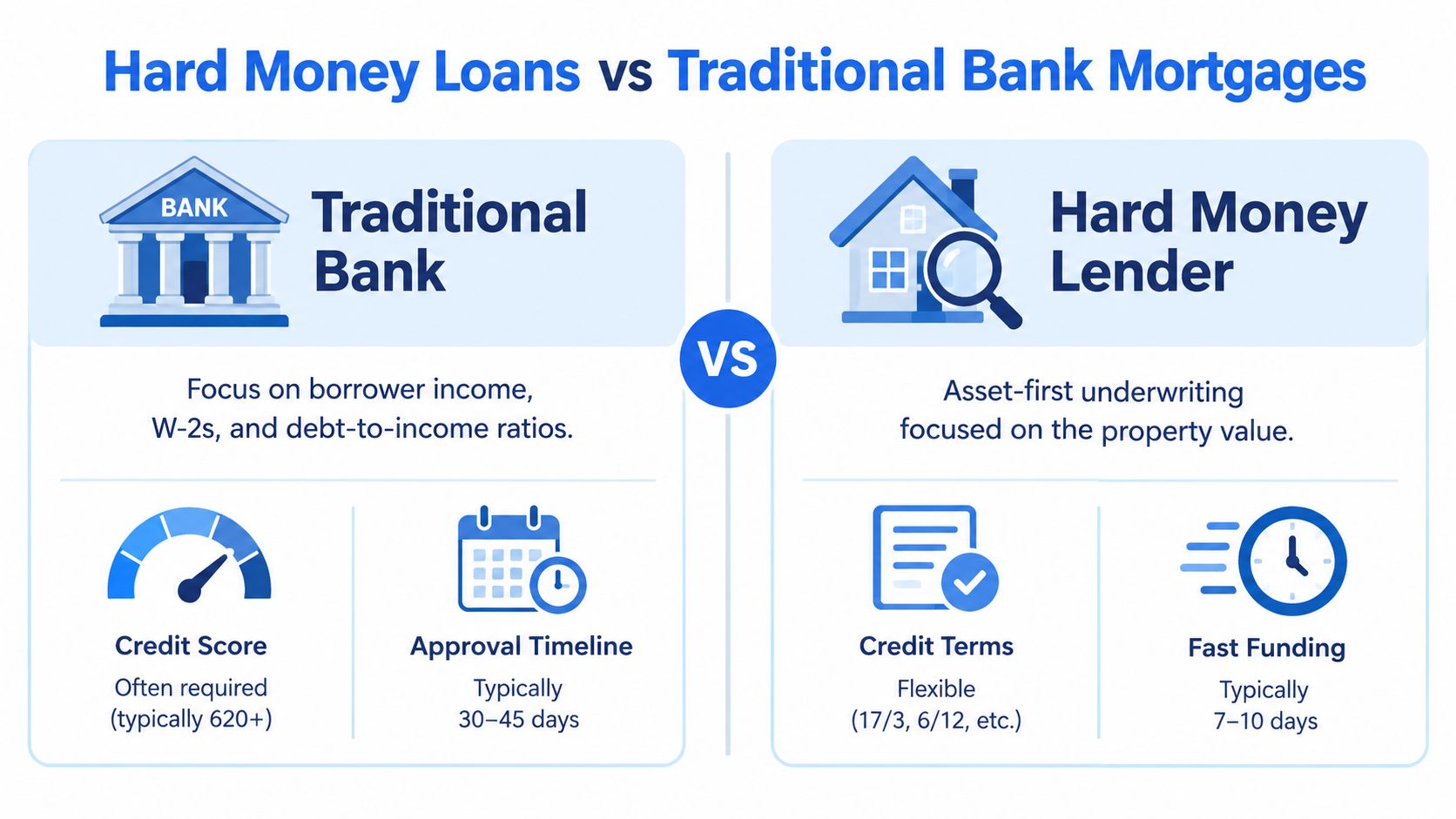
What changes for the borrower
The diligence burden doesn't disappear. It moves.
| Traditional bank mortgage | Asset-first private loan |
|---|---|
| Emphasis on borrower income, W-2s, tax returns, and debt-to-income ratios | Emphasis on property value, ARV, budget, and exit strategy |
| Often unsuitable for a property with major transition issues | Designed for properties that need renovation, stabilization, or a rapid acquisition |
| Review may depend on extensive personal documentation | Review centers on collateral, project feasibility, and repayment |
| Funding follows a standardized process | Terms can be structured around the transaction and its risks |
Sacramento hard money activity provides useful context. Data tracking 59 loans in Q2 2026 across Sacramento County, El Dorado County, and Placer County shows an average loan size of $977,603 and an average interest rate of 10.21%, according to Sacramento-area hard money market data. The market is substantial enough to measure by quarter, but that doesn't mean every property receives the same terms.
California-wide Q1 2026 averages were 10.40% interest, 2.3 points in origination fees, 67% average LTV, and $685,400 average loan size, based on the same market data source. Those figures provide context, not a promise. A lender may lower borrowing ratios when the borrower has limited experience, the scope is uncertain, or the exit depends on an aggressive valuation.
A useful application package answers the lender's questions before they become follow-up requests. Include the purchase contract, property details, scope of work, comparable sales, contractor information, proof of funds, and a written plan for repayment. The more clearly those pieces fit together, the less time the lender spends reconstructing the deal.
Physical and Legal Property Verification
A lender can't underwrite collateral accurately from a listing page. The property must be inspected, its legal identity confirmed, and its condition compared with the proposed scope of work. For a Sacramento non-owner-occupied property, the borrower should treat physical and legal diligence as parallel workstreams, not sequential tasks.
Start with the property record
Order a preliminary title report as soon as the purchase contract is signed. Confirm the vesting, legal description, parcel information, existing liens, easements, judgments, and any recorded restrictions. A title issue may be curable, but the lender needs to know whether the problem can be resolved before closing.
Ownership verification deserves special attention when the seller is an entity, a trust, or an estate. Use this guide to verifying property ownership to organize the ownership check and identify documentation that may be needed from the seller.

A preliminary report isn't a substitute for resolving defects. Open liens, unclear authority to sell, unreleased prior deeds of trust, boundary disputes, and undisclosed easements can stop a closing or require a structure that no longer fits the borrower's timing.
Inspect what affects value
The property condition assessment should focus on defects that affect habitability, marketability, insurance, or the repair budget. Look for foundation movement, roof failure, water intrusion, electrical hazards, plumbing problems, deferred maintenance, and structural changes that don't match the recorded or permitted history.
A private lender may not require every report that a bank or institutional buyer would request. That doesn't mean the borrower should skip practical checks. For a residential renovation, a targeted inspection and permit review may answer the immediate lending questions. A commercial asset with prior industrial use, environmental concerns, or complex operations may require more extensive investigation.
Reconcile permits and zoning
Compare the borrower's scope with the property's zoning, existing use, and permit history. An unpermitted bedroom, conversion, addition, or commercial use can affect value and the exit strategy. If the proposed work requires approval, identify the responsible agency, expected sequence, and cost before presenting the budget as final.
The lender isn't looking for a perfect property. The lender is looking for a known problem with a credible solution. Documented defects, realistic allowances, and a clear approval path are easier to underwrite than a property described as “mostly cosmetic” when the inspection suggests otherwise.
Financial Underwriting and Rehab Draw Structures
The financial review asks one basic question: can the property support the requested debt through a realistic exit? To answer it, the lender tests the purchase basis, current value, ARV, renovation cost, timeline, and repayment plan together.
Sacramento guidance commonly places purchase LTV around 65% to 80% and total exposure near 65% to 75% of ARV. Stronger borrowers may receive rehab advances reaching 100% of approved renovation costs, but those funds are generally released through staged draws rather than delivered in full at closing, as outlined in this Sacramento hard money underwriting guide.
Build the capital stack from the property outward
The lender compares the requested loan with the purchase price and the projected completed value. A high ARV doesn't rescue a weak valuation. Comparable sales should reflect the property's location, size, condition, finish level, and likely buyer pool, not the highest nearby sale.
The renovation budget also needs structure. Separate labor, materials, permits, design, carrying costs, and contingency reserves. Explain which items are required to reach marketability and which are optional upgrades. A lender is more comfortable with a defined scope than with a round number unsupported by contractor pricing.
Understand the draw process
Rehab money is usually held back and reimbursed after work reaches agreed milestones. The lender may inspect completed work, review invoices, and confirm that the property has progressed before authorizing the next advance.
Industry guidance describes staged draws tied to milestones such as initial work, rough-in, and completion. Some lenders use 4 to 5 staged draws and retain part of each advance until final completion, as explained in this guide to renovation draw structures.
That process protects both sides. The lender limits the amount of capital exposed to incomplete work, while the borrower receives funding against verified progress. The borrower still needs enough liquidity to pay contractors between inspections and to cover costs that the approved budget doesn't include.
Treat the exit as underwriting, not paperwork
Hard money loans are commonly interest-only and often run for 6 to 12 months in the Sacramento market. At an average Q2 2026 interest rate of 10.21%, carrying costs can erode a thin project margin if the renovation, sale, or refinance takes longer than planned, according to Sacramento hard money market guidance.
Present a primary exit and a credible backup. A sale should include a defensible pricing strategy. A refinance should identify the expected stabilized property condition and loan qualification path. A rental hold should account for the property's ability to support its obligations, not just the borrower's hope that rents will rise.
Common Pitfalls That Delay or Kill Deals
The most dangerous assumption is that a strong-looking property automatically makes a strong loan. Lenders reject deals when the numbers depend on a best-case sale price, a contractor who hasn't confirmed availability, or a renovation schedule with no allowance for hidden conditions.
ARV is a valuation, not a target
Borrowers often select the most flattering comparable and ignore differences in condition, layout, street appeal, or buyer demand. A lender will question an ARV that requires the finished property to outperform nearby homes without a clear reason.
Use a small set of comparable sales and explain adjustments. If the proposed finish level exceeds the surrounding market, identify the buyer who will pay for it. If the property sits in a location with limited resale demand, reduce the assumption rather than asking the leverage to compensate.
The budget must survive contact with the building
A low contractor estimate can make a deal look financeable while creating a cash shortfall after demolition begins. Break the scope into trade categories, confirm material assumptions, and distinguish fixed bids from allowances. Include the costs that borrowers commonly omit, such as permits, cleanup, insurance changes, utilities, financing carry, and final corrections.
Underwriting test: If the project only works when every estimate is exact, the project doesn't work.
Experience affects structure
First-time investors aren't automatically disqualified, but they shouldn't expect the same structure as a borrower with a demonstrated renovation history. Sacramento market guidance reports rates ranging from 9.0% to 13.5% in 2026, with terms commonly becoming more conservative for less experienced borrowers, as described in this Sacramento hard money lender overview.
A new investor can strengthen the file with a qualified general contractor, a detailed scope, proof of available reserves, and a simple project that matches their management capacity. Hiding limited experience is counterproductive. The lender may discover it through the budget, contractor references, or the proposed exit.
Don't confuse a backup plan with an excuse
A sale and a refinance aren't interchangeable exits. Each depends on different conditions, documents, valuation, and timing. If the primary plan fails, the backup must still support the debt and give the borrower a practical path to repayment.
The Fast-Close Diligence Checklist and Timeline
A fast closing starts with a complete file, not with repeated requests for urgency. Send the lender a clean package that lets the team verify the collateral, understand the project, and prepare closing documents without waiting for basic information.
Assemble the file before requesting final terms
Prepare these items in a shared folder with clear file names:
- Property documents: Purchase contract, address, parcel information, current photos, and access details.
- Ownership records: Borrowing-entity documents, signer information, vesting details, and the preliminary title report.
- Project materials: Scope of work, contractor bid, permits or permit plan, renovation schedule, and comparable sales supporting the ARV.
- Financial support: Proof of funds for the required contribution, budgeted closing costs, and any construction or operating shortfall.
- Exit explanation: Sale, refinance, or rental plan with the assumptions that make repayment possible.
- Experience profile: Prior projects, contractor relationships, and a concise explanation of any relevant real estate or construction background.
Don't wait until the end to discover that the title report names a different entity or that the contractor's bid excludes a major trade. Those are simple issues when identified early and expensive issues when found after documents are being drafted.
Use the closing sequence deliberately
The first review should establish whether the property and requested structure fit the lender's parameters. The next stage confirms value, title, condition, budget, and exit. Once those questions are answered, the lender can finalize terms, order remaining third-party work, prepare documents, and coordinate the signing.
A bridge lender may provide an approval in 24 to 72 hours, while a complete closing can sometimes occur in 5 to 10 business days, depending on complexity. Borrowers who want a similar pace should respond to every condition in one organized submission instead of sending partial answers across multiple messages.
| Phase | Typical Duration | Key Action Items |
|---|---|---|
| Initial property and loan review | Same business day to several business days | Send the purchase contract, property summary, requested loan amount, budget, ARV support, and exit plan |
| Title and collateral diligence | Several business days | Review the preliminary title report, confirm ownership, inspect condition, and reconcile permits and scope |
| Underwriting and term confirmation | Several business days | Resolve valuation questions, verify funds, approve the draw schedule, and confirm the repayment structure |
| Documentation and signing | Part of a business day to several business days | Review closing documents, satisfy final conditions, coordinate the notary, and fund after execution |
For transactions that require a quicker bridge structure, review the real estate bridge loan closing process early, then ask the lender which documents must be available before the file can enter final underwriting.
Partnering With a Responsive Private Lender
Due diligence works in both directions. The borrower must provide accurate information and respond quickly, while the lender must identify real conditions early, explain the requested documentation, and avoid creating avoidable surprises near closing.
A responsive private lender should be able to discuss the property, not just quote a rate. Ask how the lender evaluates ARV, how it handles lower-experience borrowers, which inspections it requires, how rehab draws are approved, and what happens if the renovation schedule changes. Clear answers reveal whether the lender understands the transaction or is only waiting for a standardized file.
LendingXpress structures bridge, fix-and-flip, and rental property loans for California investors, including purchase, refinance, acquisition, and renovation financing for non-owner-occupied residential and commercial properties. Its process emphasizes asset-focused underwriting, conservative loan-to-value ratios, staged rehab draws, and closings that may occur in as little as three days when the file is ready.
The right capital partner doesn't replace diligence. It turns diligence into a coordinated process, so the borrower can move quickly without overlooking title defects, construction risk, valuation gaps, or an unsupported exit.
For a Sacramento acquisition, refinance, or renovation project, prepare your property documents, scope, budget, ARV support, and exit plan before you apply. Visit LendingXpress to discuss bridge, fix-and-flip, and rental property financing with a private lender built for fast, asset-focused execution.