
About 1.2 million homes were sold off-market in 2024 across the U.S., and the same analysis put Texas, Florida, and Georgia at the top of the list with 175,363, 123,637, and 62,923 off-market sales respectively ProBuilder market analysis. That's not a niche side lane, it's a proven sourcing channel. If you're trying to learn how to find off market properties, the first mistake is treating it like luck. The core work is building a repeatable system that produces steady seller conversations, then lining up financing fast enough to win the deal.
Off-market deals are attractive for a simple reason, fewer people are chasing the same house. Sellers who never list publicly often want privacy, speed, or a cleaner path through a messy situation. That can mean a tired landlord, a divorce, probate, relocation, deferred maintenance, or just someone who doesn't want the chaos of open-market marketing. The properties themselves are often messy, but the seller's motivation is usually clear once you ask the right questions and show you can close without drama.
A private lender sees the same pattern over and over. The buyer who gets the call back isn't always the one who found the property first, it's the one who can act cleanly, with fewer contingencies and less delay. Financed buyers still run into appraisal issues, condition problems, and underwriting friction, so sourcing and funding can't be separate exercises. They have to work as one system.
Practical rule: if your pipeline can create two to four real seller conversations per week, it's better than chasing a dozen random leads that never answer, never qualify, or never sign.
Why Off Market Inventory Is a Sourcing Problem Worth Solving
Off-market inventory matters because it's large enough to build a business around. In the U.S., nearly 30% of all home sales in 2024 were off-market when compared with 4.06 million total home sales ProBuilder market analysis. That means the opportunity isn't hidden in some tiny corner of the market, it's spread across a huge pool of owners who never go through the public MLS process. For investors and agents, the question isn't whether off-market deals exist, it's whether your sourcing system can consistently reach them before everyone else does.

Why motivated sellers keep showing up
Motivation doesn't vanish in strong markets. Some owners want privacy, some want to avoid repairs, and some just want a fast exit from a property that became a burden. In tighter supply cycles, the seller who values certainty over headline price often becomes the best off-market lead. That's why relationships, direct outreach, and local knowledge matter more than scrolling feeds or waiting for listing alerts.
The cost structure also changes. Cold online leads are usually expensive because you pay for volume, then spend time filtering out bad fits. A curated off-market pipeline flips that. You're talking to owners who already have a reason to consider selling, which lowers the cost per serious conversation and makes follow-up more productive.
There's still friction, though. Financed buyers have to clear appraisal, condition, and timing hurdles even when the seller is ready. That's why the strongest buyers don't just “find deals,” they build a source-and-close process that keeps inventory moving from lead to contract without falling apart.
The Best Channels for Sourcing Off Market Deals (How to Find Off Market Properties)
A quiet seller with a real reason to move will usually respond faster than a broad public listing. That is the practical side of how to find off market properties. The best channels are the ones that put you in front of owners before the crowd does, while still leaving room to close fast when a deal is real.
Start with relationships. Bird dogs, attorneys, CPAs, contractors, property managers, and title reps often hear about motivated owners before any marketing starts. A contractor may notice a landlord who is tired of repairs. A CPA may hear about an inherited property. A title rep may spot repeated ownership changes that point to an eventual sale. These channels are not high volume, but they can produce cleaner opportunities because the seller already has some familiarity with the process.
A seller who values certainty over headline price is easier to work with than someone chasing the last dollar.
Direct mail and driving for dollars come next. Targeted mail works best on a narrow list, like absentee owners or owners with visible maintenance issues. A handwritten note tied to a specific property gets more attention than a generic postcard. Driving for dollars still matters because it finds the obvious distress signals that data lists miss, boarded windows, overgrown yards, repeated notices, and homes that look ignored. The response rate is rarely dramatic, but the leads that do come back are often worth the follow-up. For a tighter acquisition angle, the guide on how to find houses to flip is a useful companion.
Public records and MLS pockets fill the gaps. Expired and withdrawn listings matter because the seller already showed intent. Coming Soon inventory can surface homes before the wider market sees them. Probate, divorce, code violations, and Lis Pendens filings are also worth tracking because they often point to owners who need a quieter exit. A data-driven off market playbook helps narrow those lists before outreach starts, which keeps time from getting burned on weak leads.
Wholesalers can be productive, but only when they control real paper and can explain how they got the deal. A long email blast full of thin leads wastes time. A smaller list with a clean story is usually better.
Online platforms and marketplaces play a supporting role. Facebook groups, Craigslist, auction sites, and niche forums can still work, especially in smaller markets or among niche property types. They are fastest to browse, but they also attract the most price-sensitive competition. Use them as supplements, not the center of the strategy.
| Channel | Typical Cost Per Lead | Realistic Deal Flow | Best Use |
|---|---|---|---|
| Relationship network | Low to moderate | Steady but uneven | Warm introductions and early notice |
| Direct mail and driving | Moderate | Slow at first, then repeatable | Absentee owners, tired landlords, distressed homes |
| MLS pockets | Low | Sporadic | Expireds, withdrawn, Coming Soon |
| Wholesalers | Low to moderate | Variable | Quick access if track record is real |
| Public records | Low | Good with discipline | Probate, divorce, liens, violations |
| Online platforms | Low | Inconsistent | Supplemental lead hunting |
Practical rule: if a wholesaler cannot show a recent closing and explain how they got the deal, keep moving.
Outreach Scripts and Sequences That Earn Replies
A tired landlord usually doesn't answer on the first try. That's normal. The owner may have held a duplex for years, raised rents once, stopped answering the property manager's calls, and decided that dealing with tenants is no longer worth the hassle. Good outreach doesn't try to force a sale in the first touch. It creates a reason to respond.
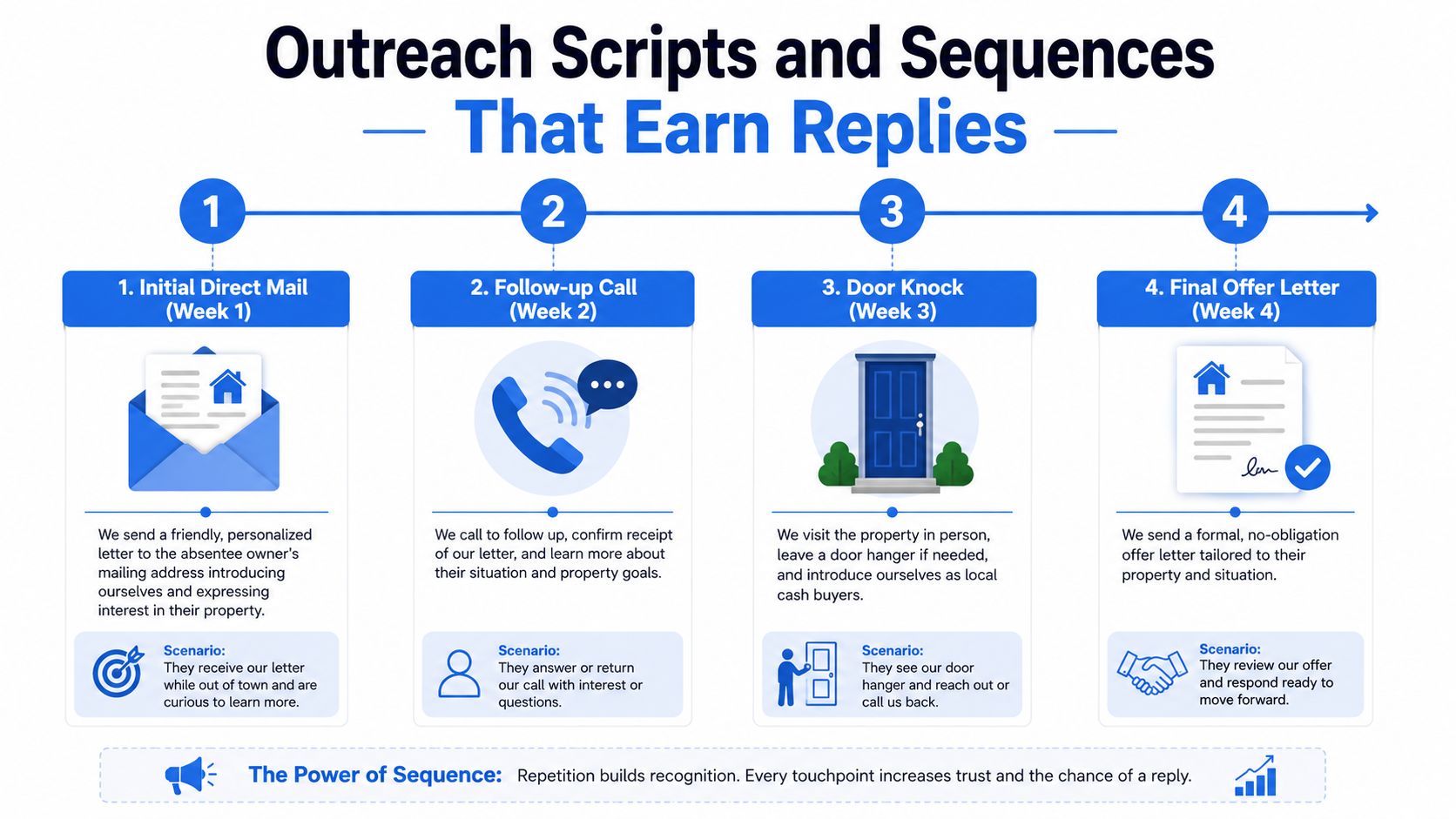
A sequence that feels human
Start with a handwritten envelope that mentions a specific observation about the property. If the roof looks tired, say that. If the units appear long-held and lightly updated, say that. The first voicemail should ask one question, not make a pitch. A short text can offer a fast, simple close, but only after you've established who you are and why you're reaching out.
Here's a cold absentee-owner opener that keeps it short:
“Hi, this is [name]. I'm calling about the property on [street]. I noticed it's been held long term, and I wanted to ask if you'd ever consider selling without repairs.”
Here's a warm referral opener:
“Hi, [name] here. [Referrer] suggested I reach out because you mentioned you may want a clean exit from the property. I buy non-owner-occupied properties and can close quickly if that helps.”
A good cadence is day 1, day 4, day 10, day 21, and day 35. That rhythm gives the owner space without letting the lead disappear. If they answer, move the conversation to the phone. If they don't, the final breakup letter should politely leave the door open and stop the pressure.
For script structure and call handling ideas, the Grou pipeline agency advice is a useful reference point for tone and pacing. The point isn't to sound slick. It's to sound like someone who can solve a problem without creating another one.
“One question is better than ten pitch lines. The seller who's curious will talk.”
Compliance matters
Don't put a price in the first touch. Disclose who you are. Respect do-not-call rules, and don't act like a casual text campaign is outside the law. The best outreach gets a reply because it feels direct, not because it feels invasive.
The call-to-action is simple, invite a conversation, not a form fill. Ask whether the owner would be open to a quick call, then let the discussion move at their pace.
Qualifying and Tracking Leads Without Losing Deals
A raw lead is not an opportunity until it clears a few basic tests. The fastest way to waste time is to treat every response as equal. A tired landlord with meaningful equity and a dated asset deserves attention before a mildly curious owner of a fully renovated home who's just collecting opinions.
Score the lead before you chase it
Use five factors, motivation, equity, condition, timeline, and price expectation. Score each one from 1 to 5 and total the result. A seller with clear motivation, decent equity, visible deferred maintenance, and a near-term plan to exit should move to the top of the list even if they haven't named a perfect price yet.
A simple spreadsheet works fine. You only need columns for source, contact date, status, next action, and contract deadline. Add notes for objections, repair issues, and who said what on the last call. If you use a basic CRM, set reminders so no lead sits untouched while you're busy chasing newer prospects.
Keep the process tight
Respond within 24 hours whenever possible. The longer a motivated seller waits, the more likely they are to talk themselves out of moving forward or field another buyer's call. Log every call and voicemail, even the bad ones, because follow-up usually wins on persistence and clarity, not on the first conversation.
Practical rule: if a lead can't explain why they'd sell, what they expect, and when they want action, it's still a nurture lead, not a contract lead.
Escalate to a site visit when condition is unclear or the numbers hinge on visible repairs. Move to a negotiation call when motivation and timeline are clear but price is fuzzy. Send a formal offer when the lead scores well and the next step is only paperwork. That keeps the decision objective instead of emotional.
Pairing Sourcing Speed With Private Financing That Closes
Off-market sourcing is only half the battle. The buyer who loses because funding drags has the same problem as the buyer who never found the deal in the first place. Conventional mortgages often take roughly 43 to 50 days to close, while hard money lenders commonly close in about 7 to 14 days hard money closing timeline. In a motivated-seller situation, that gap can decide who gets the property.
Why private financing wins the race
Private and hard money loans are built around the asset, not just the borrower's tax return. That gives investors more flexibility on condition-heavy properties, bridge scenarios, and deals that don't fit bank boxes. Fannie Mae's guidance also makes the pricing distinction clear, because an investment property is one owned but not occupied by the borrower, and that loan gets an LLPA adjustment Fannie Mae occupancy guidance. In plain English, non-owner-occupied financing is already playing by different rules.
For conventional non-owner-occupied loans, Fannie Mae-backed guidance commonly points to 15% down for a single-unit investment property and 25% down for a 2 to 4 unit investment property investment property mortgage summary. That's before you even deal with reserves, documentation, or the property's condition. Private lenders usually focus on the exit, the collateral, and whether the deal can be executed cleanly.
| Factor | Conventional Loan | Private/Hard Money |
|---|---|---|
| Speed | Slower underwriting and closing | Fast, often in days rather than weeks |
| Underwriting focus | Borrower income, credit, appraisal | Asset, equity, and exit strategy |
| Property condition | Stricter on repairs and livability | More flexible on distressed assets |
| Best use | Long-term hold with standard profile | Off-market acquisitions, fix and flip, bridge |
| Deal certainty | Higher process drag | Strong if docs and exit are ready |
Before you go shopping for deals, prepare your funding file. Have the purchase contract template, insurance binder, scope of work, and exit strategy ready. If you need to move fast, get pre-approved before outreach starts. A seller who sees a serious buyer with a real closing plan usually responds better than one who hears about “possible financing” later.
For a practical lender fit, the internal guide to private money lenders is a useful reference point when you need speed more than bank paperwork.
Legal and Ethical Boundaries Every Investor Should Respect
Off-market work gets messy when investors confuse persistence with permission. A good lead source can turn into a complaint fast if the outreach ignores compliance or if the sales pitch crosses into misrepresentation. The underwriter's view is simple, if the file can't survive scrutiny, it doesn't belong in the pipeline.
The rules you can't casually bend
Cold calling and texting require serious attention to TCPA rules, including consent, opt-outs, and time-of-day restrictions. Direct mail and email need to respect CAN-SPAM obligations, and marketing language should never steer into fair housing violations or discriminatory targeting. If you speak with distressed owners, be direct about your intent to buy and never imply guarantees you can't honor.
Wholesaling also demands discipline. Assignment and double-closing structures are not interchangeable, and disclosure expectations can vary by state and contract language. If the strategy depends on secrecy instead of compliance, the deal is already weak.
Red flags that deserve an attorney first
- Clouded title: ownership records that don't line up cleanly.
- Probate hold: estate issues that could delay transfer.
- Code violations: unresolved city or county enforcement.
- Undisclosed liens: anything that can jump ahead of your interest.
- Property transfer confusion: when the seller's authority isn't obvious.
No fast close is worth a contract that can't stand up later.
The safest off-market investors are usually the ones who slow down just enough to verify authority, title, and contract structure before they push for speed. That habit protects your reputation with brokers, sellers, and lenders.
A 30 Day Plan to Build Your Off Market Pipeline
The cleanest way to start is to run one system for sourcing, outreach, qualification, and funding readiness at the same time. Don't wait until you “have more time.” The business gets built in small daily blocks, not in a one-time burst of energy.
Week 1 list assembly
Pull absentee and tax-delinquent owner records, then build a skip-traced contact file. Segment the list by motivation signal so you're not mailing everyone the same message. A landlord who's held a property for years and an owner who moved out recently should not get the same follow-up.
Week 2 outreach launch
Run two channels at once, direct mail plus a wholesaler or broker partnership. Set a rule that every reply gets handled within 48 hours. If a lead sits too long, the momentum dies and another buyer often gets the conversation.
Week 3 qualification discipline
Use a lightweight CRM or spreadsheet with the five-factor scorecard. Route replies into hot, warm, and dead buckets. Then use the same call framework every time so your reactions don't change the process.
Week 4 financing readiness
Secure a private lending pre-approval, lock a proof-of-funds letter, and rehearse the close timeline. If a seller says yes, the deal should be able to move to funding fast. That's especially important when you're competing against another buyer who already has a ready lender.
Daily time blocks help more than you might think. Put 90 minutes into lists, 60 minutes into outreach, and 30 minutes into follow-up. Your weekly output target should be simple enough to track and hard enough to matter, a real list built, mail sent, calls booked, and offers written.
The investors who close off-market deals consistently aren't the ones with the fanciest tools. They're the ones with a narrow list, a disciplined outreach cadence, a clear qualification process, and capital that can move when the seller is ready.
If you're building an off-market pipeline and want a lender that understands speed, condition, and execution, visit LendingXpress to discuss funding for your next non-owner-occupied deal. Their team works with investors who need a fast, reliable path from contract to closing, especially when traditional banks can't keep up.