
The bank said no, or worse, it said “not yet.” You've got a non-owner-occupied commercial property under contract, a closing date approaching, and a business plan the bank's underwriting model can't understand. The building may need leasing, renovations, or operational changes before it qualifies for permanent financing. That gap is where bridge loans for commercial real estate can make sense.
A bridge loan isn't cheap money, and it isn't a substitute for a sound investment plan. It's short-term capital for an execution problem. Used correctly, it lets an investor acquire, reposition, lease, stabilize, refinance, or sell an income-producing property before a conventional lender is ready to participate.
The need is especially visible during the current refinancing cycle. One industry report cited approximately $277 billion of securitized commercial real estate loans maturing in 2025 and another $163 billion maturing in 2026, across CMBS, CRE CLOs, and agency multifamily debt. The same market coverage describes borrowers turning to short-term financing to complete business plans while rates remain high. (Bridge lending market coverage)
What a Bridge Loan Actually Does for a Commercial Deal
A sponsor is under contract to buy a $3.8 million mixed-use building. The bank started reviewing the file, requested additional leases and operating statements, and then paused approval while it reassessed the property's income. Ninety days have passed. The seller's closing deadline is two weeks away.
The sponsor doesn't necessarily have a bad deal. The problem is timing. The property needs lease-up work and improvements before its stabilized income supports the permanent loan the sponsor ultimately wants. A commercial bridge lender can underwrite the property's current value, the sponsor's plan, available liquidity, and the expected repayment route. If the lender is comfortable with the collateral and execution risk, the bridge loan can close while the sponsor completes the work.
The gap between acquisition and stabilization
Commercial bridge debt usually sits between two financing events. The first event might be acquisition. The second could be a permanent refinance after the property produces stronger income. In another deal, the bridge loan funds a purchase and repositioning plan, then gets repaid when the sponsor sells to a long-term owner.
That's why bridge financing is often called interim or transitional capital. It's generally short-duration, floating-rate, and interest-only, with repayment expected from a sale, refinance, or permanent takeout once the property is ready. The lender isn't relying only on today's cash flow. The lender is assessing whether the sponsor can execute the plan that creates the next financeable condition. (Commercial bridge loan mechanics and exit underwriting)
The loan may fund acquisition proceeds, renovation costs, closing expenses, and reserves, depending on the lender's structure. Rehab money is often held back and released in stages rather than wired entirely at closing. That protects the lender, while giving the sponsor access to capital as work advances.
Practical rule: If you can't explain exactly how the bridge loan gets repaid, you're not ready to close it.
Speed matters, but speed alone doesn't create a profitable deal. Sponsors should also improve their lead response and booking process so opportunities reach a qualified financing conversation before the closing window disappears. Tools that help investors automate CRE lead booking can support that front-end workflow, but the lender still has to verify the property, structure the debt, and fund it.
How Bridge Loan Terms Really Work for Commercial Real Estate
A traditional bank may reject a property because its current income does not meet permanent-loan standards. A debt fund or private lender may still finance it, but at a price that reflects the refinancing wall ahead. Read every bridge term as part of the execution plan, not as an isolated number.
LTV is your lender's collateral cushion
Loan-to-value measures the loan against the property's current or supported value. A loan at 65% LTV gives the lender more collateral cushion than one at 80% LTV. Many commercial bridge programs cap as-is LTV around 65% to 75%, while some stretch options reach about 80% when the sponsor, property, and business plan justify the risk. (Bridge loan leverage and DSCR benchmarks)
That cushion matters if the exit takes longer, the appraisal comes in low, or leasing falls behind plan. I would rather see a sponsor preserve equity and refinancing flexibility than borrow to the maximum and leave no room for execution problems. Compare quotes on the same basis. A bank may offer the lowest rate but require stronger current cash flow and a slower approval. A debt fund usually prices faster execution and transitional risk higher. A private lender may tailor proceeds and collateral terms, but the cost and fees can be higher.
Rate and points are the price of speed
Institutional bridge rates were running approximately 8% to 11% all-in, with 1 to 3 origination points typical, according to a 2026 commercial bridge-loan guide. A July 2026 commercial rate sheet showed a broader range of 9.00% to 14.00% all-in, depending on property type and risk. It placed office assets at 10.50% to 14.00% and described many loans as 12 to 36 months interest-only. (Commercial bridge-loan rate and term guide)
The rate premium pays for speed and for accepting a property before it reaches permanent-lender standards. Points are an upfront financing charge. Calculate them with interest, legal fees, appraisal costs, extension fees, and reserves. A lower quoted rate can still produce the worse deal if it comes with lower proceeds, costly conditions, or a maturity date that arrives before the refinance is ready.
Term, payments, and exit flexibility
Commercial bridge terms commonly run from 6 to 36 months, with 12 to 24 months most common. Many lenders also offer 6-month extension options, subject to conditions and additional cost. (Commercial bridge-loan term overview)
Interest-only payments preserve cash during renovation or lease-up because scheduled principal payments do not reduce the balance. The principal remains due at refinance, sale, or maturity. Review default interest, extension pricing, minimum interest, prepayment language, reporting requirements, and reserve controls before signing.
| Term | Typical Range | Notes |
|---|---|---|
| Loan-to-value | 60% to 75% LTV commonly, with some stretch options near 80% | Higher financing usually means tighter underwriting and less room for execution problems |
| All-in rate | 8% to 11% for institutional bridge loans, with broader commercial pricing of 9.00% to 14.00% | Asset type, sponsor strength, market, and exit quality drive pricing |
| Origination points | 1 to 3 points typical in one institutional guide | Confirm whether points are charged on the original balance or funded proceeds |
| Payment structure | Interest-only is common | Principal generally remains outstanding until the exit |
| Loan term | 6 to 36 months | 12 to 24 months is a common range |
| Extension | 6-month options are common | Conditions and fees vary by lender |
| Office financing | 60% to 65% LTV in one current rate sheet | Office pricing may also be higher than other asset classes |
| Retail and hotel financing | 65% to 70% LTV in one current rate sheet | The lender still evaluates property-specific risk |
Bridge Loans Compared to Construction, Permanent, and Mezzanine Financing
The right debt matches the property's current problem. Bridge financing covers an execution gap, such as acquiring, repositioning, leasing, or refinancing a transitional asset. Construction debt funds a defined building program. Permanent debt fits stabilized income. Mezzanine debt adds capital behind a senior loan, usually at a higher cost and with more complicated intercreditor terms.
| Feature | Bridge Loan | Construction Loan | Permanent Loan | Mezzanine Debt |
|---|---|---|---|---|
| Primary purpose | Acquire, reposition, lease up, or refinance transitional property | Fund ground-up development or major construction | Finance stabilized, income-producing property | Add financing behind senior debt |
| Closing speed | Usually faster than a bank's full permanent process | Depends on plans, permits, budget, and inspections | Slower, with extensive income and property documentation | Can be fast, but requires senior-lender coordination |
| Cost | Higher than permanent debt, often floating-rate | Pricing reflects construction and completion risk | Generally lower than bridge debt when stabilized | Usually expensive because it sits behind senior debt |
| Loan-to-value | Often around 65% to 75% LTV, with some stretch structures near 80% | Usually evaluated against project cost and value | Often driven by DSCR and stabilized value | Raises total financing beyond the senior loan |
| Term | Commonly 6 to 36 months | Through construction and completion | Long-term financing | Often matched to the senior loan or business plan |
| Exit requirement | Refinance, sale, or permanent takeout | Completion, lease-up, sale, or refinance | Debt service from ongoing property income | Repayment through refinance, sale, or recapitalization |
| Best fit | A non-owner-occupied property with a credible transition plan | A project with substantial building scope | A stabilized asset with durable income | A sponsor seeking a smaller equity contribution |
Choose the debt that matches the work
Use bridge debt when the property is usable but cannot yet qualify for permanent-loan terms. The loan buys time to complete leasing, renovations, or other execution work before the refinancing wall arrives. That only works if the business plan and exit can withstand delays.
Construction financing is the better tool for demolition, ground-up building, or a major construction scope. Permanent debt should usually come first when the property already produces stable income and meets the lender's coverage requirements. Paying bridge pricing for a stabilized asset is an avoidable expense.
Stabilized permanent loans often target approximately 1.25x to 1.35x DSCR. Bridge lenders may accept below 1.0x in-place DSCR, or skip a DSCR test, when the plan credibly supports stabilization to approximately 1.20x to 1.25x DSCR before takeout. Treat those figures as underwriting targets, not an automatic approval. The refinancing wall still depends on value, rents, occupancy, rates, and lender appetite.
The same deal can receive very different quotes. A bank may offer the lowest rate but require stronger current coverage, more documentation, and a slower closing. A debt fund may price higher while underwriting the asset's transition and closing faster. A private lender may move fastest and accept a larger execution gap, but charge more through interest, points, fees, or tighter exit terms. Compare the full cost and conditions, not the note rate alone. Review broader commercial real estate financing options before setting the capital stack.
Mezzanine debt can reduce the equity check, but it adds another lender, another document set, and another claim on project cash flow and collateral. Do not use it just because the senior lender will not advance enough. First test whether a lower-LTV bridge structure creates a safer refinance or sale.
For broader context, review this GoSBA Loans real estate advice. SBA financing may suit certain owner-user situations, while this article focuses on non-owner-occupied properties, where bridge, permanent, and investment-oriented debt follow different rules.
Underwriting, Application, and Closing with a Private Lender
A private lender doesn't ignore underwriting. The lender changes what gets priority. Instead of waiting for a long history of stabilized income, the credit team focuses on collateral, execution, sponsor capacity, and the exit.

Start with a complete deal package
Send the lender enough information to make an initial decision without chasing basics. Your package should include:
- Property details: Address, asset type, purchase price, current value, proposed value, and requested loan amount.
- Income information: Current rent roll, leases, operating statements, vacancy details, and known tenant issues.
- Business plan: Renovation scope, lease-up strategy, projected improvements, and expected exit.
- Sponsor information: Real estate experience, liquidity, entity documents, and a summary of other obligations.
- Closing materials: Purchase contract, property photos, insurance quotes, title information, and contractor estimates where applicable.
A private lender typically verifies value through comparable sales, a broker price opinion, appraisal work, or another accepted valuation method. The lender also tests whether the sponsor has enough liquidity to cover overruns, carrying costs, and delays. A strong property won't rescue a sponsor who has no ability to finish the plan.
You can review the core stages in this commercial loan underwriting process before submitting a request.
The exit receives the hardest questions
Expect the lender to ask how and when the bridge loan will be retired. If the plan is a refinance, provide the assumptions that support the future loan, including projected income, leasing progress, and expected coverage. If the plan is a sale, explain the buyer pool, pricing support, marketing route, and backup option.
Interest reserves may be included so the sponsor doesn't need to fund every payment from outside cash. Rehab and contingency reserves can also be held back. For staged draws, the lender or inspector verifies completed work, approves the draw, and wires the next advance. Build the draw schedule into the contractor's cash-flow plan.
A realistic fast-close workflow
A strong submission on Monday can move through initial review, valuation, due diligence, term-sheet approval, title, insurance, and documentation inside two weeks when the lender has direct authority and responsive operations. That timeline depends on complete documents, clean title, accessible property information, and no major surprises.
Ask who makes the credit decision, who orders third-party reports, and who controls draw approvals. A lender that promises speed but outsources every critical step may create the same delay you were trying to avoid.
Real Deals That Worked and What They Teach Investors
The following examples are representative deal structures, not verified borrower case studies. They illustrate how an investor might size and retire bridge debt without treating the loan as permanent capital.
A sponsor buys a 12-unit multifamily property for $1.4 million. The building has operational problems, under-market rents, and a clear renovation plan. The sponsor budgets $180,000 for improvements, with the rehab money released through three staged draws.
Example one is a controlled repositioning
The lender sizes the acquisition loan conservatively against the property's current condition and supports the renovation budget through the draw schedule. The sponsor contributes the equity needed for the purchase, closing costs, reserves, and any portion of the project not funded by debt.
The sponsor completes the work, leases the renovated units, and reaches 95% occupancy. At month nine, the property has stronger income and a clearer valuation story, so the sponsor refinances into permanent debt and retires the bridge loan.
| Deal Type | Loan Amount | LTV | Rate | Term | Rehab Budget | Exit |
|---|---|---|---|---|---|---|
| Multifamily repositioning | Sized below maximum leverage to preserve equity cushion | Conservative bridge leverage | Quoted by lender based on asset and execution risk | 12 months with refinance at month nine | $180,000, funded through three draws | Permanent refinance after stabilization |
| Mixed-use acquisition | Sized to meet the 21-day closing requirement | Structured around current value and exit support | Elevated pricing accepted for speed | Less than seven months in the example | Value-add work funded under the approved budget | Sale to a long-term owner |
The lesson is not that every renovation will stabilize quickly. The lesson is that the sponsor had a defined scope, a draw plan, and a refinance trigger before closing. The bridge loan served a measurable transition instead of covering an undefined operating problem.
The sponsor should still underwrite the permanent takeout independently. A projected occupancy milestone isn't enough if rents, expenses, appraisal support, and lender coverage requirements don't line up.
Example two is a speed-for-cost trade
A different investor finds a mixed-use building with a 21-day closing requirement. The seller won't wait for a conventional process, and the buyer accepts a higher rate and points to control the asset. The investor executes the value-add plan and sells to a long-term owner inside seven months.
That deal may produce a profit, but the profit isn't created by the bridge loan. The loan only preserves the opportunity long enough for the sponsor to execute. The investor must subtract interest, points, legal fees, inspection costs, reserves, selling expenses, and any extension charges before deciding whether the return justifies the financing.
The fastest loan is still a bad loan if the exit value depends on hope instead of supportable evidence.
The Real Benefits and Risks of Bridge Debt
Bridge debt gives a sponsor something a bank often can't provide: a way to close before a transitional property fits a permanent-loan box. That flexibility can be valuable for non-owner-occupied acquisitions, lease-up projects, renovation plans, and refinancing situations where current income understates the property's potential.
What the product solves
Bridge financing can help you:
- Close a time-sensitive acquisition: A private lender may focus on the property and exit instead of waiting for a lengthy bank approval cycle.
- Fund unfinished value creation: Renovations, lease-up, and repositioning can be included when the scope and budget are credible.
- Preserve operating cash: Interest-only payments can avoid scheduled principal reduction while the business plan is underway.
- Work around conventional constraints: A property with temporary vacancy or incomplete income may still qualify if the collateral and transition plan are strong.
- Create a permanent-loan path: The bridge can provide time to reach the income and coverage profile required by a permanent lender.
The trade-off is that the loan clock starts at closing, whether the contractor is ready, the tenant signs, or the market cooperates. You're paying for flexibility, so you need to manage the execution aggressively.
Where sponsors get hurt
Higher all-in cost is the obvious risk, but it's not the only one. A delayed renovation can consume reserves. A weaker appraisal can reduce refinance proceeds. A lender may require interest, tax, insurance, and contingency reserves that reduce the cash available for the project. A prepayment provision can also reduce returns if you sell earlier than expected.
Market movement creates another problem. If values soften or permanent lenders tighten their loan-to-value limits, your planned takeout may not support the outstanding balance. That can force an extension, additional equity, a sale at an unattractive price, or a restructuring conversation.
Use commercial debt guidance to sharpen your review of loan documents and debt obligations, then have qualified counsel examine the actual agreement.
The embedded video offers another visual explanation of the product and its trade-offs:
Bridge debt is a tool, not a strategy. Your strategy is the acquisition, renovation, leasing, refinance, or sale plan that repays it.
Choosing a Private Lender You Can Trust
Compare private lenders on execution, not just the headline rate. A lender that quotes an attractive number but can't close, fund draws, or explain conditions will cost you more than a transparent lender with a slightly higher price.
Start with five verification questions
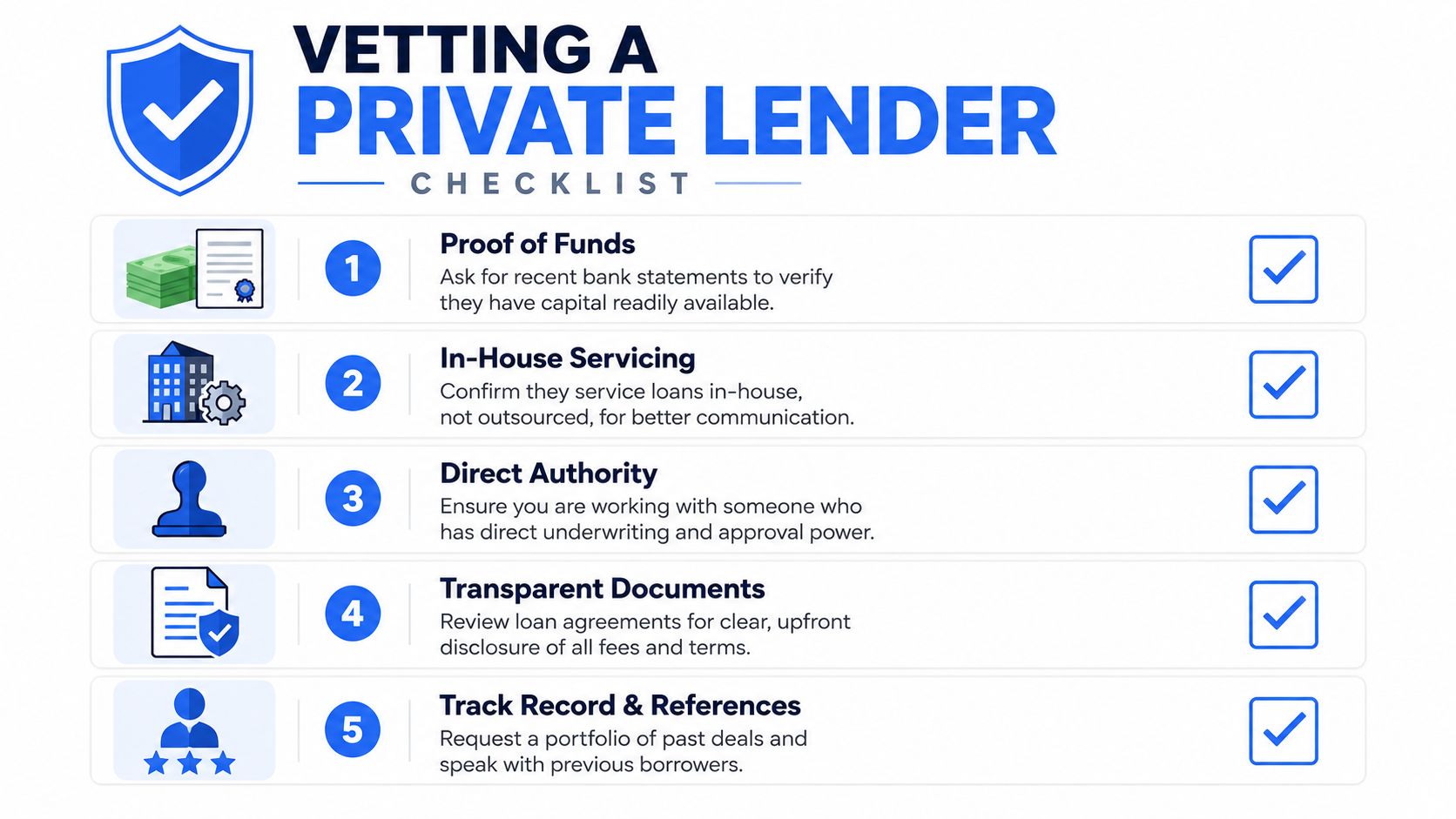
Can the lender prove available capital? Ask for evidence of funds and confirm who controls the money. A broker's promise isn't the same as a lender's funding capacity.
Who services the loan? In-house servicing can make a practical difference when you need an interest statement, payoff quote, draw approval, or modification. Ask whether servicing is handled internally or passed to another party.
Who has approval authority? You should know whether you're speaking directly with the credit decision-maker or moving through several layers of intermediaries. Direct authority usually makes deal changes easier to resolve.
What does the fee sheet include? Request a sample term sheet and identify interest, points, legal charges, valuation costs, inspection charges, extension fees, minimum interest, default interest, and prepayment terms.
How does the draw process work? Get the inspection standard, required invoices, approval workflow, and wire timing in writing. A rehab budget is only useful if you can access it when the work is complete.
Compare quotes on the same assumptions
Get 2 to 3 quotes and place them side by side using the same requested loan amount, property value, rehab budget, term, and exit. Compare LTV, rate, points, reserves, recourse, extension terms, closing timeline, and draw mechanics. Bank bridge loans can sit around 60% to 70% LTV with full recourse, while debt funds may price at SOFR plus 350 to 600 basis points, reach up to 75% LTV, and offer non-recourse carve-outs. (Commercial bridge-to-permanent financing comparison)
That comparison shows why “what rate should I expect?” is an incomplete question. Office bridge pricing can fall around 10.5% to 14.0%, while multifamily can be around 9.0% to 10.5% in one market guide. Property type and execution risk matter as much as the lender category.
Where applicable, verify state licensing requirements, including California requirements, and confirm the entity named in the documents is the entity funding your loan. Watch for vague promises, unexplained deposits, changing terms, no proof of funds, and a lender who can't describe the draw process.
LendingXpress is one California-focused private lending option for investors seeking bridge financing on non-owner-occupied commercial assets. Its stated platform supports acquisitions, refinances, stabilization, and repositioning, with flexible loan sizing, staged rehab draws, and the ability to finance up to 100% of renovation costs when the deal qualifies.
LendingXpress structures short-term bridge financing for commercial acquisitions, refinances, stabilization, and repositioning when traditional financing falls short. Review your property, exit plan, and capital needs, then visit LendingXpress to start a financing conversation with a private lending team.